
Blog Posts
HEPA Filter Cassettes for Hazardous Environments: A Technical Guide to HWSE Air Integrity
The presence of a pressurized enclosure means nothing if the internal atmosphere reaches toxic saturation levels within the initial 15 minutes of hot work. In the high-stakes environment of an offshore platform, a standard air filter isn’t a safety tool; it’s a critical point of failure. You recognize that maintaining positive pressure is useless if welding fumes and hazardous particulates aren’t actively neutralized to protect your personnel. This technical guide demonstrates how the implementation of a certified hepa filter cassette preserves atmospheric integrity within your Hot Work Safety Enclosure. By reading further, you’ll learn how these specialized components achieve 99.97% filtration of 0.3-micron particles while ensuring full compliance with ATEX and IECEx Zone 1 standards. We’ll detail the engineering behind PetroHab’s modular solutions and explain how they provide the necessary protection for personnel while maintaining a zero-ignition risk profile in explosive atmospheres. Every detail is calculated to help you mitigate risk and maintain operational excellence in the most demanding industrial settings.
Key Takeaways
- Understand how high-efficiency filtration captures sub-micron welding fumes and metallic dust to maintain internal air integrity within pressurized habitats.
- Learn the technical requirements for H13 and H14 ratings and why ATEX and IECEx compliance is mandatory for equipment operating in Zone 1 or Zone 2 hazardous areas.
- Identify the critical selection criteria that distinguish an oil-and-gas-rated hepa filter cassette from residential alternatives, specifically regarding temperature resistance and industrial durability.
- Establish rigorous maintenance protocols and recognize early warning signs of filter failure, such as pressure alarms or reduced airflow, to prevent particulate bypass.
- Explore the synergy between modular filtration and the Safe-Stop automatic shutdown system to ensure unrivaled ignition source control during hot work operations.
What is a HEPA Filter Cassette in the Context of Hot Work?
A hepa filter cassette is a specialized, modular filtration unit engineered for integration into industrial environments where ignition source control is paramount. Unlike standard residential or commercial filters, these cassettes are high-performance structural components designed to maintain air purity within a pressurized welding habitat. Their primary objective involves the capture of hazardous sub-micron metallic dust and welding fumes that pose severe risks to both personnel and sensitive equipment. Air integrity isn’t a luxury; it’s the operational baseline for every Hot Work Safety Enclosure (HWSE). Without reliable filtration, the positive pressure required to exclude flammable gases becomes impossible to sustain safely.
In high-stakes sectors like oil and gas, the hepa filter cassette acts as a critical barrier. It ensures that the air recirculated or introduced into the enclosure is free from the contaminants generated during grinding, welding, and cutting. This technical precision is what separates a professional safety system from a makeshift enclosure. The cassette format allows for rapid replacement and secure seating, which is vital when working in remote offshore locations or active refineries.
The Core Function: Beyond Simple Dust Collection
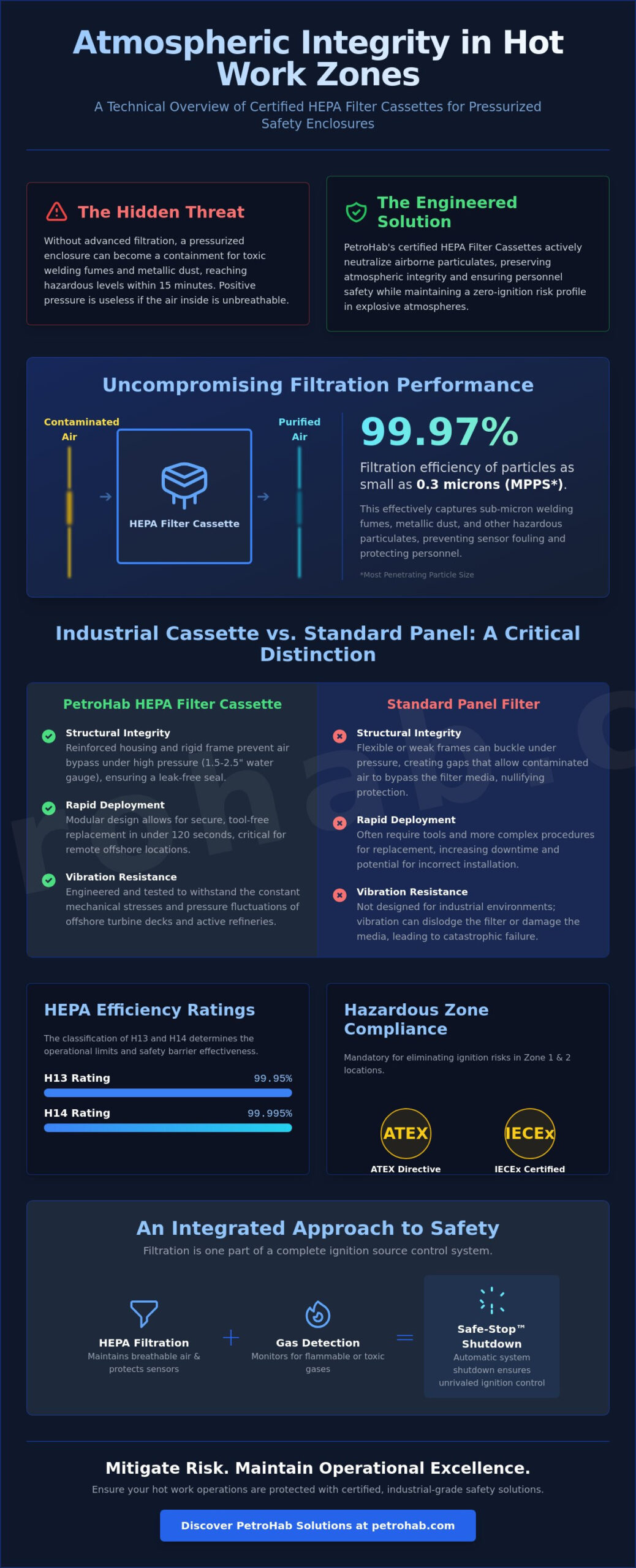
Industrial hot work generates a complex cocktail of microscopic particulates. These cassettes adhere to the rigorous HEPA filter efficiency standard, capturing 99.97% of particles as small as 0.3 microns. This level of precision prevents the fouling of gas detection sensors. When sensors become coated in metallic dust, their response time lags or they fail entirely, creating a blind spot in your safety protocol. By removing these contaminants, the system ensures that the internal atmosphere remains breathable and that safety systems remain calibrated for peak performance. It’s a calculated remedy for the invisible hazards of the job site.
Cassette vs. Panel Filters: Why Design Matters
Design differences between standard panel filters and cassettes are significant. A cassette utilizes a reinforced housing that facilitates rapid deployment and creates a robust, leak-free seal within the hot work safety enclosure. Offshore platforms subject equipment to constant vibration and rapid pressure fluctuations. Standard panels often buckle or bypass under these stresses, leading to a breach in air integrity. Cassettes provide the structural rigidity needed to maintain filtration performance under 1.5 to 2.5 inches of water gauge pressure. This ensures that no unfiltered air bypasses the media, protecting human life and high-value assets with uncompromising reliability.
- Structural Integrity: Rigid frames prevent bypass during high-pressure events.
- Rapid Deployment: Modular designs allow for tool-free replacement in under 120 seconds.
- Vibration Resistance: Specifically tested for the mechanical stresses of offshore turbine decks.
Technical Specifications and Hazardous Zone Compliance
Industrial safety in high-risk environments demands rigorous filtration standards. The classification of H13 and H14 HEPA ratings determines the operational limits of air purification systems in oil and gas facilities. An H13 rated hepa filter cassette captures 99.95% of particles, while an H14 variant increases this efficiency to 99.995%. These ratings aren’t just numbers; they represent the primary barrier between toxic particulates and the respiratory health of personnel. The U.S. Environmental Protection Agency defines a high efficiency particulate air (HEPA) filter as one capable of removing at least 99.97% of dust, pollen, mold, and bacteria. Most Penetrating Particle Size (MPPS) identifies the particle diameter that most easily evades filtration, usually 0.3 microns, making it the essential performance metric for neutralizing sub-micron welding fumes.
Explosion Prevention and Grounding Requirements
Equipment used in Zone 1 or Zone 2 locations must adhere to ATEX and IECEx directives to eliminate ignition risks. A standard hepa filter cassette often fails these environments if its frame accumulates static electricity. PetroHab utilizes conductive materials in its cassette frames to facilitate immediate electrostatic discharge. These components integrate directly into the habitat’s grounding and bonding system, ensuring no potential difference exists between the filtration unit and the enclosure. This meticulous engineering ensures all hardware aligns with the latest hazardous environment standards for 2026. By removing static buildup, the system prevents sparks in volatile atmospheres.
Pressure Drop and Airflow Dynamics
The Initial Pressure Drop is the resistance offered by a clean filter to the airflow. It’s a critical value for calculating ventilation fan efficiency. If the pressure drop is too high, the system can’t maintain the required flow rate for positive pressure integrity. Maintaining a constant internal pressure prevents the ingress of external hydrocarbons. Operators must monitor filter saturation using calibrated manometers or differential pressure gauges. A rise in pressure indicates particle loading, signaling the need for a cassette replacement before the flow rate drops below safety thresholds. Engineers who prioritize reliable ignition source control understand that airflow stability is the foundation of habitat safety.
Comparing Industrial HEPA Cassettes: Selection Criteria
Industrial environments demand hardware that exceeds consumer specifications. A residential-grade filter lacks the structural rigidity to handle the 1,000 CFM or higher flow rates required by pressurized habitats. High-performance hot work safety enclosure suppliers engineer cassettes specifically for the oil and gas sector. These units must resist temperatures exceeding 120°C when positioned near welding arcs. They also require frames made from 304 or 316 stainless steel. This prevents corrosion in offshore environments where salt spray and 90% humidity are standard operational hurdles. Choosing a frame that resists chemical degradation from H2S exposure is equally vital for long-term deployment on aging assets.
Adherence to DOE HEPA Filter Standards provides a benchmark for structural integrity and penetration testing. These standards ensure that the media doesn’t degrade when exposed to the high-velocity air streams common in industrial ventilation. Every component must be verified to maintain its rated efficiency under peak load, ensuring that toxic particulates never penetrate the enclosure’s boundary. This technical rigor is what separates a standard filter from a true industrial safety component.
Standard vs. High-Capacity Cassettes
V-Bank designs are the preferred choice for heavy welding operations. These configurations utilize multiple mini-pleat packs arranged in a “V” shape. This increases the filtration surface area by up to 50% compared to standard flat-panel filters. Increased surface area reduces the pressure drop across the hepa filter cassette. This lowers energy consumption for the ventilation system and extends the intervals between maintenance cycles. While flat panels suffice for light grinding, heavy flux-cored arc welding (FCAW) fumes require the increased dust-holding capacity of a V-Bank to prevent rapid clogging. Selecting the wrong depth can lead to airflow stagnation and a buildup of heat within the workspace.
Seal Integrity and Gasket Selection
A filter’s efficiency is irrelevant if the seal fails. In hazardous zones, bypass air represents an unacceptable risk to personnel and equipment. PetroHab utilizes specialized gaskets to maintain absolute isolation. EPDM gaskets provide excellent chemical resistance, while silicone is better for high-heat applications near the ignition source. Polyurethane remains a durable option for standard onshore sites where chemical exposure is limited.
The “Knife-Edge” seal provides superior bypass protection compared to traditional flat gaskets. In this design, a sharp metal flange on the housing embeds into a gel or soft gasket on the hepa filter cassette frame. This creates a redundant, airtight barrier that resists vibration. If a seal fails, the pressurized habitat loses its integrity and the system’s ability to exclude hazardous particulates is compromised. Meticulous gasket selection is a prerequisite for maintaining a controlled atmosphere during hot work.
Maintenance and Safe Replacement Procedures
Maintaining air integrity within a Hot Work Safety Enclosure (HWSE) requires a rigorous inspection schedule. Safety managers must establish daily checks based on 24-hour operational cycles or specific work intensity levels. This protocol ensures that the Petro-Wall panels and air intake units function at peak performance. A primary indicator of a compromised hepa filter cassette is a significant drop in differential pressure across the filter bank. If the airflow velocity falls below the OSHA-mandated 100 feet per minute threshold, the system triggers an immediate alarm. Visible particulate bypass or unusual odors inside the enclosure indicate immediate seal failure or media rupture. Technicians shouldn’t wait for a total failure; proactive monitoring prevents hazardous exposure.
Step-by-Step Cassette Change-Out
Replacing a filter demands precise execution to prevent the release of hazardous particulates. Technicians must first engage the Safe-Stop system to isolate all ignition sources. Once the habitat is de-pressurized, personnel should wear Level C PPE before opening the housing. Inspectors must examine the gasket seating surfaces for deformities, corrosion, or debris that could bypass the 99.97% efficiency rating. Even a millimeter of misalignment can compromise the entire habitat. After installing the new hepa filter cassette, perform a leak test using a calibrated particle counter or a theatrical smoke generator to confirm 100% seal integrity before re-initiating hot work.
Managing Filter Lifespan in the Field
Operating costs decrease when the primary filter is protected by MERV 8 to 11 pre-filters. These sacrificial layers capture larger debris, preventing premature blinding of the HEPA media. Environmental factors like humidity levels above 85% or heavy diesel exhaust from nearby generators can reduce filter life by 40%. Advanced hot work safety systems provide real-time telemetry, allowing operators to track performance trends and predict replacement intervals. This data-driven approach eliminates guesswork and maintains the enclosure’s protective barrier, reinforcing PetroHab’s position as the gold standard in hot work safety.
Contaminated cassettes are classified as hazardous waste under RCRA guidelines if they’ve captured toxic fumes or heavy metals. Seal used filters in 6-mil polyethylene bags immediately upon removal. PetroHab provides the engineering necessary to keep your personnel protected during these high-risk transitions. Consult with PetroHab to optimize your habitat safety protocols and air integrity monitoring.
PetroHab’s Integrated Approach to Air Quality and Safety
PetroHab engineers its HWSE systems as a unified safety ecosystem where the hepa filter cassette serves as a critical barrier. We don’t view filtration as an accessory; it’s a core component of ignition source control. By integrating these cassettes into the primary air intake, we ensure that particulates and hazardous debris never enter the pressurized work area. This integration is vital for maintaining the atmospheric purity required for high-precision hot work in volatile settings.
Our systems synchronize filtration with the Safe-Stop automatic shutdown system to provide a redundant safety layer. This system monitors internal pressure and gas concentrations in real-time. If the pressure falls below the mandatory 50 Pascal (0.2-inch water gauge) minimum or if flammable gas is detected at 10% LEL, the Safe-Stop system cuts power to all hot work tools in less than 0.5 seconds. Our customized air ducting solutions are tailored for 100% of unique site layouts. We design these routes to navigate the dense piping of offshore jackets or the expansive footprints of onshore processing plants without compromising airflow velocity.
Engineered for the Extremes
Industrial environments demand hardware that doesn’t fail under pressure. PetroHab’s components are the gold standard because they’re built for 24/7 operation in Grade A hazardous locations. The patented Quadra-Lock technology is central to this reliability. It utilizes a four-way interlocking panel system that eliminates the gaps found in standard modular enclosures. This technology ensures a 99.9% seal efficiency, which is vital for maintaining the positive pressure required to keep out fugitive emissions.
We supplement this hardware with mandatory on-site supervision and training. PetroHab experts oversee the initial 48 hours of habitat setup to ensure filtration management meets ISO 14644-1 Class 8 standards. This prevents common field errors that lead to atmospheric contamination. Every hepa filter cassette is inspected to verify that the seal integrity remains uncompromised by high-velocity coastal winds or desert particulates.
Securing Your Facility’s Future
The financial logic for investing in high-quality safety components is clear. While lower-tier solutions might reduce initial costs, they increase the probability of a multi-million dollar incident. PetroHab’s engineering reduces insurance premiums and mitigates legal liability through strict adherence to global safety protocols. We provide comprehensive documentation that proves compliance with ATEX Zone 1 and 2 requirements and IECEx standards.
This technical rigor protects your high-value assets and your corporate reputation. By choosing a system that integrates advanced monitoring with superior filtration, you’re investing in a fail-safe environment. PetroHab stands as the definitive guardian of hazardous work sites, ensuring that operational productivity never comes at the expense of human life.
Securing Air Integrity in High-Stakes Environments
Maintaining air quality within a Hot Work Safety Enclosure requires more than standard filtration; it demands engineered reliability. Utilizing a certified hepa filter cassette is essential for maintaining the pressure and purity levels required by international safety standards. PetroHab leverages its patented Quadra-Lock technology to ensure every enclosure meets ATEX and IECEx compliance, providing a robust defense against hazardous particulates. Our global presence, with established offices in Houston, Dundee, and Brazil, ensures that these technical standards are applied consistently across your international assets. We prioritize the protection of your workforce through rigorous ignition source control and modular flexibility. Safety managers rely on these systems because they’re designed to mitigate risk in the most demanding offshore and onshore conditions. You can’t afford to compromise on technical specifications when life and high-value infrastructure are at stake. Contact PetroHab today for a technical consultation on your HWSE requirements. We look forward to helping you achieve the highest standards of operational safety.
Frequently Asked Questions
What is the difference between a HEPA filter and a HEPA filter cassette?
A HEPA filter refers to the high efficiency particulate air media itself, while a HEPA filter cassette is the complete, modular housing assembly designed for rapid installation in a Hot Work Safety Enclosure (HWSE). The cassette includes a rigid frame and integrated gasket seals that prevent air bypass. This design ensures the system maintains its 99.97% filtration efficiency rating at 0.3 microns during high pressure operations.
How often should HEPA filter cassettes be replaced in a welding habitat?
Replace a hepa filter cassette when the differential pressure reaches 250 pascals or after 150 operating hours in high fume environments. In heavy welding scenarios, such as offshore deck repairs, technicians should conduct visual inspections every 12 hour shift. Maintaining clean filtration is vital to prevent the Safe-Stop system from triggering an automatic shutdown due to restricted airflow or loss of internal overpressure.
Are all HEPA filter cassettes ATEX certified for use in Zone 1?
No, only specific models engineered for explosive atmospheres carry ATEX or IECEx certification. Operators must confirm that the cassette frame consists of anti-static materials to eliminate the risk of electrostatic discharge in hazardous areas. PetroHab utilizes components that adhere to ISO 29463 standards, ensuring the filtration system doesn’t become an ignition source in environments where flammable gases are present.
Can a HEPA cassette remove gases and vapors from a hot work area?
A standard HEPA cassette captures 99.97% of solid particulates and aerosols but doesn’t remove toxic gases or volatile organic compounds. To neutralize hazardous fumes like carbon monoxide, the ventilation system requires an additional activated carbon stage. Relying on mechanical filtration alone for gas mitigation violates safety protocols and endangers personnel working within the pressurized enclosure.
What happens to the pressurized habitat if the HEPA filter becomes clogged?
A clogged filter restricts intake airflow, which causes internal overpressure to drop below the mandatory 50 pascal minimum. When this occurs, the Safe-Stop system automatically isolates power to the welding equipment or ignition source. This fail-safe mechanism ensures the integrity of the enclosure stays intact and prevents hazardous external atmospheres from entering the work area during a ventilation failure.
Is it possible to clean and reuse an industrial HEPA filter cassette?
You can’t clean or reuse a HEPA filter cassette because compressed air or solvents destroy the delicate borosilicate fiber structure. Attempting to vacuum the surface creates micro-tears that allow hazardous particulates to bypass the media entirely. Once the pressure differential exceeds 300 pascals, the unit is spent and requires disposal according to local environmental regulations for hazardous waste.
How do I know if a HEPA cassette is genuine and compliant with ISO standards?
Genuine cassettes feature permanent labels citing EN 1822 or ISO 29463 testing protocols and include a unique serial number for traceability. Every unit should arrive with a factory test report confirming it passed leak testing at the required efficiency levels. PetroHab provides full documentation for every component, allowing safety managers to verify compliance during third party audits or site inspections.
What are the risks of using a non-standard filter in a PetroHab enclosure?
Using non-standard filters compromises the airtight seal of the Petro-Wall system, which can allow sparks to escape the enclosure. Third party filters often lack the structural integrity to withstand the constant 60 pascal internal pressure maintained during hot work. This mechanical weakness leads to unplanned downtime or the failure of the ignition source control system to properly isolate hazardous energy.