
Blog Posts
Hot Work in Confined Spaces Regulations: The 2026 Compliance Guide
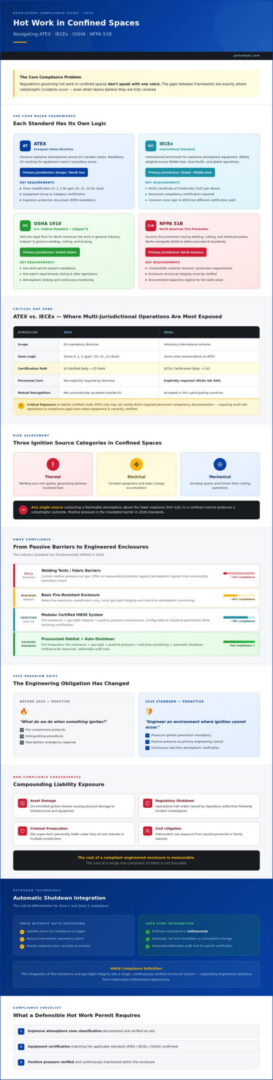
The most dangerous moment in any confined space hot work operation isn’t the ignition itself. It’s the false confidence that comes from incomplete compliance. Safety managers operating across multiple jurisdictions in 2026 face a genuinely complex challenge: hot work in confined spaces regulations don’t speak with one voice. ATEX governs European explosive atmospheres. IECEx sets the international benchmark. OSHA 1910 and NFPA 51B define North American requirements. Each framework carries its own classification logic, equipment certification demands, and permitting obligations, and the gaps between them are exactly where catastrophic incidents occur.
You already know that a single ignition source in a flammable atmosphere can be fatal. What’s less understood is how regulatory ambiguity, particularly around modular welding habitats and pressurized enclosures, leaves operations exposed even when teams believe they’re fully covered.
This guide cuts through that ambiguity. It maps the critical regulatory frameworks governing confined space hot work in 2026, identifies where standards converge and where they diverge, and explains how engineered pressurized safety ecosystems, built to exceed baseline requirements, provide the verification integrity that hot work permits demand. If you need a clear compliance roadmap, this is where it starts.
Key Takeaways
- Hot work in confined spaces regulations are not uniform — ATEX, IECEx, OSHA 1910, and NFPA 51B each impose distinct classification logic and equipment certification demands that vary by jurisdiction and operational context.
- The gap between ATEX and IECEx frameworks is where multi-jurisdictional operations are most exposed; understanding which standard governs your site — and why — is the first step toward defensible compliance.
- NFPA 51B and OSHA 1910 Subpart Q set the legal and procedural floor for North American hot work, but structural integrity of the enclosure itself determines whether a permit is truly valid or simply a paper exercise.
- Engineered pressurized habitats built to exceed baseline regulatory requirements — not merely meet them — provide the verification integrity that hot work permits demand in high-consequence environments.
- Automatic shutdown integration, such as PetroHab’s Safe-Stop system, is emerging as the critical differentiator between enclosures that satisfy Zone 1 and Zone 2 compliance on paper and those that enforce it in milliseconds.
The Regulatory Landscape of Confined Space Hot Work in 2026
Confined space hot work is a precisely defined operational category, not a general descriptor. Formally, it encompasses any welding, cutting, grinding, or open-flame activity conducted within a restricted volume characterized by limited means of egress, inadequate natural ventilation, and a configuration not designed for continuous occupancy. Understanding hot work safety fundamentals clarifies why this definition carries such regulatory weight: the physics of ignition in a confined volume are categorically different from open-air operations, and the consequences of failure are proportionally more severe.
What’s changed in 2026 is the philosophical orientation of the standards themselves. Earlier frameworks were largely reactive, focusing on fire containment, extinguishing protocols, and post-ignition emergency response. Current hot work in confined spaces regulations across all major jurisdictions now mandate proactive ignition prevention as the primary engineering obligation. The burden has shifted from “what do we do when something ignites” to “how do we engineer an environment where ignition cannot occur.”
That shift has direct commercial consequences. Non-compliance now exposes organizations to compounding liability: asset damage from uncontrolled ignition events, regulatory shutdown orders, criminal prosecution of site supervisors in jurisdictions with duty-of-care statutes, and civil litigation from injured personnel or their families. The cost of a compliant engineered enclosure is measurable. The cost of a single non-compliant incident is not bounded.
Hazardous environment standards provide the shared technical vocabulary that makes multi-jurisdictional compliance tractable. Whether a safety engineer is working under ATEX in the North Sea or IECEx in the Middle East, the underlying classification logic for explosive atmospheres, ignition source control, and equipment certification follows a common engineering grammar. That common language is what allows global operations to build defensible, auditable compliance programs.
Identifying Ignition Risks in Explosive Atmospheres
Three ignition source categories govern confined space hot work risk assessment: thermal sources from welding arcs and spatter, electrical sources from unrated equipment and static accumulation, and mechanical sources from grinding sparks and friction. In a confined volume, any one of these sources contacting a flammable atmosphere above the lower explosive limit produces a catastrophic outcome. Positive pressure, maintained continuously within the enclosure, is the mandated physical barrier in 2026 standards because it prevents the ingress of that flammable atmosphere at the source. Welding tents and fabric barriers fail this requirement categorically: they contain neither pressure nor gas, and they offer no measurable protection against atmospheric ingress from surrounding hazardous zones.
The Evolution of Engineered HWSE Compliance
The industry has moved decisively from passive barriers to active hot work safety enclosures that maintain, monitor, and verify a controlled internal atmosphere in real time. Modularity is central to this evolution: enclosures built from certified panel systems can be configured to fit irregular industrial geometries while retaining their regulatory approval status. Fire-resistant materials are not optional features; they’re classification prerequisites that determine whether an enclosure qualifies for Zone 1 or Zone 2 deployment. HWSE compliance is the integration of fire-resistance and gas-tight integrity into a single, continuously verified structural system. That definition separates engineered solutions from the improvised containment approaches that still appear on sites operating under outdated hot work in confined spaces regulations.
ATEX vs. IECEx: Global Frameworks for Pressurized Habitats
Jurisdiction determines everything. A pressurized welding habitat deployed on a North Sea platform operates under ATEX, the European Union’s directive governing equipment and protective systems in explosive atmospheres. That same habitat, shipped to an LNG facility in Qatar or a petrochemical site in Australia, falls under IECEx, the International Electrotechnical Commission’s certification scheme. The technical requirements share a common engineering foundation, but the certification pathways, documentation obligations, and equipment marking conventions are distinct. Confusing the two isn’t a minor administrative error; it’s a compliance failure that invalidates the hot work permit.
For operations spanning multiple regions, the governing framework is determined first by geography, then by maritime law for offshore assets. EU-flagged vessels and fixed installations within EU territorial waters require ATEX-certified equipment without exception. Installations in non-EU jurisdictions typically default to IECEx, though some national regulators impose additional local certification layers on top of it. The practical implication: every component of a pressurized habitat, its blowers, luminaires, and manometers, must carry the correct ‘Ex’ marking for the jurisdiction in which it will be deployed. An ATEX-marked blower is not automatically accepted as IECEx-compliant, and vice versa, despite the underlying technical standards being closely aligned.
ATEX Zone Classifications and Hot Work Restrictions
ATEX classifies explosive atmospheres by the frequency and duration of flammable gas presence. Zone 0 designates areas where a flammable atmosphere is present continuously or for long periods. Zone 1 covers areas where it’s likely to occur during normal operation. Zone 2 applies where it’s not likely but may occur in abnormal conditions. Hot work is strictly prohibited in unmodified Zone 1 environments because the probability of a flammable atmosphere coinciding with an ignition source is operationally unacceptable. The mechanism that changes this calculus is the pressurized welding habitat: by maintaining a continuous positive pressure differential, the enclosure physically prevents Zone 1 atmosphere from entering the work volume, effectively reclassifying the internal environment for the duration of the permitted operation. That reclassification is only defensible if every component within the habitat is rated for the surrounding zone, not merely the reclassified interior.
IEC 60079-13: Standards for Pressurized Equipment Rooms
IEC 60079-13 governs pressurized enclosures used in explosive atmospheres, specifying requirements for air exchange rates, pressure monitoring integrity, and the certification status of all internal and external components. The standard mandates that differential pressure be continuously monitored and verified, which is where manometers become a critical compliance instrument rather than a convenience. A manometer reading below the minimum specified differential pressure threshold is not an advisory warning; it’s a trigger condition that must initiate an automatic shutdown of hot work operations before the enclosure’s protective function is compromised. OSHA confined space regulations establish parallel permit-required monitoring obligations in North American contexts, reinforcing that pressure verification isn’t a single pre-job check but an ongoing operational requirement throughout the hot work permit window.
This is precisely where the gap between static certification documents and dynamic field performance becomes consequential. Listing compliant components on a permit doesn’t confirm they’re performing to specification during the operation. Engineered systems that integrate real-time pressure monitoring with automatic isolation, rather than relying on manual intervention, are the technical response to this gap. For safety managers responsible for hot work in confined spaces regulations compliance across multiple jurisdictions, PetroHab’s approach of engineering habitats to satisfy both ATEX and IECEx requirements simultaneously is what enables global asset mobility without re-certification at every deployment location. The ‘Ex’ markings on each component aren’t administrative formalities; they’re the auditable evidence that the enclosure’s protective function is real, not assumed. Explore PetroHab’s dual-certified habitat configurations to understand how that certification architecture is built into the system from the ground up.
OSHA and NFPA 51B: North American Compliance for Confined Spaces
In North America, the legal baseline for welding, cutting, and brazing is defined by OSHA 1910 Subpart Q. While these regulations provide the broad framework for general industry, NFPA 51B serves as the technical benchmark for fire prevention during these activities. When these operations occur within restricted volumes, the complexity of hot work in confined spaces regulations increases significantly. Basic fire watch protocols, which might suffice in open-air fabrication shops, are insufficient for the high-consequence environments of refineries and offshore platforms. The 2026 regulatory environment demands a shift from simple compliance to a risk-based engineering approach.
The Gulf of Mexico provides a clear example of this shift through the adoption of Best Available and Safest Technology (BAST). Regulators now expect operators to utilize engineered solutions that provide active protection rather than relying solely on passive fire blankets. While OSHA and NFPA standards are the primary drivers in the U.S., many operators are reconciling these with international ATEX requirements to ensure their safety protocols meet the most stringent global benchmarks. This harmonization ensures that equipment rated for explosive atmospheres in Europe also satisfies the rigorous safety expectations of North American site managers. It’s no longer enough to meet the minimum legal floor; safety leaders must deploy systems that demonstrably mitigate the risk of catastrophic ignition.
Integration with the Permit-to-Work (PTW) System
A hot work permit in 2026 isn’t a static document. It’s a dynamic verification process where HWSE structural integrity data is a prerequisite for approval. The Person in Charge (PIC) must verify that the enclosure meets specific design standards before any arc is struck. PTW checklists for confined spaces now require documented proof of differential pressure, gas detector calibration dates, and the fire-resistance rating of the enclosure panels. This documentation transforms the habitat from a temporary structure into an integrated, auditable component of the site’s safety management system.
Ventilation and Gas Monitoring Mandates
Compliance with OSHA confined space regulations requires more than just fresh air. OSHA 1910.146 mandates continuous atmospheric monitoring and controlled ventilation to prevent the accumulation of toxic or flammable gases. In the context of hot work in confined spaces regulations, this means continuous Lower Explosive Limit (LEL) monitoring is mandatory. If the LEL rises above 10%, all work must stop immediately. Emergency egress paths must also remain unobstructed and clearly marked, ensuring that personnel can evacuate the enclosure and the confined space within seconds if a hazard is detected. Engineered enclosures facilitate this by providing dedicated, gas-tight ports for ventilation ducting and monitoring sensors without compromising the habitat’s integrity.
Operationalizing Compliance: Ensuring HWSE Structural Integrity
Certification documents don’t protect workers. Physical integrity does. The gap between a habitat that satisfies hot work in confined spaces regulations on paper and one that enforces them under operational conditions is determined by a pre-operational inspection process that treats every component as a potential failure point. Before any hot work permit is activated, the supervising technician must verify that each enclosure component carries the correct ‘Ex’ marking for the surrounding zone, that differential pressure readings are within specification, that gas sensor calibration records are current, and that fire-resistant material certifications, including NFPA 701 compliance for textile elements, are physically present on site. These aren’t administrative checkboxes. They’re the evidentiary basis on which the permit stands.
Fire-resistant material certification is frequently underweighted in pre-operational protocols. NFPA 701 defines the flame propagation performance threshold that separates a compliant enclosure panel from a combustion accelerant. In high-radiant-heat environments like Zone 1 petrochemical sites, an uncertified panel doesn’t just fail to protect; it actively worsens the hazard. Every panel deployed in a pressurized habitat must carry traceable certification to its rated standard, and that certification must be verified before deployment, not assumed from prior use.
Maintaining positive pressure throughout the operation is equally non-negotiable. IEC 60079-13 specifies that differential pressure must be continuously monitored and must remain above the minimum threshold for the enclosure’s protective classification to hold. A single pressure drop event, if undetected and uncorrected, reclassifies the internal atmosphere by default. The enclosure’s protective function collapses. Competency standards for HWSE supervisors must therefore include demonstrated proficiency in pressure monitoring interpretation, not just equipment setup.
The Quadra-Lock Standard for Panel Integrity
Panel-to-panel interface integrity is the structural foundation of any pressurized habitat. Legacy systems using Velcro-based closures or friction-fit connections introduce micro-gaps under thermal expansion and mechanical vibration, precisely the conditions present during active welding operations. PetroHab’s patented Quadra-Lock panel system addresses this directly: the interlocking mechanism creates a continuous, gas-tight seal at every panel junction that doesn’t degrade under operational stress. A habitat assembled with Quadra-Lock panels maintains the differential pressure specification required by IEC 60079-13 because the seal geometry is engineered to hold, not assumed to hold. That distinction is what makes physical integrity a compliance instrument rather than an aspiration.
Automatic Shutdown Protocols and Gas Detection
Manual intervention is too slow. In a Zone 1 environment, the time between a gas sensor alarm and a human response is measured in seconds; the time between ignition and a catastrophic outcome is measured in milliseconds. Hot work safety systems that integrate gas detection directly with automatic shutdown circuits eliminate that human latency entirely. PetroHab’s Safe-Stop system is engineered to this principle: when a sensor detects an LEL threshold breach, the system isolates the ignition source automatically, without waiting for supervisor acknowledgment. The 2026 compliance standard for confined space hot work increasingly treats this capability not as an enhancement but as a baseline requirement in Zone 1 deployments.
Sensor calibration in offshore and corrosive environments deserves specific attention. Salt spray, hydrogen sulfide exposure, and temperature cycling degrade electrochemical sensor cells at rates that laboratory calibration intervals don’t account for. Calibration records must reflect the actual deployment environment, and sensors must be verified against certified reference gas before each permitted operation. A gas detector that was calibrated three months ago in a controlled facility is not a reliable instrument on an offshore platform today. Compliance with hot work in confined spaces regulations requires that calibration frequency match environmental exposure severity, not administrative convenience.
PetroHab Technology: Engineering Regulatory Excellence into HWSE Systems
Meeting the minimum threshold of hot work in confined spaces regulations is a floor, not a destination. PetroHab’s HWSE systems are engineered from the ground up to exceed the baseline requirements of ATEX, IECEx, OSHA 1910, and NFPA 51B simultaneously, not sequentially. That design philosophy matters because regulatory minimums are calibrated to prevent the worst outcomes, not to optimize operational continuity in high-consequence environments. Where a compliant enclosure prevents ignition, a PetroHab HWSE enforces it through integrated mechanical, electronic, and structural systems working in concert.
The distinction between meeting a standard and exceeding it is most visible in how the system responds to a developing hazard. Passive compliance depends on human recognition and human response. Engineered excellence removes that dependency entirely.
Safe-Stop Automatic Shutdown System (ASD)
Safe-Stop continuously monitors both differential pressure and ambient gas concentrations in real time, cross-referencing sensor data against the threshold parameters specified for the enclosure’s zone classification. When either parameter breaches its defined limit, Safe-Stop isolates welding equipment in milliseconds, eliminating the human latency that separates a controlled shutdown from an uncontrolled ignition event. This is why major offshore operators in 2026 are specifying integrated ASD capability as a procurement requirement rather than an optional feature: in Zone 1 environments, the consequence of a delayed response is not a near-miss. It’s a fatality investigation. The Safe-Stop architecture is certified to operate within both ATEX and IECEx frameworks, meaning the same system that protects a North Sea platform also satisfies the certification requirements of a Gulf of Mexico or Middle Eastern LNG facility without hardware reconfiguration.
PetroHab: Your Global Compliance Partner
PetroHab’s operational presence across Houston, the UK, and Brazil reflects the geographic reality of where hot work in confined spaces regulations are most stringently enforced and most consequentially applied. In each region, PetroHab functions as a compliance benchmark, not just an equipment supplier. Certified technicians provide on-site supervision during habitat deployment and commissioning, ensuring that Quadra-Lock panel configurations adapted to irregular confined space geometries retain their gas-tight integrity and zone classification validity throughout the operation. That field-level technical presence is what converts a certified product into a defensible permit.
Regulatory environments don’t remain static. As IEC 60079 series updates and regional enforcement interpretations evolve, PetroHab’s compliance training programs keep safety managers current, translating regulatory language into operational protocol before an audit or incident forces the issue. The goal is always the same: zero ambiguity between what the permit states and what the enclosure delivers.
Contact PetroHab to discuss your confined space compliance requirements today.
Build Your Compliance Foundation Before the Next Permit Is Signed
Hot work in confined spaces regulations in 2026 demand more than documentation. They demand physical verification, real-time monitoring, and engineered systems that enforce protection rather than assume it. The frameworks covered here, ATEX, IECEx, OSHA 1910, and NFPA 51B, each define a compliance floor. What separates a defensible operation from a liability exposure is how far above that floor your enclosure actually performs.
Three principles carry through every jurisdiction covered in this guide: structural integrity must be continuous, not assumed; gas detection must trigger automatic isolation, not manual response; and every certified component must match the zone in which it’s deployed. Patented Quadra-Lock technology, the Safe-Stop Automatic Shutdown System, and globally certified HWSE solutions are engineered precisely to meet those demands, wherever your operations are located.
Your next hot work permit deserves an enclosure that can back it up. Request a Compliance Consultation for Your Next Hot Work Project and put the right system in place before the arc strikes.
Frequently Asked Questions About Hot Work in Confined Spaces Regulations
What is the difference between ATEX and IECEx for hot work habitats?
ATEX is a mandatory EU directive governing equipment deployed in explosive atmospheres within European Union jurisdictions, including EU-flagged offshore vessels. IECEx is an international certification scheme administered by the IEC that applies in non-EU jurisdictions such as Australia, Qatar, and the Gulf of Mexico. Both frameworks share a common engineering foundation for zone classification and ignition source control, but their certification pathways, documentation requirements, and equipment marking conventions are distinct and not automatically interchangeable.
A blower or luminaire carrying an ATEX marking isn’t automatically accepted as IECEx-compliant, and deploying the wrong certification invalidates the hot work permit. Operations spanning multiple regions need habitats where every individual component carries the correct ‘Ex’ marking for its specific deployment jurisdiction. That’s the practical compliance gap that catches multi-regional operators off guard.
Is a hot work safety enclosure required by OSHA for offshore welding?
OSHA 1910 Subpart Q establishes the legal baseline for welding and cutting operations in general industry, but it doesn’t prescribe a specific enclosure type by name. What it does mandate is atmospheric monitoring, controlled ventilation, and ignition source control in permit-required confined spaces under 1910.146. In practice, on offshore platforms operating under Best Available and Safest Technology expectations, regulators expect engineered active-protection solutions rather than passive fire blankets or fabric barriers.
Many offshore operators now specify pressurized habitats as a procurement requirement precisely because passive containment doesn’t satisfy the continuous LEL monitoring and ventilation control obligations that OSHA and BSEE enforcement interpretations demand. If your operation involves hot work in confined spaces regulations governed by offshore safety cases, a certified pressurized habitat is the defensible solution, not an optional upgrade.
How does the NFPA 51B standard define hot work safety in 2026?
NFPA 51B sets the technical benchmark for fire prevention during welding, cutting, and allied processes across North American industrial sites. It defines the responsibilities of the hot work permit issuer, the fire watch requirements, and the minimum safe distances from combustible materials. In 2026, its application in high-consequence environments like refineries and petrochemical facilities increasingly intersects with the structural integrity requirements that engineered enclosures must satisfy before a permit is considered valid.
Critically, NFPA 51B alone doesn’t govern explosive atmosphere classification. Safety managers reconciling North American operations with international sites typically layer NFPA 51B requirements on top of ATEX or IECEx zone classification obligations. PetroHab HWSEs are engineered to exceed NFPA 51B’s baseline fire prevention requirements while simultaneously satisfying the zone-specific demands of both international frameworks.
Can a pressurized habitat be used in a Zone 0 environment?
No. Zone 0 designates areas where a flammable atmosphere is present continuously or for long periods, and no pressurized habitat technology currently provides a compliant engineering solution for hot work in that classification. The risk calculus in Zone 0 is categorically different: even with positive pressure maintained, the probability of a flammable atmosphere coinciding with an ignition source during any equipment failure or pressure excursion is operationally unacceptable under ATEX and IECEx frameworks.
Pressurized habitats are engineered for Zone 1 and Zone 2 deployment, where the positive pressure differential physically prevents the surrounding hazardous atmosphere from entering the work volume. Before any hot work permit is issued, the site’s zone classification must be formally confirmed. Attempting to deploy a Zone 1-rated habitat in a Zone 0 environment doesn’t reclassify the environment; it creates an undocumented and indefensible liability exposure.
What are the specific gas detection requirements for ATEX Zone 1 compliance?
ATEX Zone 1 compliance requires that gas detection equipment itself carries the appropriate ‘Ex’ certification for the surrounding zone, not just the reclassified interior of the habitat. Sensors must be calibrated against certified reference gas before each permitted operation, and calibration records must reflect the actual deployment environment. Offshore and corrosive environments degrade electrochemical sensor cells at rates that standard laboratory calibration intervals don’t account for, so calibration frequency must match environmental exposure severity.
Detection thresholds are equally specific. Under hot work in confined spaces regulations, if ambient LEL readings reach 10% of the lower explosive limit, all work must cease immediately. Integrated systems that trigger automatic shutdown at that threshold, without waiting for manual supervisor intervention, represent the current compliance expectation in Zone 1 environments. PetroHab’s Safe-Stop system is engineered to execute that isolation in milliseconds, eliminating the human response latency that separates a controlled shutdown from an ignition event.
How often must HWSE equipment be inspected for standard compliance?
There’s no single universal inspection interval that applies across all frameworks. IEC 60079-13 requires that differential pressure be continuously monitored throughout every permitted operation, making real-time verification a per-operation obligation rather than a periodic one. Panel integrity, ‘Ex’ component markings, and fire-resistant material certifications must be verified before each deployment. Gas sensor calibration must be confirmed against certified reference gas before each permitted hot work operation.
Beyond per-operation checks, periodic formal inspections of HWSE systems should align with the manufacturer’s specifications and the requirements of the site’s safety management system. In corrosive or offshore environments, inspection frequency should increase to account for accelerated material degradation. Treating inspection as an annual administrative event rather than an operational prerequisite is a compliance failure that audit records will expose.
What role does positive pressure play in hazardous environment standards?
Positive pressure is the primary physical mechanism by which a pressurized habitat reclassifies its internal atmosphere for the duration of a hot work operation. By maintaining a continuous pressure differential above the surrounding environment, the enclosure prevents flammable gas ingress at the source. This reclassification is what makes hot work permissible in an otherwise Zone 1 environment, and it’s only defensible while that differential pressure remains above the minimum threshold specified by IEC 60079-13.
A pressure drop event, if undetected, collapses the enclosure’s protective function instantly. The internal atmosphere reverts to the classification of the surrounding zone by default. This is why continuous manometer monitoring isn’t advisory; it’s the live verification that the permit’s protective assumptions remain valid. Competency in reading and responding to pressure data is a non-negotiable requirement for any HWSE supervisor.
Why is the Quadra-Lock system superior for maintaining habitat integrity?
Legacy panel connection systems using Velcro closures or friction-fit interfaces introduce micro-gaps under the thermal expansion and mechanical vibration that active welding operations generate. Those gaps compromise the gas-tight seal that IEC 60079-13 requires and that the hot work permit assumes is intact. PetroHab’s patented Quadra-Lock system addresses this directly with an interlocking panel geometry that creates a continuous, gas-tight seal at every junction, engineered to hold under operational stress rather than assumed to hold under ideal conditions.
The practical compliance consequence is straightforward: a habitat assembled with Quadra-Lock panels maintains the differential pressure specification required for its zone classification throughout the operation, not just at commissioning. That structural consistency is what makes the enclosure an auditable compliance instrument rather than a temporary structure that degrades as conditions intensify.