Blog Posts
Hot Work Permit to Work System Audit: A Technical Compliance Guide for 2026
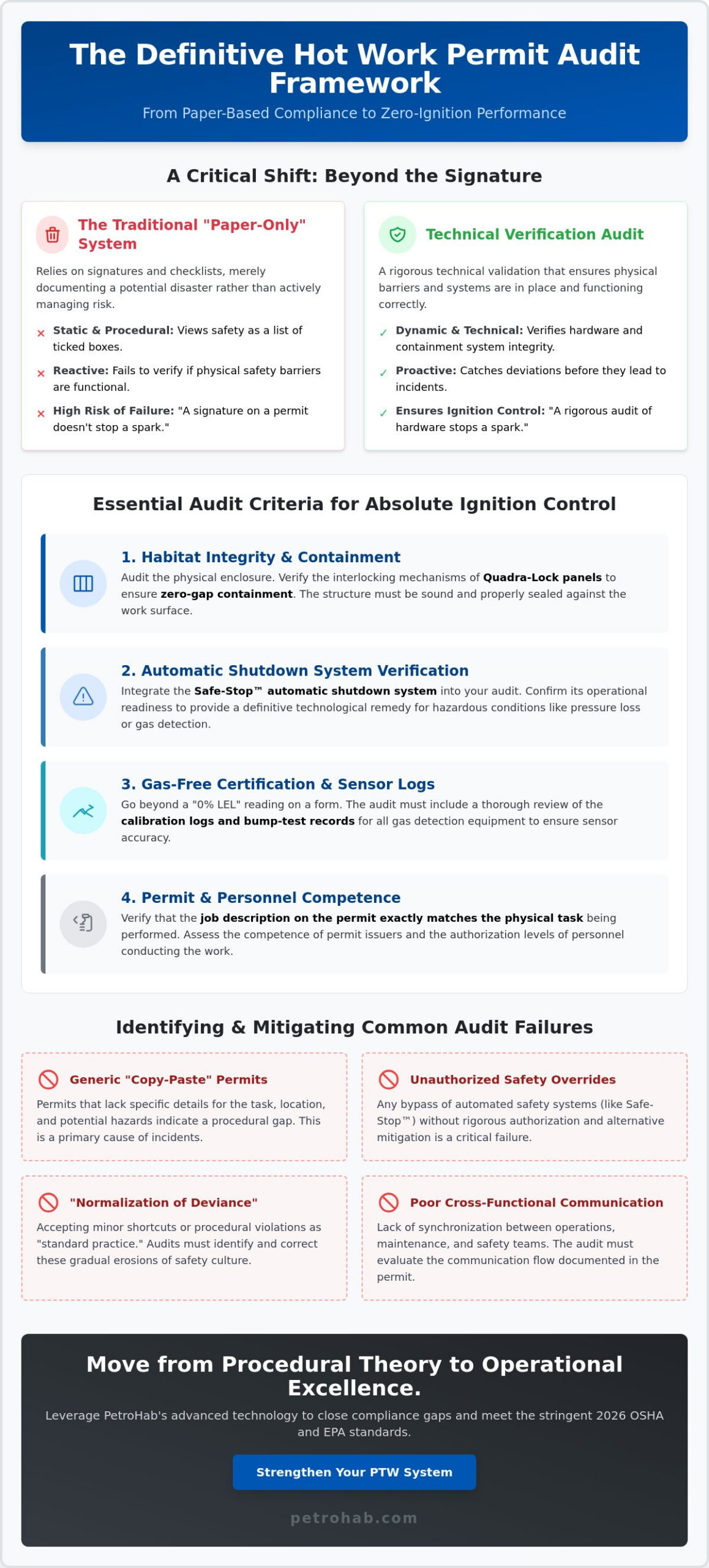
If your hot work permit system relies on paper signatures rather than physical containment verification, you aren’t managing risk; you’re documenting a potential disaster. Safety managers in high-hazard sectors often face audit fatigue from generic checklists that fail to address the technical realities of pressurized habitats. You know that a signature on a permit doesn’t stop a spark, but a rigorous technical audit of your hardware and containment systems does.
This guide provides a definitive framework for conducting a hot work permit to work system audit that prioritizes zero-ignition performance through technical verification. You’ll master the requirements for auditing habitat integrity and hardware safety to ensure absolute ignition control. We’ll examine how to validate critical components like Quadra-Lock panels and the Safe-Stop automatic shutdown system. This ensures your site meets the stringent 2026 OSHA and EPA compliance standards, moving your safety protocols from procedural theory to operational excellence.
Key Takeaways
- Learn how to transform routine site inspections into technical validations of safety barriers to ensure absolute ignition control.
- Identify specific criteria for verifying gas-free certifications and sensor calibration logs during a hot work permit to work system audit.
- Master the inspection of modular HWSE units by auditing the interlocking mechanisms of Quadra-Lock panels for zero-gap containment.
- Eliminate common compliance gaps by identifying generic “copy-paste” permits and unauthorized overrides of safety protocols.
- Integrate the Safe-Stop automatic shutdown system into your audit workflow to provide a definitive technological remedy for hazardous conditions.
The Strategic Role of PTW System Audits in Hazardous Environments
A hot work permit to work system audit is a rigorous technical validation of the safety barriers standing between an ignition source and a volatile atmosphere. It’s not a mere administrative check. While a permit authorizes a specific task, the audit verifies that the physical and procedural barriers described in that permit actually exist and function as intended. In high-hazard industrial sectors, this process serves as the primary defense against the normalization of deviance. This phenomenon occurs when minor shortcuts gradually become standard practice, often leading to catastrophic failures. Within the broader framework of Permit-to-Work (PTW) systems, the audit acts as a technical filter that catches these deviations before they result in an incident.
To better understand the foundational mechanics of these safety protocols, watch this introductory video:
The distinction between a routine site inspection and a comprehensive system audit is structural. Inspections are often binary, checking if a tool is present or a box is ticked. An audit evaluates the entire ecosystem of safety, from the calibration logs of gas detectors to the structural integrity of a PetroHab Hot Work Safety Enclosure (HWSE). As we move into late 2026, regulatory expectations are shifting. With the EPA expected to publish a final rule revising the Risk Management Program (RMP) under 40 C.F.R. Part 68 by the end of this year, the industry must move from compliance-only checklists to proactive risk-reduction auditing. This shift requires safety managers to verify that safety systems don’t just exist on paper but are technically capable of preventing ignition in real-time.
Audit Objectives: Beyond Regulatory Compliance
Effective auditing prioritizes the accuracy of the Hazard Identification and Risk Assessment (HIRA) within the active permit. Auditors must verify that the specific hazards of a location, such as proximity to hydrocarbon vents, are addressed with definitive technological remedies. This includes assessing the competence of permit issuers and the authorization levels of those performing the work. A successful hot work permit to work system audit also evaluates the communication flow between cross-functional teams. If the operations team and the maintenance crew aren’t synchronized, even the most advanced habitat system can’t guarantee safety.
The Consequences of Audit Failures in High-Hazard Zones
Historical ignition incidents frequently stem from “paper-only” compliance. In these cases, the permit was signed, but the physical barriers were compromised or improperly installed. Beyond the immediate risk to personnel, safety breaches lead to unplanned shutdowns and significant financial losses. In the US, OSHA is increasing its focus on high-risk industries with expanded inspections, making robust documentation essential. For instance, the 2024 SCCAP rule provisions require detailed root cause analysis for incidents, a process made significantly easier by consistent auditing. The PTW audit functions as the critical link between high-level safety policy and granular field execution.
Essential Audit Criteria for Hot Work Permit Compliance
Precision in a hot work permit to work system audit requires more than a cursory glance at a signature line. It demands technical verification of specific data points. You must confirm that the job description on the permit exactly matches the physical task being performed. Any discrepancy indicates a lack of oversight. Compliance with EPA hot work requirements mandates that these permits are issued for work on or near processes covered by the Risk Management Program. This ensures a baseline of safety, but excellence requires deeper scrutiny of field conditions.
Auditors must evaluate the “Gas-Free” certification process with skepticism. It’s not enough to see a “0% LEL” reading on a form. You must audit the calibration logs of the detection equipment. If sensors haven’t been bump-tested or calibrated according to manufacturer specifications, the permit is technically invalid. This level of detail separates a high-performing safety culture from one vulnerable to ignition. Integrating hazardous environment standards into the permit issuance process ensures that all personnel understand the global compliance landscape. This is critical in offshore or high-pressure environments where the margin for error is non-existent.
Documentation and Authorization Verification
Accountability rests on the traceability of signatures and the archiving of supporting documents. A thorough hot work permit to work system audit reviews permit archives to ensure that every task was time-limited. Permits that lack a specific expiration time invite scope creep. This happens when work continues beyond the original safety assessment parameters. You should also check for the presence of required supporting documents, such as isolation certificates. These documents prove that energy sources are locked out and tagged out before hot work commences. Without these, the permit lacks its necessary technical foundation.
Fire Watch and Emergency Response Readiness
Fire watch protocols are often a point of failure in high-hazard zones. A dedicated fire watcher must focus solely on the ignition source. They shouldn’t multi-task with other labor. Auditing this role involves verifying that the individual has been trained in the specific hazards of the site. You must also inspect the fire extinguishers and suppression systems:
- Verify that the extinguisher type is appropriate for the specific ignition risk.
- Check the last inspection date on the certification tag to ensure it’s current.
- Ensure the equipment is placed within immediate reach of the fire watcher.
Communication links are equally vital. Test the radio or intercom connection between the hot work site and the central control room. If an emergency occurs, a delay in communication can lead to asset loss. Utilizing a PetroHab HWSE provides a physical barrier, but the human element of the fire watch remains the final line of defense. Post-work monitoring must continue for at least 30 minutes to detect smoldering materials.
Auditing Habitat Integrity and Pressurized Containment Systems
A comprehensive hot work permit to work system audit must pivot from administrative verification to the physical assessment of containment hardware. While previous sections focused on the permit lifecycle, the actual safety of the site depends on the integrity of the hot work safety enclosure (HWSE). Auditors need to inspect the structural seals and the modular assembly of these units. If a seal is compromised, the pressurized environment fails. This creates an immediate risk in areas where flammable gases might be present. You must evaluate the fire-resistant materials against the latest engineering standards to confirm they haven’t suffered from previous thermal exposure.
Maintaining positive pressure is a technical requirement aligned with OSHA standard 29 CFR 1910.252. You should verify the calibration and functionality of manometers during the audit. These devices aren’t just indicators; they’re the only way to confirm that the habitat is successfully excluding external atmospheres. If the manometer isn’t functional or properly calibrated, the entire system’s safety claim is void. It’s the auditor’s duty to ensure that these instruments provide accurate, real-time data to the operators.
Pressurized Habitat Performance Metrics
Auditors must verify that the system maintains a differential of at least 0.1 inch water gauge. This pressure prevents the ingress of hydrocarbons. Air exchange rates must be audited to ensure they meet the specific volume requirements of the welding task. The positioning of air intake ducts is another critical point. They must be located in non-hazardous zones to prevent the system from pumping volatile gases into the enclosure. A habitat that’s too small for the task increases the risk of thermal damage to the panels and restricts the fire watcher’s line of sight.
Quadra-Lock Panel and Enclosure Inspection
Inspect each panel for signs of thermal degradation or mechanical stress. The interlocking mechanism of Quadra-Lock panels is designed to ensure zero-gap containment. Unlike traditional welding blankets or inferior screens, this system creates a rigid, airtight barrier. The interlocking design of Quadra-Lock technology eliminates the “chimney effect” that often draws sparks and hot debris through gaps in standard enclosures.
The modular configuration must match the approved engineering drawings for the specific site. If the field team has modified the layout without authorization, the integrity of the seal is no longer guaranteed. Auditors should look for specific points of failure:
- Tears or abrasions in the fire-resistant fabric that could allow spark escape.
- Proper alignment of the Quadra-Lock interlocking edges to maintain the pressure seal.
- Secure attachment points to the existing infrastructure to prevent panel shifting during work.
By focusing on these hardware specifics, the audit moves beyond a “paper exercise” and becomes a genuine safety barrier.
Identifying and Mitigating Common Audit Failures in Hot Work
A rigorous hot work permit to work system audit often exposes a dangerous trend known as “Copy-Paste” syndrome. This occurs when permit issuers replicate previous documents without conducting a fresh assessment of the current field conditions. Generic permits are a liability. They ignore dynamic hazards such as changing wind directions or the introduction of new combustible materials near the work site. Auditors must verify that every permit reflects the specific, real-time technical realities of the environment. If the permit doesn’t account for the current atmospheric data or the precise location of the ignition source, it fails the validation process.
Sparks and slag don’t respect the boundaries of a welding screen. The “Blind Spot” represents a critical failure mode where auditors overlook areas behind, beneath, or above the designated work area. Combustible migration can lead to ignition in adjacent spaces that were never properly isolated. Technical audits must include a 360-degree inspection of the surrounding infrastructure. Utilizing advanced hot work safety systems provides a structured methodology to eliminate these human errors. These systems ensure that physical barriers and electronic monitoring work in tandem to provide absolute ignition control.
Behavioral and Procedural Gaps
Audit findings frequently highlight “toolbox talk” fatigue. When safety briefings become repetitive, personnel stop identifying unique risks. Auditors should observe these briefings to ensure they are task-specific. A failure to re-evaluate hazards when environmental conditions shift is a major procedural gap. For example, a shift in wind speed can render a standard spark curtain ineffective. You must also verify the correct selection of fire blankets. Using a general-purpose blanket for high-intensity grinding is a technical error that compromises site safety. Correcting these behaviors requires consistent, authoritative oversight.
Technical and Hardware Failures
Hardware non-conformance is often binary. A gas detector is either calibrated or it’s a liability. Auditors must check for expired calibration tags and low battery statuses on all detection equipment. Improper ducting paths are another common failure point. If the air intake for a pressurized habitat is positioned too close to a potential leak source, the system will introduce contaminants rather than excluding them. When a hot work permit to work system audit identifies these failures, you must apply a Root Cause Analysis (RCA) framework. This aligns with the 2024 SCCAP rule requirements for detailed incident investigation. Secure your facility with PetroHab technology to ensure your hardware meets the highest technical standards for hazardous environments.
A critical SERP gap in many safety programs is the failure to integrate ATEX and IECEx standards into the audit process. You must verify that all electrical equipment used within the habitat, including lighting and ventilation fans, carries the appropriate certification for the specific zone. If a piece of hardware isn’t rated for the explosive atmosphere it’s operating in, the entire containment strategy is undermined. Stoic adherence to these technical specifications is the only way to guarantee asset protection.
Leveraging PetroHab Technology to Close Compliance Gaps
Closing the gap between safety policy and field execution requires a shift from passive documentation to active technological intervention. While digital permit software can streamline administrative tasks, it cannot physically contain a spark or isolate an ignition source. A technical hot work permit to work system audit must verify that the hardware on-site is capable of autonomous protection. Implementing pressurized welding habitats represents the gold standard for high-risk compliance. These systems provide a controlled environment where safety is engineered into the structure itself, rather than being dependent on human vigilance alone.
Safe-Stop: The Ultimate Audit Failsafe
The Safe-Stop Automatic Shutdown System acts as the definitive technical remedy for hazardous conditions. It integrates directly into the hot work permit to work system audit by providing verifiable data logs that create an immutable audit trail. This system monitors internal pressure and detects flammable gases in real-time. If the system identifies a loss of pressure or the presence of LEL concentrations, it automatically isolates the ignition source. This reduces the burden on auditors. Instead of guessing if a manual shutdown would have occurred, you can verify the system’s logic through its sensor-based monitoring history.
The PetroHab Advantage in Industrial Audits
Standardizing safety across global operations is a primary challenge for major energy producers. PetroHab’s modular HWSE utilizes patented Quadra-Lock technology to ensure a consistent, high-integrity seal at every site. These panels eliminate the variables associated with traditional welding blankets. By using standardized hardware, safety managers can maintain a “perpetual audit” state. This is supported by on-site supervision and training from certified technicians who ensure every enclosure meets international safety benchmarks.
PetroHab’s approach ensures that your safety infrastructure is as resilient as the assets you protect. Don’t leave your compliance to chance or paper-based checklists. Contact PetroHab to optimize your hot work safety infrastructure.
Establishing a Definitive Safety Barrier Through Technical Auditing
Achieving zero-ignition performance requires a transition from administrative checklists to the rigorous verification of physical containment hardware. You’ve seen how auditing habitat integrity and interlocking mechanisms prevents the normalization of deviance. Implementing a hot work permit to work system audit that prioritizes technical data over paper signatures ensures that every barrier functions as a calculated remedy against hazardous conditions. By focusing on the synergy between pressurized containment and automated failsafes, you eliminate the human errors that lead to industrial incidents.
PetroHab has been trusted by global oil and gas majors for over 15 years to protect personnel and high-value assets. Our patented Quadra-Lock technology provides superior containment through rigid interlocking panels, while our ATEX and IECEx certified monitoring systems offer verifiable safety logs for your audit trails. Request a Quote for PetroHab Hot Work Safety Enclosures to integrate these definitive technologies into your facility. Your commitment to meticulous technical precision today secures the operational excellence of tomorrow.
Frequently Asked Questions
What is the primary purpose of a hot work permit to work system audit?
The primary purpose is to validate the technical integrity of safety barriers and procedural compliance. It ensures that the controls identified on paper actually exist in the field to prevent ignition. It serves as a critical quality control mechanism for the entire permit lifecycle. By identifying gaps between safety policy and field execution, the audit protects personnel and high-value assets from catastrophic failures.
How often should a facility conduct a technical audit of its hot work permit system?
Best practices suggest annual comprehensive system audits, supplemented by quarterly spot checks. High-hazard environments or facilities with high personnel turnover often require more frequent reviews. This schedule ensures that safety protocols evolve alongside operational changes and aging infrastructure. Regular auditing prevents the normalization of deviance, where minor shortcuts gradually become standard practice. Consistency in auditing maintains a “perpetual audit” state of readiness.
What are the most common findings during a hot work safety audit?
Frequent findings include “copy-paste” hazard assessments that ignore site-specific conditions and expired gas detector calibrations. Auditors also identify improper fire watch positioning and a lack of training among permit performers. Hardware failures, such as compromised seals in modular enclosures, are also common. Addressing these findings requires a shift from administrative focus to hardware verification to ensure safety systems function as intended.
How does a pressurized habitat change the audit requirements for hot work?
A pressurized habitat introduces technical verification steps for manometer calibration and positive pressure maintenance. The hot work permit to work system audit must now include checks for air intake location and seal quality. It shifts the audit focus toward engineering controls rather than just behavioral safety. Auditors must confirm the system maintains at least 0.1 inch water gauge to prevent hydrocarbon ingress.
Who is qualified to perform a hot work permit system audit in the oil and gas industry?
Qualified auditors typically include senior safety engineers or third-party safety consultants with specialized training in hazardous area classifications. They must understand the technical nuances of ignition prevention and environmental containment. Experience with international standards like ATEX or IECEx is often a prerequisite for high-risk industrial sites. These professionals act as trusted advisors, using their expertise to identify granular details of hazards that others might overlook.
What is the difference between a hot work permit and a hot work audit?
A permit is a task-specific authorization that outlines hazards and controls for a single job. An audit is a systemic evaluation of the permit process itself. While the permit manages the immediate risk of a specific welding or grinding task, the audit ensures the management system remains robust. The audit validates that the permit system actually produces safe outcomes across the entire facility.
Can digital permit systems replace the need for physical site audits?
Digital systems can’t replace physical audits because they can’t verify hardware integrity or actual environmental conditions. Software manages data and workflows effectively, but it can’t confirm if a habitat seal is compromised. Physical verification remains the only way to ensure absolute ignition control in a live hazardous zone. An auditor must still step onto the site to inspect physical barriers like Quadra-Lock panels.
How do Quadra-Lock panels improve audit outcomes for hot work safety enclosures?
Quadra-Lock panels provide a standardized, rigid interlocking system that simplifies the verification of seal integrity. Auditors can quickly confirm zero-gap containment through visual and physical inspection of the joints. This consistency eliminates the variables found in traditional welding blankets or non-interlocking screens. Using these panels leads to more reliable hot work permit to work system audit results by providing a definitive, repeatable safety barrier.