Blog Posts
NFPA 51B Hot Work Permit: A Guide to Industrial Compliance in 2026
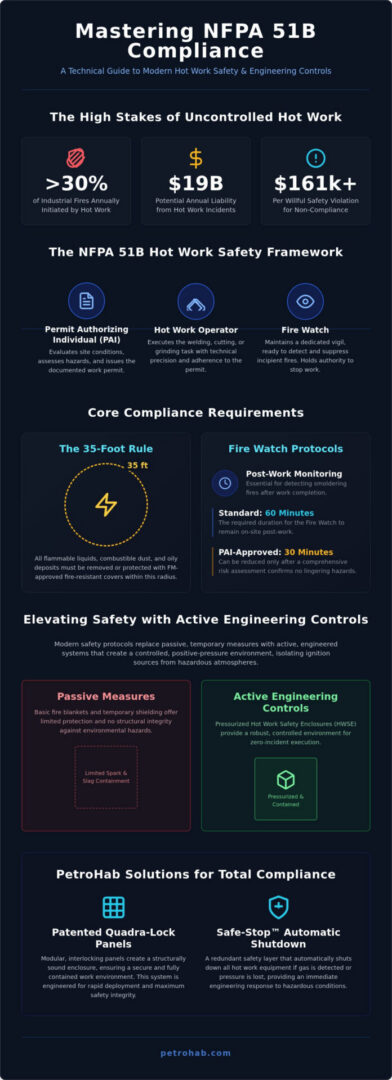
Hot work initiates over 30% of industrial fires annually. This transforms standard maintenance into a potential $19 billion liability. For safety engineers, the nfpa 51b hot work permit functions as a primary engineering control rather than a mere administrative requirement. You understand that the current regulatory environment is demanding, particularly when managing ignition risks in gas-prone areas where operational downtime is not an option. Failure to adhere to the 2024 edition of NFPA 51B can lead to willful safety violations exceeding $161,000 per instance.
This guide provides the technical expertise needed to master the 2024 standard and integrate pressurized habitats into your Permit-to-Work workflows. We’ll analyze the 35-foot rule, the transition to documented permits, and fire watch protocols that range from 30 to 60 minutes. You’ll discover how PetroHab Hot Work Safety Enclosures utilize patented Quadra-Lock panels and Safe-Stop automatic shutdown systems to create a controlled environment. We’ll detail how these technologies mitigate risk and ensure zero-incident execution during critical maintenance. This methodical approach ensures your site remains compliant while protecting both personnel and high-value assets.
Key Takeaways
- Understand the technical updates in the 2024 edition of the nfpa 51b hot work permit, including the transition to documented digital platforms and revised fire watch protocols.
- Enforce the 35-foot rule with precision by utilizing specialized shielding and fire-resistant covers to protect high-value assets from ignition.
- Replace passive safety measures with active engineering controls like pressurized Hot Work Safety Enclosures (HWSE) to manage hazardous environments.
- Streamline Permit-to-Work (PTW) workflows by integrating rigorous site hazard assessments and enclosure specifications into your primary safety documentation.
- Deploy redundant safety layers like the Safe-Stop automatic shutdown system and modular Quadra-Lock panels to ensure zero-incident execution in gas-prone areas.
Understanding the NFPA 51B Hot Work Permit Framework
NFPA 51B serves as the foundational standard for fire prevention in high-stakes industrial environments. It provides the rigorous framework necessary to manage ignition risks during operations like welding, thermal cutting, and grinding. In 2026, the nfpa 51b hot work permit is a critical component of risk management. It bridges the gap between regulatory requirements and field execution. This isn’t just a paperwork exercise; it’s a technical necessity for maintaining site integrity.
Effective oversight relies on clearly defined responsibilities. The Permit Authorizing Individual (PAI) evaluates the site and issues the authorization. The operator executes the task with technical precision. The Fire Watch maintains a dedicated vigil to detect and suppress incipient fires. This structure ensures that no single point of failure leads to a catastrophic event. Facilities distinguish between designated areas, which are engineered for permanent hot work, and permit-required areas. The latter involve environments where combustible materials or flammable vapors are present. Adhering to Hot Work Safety Principles requires a systematic approach to identifying these hazards before any spark is generated.
Review the following technical overview to visualize these safety requirements in practice:
Scope and Purpose of NFPA 51B
The standard’s primary objective is to eliminate the leading cause of industrial property damage. In refinery and offshore settings, the evolution of these standards reflects an increasing focus on environmental containment. Compliance failures result in severe legal liabilities and can trigger OSHA penalties exceeding $161,000 per violation. NFPA 51B acts as an active guardian for personnel and high-value assets. It ensures that every hazardous condition is met with a definitive engineering or procedural remedy.
The Anatomy of a Compliant Permit
A compliant nfpa 51b hot work permit must be documented with technical accuracy. It includes the work scope, duration, and a detailed inventory of nearby hazards. Pre-work site inspections confirm that the 35-foot rule is enforced. Post-work monitoring is equally vital. The Fire Watch must remain on-site for at least 60 minutes, though a PAI may reduce this to 30 minutes if the hazard profile allows. This methodical sign-off procedure ensures the site is stable before normal operations resume.
Core Compliance Requirements for Hot Work Safety
Compliance with the 35-foot rule is the primary defense against unintended ignition. This radius dictates that all flammable liquids, combustible dusts, and oily deposits must be removed from the vicinity of the work. If removal is impossible, items must be protected by FM-approved fire-resistant covers or specialized shielding. The Official NFPA 51B Standard provides the technical framework for these requirements. Every nfpa 51b hot work permit depends on the rigorous application of these spatial controls to prevent spark-related incidents.
The Fire Watch role is equally critical. These individuals must have the authority to stop work if hazardous conditions arise. They require specific training in site-specific hazards and the operation of fire suppression equipment, such as portable extinguishers or fire hoses. For 2026 operations, the post-work monitoring period remains a standard 60 minutes. A Permit Authorizing Individual (PAI) can only reduce this to 30 minutes after a comprehensive risk assessment confirms no lingering hazards exist. This vigil is essential for detecting smoldering fires that may ignite long after the operator has left the area.
Fire Prevention and Suppression Measures
Selecting the right materials for containment is a technical decision. Basic welding blankets often fail to provide the structural integrity needed for high-pressure environments. You must use materials that are FM-approved for the specific temperature and duration of the task. On multi-level structures, managing sparks and slag requires vertical containment to prevent ignition on lower decks or in open drains. Utilizing modular Quadra-Lock Panels ensures that sparks remain confined within a controlled enclosure. This offers a level of protection that loose textiles cannot match, especially in high-wind offshore environments where blankets can shift or fail.
Atmospheric Monitoring and Gas Detection
Atmospheric integrity is paramount in the energy sector. Mandatory gas testing protocols must be established before any work begins. While periodic monitoring is a minimum requirement, continuous gas detection is the benchmark for safety in hazardous atmospheres. Work must stop immediately if gas concentrations reach 10% of the Lower Explosive Limit (LEL). Modern safety workflows integrate these gas detectors directly with the permit sign-off process. This ensures that the nfpa 51b hot work permit is only active when the atmosphere is confirmed to be within safe parameters through real-time data.
Engineering Controls: Elevating Safety with HWSE
Engineering controls represent the highest tier in the hierarchy of hazard mitigation. While traditional fire blankets and passive shielding offer a baseline of protection, they don’t address the risk of gas ingress in volatile environments. The PetroHab Hot Work Safety Enclosure (HWSE) serves as a definitive technological remedy. It transforms a hazardous location into a controlled environment, allowing maintenance to proceed without costly facility shutdowns. This proactive approach is essential for safety managers who prioritize risk mitigation over reactive suppression.
The science of positive pressure is the core mechanism of the HWSE. By maintaining an internal pressure slightly higher than the external atmosphere, the enclosure physically prevents flammable gases from entering the work area. This active containment is essential for securing an nfpa 51b hot work permit in gas-prone zones. It reduces the operational impact of the 35-foot rule by creating a hermetically sealed barrier between the ignition source and potential fuel sources. When you isolate the hazard at the source, you ensure that sparks and slag cannot interact with the surrounding environment.
The Mechanics of Pressurized Habitats
Technical integrity within an HWSE depends on precise monitoring. Manometers are used to maintain enclosure integrity, providing real-time data on pressure differentials. This ensures the habitat remains pressurized throughout the duration of the hot work. Proper air ducting and ventilation are also required to provide a continuous supply of breathable air for the operator. These systems work in tandem to exhaust fumes while preventing the buildup of heat. For a deeper technical analysis, review our resource on How Positive Pressure Habitats Ensure Worker Safety. Integrating these systems into your nfpa 51b hot work permit process provides a documented layer of engineering protection that standard permits lack.
Modular vs. Fixed Containment
Modularity is a critical requirement for complex industrial sites, particularly in tight offshore spaces. Unlike fixed structures, Quadra-Lock Panels allow for rapid deployment and customization around existing piping and structural obstacles. These patented panels provide the structural integrity required for high-heat welding while ensuring the materials meet NFPA 51B flame resistance standards. Every component is engineered to withstand the rigors of heavy industry. This modularity doesn’t sacrifice safety; instead, it enhances it by ensuring a tighter seal than generic, ill-fitting blankets. By utilizing the Safe-Stop automatic shutdown system as a redundant safety layer, you create a fail-safe environment where the welding power source is instantly deactivated if pressure is lost or gas is detected.
Integrating HWSE into the Permit-to-Work (PTW) Process
The integration of technical hardware with administrative protocols is where true industrial safety is realized. A standard nfpa 51b hot work permit often fails because it lacks a direct connection to the engineering controls active on site. By embedding the PetroHab Hot Work Safety Enclosure (HWSE) into the Permit-to-Work (PTW) process, safety managers create a verifiable safety loop. This protocol doesn’t just satisfy a checklist; it establishes a rigorous defense against ignition. The process begins with a pre-installation site hazard assessment where technicians perform gas testing to establish a baseline before the enclosure is erected.
Once the assessment is complete, the permit must explicitly document the enclosure specifications. This includes the configuration of the Quadra-Lock Panels and the specific air exchange rates required for the task. Verification is the next critical phase. The Permit Authorizing Individual (PAI) must confirm that positive pressure is established and that all automatic shutdown systems are functional. Continuous monitoring then follows, ensuring that the PAI maintains oversight throughout the duration of the hot work to detect any environmental changes immediately.
Automated Redundancy and Shutdown Systems
Permit compliance in 2026 demands more than manual oversight. Automatic shutdown systems provide a redundant layer of protection that operates independently of human intervention. Integrating Safe-Stop technology with industrial power sources ensures that welding or cutting equipment is immediately de-energized if a hazard is detected. This technology acts as a fail-safe mechanism, responding to loss of pressure or the presence of flammable gases within milliseconds. For a detailed technical breakdown, consult our A Comprehensive Guide to Advanced Hot Work Safety Systems. These automated systems transform the permit from a passive document into an active safety protocol.
Training and Competency for Permit Compliance
Hardware alone won’t guarantee safety; it requires competent personnel for deployment and operation. Habitat deployment must be overseen by certified technicians who understand the granular details of environmental containment. The Fire Watch within a habitat context requires specialized training that goes beyond standard fire extinguisher use. They must understand the mechanics of the HWSE and be prepared to execute emergency procedures if the habitat fails or if gas is detected. This competency ensures that every nfpa 51b hot work permit is backed by a team capable of maintaining the integrity of the controlled environment.
To ensure your facility meets these rigorous standards, you can request a technical consultation for your HWSE integration.
PetroHab Solutions for NFPA 51B Compliance
PetroHab provides a definitive suite of engineering controls designed to meet the rigorous demands of heavy industry. While administrative protocols define the rules, our technology provides the physical protection required to execute them safely. Securing an nfpa 51b hot work permit in high-risk zones requires more than a signature. It requires a system that actively manages environmental hazards. Our Petro-Habitats are engineered for durability in extreme environments. They provide a resilient barrier against ignition sources, ensuring that maintenance doesn’t compromise site integrity.
Quadra-Lock: The Core of Habitat Integrity
Quadra-Lock technology represents a significant advancement in habitat integrity. Traditional panel joining methods often rely on friction or overlapping textiles. These can fail under pressure or in high-wind conditions. Our patented Quadra-Lock Panels utilize a modular interlocking design to ensure a gas-tight seal. This design maintains the positive pressure differential necessary for environmental containment. The materials used in PetroHab systems are selected for their high-heat resistance and structural durability. This ensures the enclosure remains intact during intense welding or cutting operations.
Safe-Stop: Eliminating the Human Error Factor
The Safe-Stop Automatic Shutdown System serves as the gold standard in redundant safety. It eliminates the human error factor by continuously monitoring the Lower Explosive Limit (LEL) and internal pressure levels. If the system detects gas concentrations at 10% LEL or a loss of positive pressure, it immediately isolates power to the welding equipment. This rapid response occurs in milliseconds. It prevents an ignition event before it can begin. For a broader look at international requirements, see our guide on Hazardous Environment Standards: Compliance and Safety. Integrating this technology into your nfpa 51b hot work permit workflow provides a fail-safe layer that manual monitoring cannot match.
Beyond hardware, PetroHab offers global support to assist with compliance and on-site training. From our Houston-based manufacturing facility, we provide technical expertise to safety managers worldwide. This ensures your personnel are competent in deploying and operating these critical safety systems. Our role as an active guardian of industrial sites is reinforced by our commitment to zero-incident execution. We provide the tools and the knowledge to protect your personnel and high-value assets in the most challenging environments.
Advancing Industrial Safety Through Engineering Excellence
Industrial safety in 2026 requires a transition from passive administrative oversight to active engineering control. Mastery of the nfpa 51b hot work permit is no longer just about documentation; it’s about the technical integration of environmental containment. By deploying pressurized habitats, safety managers effectively neutralize ignition risks in gas-prone environments while maintaining operational continuity. These systems provide the definitive technological remedy for high-stakes maintenance tasks where passive measures often fail.
PetroHab remains at the forefront of this evolution, leveraging global industrial safety expertise to protect your personnel and high-value assets. Our patented Quadra-Lock Panel technology ensures a gas-tight seal, while the Safe-Stop Automatic Shutdown system provides a fail-safe redundant layer. This combination of innovation and rigorous engineering establishes a new benchmark for safety excellence. You can secure your facility against the leading causes of industrial fire with proven, resilient equipment that meets the most demanding international standards.
Contact PetroHab for NFPA 51B Compliant Hot Work Solutions and ensure your next maintenance cycle is defined by zero-incident execution and full regulatory compliance.
Frequently Asked Questions
What is the most critical requirement of an NFPA 51B hot work permit?
The most critical requirement is the formal authorization and hazard assessment conducted by a Permit Authorizing Individual (PAI). This process ensures that all fire hazards are identified and mitigated before any ignition source is introduced. The nfpa 51b hot work permit serves as documented verification that the 35-foot rule is enforced and a dedicated Fire Watch is stationed. It establishes a technical protocol designed to prevent industrial property damage and personnel injury.
How does a pressurized habitat affect the 35-foot rule in NFPA 51B?
A pressurized habitat functions as an advanced engineering control that physically isolates the ignition source from the surrounding environment. While NFPA 51B requires a 35-foot radius clear of combustibles, the use of a PetroHab Hot Work Safety Enclosure (HWSE) creates a controlled atmosphere. This containment prevents sparks and slag from escaping the work area. It provides a definitive technological remedy when clearing the full 35-foot radius is operationally impossible or impractical for the facility.
Can hot work be performed without a permit in an industrial facility?
Hot work can only be performed without a permit in areas specifically designated and engineered for such activities, such as permanent maintenance shops. In all other locations, an nfpa 51b hot work permit is mandatory. Performing welding or cutting in non-designated areas without documented authorization is a major safety violation. This oversight can lead to catastrophic fires and OSHA penalties exceeding $161,000 per willful violation in high-risk industrial zones.
What is the role of the Fire Watch according to NFPA 51B?
The Fire Watch is responsible for maintaining a dedicated vigil during and after hot work operations to detect and extinguish incipient fires. They must have the authority to stop work if hazardous conditions develop. According to the 2024 edition, the Fire Watch must remain on site for at least 60 minutes post-work. A PAI may reduce this to 30 minutes only if a thorough technical risk assessment confirms no remaining hazards or smoldering materials.
How often must gas testing be performed during a hot work permit duration?
Gas testing must be performed before work begins and at intervals specified by the PAI based on specific site hazards. In volatile environments, continuous atmospheric monitoring is the industry benchmark for safety. If gas concentrations reach 10% of the Lower Explosive Limit (LEL), work must cease immediately. Integrating automated gas detection with the permit process ensures that the work area remains safe throughout the entire duration of the maintenance task without interruption.
What happens if a hot work permit expires before the task is finished?
All hot work must stop immediately if the permit expires or if site conditions change significantly. A new assessment by the PAI is required to issue a fresh permit or extend the existing authorization. This process ensures that the technical requirements and hazard mitigations remain valid for the current environment. Continuing work under an expired permit compromises site integrity and violates international safety standards and rigorous regulatory compliance protocols established for hazardous areas.
How does the Safe-Stop system enhance NFPA 51B compliance?
The Safe-Stop system enhances compliance by providing a redundant, automated safety layer that exceeds manual monitoring requirements. It continuously tracks internal pressure and gas levels within the habitat. If the system detects gas or a loss of positive pressure, it instantly isolates power to the welding equipment. This eliminates the human error factor and ensures that the hot work environment remains within the safe parameters defined by the permit, protecting personnel and high-value assets.
Are modular habitats like Quadra-Lock panels required for all offshore welding?
While not explicitly mandated by name in the standard, modular systems like Quadra-Lock panels are the preferred solution for meeting NFPA 51B containment requirements in tight offshore spaces. Their patented interlocking design ensures a gas-tight seal that traditional blankets cannot achieve. These panels provide the structural integrity and fire resistance necessary for high-heat operations. They represent the modern engineering standard for protecting personnel and assets in the most challenging and hazardous offshore environments.