Blog Posts
Oil Rig Fire Prevention Strategies: Advanced Ignition Control in 2026
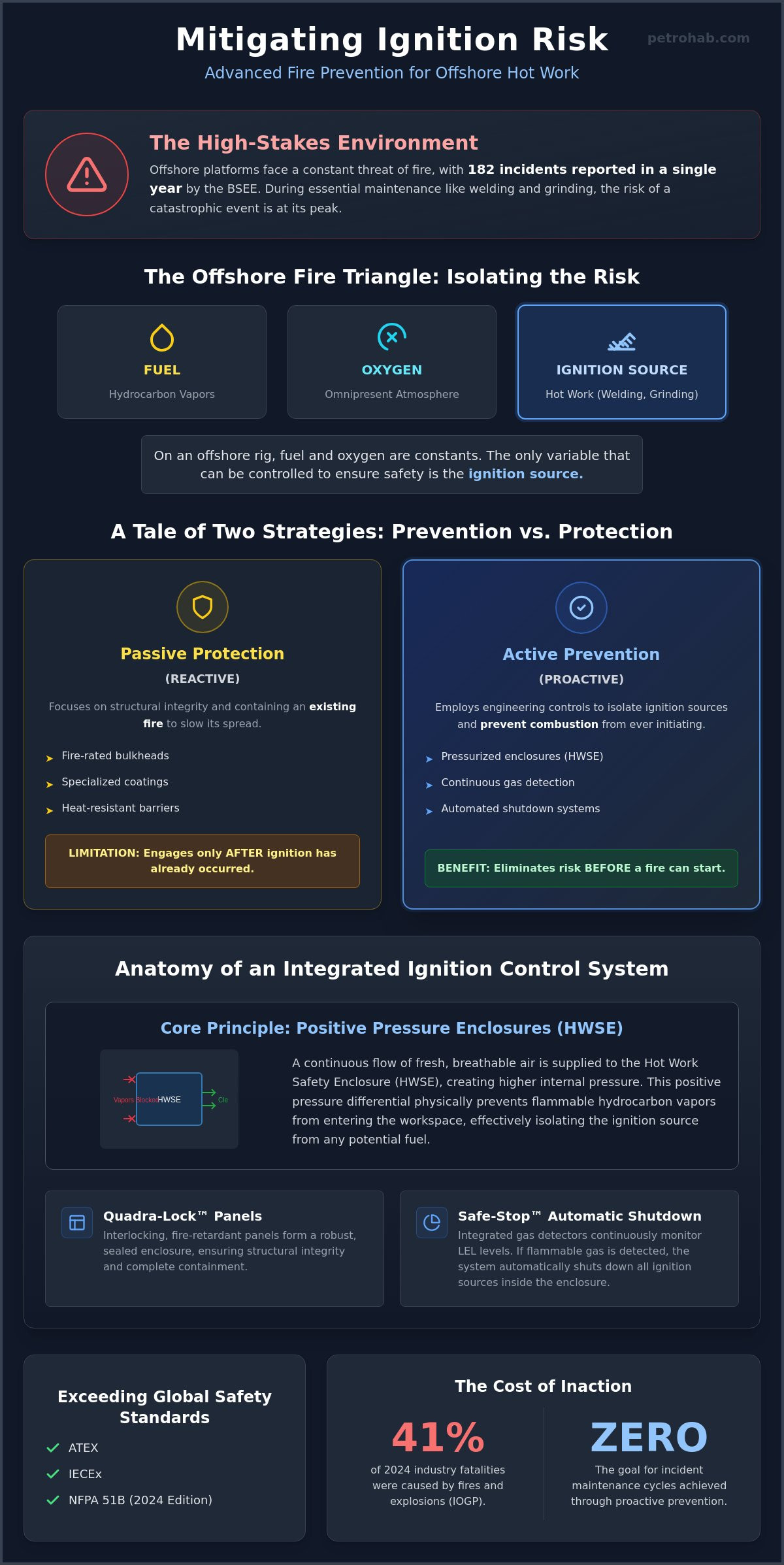
The BSEE reported 182 fires on offshore facilities in 2025, a stark reminder that the margin for error on a platform is non-existent. You’re likely facing the constant pressure of maintaining zero-incident cycles while implementing effective oil rig fire prevention strategies to meet the complex demands of ATEX and IECEx compliance. It’s a high-stakes environment where traditional methods often fail to mitigate the risk of catastrophic asset loss during essential welding or grinding tasks.
By reading this technical analysis, you’ll master the sophisticated pressurized containment protocols necessary to eliminate ignition risks. We’ll provide the engineering insights you need to ensure total fire safety on offshore platforms, even during the most hazardous hot work operations. This guide examines the implementation of Quadra-Lock panels and the Safe-Stop Automatic Shutdown System to maintain rigorous safety standards. We’ll also detail how the latest 2026 BSEE regulatory updates and advanced Petro-Habitats help you achieve a zero-incident maintenance cycle without compromising operational uptime.
Key Takeaways
- Identify the specific interaction of the fire triangle in offshore environments to neutralize ignition triggers during critical maintenance turnarounds.
- Evaluate the distinction between passive barriers and active oil rig fire prevention strategies to implement real-time gas detection and automated containment.
- Understand the operational mechanics of positive pressure within a Hot Work Safety Enclosure (HWSE) to prevent the ingress of flammable hydrocarbons.
- Align offshore operations with global safety standards by reviewing the technical requirements of ATEX, IECEx, and the 2024 edition of NFPA 51B.
- Deploy integrated systems featuring Quadra-Lock panels and automated shutdown technology to establish redundant safety layers in high-risk zones.
The Fire Triangle in Offshore Environments: Identifying Critical Risks
The fire triangle remains the fundamental framework for understanding combustion, yet its application on offshore platforms involves high-stakes variables. Unlike onshore facilities, offshore rigs operate in an environment where fuel is the primary commodity and oxygen is omnipresent. Controlling heat is the only viable path to safety. Effective oil rig fire prevention strategies prioritize the isolation of ignition sources from the surrounding atmosphere. Maintenance turnarounds introduce significant risks, as grinding, welding, and cutting generate the thermal energy required to bridge the gap between fuel and oxygen.
To better understand the inherent risks present on these facilities, watch this helpful video:
Environmental factors complicate these efforts. High-velocity winds can transport hydrocarbon vapors across decks, while salt spray accelerates the degradation of passive fire protection materials. This corrosive atmosphere can compromise the integrity of traditional barriers, making active containment essential. The IOGP reported that explosions and fires accounted for 41% of industry fatalities in 2024. These statistics underscore the necessity of rigorous Process Safety Management to protect personnel and high-value assets. Common ignition triggers during maintenance include:
- Electrical arcing from damaged equipment
- Friction-generated sparks from grinding
- Open flames from welding torches
- Static electricity discharge
Hydrocarbon Vapor Migration and Ignition Risks
Fugitive emissions often originate from leaking valves, seals, or flanges and migrate toward maintenance zones. These gases become dangerous when they reach their Lower Explosive Limit (LEL), the minimum concentration at which a gas can ignite. Monitoring LEL levels is a critical component of technical oil rig fire prevention strategies. In the context of hot work, an ignition source is any thermal energy, such as a spark, flame, or heated surface, capable of initiating combustion in a flammable atmosphere.
The High Cost of Reactive Fire Management
Relying on reactive suppression systems is a flawed strategy in high-oxygen, hydrocarbon-rich environments. Once a fire starts, the economic impact is immediate and severe, often resulting in total platform shutdowns and millions in lost production. Traditional suppression systems may struggle to extinguish deep-seated fires before structural damage occurs. Investing in pressurized containment systems like Quadra-Lock panels offers a definitive technological remedy. The cost of preventing an incident through advanced ignition control is a fraction of the liability associated with a catastrophic failure. Safety managers must view prevention as a fundamental operational requirement rather than a discretionary expense.
Active vs. Passive Fire Prevention Strategies
Technical oil rig fire prevention strategies require a clear distinction between passive protection and active prevention. Passive fire protection focuses on structural integrity and the containment of an existing fire. This includes fire-rated bulkheads, specialized coatings, and heat-resistant barriers designed to slow the spread of flames and maintain the platform’s stability. While these elements are essential for meeting U.S. Coast Guard fire protection standards, they’re reactive by nature. They only engage after an ignition event has already occurred.
Active fire prevention represents a superior engineering control within the hierarchy of safety management. It focuses on the active isolation of ignition sources and the continuous monitoring of the environment to prevent combustion from ever initiating. For live platform maintenance, active systems provide a definitive technological remedy. They ensure that even if hydrocarbon vapors are present on the rig, they can’t interact with the thermal energy generated by hot work. This proactive stance is the only way to achieve zero-incident maintenance cycles in high-risk environments.
Passive Barriers and Fire-Resistant Materials
Fire blankets and static shielding serve as the first line of defense in traditional hot work setups. They protect nearby equipment from slag and sparks. However, these materials have significant limitations during high-heat welding operations. They can’t prevent the migration of flammable gases into the work area. In a hydrocarbon-rich environment, a fire blanket is insufficient to stop an explosion if the LEL is reached. Utilizing Quadra-Lock panels within a pressurized system provides a level of durability and heat resistance that far exceeds standard fire blankets. Passive bulkheads are vital for platform design, but they don’t address the immediate risks of maintenance-related ignition triggers.
Active Ignition Control Systems
The most effective oil rig fire prevention strategies isolate the ignition source at its point of origin. This is achieved through the deployment of advanced hot work safety systems that create an impenetrable barrier between the work and the environment. These systems utilize real-time gas detection and automated shutdown mechanisms. If the system detects a loss of pressure or the presence of gas, it immediately terminates power to the welding equipment. This level of control ensures that a flammable atmosphere can’t form within the enclosure. Safety managers who prioritize pressurized containment solutions effectively eliminate the most common triggers for offshore fires. This approach transforms the safety profile of the platform from reactive to preventative.
Implementing Pressurized Habitats for Hot Work Safety
The Hot Work Safety Enclosure (HWSE) represents the industry benchmark for isolating ignition sources in hydrocarbon-rich environments. Unlike static barriers, an HWSE functions as a dynamic containment system that actively manages the atmosphere within the work area. This technology is a cornerstone of modern oil rig fire prevention strategies, providing a controlled environment where welding or grinding can occur safely on a live platform. The operational mechanism relies on establishing a localized environment that is physically separated from the platform’s hazardous zones.
Maintaining this separation requires adherence to OSHA Fire Prevention Guidelines, which emphasize the importance of controlling flammable vapors and ignition sources simultaneously. By utilizing pressurized welding habitats, operators ensure that the internal atmosphere remains free of combustible gases, even if a leak occurs nearby. This engineering approach eliminates the dependency on traditional fire watches alone, replacing human observation with definitive technical barriers.
The Engineering of Positive Pressure
Positive pressure is the primary defense mechanism against gas ingress. The system utilizes powerful blowers to intake air from a verified clean source and force it into the enclosure. This creates a pressure differential where the internal air pressure is higher than the external atmospheric pressure. Manometers continuously monitor these differentials, providing real-time data to the safety team. To meet rigorous safety standards, an ATEX-compliant habitat must maintain a minimum overpressure of 50 pascals relative to the external environment. This constant outflow of air ensures that any fugitive emissions are pushed away from the ignition source rather than drawn toward it.
Modular Construction with Quadra-Lock Panels
Rig geometries are rarely uniform, requiring a containment solution that’s as versatile as it’s durable. The use of Quadra-Lock panels allows for rapid, modular construction that adapts to complex piping and structural beams. These panels don’t just provide a heat barrier; they interlock to create a structural integrity that withstands high offshore winds. This interlocking design eliminates gaps that could compromise the pressure seal. Because the panels are modular, technicians can assemble an enclosure of virtually any size or shape, ensuring that oil rig fire prevention strategies remain effective regardless of the maintenance task’s location. This flexibility reduces setup time and minimizes operational downtime, allowing for zero-incident maintenance cycles without sacrificing platform productivity.
Regulatory Compliance and Safety Management Systems
Adherence to international safety standards is the foundation of any resilient offshore operation. In June 2026, the Bureau of Safety and Environmental Enforcement (BSEE) finalized a rule that updated 40 existing industry standards and incorporated 23 new ones into federal regulations. This update ensures that oil rig fire prevention strategies remain synchronized with the latest technological advancements in ignition control. Rigorous compliance isn’t merely a legal obligation. It’s a calculated strategy to mitigate the risk of catastrophic failure in hydrocarbon-rich environments.
Global Compliance: ATEX, IECEx, and Beyond
Effective risk management requires a deep understanding of hazardous environment standards like ATEX and IECEx. These frameworks categorize platform areas into Zone 0, Zone 1, and Zone 2 based on the frequency and duration of explosive atmospheres. Most pressurized habitats are deployed in Zone 1 or Zone 2 areas. Every component within a hot work safety enclosure must possess the correct certification to prevent it from becoming an ignition source itself. This includes intrinsically safe manometers, flame-retardant Quadra-Lock panels, and explosion-proof ventilation systems. Using uncertified components in a pressurized enclosure negates the entire safety protocol and creates a false sense of security.
The Permit-to-Work (PTW) Integration
The Permit-to-Work (PTW) system acts as the administrative control layer for all high-risk tasks. When you integrate pressurized habitats into this workflow, you transition from a purely procedural approach to a technical one. The 2024 edition of NFPA 51B mandates a fire watch for at least 60 minutes after hot work is completed. While the Permit Authorizing Individual (PAI) can reduce this to 30 minutes in specific scenarios, the presence of a pressurized enclosure provides a superior level of isolation that simplifies the approval process.
On-site supervision by certified habitat technicians is essential for maintaining enclosure integrity. These specialists ensure that the positive pressure remains within the required parameters and that the Safe-Stop Automatic Shutdown System is fully operational. If the system detects a loss of pressure or gas ingress, it acts as a digital fail-safe, instantly terminating power to welding equipment. This automated response complements manual PTW checks and eliminates the risk of human error during critical maintenance cycles. To ensure your platform meets these rigorous 2026 requirements, you should deploy certified pressurized habitats for all upcoming turnaround projects.
The PetroHab Solution: Integrated Ignition Control Systems
PetroHab provides a definitive technological remedy for offshore ignition risks. The PetroHab Hot Work Safety Enclosure (HWSE) stands as the industry benchmark for pressurized containment, protecting both personnel and high-value assets. This system integrates advanced engineering with rigorous safety protocols to redefine oil rig fire prevention strategies. The effectiveness of this solution stems from the synergy between physical containment and automated response systems.
Uncompromising Safety with Safe-Stop Technology
The Safe-Stop Automatic Shutdown System functions as the digital heart of the PetroHab habitat. It doesn’t just monitor pressure; it simultaneously evaluates gas levels to ensure the atmosphere remains non-combustible. If the system detects a loss of overpressure or the presence of hydrocarbon vapors, it triggers an immediate shutdown of all connected hot work equipment. This fail-safe mechanism eliminates the inherent risks of human reaction time and manual oversight. By automating the monitoring process, Safe-Stop provides a level of reliability that traditional fire watches can’t match. It ensures that the ignition source is neutralized before a hazardous condition can escalate into a catastrophic event.
Global Support and Expert Supervision
Selecting the right hot work safety enclosure suppliers is a critical decision for safety managers. PetroHab supports global operations through a robust leasing model and the deployment of certified on-site technicians. Our experts understand the granular details of offshore hazards and ensure that every enclosure is installed with technical precision. They utilize Quadra-Lock panels to create a resilient, interlocking barrier that withstands the harsh conditions of the marine environment. These panels provide superior thermal protection and structural integrity, ensuring the enclosure remains airtight even in high-velocity winds.
Expert supervision extends beyond installation. PetroHab’s professional training programs are designed to enhance the safety culture of the entire platform. Technicians provide hands-on instruction to rig personnel, focusing on the operational requirements of the Safe-Stop system and the maintenance of positive pressure. This comprehensive approach ensures that oil rig fire prevention strategies are successfully integrated into the platform’s Permit-to-Work workflow. By partnering with a seasoned veteran in ignition control, operators can execute complex maintenance turnarounds with absolute confidence in their safety systems.
Securing the Future of Offshore Hot Work Operations
Modern offshore safety demands a transition from reactive suppression to proactive ignition isolation. You’ve seen that controlling the fire triangle requires more than simple barriers; it necessitates the deployment of active pressurized systems that neutralize risks at their source. Implementing advanced oil rig fire prevention strategies is the only way to navigate the complexities of 2026 regulatory updates while maintaining operational uptime. Meticulous attention to atmospheric containment ensures that maintenance tasks don’t compromise platform integrity or personnel safety.
PetroHab remains the industry benchmark for safety excellence. Our systems utilize patented Quadra-Lock technology to ensure structural and atmospheric integrity in the harshest marine environments. With ATEX and IECEx compliant hardware and global 24/7 technical support, we act as a critical safety partner for your most challenging turnaround projects. You can eliminate the threat of catastrophic asset loss through calculated engineering and uncompromising standards. Meticulous planning today prevents the accidents of tomorrow.
Take the definitive step toward zero-incident maintenance cycles today. Request a technical consultation for PetroHab HWSE solutions to secure your platform’s high-value assets and personnel. Your commitment to safety is the foundation of operational excellence.
Frequently Asked Questions
What are the primary fire risks during offshore oil rig maintenance?
The primary risks include the ignition of fugitive hydrocarbon vapors by sparks or heat generated during welding and grinding. In 2025, the BSEE reported 182 fires on offshore facilities, highlighting the persistent danger of maintenance turnarounds. Effective oil rig fire prevention strategies prioritize the isolation of these thermal triggers from the surrounding atmosphere to prevent combustion.
How does a pressurized welding habitat prevent fires?
A pressurized welding habitat prevents fires by maintaining an internal air pressure higher than the external atmosphere. This positive pressure creates a physical barrier that forces air out of the enclosure, preventing flammable gases from entering the work area. By isolating the ignition source from potential fuel, the habitat eliminates the risk of accidental combustion during hot work.
What regulatory standards govern fire prevention on oil rigs in 2026?
Regulatory oversight in 2026 is defined by the BSEE rule finalized in June, which incorporated 23 new industry standards for offshore operations. Additionally, the 2024 edition of NFPA 51B and international ATEX or IECEx standards provide the technical framework for ignition control. Compliance with these standards is mandatory for ensuring the safety of personnel and high-value assets in hazardous zones.
Is it possible to perform welding on a live oil platform safely?
Welding on a live oil platform is safe when using advanced pressurized containment technology like the PetroHab HWSE. These enclosures create a controlled environment that effectively separates hot work from hydrocarbon-rich atmospheres. This approach allows for essential maintenance without requiring a total platform shutdown, provided that all oil rig fire prevention strategies and automated fail-safes are active.
What is the role of an automatic shutdown system in fire prevention?
An automatic shutdown system, such as the Safe-Stop, serves as a digital fail-safe that monitors both gas levels and internal pressure. If the system detects a loss of overpressure or the presence of gas, it immediately terminates power to all welding equipment. This rapid response eliminates human error and ensures that the ignition source is neutralized before a fire can occur.
How does the Quadra-Lock panel system improve habitat safety?
The Quadra-Lock panel system improves habitat safety by providing a flame-retardant, interlocking barrier that ensures an airtight seal. These panels are engineered to withstand high offshore winds and intense heat, preventing leaks that could compromise the positive pressure. Their modular design allows for a precise fit around complex rig geometries, maintaining the integrity of the containment zone.
What training is required for personnel operating in hot work enclosures?
Personnel must undergo specialized training on the technical operation of the Hot Work Safety Enclosure and the Safe-Stop system. This includes instruction on monitoring manometers, responding to automatic shutdowns, and maintaining the structural integrity of the habitat. Professional training programs ensure that the safety culture on the rig aligns with rigorous international standards for ignition prevention.
Can pressurized habitats be used in ATEX Zone 1 environments?
Pressurized habitats are specifically designed for use in ATEX Zone 1 and Zone 2 environments. To operate safely in Zone 1, the enclosure must utilize certified explosion-proof components and maintain a minimum overpressure. These systems provide a definitive technological remedy for high-risk areas where explosive atmospheres are likely to occur during normal operations.