Blog Posts
The Critical Role of the Welding Habitat Manometer in 2026 Hot Work Safety
In the high-stakes environment of an offshore platform, the difference between operational success and a catastrophic ignition event often rests on a few millimeters of water gauge. Safety managers recognize that maintaining constant positive pressure is the only definitive way to prevent flammable gases from entering a hot work area. You’ve likely experienced the professional burden of monitoring a pressurized enclosure, knowing that a minor seal failure could immediately compromise the safety of your personnel and high-value assets, a standard strictly upheld by industry leaders like PetroHab LLC.
This article demonstrates how a precision-engineered welding habitat manometer serves as the vital sensory backbone for your 2026 hot work safety protocols. You’ll discover how to interpret subtle pressure fluctuations to validate the physical integrity of Quadra-Lock panels and ensure your Safe-Stop Automatic Shutdown System remains fully synchronized. We’ll examine the specific technical requirements for IEC 60079-13:2026 compliance, providing a clear roadmap to maintain a 100% safe environment while meeting the most rigorous ATEX and IECEx standards. This technical overview clarifies the transition from manual monitoring to automated protection, ensuring your site operations remain both compliant and productive.
Key Takeaways
- Understand how maintaining positive pressure serves as the primary barrier against external hydrocarbons in hot work safety enclosures.
- Learn to differentiate between analog and digital monitoring hardware to select the appropriate welding habitat manometer for ATEX/IECEx certified environments.
- Discover how the Safe-Stop Automatic Shutdown System utilizes real-time pressure data to trigger non-negotiable low-pressure trip protocols.
- Implement a 2026-compliant protocol for pre-work calibration and regular manual cross-checks to ensure monitoring accuracy.
- Explore how Quadra-Lock panel technology creates the superior airtight seal necessary for stable pressure readings and habitat integrity.
The Critical Role of Positive Pressure in Hot Work Safety Enclosures (HWSE)
Positive pressure is the primary defense mechanism within any PetroHab Hot Work Safety Enclosure. It works by maintaining a higher internal atmospheric pressure than the surrounding hazardous environment. This pressure differential ensures that any potential air movement occurs from the inside out, effectively blocking the ingress of external hydrocarbons or flammable gases. In the 2026 industrial safety landscape, this physical barrier is a mandatory requirement for executing hot work in volatile areas. Safety engineers rely on the welding habitat manometer to provide the definitive data required for the Permit-to-Work (PTW) process. During the PTW validation phase, the manometer reading is the primary indicator of habitat readiness. Inspectors require a stable, documented pressure reading before any ignition source is introduced to the site.
Principles of Atmospheric Exclusion
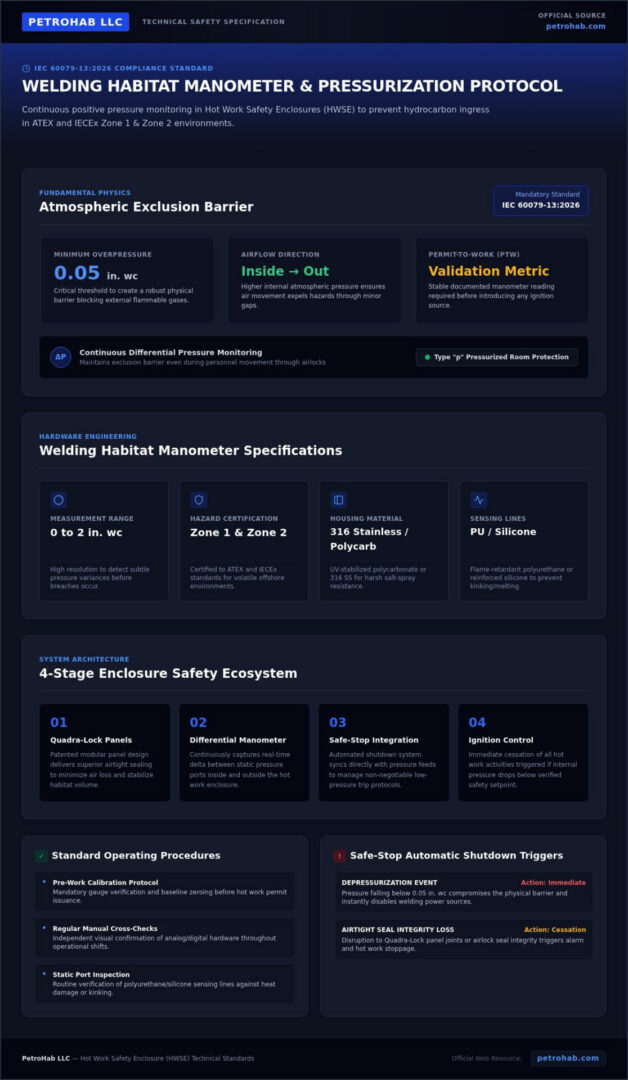
Effective containment requires a specific minimum overpressure, typically measured at 0.05 inches of water gauge (wc). This value creates a robust physical barrier that prevents hazardous vapors from entering the enclosure through minor gaps or during door operations. Maintaining this level depends on the precise relationship between the volume of the enclosure and the airflow delivered by the ventilation system. PetroHab systems utilize Quadra-Lock panels to create a superior airtight seal, which minimizes air loss and allows the system to sustain pressure even during personnel movement through airlocks. Understanding manometer pressure measurement principles is essential for operators to distinguish between safe operational fluctuations and critical depressurization. If the internal pressure drops below the setpoint, the atmospheric exclusion barrier is compromised, necessitating an immediate cessation of all hot work activities.
Regulatory Standards and IEC 60079-13 Compliance
The IEC 60079-13:2026 standard defines the “p” protection type for pressurized rooms, which serves as the global benchmark for modern welding habitats. This regulation mandates rigorous monitoring for equipment operating in Zone 1 and Zone 2 environments to prevent internal explosions. A certified welding habitat manometer must be integrated into the safety ecosystem to provide constant, accurate feedback to the Safe-Stop Automatic Shutdown System. PetroHab ensures its HWSE integrity meets these global 2026 safety benchmarks by combining patented Quadra-Lock technology with advanced monitoring hardware. This integration guarantees that the enclosure remains a controlled environment. It’s a calculated approach to risk mitigation where hazardous conditions are met with definitive technological remedies, ensuring the protection of personnel and high-value assets in high-stakes heavy industry environments.
Technical Specifications of a Welding Habitat Manometer
A precision-engineered welding habitat manometer must withstand the rigorous conditions of offshore and heavy industrial sites. Unlike standard industrial gauges, these devices require ATEX or IECEx certification to operate safely within Zone 1 and Zone 2 hazardous areas. Reliability is paramount when monitoring the integrity of a pressurized enclosure. In salt-spray environments, the monitoring hardware should feature corrosion-resistant materials, such as 316 stainless steel or UV-stabilized polycarbonate housings. It’s essential for ensuring the equipment remains functional despite constant exposure to corrosive maritime elements. The ideal measurement range for most hot work safety enclosures typically spans from 0 to 2 inches of water column (wc), providing the resolution needed to detect even minor pressure drops before they become critical safety breaches.
Differential Pressure Measurement Mechanics
The core function of the welding habitat manometer is to monitor the pressure differential between the interior of the habitat and the external atmosphere. Differential pressure is the variance between two points. To achieve this, sensing lines are routed from the manometer to static pressure ports located both inside and outside the enclosure. These lines must be constructed from durable materials like flame-retardant polyurethane or reinforced silicone to prevent kinking or melting in hot work zones. The device measures the delta between these two environments to confirm that the internal pressure remains higher. This constant verification is what prevents the ingress of flammable gases. By focusing on this specific mechanical variance, operators can ensure the Quadra-Lock panels are performing as intended, maintaining a secure barrier against external hydrocarbons.
Digital vs. Analog: Choosing the Right Tool for 2026
Choosing between analog and digital monitoring depends on the project’s specific demands. Analog Magnehelic gauges are prized for their reliability in extreme temperature fluctuations and their independence from power sources. They provide a clear, visual reference for on-site personnel who need to check status at a glance. Conversely, digital manometers offer advanced capabilities like data logging and integration with remote monitoring systems, which are increasingly required for 2026 safety audits. These digital units often include programmable alarms that provide an audible warning if pressure drops below the 0.05 inches wc threshold. PetroHab recommends a hybrid monitoring approach for high-stakes offshore projects to ensure redundancy. By combining the immediate visibility of an analog gauge with the precision and logging of a digital system, safety managers gain a comprehensive view of habitat health. For those seeking the highest standard in monitoring hardware, exploring the integrated solutions available for a pressurized welding enclosure ensures all technical specifications meet current regulatory benchmarks.
Integrating Manometers with the Safe-Stop Automatic Shutdown System
The Safe-Stop Automatic Shutdown System acts as the central intelligence of the habitat, processing real-time data from the welding habitat manometer to maintain site safety. While the manometer measures the pressure, the Safe-Stop system executes the logic required for ignition prevention. This integration is vital for high-risk operations where manual monitoring is insufficient. It transforms a passive gauge into an active safety component. By constantly communicating with the control unit, the manometer ensures that the habitat remains a pressurized environment capable of excluding hazardous gases.
The ‘Low-Pressure Trip’ threshold is a non-negotiable safety parameter set at the 2026 regulatory minimum. If the pressure falls below this limit, the system immediately identifies a breach in habitat integrity. In Zone 1 operations, redundancy in pressure sensing is mandatory. PetroHab utilizes dual-channel monitoring to ensure that a single sensor failure doesn’t compromise the entire safety loop. The system also includes sophisticated signal filtering. This prevents accidental shutdowns caused by minor, harmless pressure fluctuations often seen when personnel use the airlocks. This redundant architecture provides the high level of reliability required by safety managers and offshore engineers.
Automated Response Protocols for Pressure Loss
When the system detects a pressure drop below the safety limit, it initiates a pre-programmed sequence of events. The Safe-Stop system instantly isolates all potential ignition sources, including welding machines, grinders, and lighting systems. This isolation happens in milliseconds. It prevents any spark from interacting with potentially ingressing gases. By providing precise alarm diagnostics, the system helps operators identify the exact cause of the trip, whether it’s a door left open or a damaged Quadra-Lock panel. This reduces troubleshooting time and minimizes operational downtime. It’s a definitive technological remedy for a hazardous condition.
Signal Transmission and Integrity in HWSE
Signal integrity between the manometer and the control unit is critical. PetroHab employs intrinsically safe (IS) barriers for all welding habitat manometer connections to prevent the monitoring hardware itself from becoming an ignition hazard. These barriers ensure that electrical signals remain below the energy levels required to ignite a flammable atmosphere. This setup allows for zero latency between the moment a pressure drop is detected and the moment power isolation occurs. For a broader look at these technologies, consult A Guide to Advanced Hot Work Safety Systems. This calculated approach to signal integrity ensures that the hardware functions as a reliable guardian of the industrial site.
Operational Best Practices for Pressure Monitoring
Safety managers in 2026 must adhere to a strict monitoring discipline that prioritizes data integrity and personnel protection. Monitoring the welding habitat manometer is a continuous task that requires both automated oversight and human verification. We recommend manual cross-checks against digital sensors at least every two hours. This frequency ensures that the Safe-Stop system and the physical gauges remain perfectly synchronized. Documentation is equally critical for compliance. You must maintain a precise pressure log that records timestamps, specific water gauge readings, and the initials of the inspecting technician. These logs are essential for satisfying regulatory audits and verifying habitat integrity over the duration of a project. Environmental factors also play a significant role. High wind speeds can create a venturi effect or localized pressure pockets around the enclosure. These conditions might distort readings, so operators must account for ambient weather when evaluating the stability of the internal atmosphere.
Pre-Work Calibration and Zeroing Procedures
Before any hot work begins, technicians must perform a formal calibration sequence. This starts with zeroing the instrument to ensure the starting point is accurate. Zeroing the instrument is the baseline for all safety data. Technicians should disconnect the sensing tubes to ensure the gauge reads exactly zero relative to the local atmosphere. You must also inspect the sensing lines for internal blockages, kinks, or moisture buildup. Blocked lines lead to sluggish responses or false readings that could delay a critical shutdown. Once zeroed, reconnect the lines and verify that the pressure climbs steadily to the target 0.05 inches wc as the ventilation fans reach operational speed.
Interpreting Fluctuations and Troubleshooting
Operators must learn to read pressure trends rather than just isolated numbers. A sudden, sharp dip usually indicates a door has been opened or an airlock is being cycled. However, a slow, steady decline over several hours typically points to a structural issue, such as a seal failure or Quadra-Lock panel misalignment. If the pressure trends downward, check the panel joints and the floor seals immediately. Proper alignment of the Quadra-Lock system is essential for maintaining the airtight seal that the manometer monitors. If the manometer indicates a rapid loss of containment, the emergency protocol is clear: stop work, isolate the gas supply, and evacuate the habitat. This proactive approach identifies risks before they escalate into ignition events. To ensure your team is equipped with the best hardware for these protocols, consider the benefits of a PetroHab Hot Work Safety Enclosure.
PetroHab’s Engineered Approach to Habitat Integrity
PetroHab defines the global standard for pressurized containment in 2026. The effectiveness of the welding habitat manometer depends entirely on the physical integrity of the enclosure it monitors. Without a superior seal, even the most advanced sensor cannot maintain the overpressure required for offshore safety. PetroHab achieves this through a calculated synergy between its Hot Work Safety Enclosure (HWSE) and the Safe-Stop Automatic Shutdown System. This integrated approach ensures that safety managers don’t just react to hazards but actively prevent them through engineered reliability. By positioning the manometer as the central diagnostic tool, PetroHab transforms passive containment into an active safety ecosystem.
The Quadra-Lock Advantage for Pressure Stability
Traditional habitats often rely on zip or velcro fasteners. These methods are prone to mechanical air loss and rapid degradation in high-heat or corrosive environments. In contrast, the patented Quadra-Lock technology utilizes a modular interlocking panel system that minimizes mechanical air loss. This mechanical stability allows for a more consistent reading on the welding habitat manometer, significantly reducing the risk of nuisance trips while ensuring a constant atmospheric barrier. For more technical details on this system, see A Guide to PetroHab’s Quadra-Lock Panel Technology. By creating a robust airtight environment, Quadra-Lock panels facilitate the high-precision monitoring necessary for Zone 1 and Zone 2 operations where ignition prevention is non-negotiable.
Global Technical Support and Training
Managing the complexities of habitat pressure requires more than high-quality hardware. It demands expert oversight and technical precision. PetroHab provides on-site supervision to manage the granular details of habitat integrity and pressure maintenance. Our technicians receive specialized training in manometer precision and the interpretation of complex pressure trends. This expertise ensures that your site remains compliant with regional safety authorities and international standards like IEC 60079-13:2026. PetroHab acts as a critical safety partner, delivering the durable equipment and meticulous support needed for operational excellence. To secure these systems for your next project, Contact PetroHab for HWSE Leasing and Sales.
Securing the Future of Pressurized Hot Work
The 2026 regulatory environment leaves no room for error in hazardous area containment. As we’ve established, a precision-engineered welding habitat manometer serves as the definitive diagnostic tool for validating habitat integrity. By integrating this hardware with the Safe-Stop Automatic Shutdown System and patented Quadra-Lock sealing technology, you create a fail-safe environment that actively prevents ignition events. This synergy protects your personnel and ensures your operations meet the highest ATEX and IECEx standards. Trusted by global oil and gas majors, these systems transform complex safety protocols into reliable, manageable site procedures. Safety managers don’t leave site security to chance; they rely on proven engineering.
Maintaining a 100% safe hot work environment requires the right combination of expert training and superior technology. You can now implement these benchmarks on your own site to mitigate risk and ensure total compliance. Request a Quote for ATEX-Certified HWSE and Monitoring Systems to secure your facility with industry-leading protection. We’re here to support your unwavering commitment to operational excellence and personnel safety through calculated, technological remedies.
Frequently Asked Questions
What is the minimum positive pressure required for a welding habitat in 2026?
The minimum overpressure required is 0.05 inches of water gauge (wc) relative to the external atmosphere. This standard, defined by IEC 60079-13:2026, ensures that any air movement occurs from the inside out. This physical barrier prevents the ingress of flammable hydrocarbons. Maintaining this specific threshold is a non-negotiable safety requirement for all hot work safety enclosures operating in Zone 1 and Zone 2 hazardous areas.
Can I use a standard industrial manometer for an offshore HWSE?
A standard industrial manometer is insufficient for offshore applications because it lacks the necessary hazardous area certifications. A welding habitat manometer used in these environments must carry ATEX or IECEx certification to ensure it isn’t an ignition source. Standard gauges also lack the corrosion resistance needed for salt-spray environments. PetroHab utilizes specialized hardware designed to withstand the rigorous conditions found on offshore platforms and refineries.
What happens to the hot work if the manometer detects a pressure drop?
If the manometer detects pressure falling below the safety limit, the Safe-Stop Automatic Shutdown System immediately isolates all ignition sources. This automated response happens in milliseconds to prevent sparks from interacting with potentially ingressing gases. Welding machines, grinders, and non-certified lighting are powered down instantly. Work cannot resume until the habitat integrity is restored and the internal pressure is stabilized above the required 0.05 inches wc threshold.
How often should a welding habitat manometer be calibrated?
Technicians should perform a zeroing procedure before every shift to establish an accurate atmospheric baseline. While full laboratory calibration follows manufacturer schedules, daily field checks are essential for data integrity. You must verify that sensing lines are free of blockages or moisture. Regular manual cross-checks against automated sensors every two hours ensure that the entire monitoring ecosystem remains synchronized and compliant with 2026 safety protocols.
Is a digital manometer safer than an analog Magnehelic gauge?
Neither is inherently safer, but they offer different advantages for habitat monitoring. Analog Magnehelic gauges provide high reliability in extreme temperatures and don’t require external power. Digital manometers offer superior precision, data logging, and remote alarm capabilities required for modern safety audits. PetroHab often recommends a hybrid approach. This combination ensures redundancy, providing both a clear visual reference for technicians and digital records for regulatory compliance.
How does the manometer integrate with the Safe-Stop system?
The manometer acts as the primary sensory input for the Safe-Stop Automatic Shutdown System. It sends a continuous signal through intrinsically safe (IS) barriers to the central control unit. If this signal indicates a pressure drop below the setpoint, the system logic triggers an immediate power isolation. This integration removes the risk of human error, ensuring that the enclosure is always protected by a definitive, automated technological remedy.
What are the common causes of false low-pressure readings in a habitat?
False low-pressure readings often stem from blocked or kinked sensing lines rather than actual containment failure. Environmental factors, such as high wind speeds creating a venturi effect, can also distort readings. Rapid cycling of airlock doors might cause temporary dips that trigger alarms if the system logic isn’t properly filtered. Regular maintenance of the Quadra-Lock panels and sensing tubes minimizes these nuisance trips while maintaining a secure barrier.
Does the manometer monitor gas levels as well as pressure?
A welding habitat manometer is designed exclusively to measure differential pressure, not gas concentrations. While it validates the physical barrier, gas monitoring is handled by dedicated sensors integrated into the Safe-Stop Automatic Shutdown System. These systems work in tandem to provide a comprehensive safety solution. The manometer ensures the pressure barrier is intact, while gas detectors monitor the intake and internal air for the presence of flammable hydrocarbons.