
Blog Posts
CO2 and O2 Level Monitoring in Welding Enclosures
What if an oxygen reading appears acceptable while carbon dioxide is accumulating? CO2 and O2 level monitoring in welding enclosures addresses two related but distinct questions: how much oxygen is present, and what the carbon dioxide concentration is. Neither reading, on its own, proves that the enclosure is free of other hazardous gases, welding fumes, or changing conditions.
It’s reasonable to want a clear signal that conditions are under control, but CO2 and O2 readings require different interpretations. Oxygen measurements can identify an oxygen-deficient atmosphere, while CO2 measurements track carbon dioxide specifically. Assess changes in either reading alongside ventilation, enclosure conditions, and the site’s hot work procedures.
This guide explains what each measurement can reveal, how to plan monitoring and respond to abnormal readings, and how to connect gas data to practical enclosure controls without relying on one sensor to tell the whole story. It also explains how PetroHab’s pressurized welding enclosures and Safe-Stop Automatic Shutdown System fit into a broader safety and control strategy.
Key Takeaways
- CO2 and O2 readings answer different questions about enclosure conditions. Interpret each according to what its instrument measures.
- CO2 and O2 level monitoring in welding enclosures is most useful when readings are considered alongside trends, ventilation, and work conditions.
- Choose sensor placement and verification procedures based on worksite hazards and conditions.
- Set alarm responses through applicable site procedures, manufacturer guidance, and current requirements rather than relying on assumed thresholds.
- Use gas readings alongside pressure monitoring and other hot work controls. No single measurement establishes that every hazard is controlled.
Why CO2 and O2 Monitoring Matters Inside Welding Enclosures
Enclosure gas monitoring measures atmospheric conditions that may affect personnel and hot work controls. Readings can change as ventilation, process conditions, or gas ingress alter the atmosphere. CO2 and O2 level monitoring in welding enclosures helps teams assess two distinct parts of that changing picture: oxygen concentration and carbon dioxide concentration. Neither measurement alone describes every hazard present.
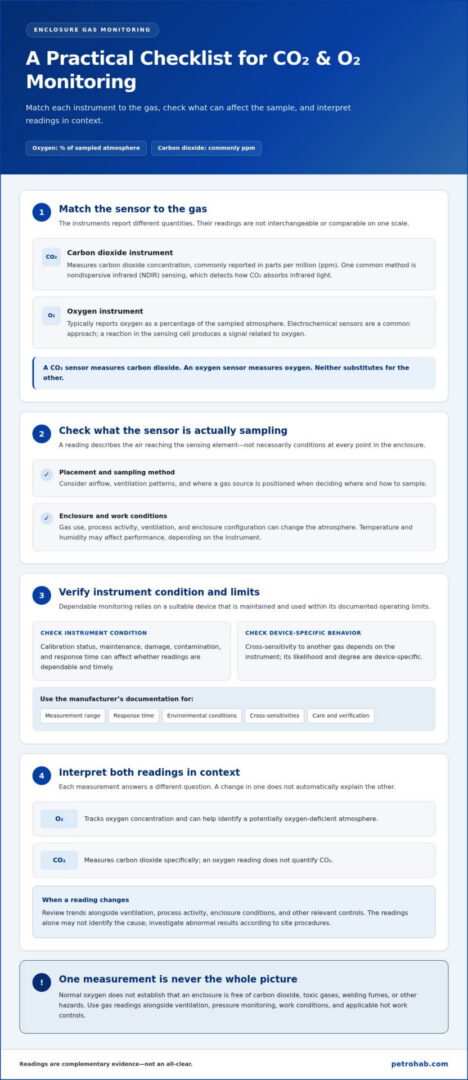
Oxygen sensors show the proportion of oxygen in the sampled atmosphere. Carbon dioxide sensors detect and measure CO2. The readings aren’t interchangeable, and a change in one doesn’t automatically explain the other. Welding gases and other inert gases, such as argon, can displace oxygen where they accumulate. Actual enclosure conditions depend on the work process, gas use, ventilation, and how the space is configured.
What an oxygen reading can and cannot tell you
An oxygen reading helps identify whether the atmosphere may be oxygen-deficient, a condition that can threaten personnel. Oxygen concentration also affects combustion behavior, so a reading can inform hot work controls. However, a normal oxygen reading doesn’t establish that the enclosure is free of carbon dioxide, toxic gases, welding fumes, or other hazards. Treat it as one measurement, not an all-clear for the atmosphere.
Why carbon dioxide deserves separate attention
Elevated CO2 presents a distinct gas hazard and requires its own measurement. An oxygen reading doesn’t quantify carbon dioxide concentration. Oxygen may appear within an expected range even when a CO2 reading needs investigation. If CO2 is used in a welding process or may enter the enclosure because of site conditions, include that possibility in the hazard assessment. Verify the gases used and potential sources for the specific work rather than assuming every enclosure has the same atmosphere.
Interpret both readings in context. A shift may reflect changes in ventilation, process activity, or gas entering the enclosure, but the readings alone may not identify the cause. Review trends alongside work conditions and other relevant controls, then investigate abnormal results according to site procedures. This distinction is central to practical monitoring: oxygen monitoring assesses the available oxygen, while carbon dioxide detection measures CO2 specifically. Together, the readings provide complementary evidence, not proof that every atmospheric or hot work hazard is controlled.
How CO2 and O2 Sensors Measure Enclosure Atmospheres
CO2 and O2 level monitoring in welding enclosures depends on instruments designed to measure specific gases. A CO2 instrument reports carbon dioxide concentration, commonly in parts per million (ppm), while an oxygen instrument typically reports oxygen as a percentage of the sampled atmosphere. These figures describe different quantities, so they can’t be compared as if they were readings on one scale.
How CO2 detection differs from oxygen measurement
One common method for measuring CO2 is nondispersive infrared (NDIR) sensing. The instrument detects how carbon dioxide absorbs infrared light and uses that response to estimate its concentration. Electrochemical sensors are a common approach for oxygen measurement: a chemical reaction within the sensing cell produces a signal related to oxygen in the sample. These are established methods, not specifications for every instrument. Design, measurement range, output, and performance vary by device.
A CO2 sensor measures carbon dioxide; an oxygen sensor measures oxygen, and neither can substitute for the other. Choose a device based on the gas it needs to detect. OSHA describes welding-related health and safety hazards, including hazards from fumes and gases, underscoring why instrument selection should reflect the work and atmospheric risks being assessed.
What can affect readings in a welding enclosure
A reading reflects the air reaching the sensing element, not necessarily conditions at every location in the enclosure. Sensor placement and sampling method matter: airflow, ventilation patterns, and the position of a gas source can affect what a sensor detects. Depending on the instrument’s design and operating limits, temperature and humidity may also affect performance.
Sensor condition matters too. Calibration status, maintenance, damage, contamination, and response time can affect whether readings are dependable and timely. Cross-sensitivity is instrument-specific: another gas may affect a sensor’s response, but the likelihood and degree depend on the device. Review the manufacturer’s documentation for measurement range, response time, environmental operating conditions, cross-sensitivities, care, and verification procedures.
For practical instrument selection, match each device to the target gas and expected enclosure conditions. Use its documented limits to guide placement and operation. PetroHab’s pressurized welding enclosures form part of an enclosure-level hot work control approach. Consider gas measurements alongside other relevant controls, not as a complete assessment on their own.
How to Interpret CO2 and O2 Readings Together
Paired readings provide separate evidence about enclosure conditions. Oxygen data tracks oxygen concentration; CO2 data tracks carbon dioxide. A change in one measurement may occur without a corresponding change in the other, so interpret each value according to the gas it measures. CO2 and O2 level monitoring in welding enclosures is most useful when readings are reviewed with trends and work conditions, not treated as a single pass-or-fail signal.
What changing readings may indicate
A rising or falling value is a signal to review conditions under the site monitoring procedure, not a diagnosis. Compare the change with the work timeline and nearby observations. Depending on the job, checks may include ventilation, work activity, and gas supply conditions. Confirm that the instrument is functioning and assess the readings using the site’s defined response process. Don’t assume a particular cause from a single value or trend.
Why readings need operational context
Interpret gas measurements alongside enclosure pressure, airflow, work scope, and surrounding conditions. A sensor reports a measured concentration at its point of detection; it doesn’t authorize hot work to continue. Decisions about work belong within applicable site procedures and the broader control system, including evaluation of abnormal readings and other relevant hazards.
For example, if a trend changes while work activity or ventilation also changes, record those conditions and investigate according to procedure rather than attributing the reading to one factor without evidence. This disciplined review makes readings more useful for operational decisions while preserving their limits. For more on how enclosure design fits into hot work controls, see this guide to pressurized welding habitats.
How to Build a Practical Enclosure Gas Monitoring Plan
A practical plan connects each measurement to a hazard, a location, and a response. For CO2 and O2 level monitoring in welding enclosures, establish the process before hot work begins and maintain it as conditions change. Use this sequence to structure the site plan:
- Identify hazards. Review the work scope, gases used or potentially present, enclosure design, ventilation, and surrounding conditions. Determine which gases need monitoring and whether other atmospheric hazards require separate controls.
- Select suitable instruments. Match each instrument to the target gas, required measurement range, operating environment, and sampling method. Use manufacturer documentation to understand its response time, limitations, and environmental operating conditions.
- Determine sensor locations. Base placement on enclosure layout, airflow, work activity, and the hazard assessment. Personal monitoring, fixed area monitoring, or sampled measurements may suit different needs. There is no universal configuration for every job.
- Verify instrument function. Follow manufacturer instructions and site procedures for calibration, functional checks, maintenance, and any required pre-use verification. A reading is useful only if the instrument is operating as intended.
- Define actions and responsibilities. Document who reviews readings, responds to alarms, communicates changing conditions, and records follow-up actions.
Set checks, alarms, and response responsibilities
Set alarm levels using applicable site procedures, instrument manufacturer guidance, and current requirements for the work location. Don’t assume one threshold applies to every enclosure or jurisdiction. Define what happens when an alarm activates, including how workers are notified and who has authority to direct the next steps.
An alarm is effective only when it triggers a defined response. Site procedures should specify when work stops after an alarm condition and explain how personnel follow the response process before work resumes. Acknowledging an alarm does not resolve its cause.
Keep routine instrument checks and monitoring records consistent with site procedures. Record relevant readings, instrument status, alarms, and actions taken. At shift handover, communicate current conditions, unresolved alarms, equipment issues, and changes to the work scope or controls. Clear responsibility helps prevent gaps between crews.
Gas monitoring works best as part of an enclosure-level control strategy. PetroHab’s Safe-Stop Automatic Shutdown System monitors gas levels and pressure, while its pressurized welding enclosures provide the broader hot work setting. Explore PetroHab’s hot work safety solutions to learn about these enclosure and shutdown capabilities.
Connect Gas Monitoring to Hot Work Enclosure Controls
Gas readings are one input in a broader hot work safety strategy. CO2 and O2 level monitoring in welding enclosures helps assess selected aspects of the atmosphere, but it doesn’t establish enclosure pressure, confirm that every hazard is controlled, or replace site procedures for authorizing work. Each control addresses a different condition and should be interpreted within the full operating plan.
How monitoring fits with pressure and shutdown controls
Gas monitoring measures concentrations of specific gases at the sensor or sampling point. Pressure monitoring measures enclosure pressure conditions. The measurements serve distinct purposes: an acceptable gas reading does not establish that pressure is within the required operating conditions, and a pressure reading does not reveal the concentration of CO2 or oxygen.
PetroHab’s Hot Work Safety Enclosures provide an enclosure-level setting for hot work, while the Safe-Stop Automatic Shutdown System monitors gas levels and pressure. Keep the distinction clear when developing controls. Don’t assume a particular CO2 or O2 sensor channel, threshold, or system response unless specified for the equipment and project. Define how monitoring information fits with alarms, work stoppage, communications, and site authorization procedures.
Apply the principles to a project-specific enclosure plan
Build the plan around the actual work, not a generic sensor layout. Start with the work scope and hazard assessment. Identify which gases and other conditions require attention, then select instruments suited to those targets and the enclosure environment. Determine monitoring locations using enclosure design, airflow, work activity, and potential gas ingress. Document how readings will be reviewed, who responds to alarms, and what steps are required before work can proceed after an abnormal condition.
Keep controls coordinated as conditions change. A change in work scope, ventilation, gas supply, or enclosure configuration may require the team to reassess monitoring arrangements under site procedures. Record instrument checks, relevant readings, alarms, and actions, and carry unresolved issues through shift handover. This connects the monitoring plan to the enclosure’s operating status rather than treating sensor data as a standalone decision.
For additional guidance on enclosure design and hot work controls, read the hot work safety enclosure guide. To explore PetroHab’s enclosure options for project planning, explore PetroHab enclosure solutions.
Build Monitoring Into Every Hot Work Plan
Effective CO2 and O2 level monitoring in welding enclosures starts with understanding what each reading measures. Oxygen and carbon dioxide provide distinct information, so interpret them alongside trends, ventilation, work activity, and other enclosure conditions. Neither reading alone establishes that every atmospheric hazard is controlled.
A dependable monitoring plan also defines instrument selection and placement, routine checks, alarm settings based on applicable procedures and manufacturer guidance, and clear response responsibilities. Gas and pressure measurements address different conditions, so include both within the wider hot work control strategy.
PetroHab manufactures, leases, and sells modular Hot Work Safety Enclosures built with patented Quadra-Lock technology. Its Safe-Stop Automatic Shutdown System monitors gas levels and pressure as part of its shutdown function. These capabilities support a coordinated enclosure approach alongside project-specific hazard assessments and site procedures.
Explore PetroHab hot work enclosure solutions to see how enclosure and shutdown capabilities can fit into your planning. Clear monitoring roles and defined responses help teams approach hot work with greater confidence.
Frequently Asked Questions
Why monitor both CO2 and O2 inside a welding enclosure?
Monitor both because they measure different gases and reveal different aspects of the enclosure atmosphere. An oxygen instrument reports oxygen concentration, while a CO2 instrument measures carbon dioxide concentration. One reading can’t stand in for the other or establish that all atmospheric hazards are controlled. Reviewing both readings with ventilation, work activity, and other site conditions gives personnel a more complete basis for following hot work procedures and investigating changes.
Can an oxygen monitor detect elevated carbon dioxide?
No. An oxygen monitor measures oxygen, not carbon dioxide, and it doesn’t quantify CO2 concentration. Oxygen levels may change when gases displace air, but that reading alone cannot identify which gas is present or how much CO2 is in the atmosphere. Use an instrument intended to measure each target gas identified by the hazard assessment, and interpret its output according to the manufacturer’s instructions and site procedures.
How should gas monitors be positioned in a welding enclosure?
Determine placement from the enclosure design, airflow, work activity, and project hazard assessment. A sensor should measure conditions relevant to the people and work being protected, but one location may not represent the entire enclosure. Personal, fixed area, or sampled monitoring may suit different tasks. Follow the instrument manufacturer’s placement and sampling guidance, and reassess locations if the work scope, ventilation, or enclosure configuration changes.
What happens if a CO2 or O2 alarm activates during hot work?
Follow the site’s alarm response procedure immediately. The procedure should define how work is stopped, how personnel are notified, who assesses the condition, and what controls are needed before work resumes. Don’t treat alarm acknowledgment as resolution. Record the alarm and actions taken, and investigate the reading in context, including instrument status and relevant changes in work or ventilation. The response must follow applicable site procedures and requirements.
How often should welding enclosure gas monitors be checked or calibrated?
Use the inspection, calibration, and functional-check intervals specified by the instrument manufacturer and site procedures. Requirements can vary by device, use, and operating conditions, so there isn’t one interval that applies to every monitor. Before relying on readings, complete the checks required for the instrument and confirm it’s operating as intended. Keep records of checks, calibration, maintenance, and faults, and communicate unresolved issues during shift handover.
Does a normal oxygen reading mean the enclosure atmosphere is safe?
No. A normal oxygen reading only describes the oxygen measurement at the sensor or sampling point. It doesn’t rule out elevated CO2, other hazardous gases, welding fumes, or changing conditions elsewhere in the enclosure. Treat oxygen data as one part of the atmospheric assessment, alongside other gas measurements and hot work controls required by the site procedure. Don’t use a single reading as authorization to continue work.
How do gas readings relate to pressure monitoring in a pressurized habitat?
Gas readings and pressure measurements monitor different conditions. Gas instruments measure the concentration of their target gases; pressure monitoring tracks enclosure pressure. One doesn’t prove the other is within its required operating conditions. PetroHab’s Safe-Stop Automatic Shutdown System monitors gas levels and pressure as part of its automatic shutdown function. Use readings and system indications alongside project procedures, without assuming a specific CO2 or O2 sensor channel unless specified for the equipment.