
Blog Posts
Engineered Habitat vs. Traditional Scaffold and Tarp: A Technical Safety Comparison
Is a traditional scaffold and tarp enclosure sufficient for hot work in a Zone 1 or Zone 2 environment? Most safety engineers rely on these passive setups for basic weather protection, yet they often fail to address the critical risks of ignition in hazardous zones. When comparing an engineered habitat vs traditional scaffold and tarp enclosure, the primary distinction lies in active versus passive protection. A simple tarp cannot maintain the positive pressure required to prevent flammable gases from reaching a spark source, leaving your facility vulnerable to catastrophic incidents and regulatory penalties.
You know that a single safety breach can result in massive downtime and OSHA penalties reaching $161,323 for willful violations. This article explains how engineered habitats surpass traditional methods by providing reliable containment of sparks and heat. We’ll analyze the technical superiority of Petro-Habitats, focusing on the structural integrity of Quadra-Lock panels and the integration of the Safe-Stop automatic shutdown system. By the end, you’ll understand how to achieve full compliance with ATEX, NFPA 51B 2024, and April 2026 OSHA standards while ensuring zero-incident hot work performance.
Key Takeaways
- Identify the critical distinctions between active pressurized systems and passive fire-retardant sheeting to ensure proper equipment selection for hazardous zones.
- Understand why the technical comparison of an engineered habitat vs traditional scaffold and tarp enclosure centers on the ability to maintain a consistent positive pressure of 0.1 to 0.5 inches of water column.
- Evaluate the structural superiority of interlocking Quadra-Lock panels over traditional tarp grommets to eliminate thousands of potential gas leak points in your enclosure.
- Determine the specific international certifications, including ATEX and IECEx, required to satisfy NFPA 51B standards and mitigate risk in explosive atmospheres.
- Discover how modular Petro-Habitats optimize operational ROI by allowing critical hot work to continue safely during live production cycles.
Defining the Standards: Engineered Habitats vs. Traditional Enclosures
Safety professionals must recognize that not all containment systems are created equal. In heavy industry, the distinction between an engineered habitat vs traditional scaffold and tarp setup is the difference between active risk management and passive weather shielding. While traditional enclosures rely on scaffolding frames draped with fire-retardant (FR) tarps, they lack the technological infrastructure to manage explosive atmosphere risks. These systems are often sufficient for shielding personnel from rain or wind, but they’re fundamentally incapable of preventing gas ingress in a Zone 1 or Zone 2 environment.
An engineered habitat is a complex, pressurized system designed to isolate ignition sources from flammable gases. It provides a controlled, monitored internal environment that traditional sheeting simply cannot replicate. Safety managers must distinguish between simple weather containment and technical explosive atmosphere isolation to maintain site integrity. Relying on passive barriers for hot work in hazardous zones introduces unacceptable levels of risk to personnel and high-value assets.
To better understand the differences between engineered systems and traditional framing methods, watch this helpful comparison:
The Role of the Hot Work Safety Enclosure (HWSE)
Industry standards increasingly favor standardized hot work safety enclosures (HWSE). An HWSE is defined as a modular, fire-resistant, and pressurized workspace. Unlike a simple tarp wrap, these enclosures are built from specialized materials like Quadra-Lock panels that ensure structural integrity. Their primary function is two-fold. They prevent spark egress from the work area while simultaneously blocking flammable vapors from entering. This dual-action protection is essential for high-risk operations on offshore platforms and refineries where gas leaks are a constant threat. The modular nature of these systems allows for rapid deployment without sacrificing the stringent seals required for pressure maintenance.
Passive vs. Active Protection Systems
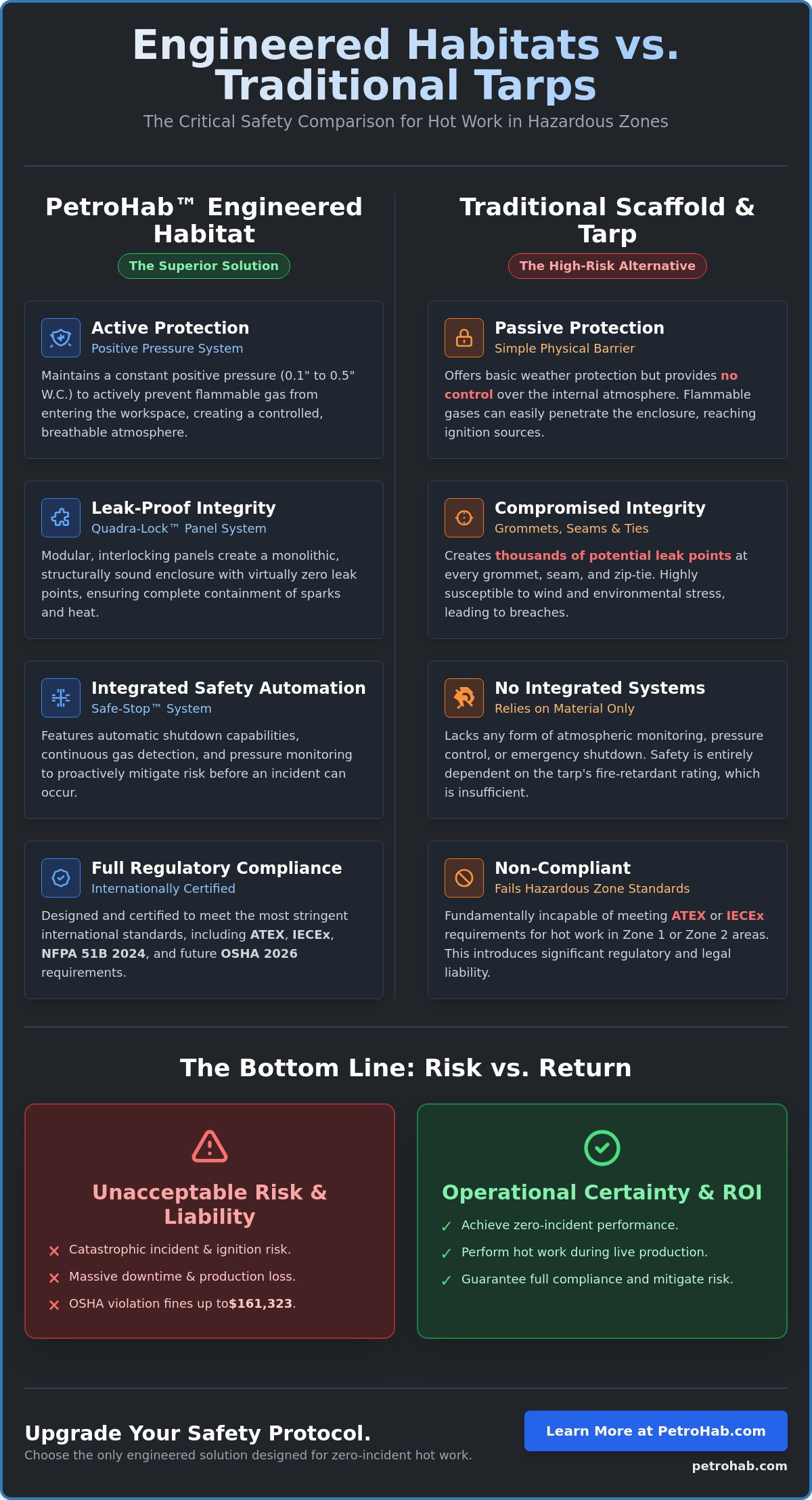
The technical gap between these methods is most evident when comparing passive and active protection. Passive systems, such as traditional tarps, only provide a physical barrier. They suffer from high leakage rates at seams, grommets, and zip-tie points. In contrast, an engineered habitat is an active system. It functions as a positive pressure enclosure that utilizes manometers and high-capacity fans to maintain a higher pressure inside the unit than the surrounding atmosphere. This ensures that any breach results in air flowing out rather than hazardous gas flowing in. Simple flame-retardant ratings are insufficient for high-risk petrochemical environments. You need the active monitoring and pressure control found in Petro-Habitats to ensure zero-incident performance and full compliance with international safety mandates.
The Technical Gap: Positive Pressure and Gas Detection
The technical divide between an engineered habitat vs traditional scaffold and tarp system is defined by atmospheric control. While tarps act as a basic physical barrier, they cannot regulate the environment within the enclosure. Engineered habitats operate as active safety systems. They don’t just shield; they repel. By maintaining a constant internal pressure, these systems ensure that hazardous vapors are physically blocked from entering the workspace where hot work occurs.
Standard scaffolding must meet the structural requirements of the OSHA Scaffolding Standard 1926.451. However, this standard focuses on load-bearing capacity and fall protection, not gas containment. Traditional tarps cannot maintain the 0.1 to 0.5 inches of water column pressure required for hazardous zone safety. If a seal is breached in a pressurized habitat, the internal pressure forces air outward. This prevents flammable vapors from entering the enclosure, a fail-safe mechanism that passive tarp setups lack entirely.
Maintaining Atmospheric Integrity
Effective risk mitigation requires maintaining positive pressure through a continuous supply of clean air. This air must be sourced from a verified non-hazardous area, often located a significant distance from the work site. Traditional scaffold and tarp setups frequently suffer from “dead air” pockets. These areas allow hazardous gases to accumulate unnoticed, creating a high risk of ignition. Pressurized habitats eliminate these pockets through constant air exchange and flow management, ensuring the atmosphere remains breathable and non-explosive.
Automatic Shutdown Integration (ASD)
The integration of gas detection systems represents the most significant safety advancement over traditional methods. Systems like the Safe-Stop Automatic Shutdown System monitor the intake air for Lower Explosive Limit (LEL) levels in real-time. If gas is detected or if internal pressure falls below safety thresholds, the system immediately cuts power to welding machines and closes gas valves. Manual monitoring in tarp enclosures cannot match this speed. Human error and slow response times are major contributors to maintenance-related accidents. In fact, inadequate gas monitoring and isolation failures account for 30% of refinery fires during maintenance operations. Implementing a PetroHab Hot Work Safety Enclosure ensures these technical gaps are closed before work begins.
Structural Integrity: Quadra-Lock vs. Tarp Grommets
The structural reliability of an enclosure determines its effectiveness as a safety barrier. When evaluating an engineered habitat vs traditional scaffold and tarp system, the method of attachment is a critical point of failure. Traditional enclosures rely on fire-retardant (FR) tarps secured by grommets and plastic zip-ties. These attachment points are inherent weaknesses. Over time, tension and environmental stress cause grommets to tear, creating thousands of potential leak points that compromise atmospheric control. In contrast, engineered habitats utilize specialized panels designed for technical containment rather than simple coverage.
Engineered panels provide significantly higher resistance to high-temperature slag and grinding sparks. While FR tarps are designed to resist ignition, they often degrade or melt when subjected to continuous hot work debris. The modularity of a Petro-Habitat allows for rapid reconfiguration around complex piping manifolds. This flexibility ensures a tight seal is maintained even in congested industrial environments, a task that is nearly impossible to achieve with the bulky, overlapping folds of traditional sheeting.
The Quadra-Lock Advantage
The Quadra-Lock system replaces unreliable manual sealing methods with a patented interlocking mechanism. These panels snap together to create a near-hermetic seal across the entire surface of the enclosure. This eliminates the need for flammable adhesives, duct tape, or specialized glues that often fail in high-humidity or oily environments. From a durability perspective, these engineered panels are built for heavy-duty, repeated use. While traditional tarps are often treated as single-use items due to contamination or mechanical damage, Quadra-Lock panels maintain their structural integrity across multiple deployment cycles, ensuring consistent protection for your personnel and assets.
Wind Loads and Environmental Stability
Environmental forces present a major challenge for temporary enclosures, particularly on offshore platforms. Traditional scaffold wraps often suffer from the “sail effect.” High winds catch the broad surface area of the tarps, exerting massive lateral pressure on the underlying scaffold structure. This can lead to structural collapse or the tearing away of the containment material. According to OSHA safety standards for scaffold tarps, a competent person must evaluate how these wind loads affect the scaffold’s stability. Engineered habitats are designed to manage these forces. Their rigid panel construction and secure mounting systems allow them to withstand external wind forces while simultaneously maintaining the internal positive pressure required for safety. This stability is essential for live production environments where weather conditions can change rapidly without warning.
Compliance and Risk Mitigation Standards
Compliance isn’t a suggestion; it’s a mandate in high-stakes industrial environments. When choosing between an engineered habitat vs traditional scaffold and tarp enclosure, safety managers must evaluate the regulatory framework governing hazardous zones. Traditional tarps often fail to meet the rigorous documentation and performance requirements for Zone 1 and Zone 2 areas. NFPA 51B (2024 Edition) dictates strict fire prevention protocols during hot work, emphasizing the need for reliable containment. Engineered habitats are designed to satisfy these requirements through verifiable pressure logs and automated gas detection systems that provide a clear audit trail.
Auditors look for systems that provide active protection, which is the core differentiator when analyzing an engineered habitat vs traditional scaffold and tarp solution. Passive barriers can’t provide the real-time data needed to prove that a workspace remained non-explosive throughout a shift. By utilizing a technical remedy that integrates pressure monitoring and gas sensing, you move beyond “best efforts” into the realm of quantified risk mitigation.
Meeting Global Safety Benchmarks
Safety professionals must prioritize hazardous environment standards to maintain operational licenses and protect personnel. For explosive atmospheres, equipment must carry ATEX Directive 2014/34/EU or IECEx certifications, such as those defined in IEC 60079-13:2017. Traditional scaffold setups with FR tarps lack these system-wide certifications. Engineered habitats provide the necessary traceability for safety audits and simplify the Permit-to-Work (PTW) process. They deliver a pre-certified, controlled environment that reduces the administrative burden on safety officers. This ensures that every hot work session begins with a verified safety baseline, removing the guesswork associated with manual tarp installations.
Liability and Insurance Considerations
Using non-certified or “home-made” enclosures creates significant legal and financial exposure. In the event of an ignition incident, insurance providers may deny claims if the containment system didn’t meet international standards. Certified HWSE systems act as a hedge against this liability. They often lead to lower insurance premiums for high-risk projects because they represent a documented reduction in risk. This shift from manual to automated monitoring also reduces the “Fire Watch” burden. Automated systems provide a level of vigilance that human observers cannot maintain consistently. You can find detailed strategies for incident prevention in our advanced hot work safety systems guide. This technological transition ensures that your facility remains compliant while protecting high-value assets from the consequences of ignition breaches.
Protect your facility and ensure full regulatory compliance by choosing a PetroHab Hot Work Safety Enclosure for your next maintenance cycle.
Operational ROI: Why Engineered Habitats Cost Less in the Long Run
The financial logic behind choosing an engineered habitat vs traditional scaffold and tarp system extends far beyond the initial procurement cost. While traditional tarping appears cheaper on a line-item budget, it represents a significant drain on operational efficiency. Manual “wrapping” of a scaffold is a labor-intensive process that offers no predictable timeline or guaranteed seal. In contrast, modular engineered systems provide a standardized, repeatable setup process that drastically reduces the man-hours required for mobilization. When you calculate the total cost of ownership, the technical reliability of a Petro-Habitat provides a superior return on investment by eliminating the hidden costs of safety failures and production delays.
Asset protection is another critical factor in the ROI equation. Traditional FR tarps are prone to melting or thermal degradation when exposed to sustained slag and grinding sparks. This failure puts surrounding sensitive electronics and high-pressure piping at risk. An engineered habitat acts as a durable shield, ensuring that hot work debris is contained within a controlled environment. By preventing damage to high-value equipment, these systems avoid the secondary costs associated with unplanned repairs and component replacements during a turnaround.
Maximizing Production during Turnarounds
The most significant economic advantage of pressurized habitats is the ability to conduct simultaneous operations (SIMOPS). Traditional tarp enclosures often require the shutdown of entire plant sections because they cannot guarantee the isolation of ignition sources. This downtime can cost a facility millions in lost production every day. Because a Petro-Habitat maintains a verified positive pressure, hot work can continue safely while live production occurs in adjacent zones. The interlocking Quadra-Lock panels also create a smaller, more efficient footprint than bulky scaffold wraps. This improved site access allows multiple maintenance teams to work in parallel, shortening the overall duration of the turnaround and returning the facility to full capacity sooner.
The Final Verdict: Safety as a Strategic Investment
Choosing between an engineered habitat vs traditional scaffold and tarp setup is a strategic decision that impacts the long-term resilience of your facility. The “Zero-Incident” economy is built on the prevention of catastrophic events. While the maximum OSHA penalty for a willful violation is $161,323, the actual cost of a refinery fire or explosion is immeasurable in terms of asset loss and reputation damage. Investing in active safety technology is the only way to reliably mitigate these risks. For procurement teams, identifying professional hot work safety enclosure suppliers is the first step toward achieving operational excellence. High-stakes environments demand high-performance tools. Select the technology that actively guards your personnel and your bottom line.
Ensure your next project meets the highest standards of technical safety. Contact us to deploy a PetroHab Hot Work Safety Enclosure and secure your site today.
Securing Operational Integrity in Hazardous Environments
Industrial safety requires a definitive shift from passive containment to active, engineered systems. When evaluating an engineered habitat vs traditional scaffold and tarp setup, the technical superiority of pressurized protection is undeniable. You’ve learned how positive pressure management and real-time gas monitoring eliminate the vulnerabilities inherent in manual tarping and zip-tie seals. By implementing patented Quadra-Lock™ Technology and ATEX and IECEx Certified Systems, you ensure full compliance with international standards while protecting your facility from catastrophic ignition events.
PetroHab remains a committed partner in your risk mitigation strategy, providing global support and on-site supervision to maintain operational excellence. We understand the granular details of industrial hazards and provide the rigorous, uncompromising expertise needed for high-stakes turnarounds. Don’t leave your site’s safety to chance with unmonitored barriers. Secure your high-value assets and personnel with a proven technological remedy designed for the most demanding environments.
Request a Technical Consultation for Your Next Hot Work Project
Frequently Asked Questions
Can traditional fire-retardant tarps be used for pressurized habitats?
Traditional fire-retardant tarps cannot be used to create a pressurized habitat because they lack the structural rigidity and airtight integrity required for pressure maintenance. These materials are designed for passive spark deflection rather than gas containment. When comparing an engineered habitat vs traditional scaffold and tarp system, the tarp’s grommets and overlapping seams allow for excessive air leakage. This prevents the system from reaching the necessary 0.05 inches of water column pressure required to repel hazardous vapors.
What are the main risks of using scaffold and tarp for hot work in Zone 1?
The primary risks include the ingress of flammable gases and the egress of high-temperature sparks, which can lead to catastrophic ignition. Because traditional enclosures are passive barriers, they don’t provide real-time atmospheric monitoring or automated shutdown capabilities. This vulnerability is significant; inadequate gas monitoring and isolation failures contribute to 30% of refinery fires during maintenance. Additionally, using these setups in Zone 1 environments often leads to regulatory non-compliance during safety audits.
How does an engineered habitat maintain positive pressure differently than a tarp enclosure?
An engineered habitat maintains positive pressure through an active system of high-capacity fans and manometers that continuously pump clean air into the workspace. This creates a pressure differential where internal air is always forced outward through any minor openings. Traditional tarp enclosures are passive and cannot hold pressure. If a seal is breached in a pressurized Petro-Habitat, the outward airflow prevents hazardous gases from entering, whereas a tarp enclosure would allow gas to drift inside freely.
Is an automatic shutdown system required for all engineered habitats?
An automatic shutdown system (ASD) like Safe-Stop is a critical technical requirement for managing risk in explosive atmospheres. While the enclosure provides the physical barrier, the ASD acts as the fail-safe by monitoring Lower Explosive Limit (LEL) levels in the air intake. If gas is detected or pressure is lost, the system immediately terminates power to all hot work equipment. Relying on manual monitoring in an engineered habitat vs traditional scaffold and tarp comparison introduces human error that automated systems effectively eliminate.
What is the lifespan of a Quadra-Lock panel compared to a standard FR tarp?
Quadra-Lock panels are durable, multi-use assets designed for hundreds of deployment cycles in harsh industrial environments. They resist thermal degradation from slag and grinding sparks far better than fabric-based barriers. Standard FR tarps are frequently treated as single-use items because they melt, tear, or become contaminated with hydrocarbons during a single project. The interlocking technology of Quadra-Lock ensures the panels maintain their sealing capability long after a traditional tarp would have failed structurally.
Do engineered habitats require specialized training for installation?
Installation of a pressurized Petro-Habitat requires a competent person trained in pressure containment and gas detection protocols. This ensures that the enclosure is correctly sealed and that the Safe-Stop system is properly calibrated to the local environment. Unlike the general labor used to wrap scaffolding in plastic, habitat technicians must understand the technical requirements of IEC 60079-13:2017. This specialized oversight ensures the system functions as an active safety guardian throughout the duration of the hot work.
How do engineered habitats handle wind loads on offshore platforms?
Engineered habitats utilize rigid panel construction and secure mounting hardware to resist the lateral forces of high winds. This engineering prevents the “sail effect” often seen with traditional scaffold tarps, which can destabilize the underlying structure during offshore storms. By maintaining structural stability, the habitat ensures that the internal pressure seal remains intact even when external environmental conditions are severe. This reliability is essential for maintaining SIMOPS on live production platforms.
Which international standards govern the use of hot work safety enclosures?
The primary standards include IEC 60079-13:2017 for pressurized room design and the ATEX Directive 2014/34/EU for equipment used in explosive atmospheres. In North America, operations must comply with NFPA 51B (2024 Edition) and the latest April 2026 OSHA standards for hot work safety. Following these benchmarks ensures that your facility meets global compliance requirements and mitigates the risk of willful violations, which can carry penalties of $161,323 per occurrence.