Blog Posts
IECEx Requirements for Pressurized Habitats: The 2026 Technical Compliance Guide
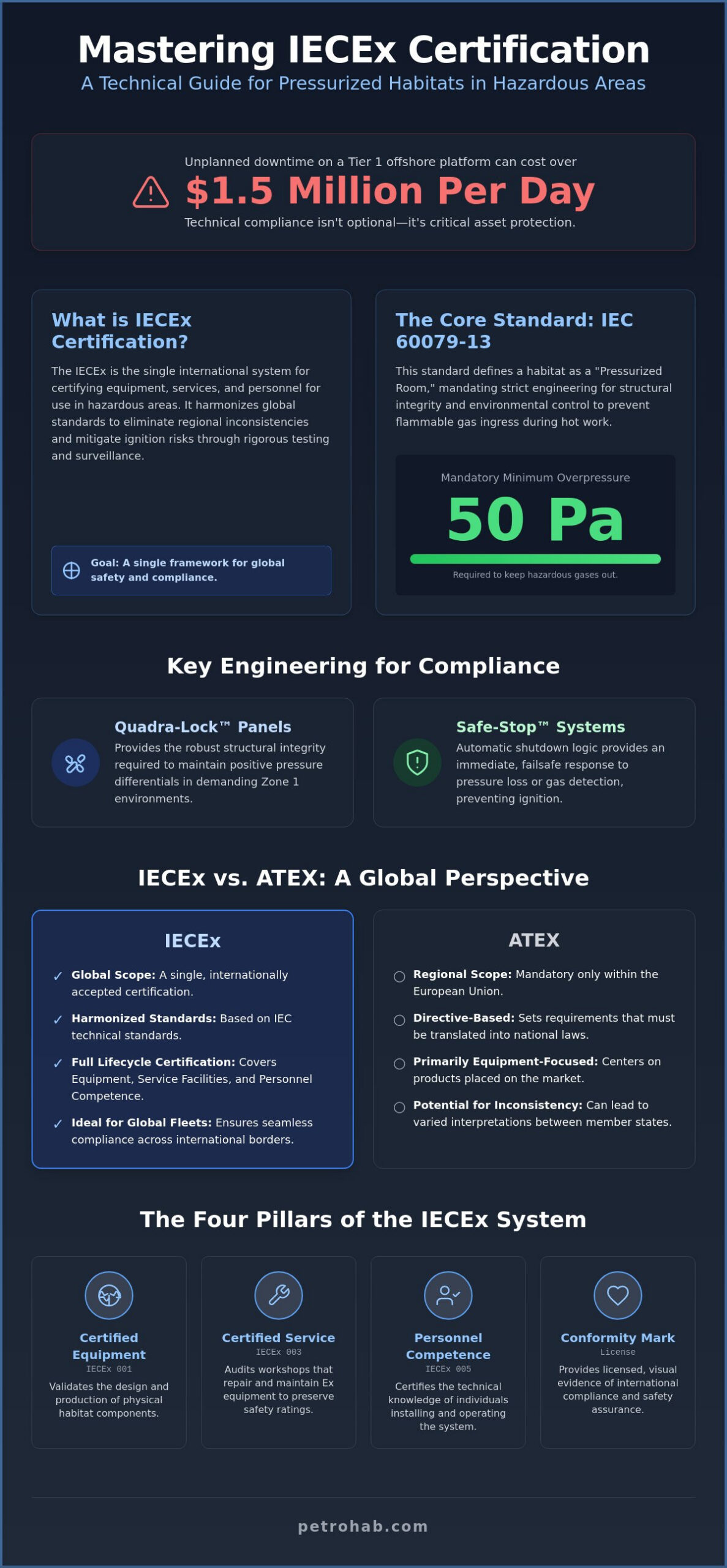
A single day of unplanned production downtime on a Tier 1 offshore platform can result in over $1.5 million in lost revenue. For safety managers and engineers, these high stakes mean that technical compliance is not a mere administrative hurdle, but a critical component of asset protection. You already know that any delay caused by non-compliant hardware or confusion over the latest iecex requirements for pressurized habitats can jeopardize both project timelines and personnel safety. The transition to prEN IEC 60079-13:2026 and the 6th Edition of the ATEX guidelines has created a complex regulatory environment that demands absolute precision in habitat engineering.
This guide provides a definitive framework for mastering the technical nuances of IECEx certification to ensure your pressurized habitats meet the highest global safety standards. We will analyze the 2026 updates to the IEC 60079-13 standard, focusing on how to harmonize international requirements for global fleets. You will learn how to verify habitat integrity through the use of Quadra-Lock interlocking panels and Safe-Stop automatic shutdown systems. This technical overview serves as a blueprint for reducing operational risk and maintaining the strict overpressure differentials required for hot work in hazardous areas.
Key Takeaways
- Define the strategic advantage of IECEx over regional ATEX frameworks to ensure seamless compliance for global offshore fleets.
- Differentiate between the Certified Equipment Scheme and the Certified Service Facilities Scheme to guarantee that both hardware and maintenance protocols meet international standards.
- Master the specific iecex requirements for pressurized habitats, including the technical execution of “Ex p” protection techniques and mandatory 50 Pa minimum overpressure levels.
- Evaluate how modular technologies like Quadra-Lock panels and Safe-Stop systems provide the engineering integrity required to maintain pressure in Zone 1 environments.
- Establish a rigorous verification framework to satisfy BSEE and other global regulatory bodies while significantly reducing the risk of ignition-related downtime.
What is IECEx Certification and Why is it Mandatory for Pressurized Habitats?
IECEx is the international framework for certifying equipment and services used in hazardous locations. Managed by the International Electrotechnical Commission, it harmonizes technical standards to eliminate the inconsistencies of regional regulations. Its primary objective is the mitigation of ignition risks through rigorous hardware testing and continuous manufacturing surveillance. For engineers and safety managers, understanding the specific iecex requirements for pressurized habitats is essential for any operator performing hot work in Zone 1 or Zone 2 areas. Without this certification, an enclosure is merely a physical barrier; with it, it becomes a high-integrity safety asset designed to contain potential ignition sources.
To better understand the practical implementation of these systems, watch this video illustrating a pressurized welding habitat in a brownfield environment:
The Legal and Operational Necessity of Certification
Regulatory bodies like the Bureau of Safety and Environmental Enforcement (BSEE) increasingly mandate adherence to international standards to prevent catastrophic incidents on offshore assets. Utilizing non-certified hot work safety enclosures in hydrocarbon-rich environments introduces unacceptable liability for facility owners. PetroHab LLC recognizes that certification is the only way to verify that equipment will perform as engineered under extreme conditions. Non-compliance often results in immediate work stoppages, legal penalties, and catastrophic financial loss. Certification provides the technical assurance that the hardware remains an active guardian of industrial sites, protecting both personnel and high-value infrastructure from the volatile conditions typical of the energy sector.
The IEC 60079-13 Standard: The Bible for Pressurized Rooms
The IEC 60079-13 standard is the definitive technical reference for pressurized rooms. It classifies a habitat not just as a temporary shelter, but as a sophisticated “pressurized room” that must maintain specific environmental parameters. This framework dictates strict iecex requirements for pressurized habitats regarding structural integrity and gas ingress prevention. The standard ensures the enclosure can withstand the internal pressure differentials required to keep flammable gases out. By treating the habitat as a controlled room, the standard enforces a level of engineering discipline that traditional, non-certified welding tents cannot match. This includes mandatory logic for automatic shutdowns and real-time monitoring of the internal atmosphere to ensure an unwavering commitment to safety.
The Four Pillars of the IECEx System for Habitat Safety
The IECEx system operates as a comprehensive safety ecosystem, moving beyond simple equipment approvals to encompass the entire lifecycle of a habitat. It’s built upon four distinct pillars that provide a verifiable chain of custody for safety:
- Ex 001 (Certified Equipment): Validates the design and production of the physical habitat components.
- Ex 003 (Certified Service Facilities): Audits the workshops that repair and maintain Ex equipment to preserve original safety ratings.
- Ex 005 (Personnel Competence): Certifies the technical knowledge of the individuals installing and operating the system.
- Conformity Mark License: Provides visual, licensed evidence of international compliance for facility owners.
Adhering to iecex requirements for pressurized habitats requires more than just buying certified hardware; it demands that every touchpoint, from the technician to the maintenance shop, meets the same rigorous benchmarks. This holistic approach eliminates the weak links that often lead to hazardous area incidents.
Ex 001: Hardware Integrity and the CoC
Ex 001 focuses on the engineering and manufacturing of the hardware itself. Every component of a Hot Work Safety Enclosure must possess a Certificate of Conformity (CoC), which serves as the final proof of compliance. This certificate is the result of a successful Ex Test Report (ExTR), a document that records the laboratory performance of the equipment under stress. For modular systems, individual testing of components is critical. Quadra-Lock Panels are engineered and tested to ensure the interlocking seams maintain the necessary pressure differential. This modular integrity is what prevents gas ingress during high-energy hot work operations. If you’re auditing a fleet, always verify the CoC against the manufacturer’s technical claims to ensure the hardware is fit for purpose.
Ex 005: Ensuring Competence in the Field
While hardware provides the physical barrier, the Personnel Competence Scheme (Ex 005) ensures the human element doesn’t compromise the system. A technician’s ability to interpret hazardous area classifications and deploy logic-controlled shutdown systems is vital. Certified personnel undergo specialized training to handle the complexities of pressurized room setup. They’re trained to identify and rectify subtle leaks or sensor placement errors that could lead to an ignition event. Certified supervision isn’t a luxury; it’s a technical requirement for maintaining the safety envelope. Mastering the iecex requirements for pressurized habitats at the personnel level prevents common errors, such as improper panel alignment or failure to calibrate pressure sensors. This commitment to expert oversight is a hallmark of a professional safety partner in offshore environments.
IECEx vs. ATEX: Navigating Global Compliance for Offshore Projects
Understanding the distinction between ATEX and IECEx is fundamental for any global procurement strategy. ATEX refers to the mandatory European framework governed by Directive 2014/34/EU. It’s a legal requirement for any equipment sold or used in explosive atmospheres within the European Union. While ATEX is a regional mandate, IECEx is an international certification scheme recognized in most industrial jurisdictions worldwide. For safety managers, the choice isn’t always one or the other. Dual certification represents the gold standard, ensuring that hardware meets the technical rigors of both systems. Adherence to these hazardous environment standards directly influences procurement decisions, as it guarantees the equipment’s readiness for deployment across varied geographic assets.
The technical requirements under both schemes are largely harmonized, as they both rely on the IEC 60079 series of standards. However, the administrative pathways to compliance differ significantly. When evaluating iecex requirements for pressurized habitats, engineers must consider the specific demands of the project location. While a habitat might be ATEX-compliant for a North Sea operation, an offshore project in Australia or the Middle East will likely require an IECEx Certificate of Conformity. This global recognition makes IECEx the preferred choice for operators managing international fleets of pressurized welding enclosures.
Regional Acceptance and Export Requirements
Jurisdictions such as Australia, Malaysia, and the United Arab Emirates prioritize IECEx over regional standards. In these regions, major operators like ADNOC and Saudi Aramco often include IECEx as a non-negotiable project specification. For projects in the United States or Brazil, IECEx test reports (ExTRs) provide a streamlined path to obtaining local certifications from National Recognized Testing Laboratories (NRTLs) or INMETRO. IECEx serves as the universal technical passport for safety equipment, allowing hardware to move across international borders without redundant and costly testing. This efficiency reduces project lead times and ensures that safety hardware remains consistent across a global organization.
The Role of Notified Bodies vs. Certification Bodies
The administrative oversight of these certificates differs by framework. ATEX certificates are issued by “Notified Bodies” designated by EU member states. In contrast, IECEx certificates are issued by approved “Ex Certification Bodies” (ExCBs). Both systems require regular surveillance audits of the manufacturer’s quality management system to ensure ongoing compliance. One major advantage of the IECEx system is its centralized online database. Safety managers can instantly verify the validity of a certificate for their pressurized habitats by searching the IECEx website. This transparency eliminates the risk of using forged or expired documentation, providing a definitive layer of verification for iecex requirements for pressurized habitats. Regular audits ensure that technologies like Quadra-Lock panels continue to meet the precise interlocking standards required for environmental containment.
Engineering Requirements: Maintaining Positive Pressure and Ignition Control
The “Ex p” protection technique is the engineering foundation for operating within Zone 1 hazardous areas. It relies on maintaining a constant internal overpressure to prevent the ingress of flammable gases. According to iecex requirements for pressurized habitats, a minimum overpressure of 50 Pa (0.2 inches of water column) must be maintained relative to the external atmosphere. This requirement is not an arbitrary figure; it’s the calculated threshold for preventing gas molecules from diffusing against the airflow. This pressure differential ensures that any leak results in air moving from the interior to the exterior, effectively keeping explosive mixtures away from ignition sources.
Structural integrity is paramount. If a panel fails or a seam opens, the internal pressure drops, and the safety barrier is compromised. High-integrity automatic shutdown systems are then required to terminate all hot work activities immediately. Fire-resistant materials play a secondary but vital role here, ensuring that the enclosure maintains its shape and containment properties even if exposed to extreme heat or stray sparks during a welding operation.
Structural Integrity and the Quadra-Lock Advantage
Modular panels must withstand internal pressure without leaking. Traditional fastening methods, such as hook-and-loop, often fail to provide the airtight seal necessary for consistent pressurization. Quadra-Lock interlocking technology addresses this by creating a mechanical bond between panels. This patented design ensures the enclosure remains airtight under the high-pressure demands of offshore environments. The system resists salt spray and UV degradation, maintaining the structural rigidity needed to support the “Ex p” logic throughout the project’s duration.
Gas Detection and Fail-Safe Logic
Ignition control is maintained through environmental monitoring and fail-safe logic. Gas detectors must be IECEx certified for the specific zone and placed at both air intakes and within the habitat. When sensors detect gas at 10% LEL or pressure falls below 50 Pa, the system severs power to all ignition sources. Real-time manometers provide the digital data necessary to verify habitat health continuously. These protocols ensure compliance with all iecex requirements for pressurized habitats while protecting personnel and high-value assets. To ensure your site meets these benchmarks, you should consult with a certified HWSE engineer to review specific engineering specifications.
PetroHab LLC: Delivering Certified Excellence in Hazardous Area Safety
PetroHab LLC stands as a Houston-based veteran in the engineering and deployment of certified Hot Work Safety Enclosure technology. As a seasoned veteran of the energy sector, the company understands the granular details of industrial hazards better than anyone else. Meeting the technical iecex requirements for pressurized habitats is a complex undertaking that PetroHab LLC meets through a combination of patented hardware and automated shutdown logic. Every component’s designed to function within a broader mission to eliminate workplace accidents in Zone 1 and Zone 2 areas. This commitment to safety excellence’s anchored in the use of fire-resistant, high-quality materials that have undergone rigorous testing to international standards.
By prioritizing risk mitigation and the protection of high-value assets, PetroHab LLC instills absolute confidence in safety managers and engineers operating in high-stakes environments. This focus on durability ensures that the enclosure remains a resilient barrier against external hazards while maintaining the internal environment necessary for safe hot work.
The Precision of Quadra-Lock Interlocking
The structural integrity of a pressurized habitat depends entirely on the quality of its seams. Quadra-Lock panels represent the industry benchmark for modular integrity, eliminating the inherent weaknesses found in traditional fastening systems. While older designs rely on porous fasteners that permit air leakage, the patented Quadra-Lock technology utilizes a mechanical interlocking mechanism to create an airtight seal. This precision allows operators to maintain the mandatory 50 Pa pressure differential with greater reliability and less demand on air supply systems. The ease of assembly doesn’t compromise the “Ex p” seal; instead, it ensures that the habitat’s deployed correctly every time, even in the corrosive conditions of offshore platforms. PetroHab LLC ensures that these panels are tested to withstand the extreme temperatures associated with welding and grinding operations.
Safe-Stop: The Ultimate Compliance Tool
To fulfill the automated risk mitigation demands of IECEx, PetroHab LLC integrates the Safe-Stop automatic shutdown system into every habitat operation. This high-precision tool acts as the central logic controller, continuously monitoring multiple parameters including internal pressure and the presence of flammable gases. The Safe-Stop system provides a definitive fail-safe response. It severs power to all welding equipment and ignition sources the moment a safety threshold’s breached. This reliability’s critical for maintaining continuous compliance with iecex requirements for pressurized habitats. By automating the shutdown sequence, PetroHab LLC removes the risk of human error in emergency scenarios. Operators looking to enhance their safety protocols can explore various leasing and sales options for global projects, ensuring their fleets are equipped with the most durable and compliant technology available. This hardware’s supported by certified on-site supervision to guarantee that every installation maintains its engineering-led safety profile.
Advancing Operational Safety Through Technical Compliance
Technical compliance serves as the final safeguard for high-value assets in volatile environments. As industrial standards evolve, maintaining the rigorous iecex requirements for pressurized habitats becomes a strategic necessity for global operators. PetroHab LLC recognizes that this is not merely a box-ticking exercise, but a fundamental commitment to ignition prevention. By moving beyond temporary shelters to fully engineered pressurized rooms, organizations eliminate the technical vulnerabilities that lead to unplanned shutdowns and safety breaches.
PetroHab LLC delivers the technical precision required to uphold these international safety benchmarks. Through the deployment of patented Quadra-Lock interlocking panels and Safe-Stop automatic shutdown systems, we provide a verified technological remedy for hazardous area operations. This engineering-led approach is supported by a global network of certified service facilities, ensuring your equipment remains durable and compliant across every asset. We invite you to consult with a PetroHab LLC expert on IECEx-compliant habitat solutions to secure your next project. Protecting your personnel and high-value assets is a responsibility we meet with unwavering commitment.
Frequently Asked Questions
Is IECEx certification mandatory for offshore welding habitats in 2026?
IECEx certification is a mandatory project specification for major global operators like ADNOC and Saudi Aramco in 2026. While it remains a voluntary international scheme, it’s the primary benchmark for compliance in regions such as Australia, Southeast Asia, and the Middle East. Adhering to iecex requirements for pressurized habitats ensures that your equipment meets the highest global safety standards, reducing the risk of project delays or regulatory work stoppages on offshore assets.
How does IEC 60079-13 differ from standard ATEX requirements for habitats?
IEC 60079-13 is the specific technical standard governing the design and testing of pressurized rooms, while ATEX is a European legal directive. The standard provides the granular engineering requirements, such as overpressure levels and shutdown logic, that both ATEX and IECEx use for assessment. While ATEX focuses on European market access, IEC 60079-13 ensures the technical integrity of the habitat regardless of the administrative framework applied.
Can I use an ATEX certified habitat in a region that requires IECEx?
An ATEX certificate alone is typically insufficient in regions that prioritize the IECEx scheme. Jurisdictions like the UAE or Australia require an IECEx Certificate of Conformity to verify compliance with international safety protocols. However, because both systems utilize the same technical standards, a manufacturer can often use existing ATEX test data to streamline the process of obtaining the necessary IECEx documentation for global project deployment.
What is the role of a manometer in an IECEx certified pressurized habitat?
A manometer serves as the critical diagnostic tool for verifying the “Ex p” protection technique. It measures the pressure differential between the habitat interior and the external hazardous atmosphere to ensure it remains at or above the mandatory 50 Pa. This device is integrated into the Safe-Stop system, providing the real-time data necessary to trigger an automatic shutdown if the overpressure falls below the safety threshold required by international standards.
How often do IECEx certified components like Safe-Stop require re-certification?
Most IECEx certificates for equipment like the Safe-Stop system require renewal every 3 to 5 years. However, the manufacturer must undergo annual surveillance audits to maintain the validity of their Quality Assessment Report (QAR). These recurring evaluations ensure that the production processes and component quality continue to meet the rigorous iecex requirements for pressurized habitats, preventing safety degradation over the equipment’s operational lifespan.
Are the individual panels of a habitat, like Quadra-Lock, individually certified?
Individual components must be validated as part of the overall certified system. Quadra-Lock panels undergo specific testing for fire resistance and interlocking integrity to ensure they maintain the required airtight seal. Certification covers the materials and the mechanical interlocking design, confirming that the modular structure can withstand the internal pressures required for Zone 1 operations without leaking or compromising the safety of the enclosure.
What happens to the IECEx certification if I modify the habitat structure?
Any unauthorized modification to the certified habitat structure immediately voids the IECEx Certificate of Conformity. The certification is based on a specific, tested design documented in the Ex Test Report. If you alter the panels or the monitoring logic, the system no longer matches its certified blueprint. You must submit any structural changes to a recognized Certification Body for a new evaluation to preserve the habitat’s safety rating.
How can I verify a manufacturer’s IECEx Certificate of Conformity online?
You can verify any certificate through the centralized IECEx online database at the official IECEx website. This platform allows safety managers to search by certificate number, manufacturer name, or equipment type. The database provides instant access to the current status of the certificate, its technical scope, and the specific standards used for testing. This transparency is a fundamental pillar of the international certification scheme.