Blog Posts
Maintaining Positive Pressure: A Technical Guide for Hazardous Area Habitats
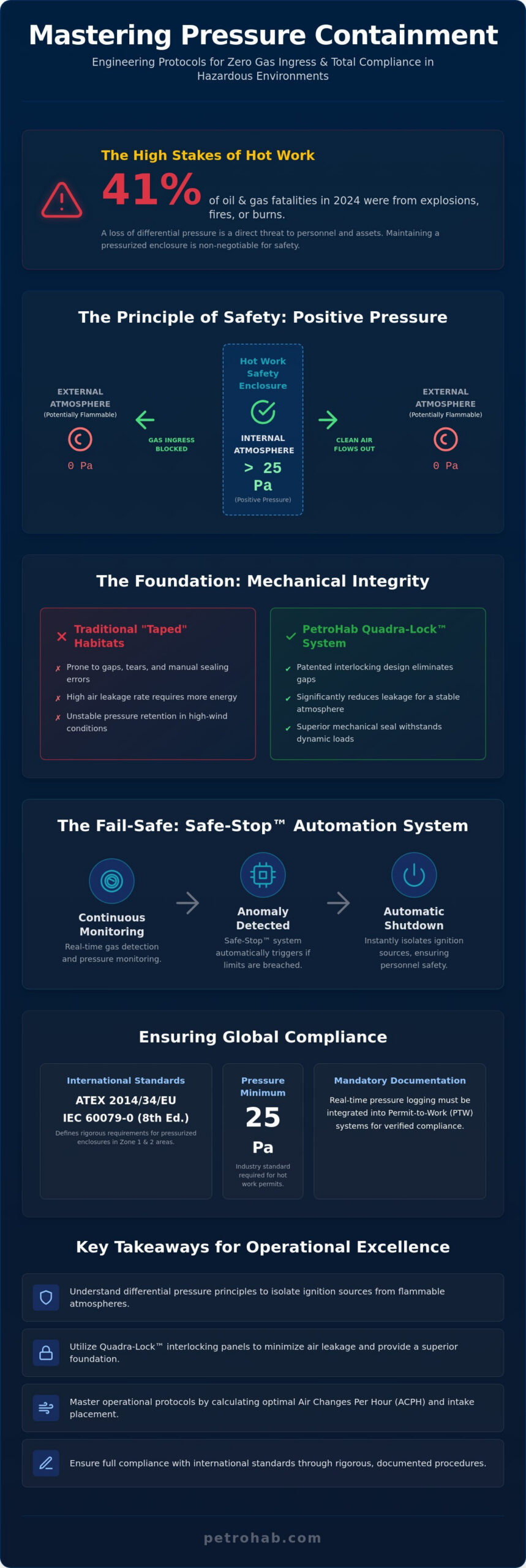
Explosions, fires, or burns accounted for 41% of oil and gas fatalities in 2024. This data from the International Association of Oil & Gas Producers underscores the lethal stakes of performing hot work in hazardous environments. You understand the technical difficulty of maintaining positive pressure when high-wind offshore conditions threaten the integrity of manual seals. A loss of differential pressure isn’t just a regulatory failure; it’s a direct threat to personnel and high-value assets.
This guide provides the engineering principles and operational protocols required to master pressure containment in industrial enclosures. You’ll learn how to achieve the mandatory 25 Pascal minimum requirement using the patented Quadra-Lock panel system and the Safe-Stop automatic shutdown system. We’ll outline a methodical approach to ensure zero gas ingress, total compliance with 2026 safety standards, and uninterrupted operational uptime during critical maintenance.
Key Takeaways
- Understand the mechanical principles of differential pressure required to isolate ignition sources from flammable atmospheres.
- Identify how Quadra-Lock interlocking panels minimize air leakage to provide a superior foundation for pressurized containment.
- Master the operational protocols for maintaining positive pressure by calculating optimal Air Changes Per Hour (ACPH) and intake placement.
- Implement automated fail-safes using the Safe-Stop system to integrate continuous gas detection with pressure monitoring.
- Ensure full compliance with international safety standards for hot work permits in hazardous industrial zones.
The Physics of Safety: Why Maintaining Positive Pressure is Non-Negotiable
In hazardous industrial environments, the distinction between a controlled workspace and a catastrophic event depends entirely on differential pressure. Positive pressure in a PetroHab Hot Work Safety Enclosure (HWSE) describes an internal atmosphere maintained at a higher pressure level than the surrounding ambient air. This mechanical state ensures that air always moves from the inside of the habitat to the outside. It’s a fundamental principle of fluid dynamics applied to life safety.
This application utilizes The Physics of Safety to create a barrier against external contaminants. By forcing air through the enclosure at a constant rate, the system displaces potential hazards. The goal is simple but absolute: prevent the ingress of hydrocarbons and flammable gases into the area where welding or grinding occurs. This creates a protected enclosure that isolates ignition sources from the surrounding explosive atmosphere.
To better understand this concept in a field application, watch this technical overview:
The Barrier Effect: Gas Ingress Prevention
Molecular movement dictates the safety margin of a habitat. When the internal pressure exceeds the external atmosphere, air molecules move outward with enough force to repel incoming gas molecules. This creates a physical barrier that doesn’t rely on fabric integrity alone. Maintaining positive pressure is the only reliable method for keeping explosive mixtures away from welding arcs and grinding sparks.
The relationship between pressure levels and gas density is critical. High density air inside the HWSE pushes against every seal and joint. If the system experiences even a slight drop to neutral pressure, the safety margin vanishes. Neutral pressure allows for gas migration through diffusion or external wind pressure. In high-wind offshore environments, this risk is magnified. Consistent pressure maintenance remains the only definitive method for ensuring personnel safety during hot work operations.
Regulatory Requirements for Pressurized Habitats
Adherence to international safety protocols is mandatory for any hot work in Zone 1 or Zone 2 areas. ATEX 2014/34/EU and the eighth edition of IEC 60079-0 define the rigorous requirements for pressurized enclosures. Maintaining positive pressure at a minimum of 25 Pascals is the industry standard required for standard hot work permits. This threshold provides a calculated buffer against atmospheric fluctuations.
Satisfying these hazardous environment standards requires more than physical equipment; it requires rigorous documentation. Safety managers must integrate real-time pressure logging into their Permit-to-Work (PTW) systems. This data provides the necessary proof of integrity throughout the duration of the task. Without verified pressure logs, compliance with modern safety regulations is impossible. The system must prove it’s protected before the first spark is struck.
Mechanical Integrity: The Role of Quadra-Lock in Pressure Retention
The structural foundation of a habitat determines its safety rating. Unlike residential structures that prioritize thermal insulation, industrial enclosures must withstand extreme vibration, heat, and high-velocity winds. Maintaining positive pressure requires a mechanical seal that remains airtight under dynamic loads. The modular design of the PetroHab HWSE uses Quadra-Lock panels and a rigid, adaptable frame to establish this boundary. Using fire-resistant materials that meet international safety standards ensures the structure maintains its integrity even when exposed to intense heat from welding arcs.
These panels aren’t just barriers; they’re engineered components. The patented interlocking design eliminates the gaps common in traditional, “taped” habitats. By creating a physical overlap at every joint, the system significantly reduces the leakage rate. This mechanical advantage allows for a more stable internal atmosphere and reduces the load on air intake systems. Proper installation of these panels is a core component of the safety mission to eliminate workplace accidents in hazardous environments.
Quadra-Lock Technology: Minimizing the Leakage Rate
The Quadra-Lock panel connection system utilizes a specific interlocking geometry that creates a tortuous path for air escape. Traditional enclosures often rely on adhesive tapes or simple overlaps that fail when exposed to the high-heat cycles of welding. The Quadra-Lock design ensures that the pressure boundary remains intact even as the enclosure shifts during offshore operations. This superior sealing capability means that maintaining positive pressure requires less cubic feet per minute (CFM) from air compressors, which optimizes fuel consumption and reduces equipment wear.
Sealing Penetrations and Pipework
Industrial sites rarely provide flat, unobstructed surfaces for enclosure assembly. Habitats must often encompass complex pipework, structural beams, and irregular machinery. To preserve the pressure differential, technicians use specialized fire-stop materials and custom sleeves that integrate directly with the Quadra-Lock panels. These seals must be as durable as the panels themselves. Seal integrity is the primary variable in pressure stability.
Adhering to Operational Best Practices ensures that your site meets federal and international safety standards. For projects requiring custom configurations, you can explore PetroHab’s modular HWSE solutions to find a tailored fit for your specific infrastructure requirements.
Operational Best Practices for Maintaining Airflow and Pressure
Establishing a mechanical boundary with Quadra-Lock panels is the first step toward a secure habitat. The second step is the active management of the internal atmosphere. Maintaining positive pressure requires a calculated balance of air volume and directional flow. This dynamic equilibrium ensures that even if a seal is momentarily compromised, the outward velocity of air prevents any flammable gas from entering the enclosure.
Engineers must determine the required Air Changes Per Hour (ACPH) based on the volume of the Petro-Habitat and the nature of the hot work. High-volume throughput is essential for flushing out welding fumes and maintaining thermal comfort for personnel. Technicians should position air intake fans in verified clean-air zones, typically upwind and away from known hydrocarbon sources. A site-specific survey is necessary before every deployment to identify these intake points.
Air delivery relies on the integrity of the ducting system. Use only anti-static, reinforced ducting to transport air from the blowers to the habitat. Kinks, sharp turns, or excessively long runs reduce static pressure, making it significantly harder to sustain the required differential. Managing the exit of this air is equally vital. Weighted exhaust dampers and spark arrestors allow air to leave the enclosure while preventing the escape of hot particles and maintaining the internal pressure threshold.
Optimizing Air Intake Systems
Selecting the correct blower is a critical safety decision. Blowers must be explosion-proof and carry the relevant ATEX or IECEx certifications for the specific zone of operation. Redundancy is a core requirement for high-stakes projects. If a primary blower fails, a secondary unit must be ready to engage immediately to prevent a total pressure loss. Additionally, intake air must pass through high-efficiency filters. This protects the health of the personnel inside and prevents the buildup of particulates on the Safe-Stop system’s sensitive monitoring equipment.
Environmental Factors: Managing Wind and Temperature
Offshore environments present unique atmospheric challenges. High-velocity winds create localized low-pressure zones on the leeward side of structures. These zones can “pull” air out of the habitat faster than the blowers can supply it. Technicians must actively monitor these conditions and adjust blower speeds to compensate for environmental fluctuations. Internal heat from welding also affects maintaining positive pressure by decreasing air density. As air heats up, it expands. This expansion can cause pressure spikes if not properly managed through calibrated exhaust venting, requiring constant vigilance from the safety supervisor.
Monitoring and Automation: The Safe-Stop Fail-Safe System
Mechanical containment via Quadra-Lock panels provides the physical barrier, but technical safety requires active, real-time verification. Maintaining positive pressure is a dynamic task that requires constant oversight. Digital monitoring systems act as the central nervous system of the Petro-Habitat, ensuring that the internal environment remains isolated from external hazards. Without continuous data feedback, a safety manager cannot verify the integrity of the pressure boundary against fluctuating atmospheric conditions.
The Safe-Stop philosophy dictates that if the mechanical or atmospheric barrier fails, the ignition source must be eliminated immediately. This system integrates high-precision differential pressure sensors with flammable gas detection. If the internal pressure drops below the mandatory 25 Pascal threshold, or if gas is detected at the air intake, the system triggers an automated response. Audible and visual alarms provide immediate notification to technicians, ensuring they can evacuate or secure the area before a hazardous condition escalates.
How Automatic Shutdown Systems Protect Assets
Manual monitoring is insufficient for high-risk hot work in explosive atmospheres. Human reaction times cannot match the speed of an integrated safety loop. The Safe-Stop system utilizes a rigorous 5-step process to protect personnel and high-value assets. This sequence includes detection of the fault, rapid analysis of the sensor data, activation of local alarms, an immediate cut of power to the welding source, and the isolation of the habitat from the external environment. This automation ensures that the work environment remains secure even if the primary air supply is compromised.
Connecting the shutdown system directly to the welding power source is a non-negotiable safety requirement. It removes the possibility of human error during a pressure loss event. By automating the transition from an active work state to a safe shutdown, operators minimize the risk of accidental ignition. This level of technical precision is what defines the PetroHab approach to risk mitigation in heavy industry.
Calibrating Manometers and Sensors
The reliability of an automated system depends on the accuracy of its sensors. Differential pressure transmitters and manometers require regular calibration to ensure they provide precise readings in harsh environments. Technicians must establish low-pressure trip points based on site-specific risk assessments, typically anchored at the 25 Pascal minimum. These sensors must remain fully functional while exposed to extreme humidity, vibration, and the corrosive effects of salt spray found on offshore platforms.
Routine testing of the trip logic ensures that the link between the pressure sensor and the power cutoff remains robust. Documentation of these calibration cycles is essential for maintaining a valid Permit-to-Work (PTW) and proving compliance with 2026 international safety standards. To ensure your site is equipped with the latest in fail-safe technology, you should consult with PetroHab’s engineering team to review your specific monitoring requirements.
PetroHab Solutions: Engineering the Industry Benchmark for Pressure
PetroHab delivers an integrated safety ecosystem that addresses the common “leaky habitat” problem. By combining the mechanical seal of Quadra-Lock panels with the digital precision of the Safe-Stop system, operators achieve a level of risk mitigation that exceeds traditional methods. Maintaining positive pressure is not merely a goal; it’s a guaranteed operational state facilitated by superior engineering. This synergy ensures that ignition sources remain isolated from explosive atmospheres throughout the duration of the hot work permit.
Equipment performance depends on precise deployment. PetroHab provides professional on-site supervision and technician training to ensure that every Hot Work Safety Enclosure (HWSE) meets the rigorous demands of the energy sector. Whether in the high-wind environments of the North Sea or the humid conditions of the Gulf of Mexico, our systems comply with the latest 2026 international safety standards. This global support network ensures that safety managers have access to expert guidance and certified equipment regardless of their operational location.
Flexibility in procurement allows safety managers to align equipment availability with specific project timelines. We offer both leasing and purchasing options for the PetroHab HWSE and Safe-Stop systems. Leasing is often the preferred choice for short-term refinery turnarounds, while purchasing provides long-term facility maintenance teams with a permanent, reusable asset for recurring hot work requirements. Both models include access to our technical expertise and compliance documentation.
The Quadra-Lock Advantage
The industry is shifting away from generic, temporary enclosures toward patented Quadra-Lock systems. These panels offer unmatched durability and reusability in harsh industrial environments. Their modular nature allows for rapid assembly, often pressurizing a standard habitat in under 3 hours. In a recent refinery turnaround, PetroHab systems successfully maintained the required 25 Pascal pressure differential throughout a 30-day welding schedule while the facility remained live. This reliability proves that mechanical integrity is the foundation of site safety.
Next Steps for Safety Managers
Implementing a pressurized habitat requires a detailed technical assessment of the work area and potential hazards. PetroHab technicians work with your team to determine the optimal configuration for your specific infrastructure and airflow requirements. Training your personnel on habitat integrity and maintaining positive pressure is essential for sustaining a culture of safety excellence. We provide the tools and the knowledge to eliminate workplace accidents in hazardous environments.
To ensure your next project meets the highest standards of risk mitigation, Consult with PetroHab for advanced hot work safety solutions.
Achieving Operational Excellence in Hazardous Environment Safety
Effective risk mitigation in Zone 1 and Zone 2 areas requires a disciplined integration of mechanical integrity and automated oversight. You’ve seen how the patented Quadra-Lock sealing technology establishes a superior boundary. The Safe-Stop system provides the necessary fail-safe to prevent ignition events. Maintaining positive pressure at the required 25 Pascal threshold is a continuous operational duty that protects both personnel and high-value assets from the catastrophic risks of gas ingress.
PetroHab brings decades of experience in offshore oil and gas to every deployment, ensuring your site remains compliant with the latest ATEX and IECEx monitoring requirements. Our calculated approach to habitat engineering eliminates the vulnerabilities of traditional enclosures. By prioritizing technical precision and reliable technology, you’ll ensure that hot work proceeds without compromising site safety or operational uptime. It’s the most reliable way to guarantee protection in high-stakes environments.
Take the next step in protecting your infrastructure and workforce. Secure Your Facility with PetroHab HWSE Solutions and partner with an industry leader dedicated to zero workplace accidents. Our team is ready to deliver the resilience your operations demand.
Frequently Asked Questions
What is the minimum positive pressure required for a welding habitat?
The minimum positive pressure required for a standard hot work permit is 25 Pascals, which is equivalent to 0.1 inches of water gauge. This threshold is the industry benchmark for ensuring that internal air density remains higher than the external atmosphere. Maintaining positive pressure at this specific level provides a calculated safety buffer against localized wind gusts and atmospheric fluctuations that could otherwise force flammable gases into the enclosure.
How does the Safe-Stop system respond to a sudden pressure drop?
The Safe-Stop system initiates an immediate, automated shutdown of all ignition sources the moment internal pressure falls below the 25 Pascal threshold. It executes a rapid sequence of detection, analysis, and power isolation to eliminate risk within milliseconds. This fail-safe mechanism removes the danger of human error; it ensures that welding or grinding cannot continue if the mechanical barrier is compromised or the air supply fails.
Can Quadra-Lock panels be used in Zone 1 hazardous areas?
Yes, Quadra-Lock panels are engineered specifically for deployment in Zone 1 and Zone 2 hazardous areas. Their patented interlocking design provides the mechanical integrity necessary to isolate hot work from potentially explosive atmospheres. These panels utilize fire-resistant materials that meet international safety standards; they ensure the enclosure remains a durable and resilient barrier against the harsh conditions often found on offshore platforms and refineries.
How often should the air intake blowers be inspected during a shift?
Air intake blowers require continuous digital monitoring through the Safe-Stop system, supplemented by physical inspections at the start of each shift and every four hours during operation. Technicians must verify that the blowers remain in a clean-air zone and that intake filters are free of obstructions. Regular physical verification ensures that mechanical components perform optimally and that the system consistently delivers the volume required for maintaining positive pressure.
What happens if flammable gas is detected at the air intake?
If the Safe-Stop system detects flammable gas at the air intake, it immediately triggers an automatic shutdown of all power to the habitat and activates audible and visual alarms. This response prevents the blowers from drawing explosive mixtures into the workspace. Work cannot resume until the external atmosphere is confirmed clear and the safety supervisor revalidates the permit-to-work, ensuring that personnel remain protected from external gas ingress.
Is a manometer required for all pressurized hot work enclosures?
A calibrated manometer or differential pressure transmitter is a mandatory requirement for all pressurized hot work enclosures to verify safety compliance. Digital manometers integrated into the Safe-Stop system provide continuous, real-time data logging of internal pressure levels. This documentation is essential for proving the integrity of the habitat during safety audits and is a core requirement for the valid issuance of hot work permits in 2026.
How do you maintain pressure when workers are entering or exiting the habitat?
Pressure is maintained during entry and exit through the use of integrated air-lock door systems or by adjusting blower output to compensate for the temporary opening. The superior sealing capability of the Quadra-Lock panel system minimizes overall air leakage; this allows the blowers to sustain the required differential pressure even during technician transitions. Proper procedural training ensures that doors are never left open longer than necessary to preserve the atmospheric barrier.
What is the difference between a pressurized welding habitat and a standard enclosure?
The primary difference is the active management of the internal atmosphere through positive pressure and automated fail-safes. A standard enclosure provides only a physical spark barrier, while a pressurized welding habitat uses blowers to create a pressure differential that repels flammable gases. PetroHab habitats integrate the Safe-Stop system and Quadra-Lock panels to provide a documented, ATEX-compliant safety solution that standard, non-pressurized enclosures cannot offer.