Blog Posts
Pressurized Habitat Ventilation Systems: How Airflow Supports Hot Work Safety
What keeps a pressurized habitat controlled during hot work: the air supply, the enclosure, or the controls that respond when conditions change? A pressurized habitat ventilation system is more than blowers and ducting. Air supply, distribution, pressure management, discharge, monitoring, and shutdown functions must work together to support the habitat’s intended operating conditions.
To assess the arrangement, trace the air from its source to the enclosure, then consider where it can exit and how changing conditions are detected. Ventilation equipment moves air, but it is not the complete safety system. The enclosure, operating controls, monitoring, and defined shutdown response also matter. Their roles and requirements depend on the habitat design and site procedures.
This article explains the main functions and components, how air supply, pressure, and discharge relate, and what monitoring and shutdown arrangements are intended to do. It also offers practical questions to review with qualified personnel, so you can assess a habitat solution without relying on unverified specifications or performance claims.
Key Takeaways
- Assess the pressurized habitat ventilation system as a coordinated arrangement, not as air-supply equipment alone.
- Trace how air moves from intake through delivery and distribution, then outward through enclosure openings.
- Review the air supply, ducting, pressure indications, enclosure interfaces, and shutdown response with qualified personnel.
- Follow the project’s approved procedures to inspect the setup, confirm indications, and document ventilation conditions during operations.
- When comparing habitat options, distinguish confirmed components such as Quadra-Lock Panels and the Safe-Stop Automatic Shutdown System from details that need project-specific verification.
What Is a Pressurized Habitat Ventilation System and What Does It Control?
A pressurized habitat ventilation system coordinates air supply, distribution, pressure management, and discharge within an enclosed work area. It introduces air to support positive pressure relative to the surrounding atmosphere, with air moving outward through openings. The system’s purpose and operating limits depend on the habitat design and site conditions. Ventilation is one safety control, not a replacement for risk assessment or approved work procedures.
That distinction matters during hot work. Air movement alone does not confirm that the environment is controlled. Teams need to consider how air is delivered, how the enclosure is assembled, where air can leave, and how operating conditions are assessed. The positive pressure enclosure principle describes using inward airflow to establish positive pressure and limit the entry of surrounding atmosphere. Actual performance depends on the installation and operating conditions.
How Is Ventilation Different from a Fan or Air Duct?
A fan moves air, and ducting directs it. Neither, by itself, describes the full ventilation arrangement. A pressurized habitat ventilation system also involves how air is supplied and distributed, how pressure is indicated or controlled, and how air discharges through enclosure openings. When reviewing a setup, trace the complete route from supply to outlet rather than checking the fan or duct in isolation. For more detail, consult PetroHab’s article about air ducting in habitat ventilation.
Why Does Positive Pressure Matter During Hot Work?
When conditions are maintained as designed, positive pressure supports outward airflow at openings. This movement is intended to reduce the potential for surrounding gases to enter the habitat, but it is not an unconditional guarantee. Enclosure integrity, open access points, air supply, and the surrounding atmosphere all affect the assessment. Review these factors under site procedures, and consult PetroHab’s guide to pressurized welding habitats for broader context on habitat design and use.
How Air Supply, Pressure, and Discharge Work Together
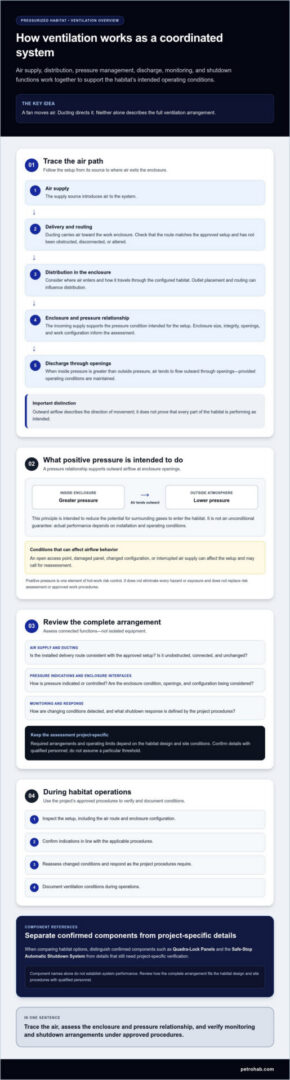
Airflow through a habitat follows a connected sequence: air enters at the supply point, travels through delivery components, and is distributed within the enclosure. The incoming supply supports the pressure condition intended for the setup. Air then moves outward through openings as the system operates. Because each stage affects the next, assess the pressurized habitat ventilation system as a whole rather than judging performance from a fan or duct alone.
When pressure inside the enclosure is greater than pressure outside, air tends to flow outward through openings, provided operating conditions are maintained. This pressure difference describes the direction of airflow; it does not prove that every part of the habitat is performing as intended. Supply capacity, enclosure size and integrity, openings, and the work configuration all inform the assessment. Site personnel should verify applicable operating limits and procedures rather than assume a particular threshold.
Where Do Air Supply and Ducting Fit?
The supply source introduces air, while ducting carries it toward the work enclosure. Routing and outlet placement can influence how air is distributed, so a useful assessment considers where air enters and how it travels through the configured habitat. Check that the installed route matches the approved setup and that it has not been obstructed, disconnected, or altered. The required arrangement depends on the system and job. Review PetroHab’s habitat air-ducting article for more on duct routing and delivery, then confirm setup details with qualified personnel.
What Happens at the Enclosure Boundary?
Air can move outward at openings only while operating conditions support the intended pressure relationship. An open access point, damaged panel, changed configuration, or interruption to the air supply can affect airflow behavior. These are reasons to reassess the setup, not automatic proof of failure or continued control. Check the enclosure’s condition and configuration against project procedures, and respond to any changed indication as those procedures require.
Positive pressure is one element of hot-work risk control. It does not eliminate every hazard or exposure, and ventilation should be considered alongside site risk assessment and applicable work procedures. For shipyard employment, OSHA’s hot-work requirements address ventilation in that specific regulatory context. To review habitat options and related safety systems, see PetroHab habitat solutions.
Which Ventilation Components and Controls Should Be Assessed?
Review the pressurized habitat ventilation system as a set of connected components and interfaces. A component may work as intended on its own yet still be unsuitable for a particular worksite or configuration. Confirm the complete arrangement, including which equipment is part of the habitat and which is supplied or controlled by the site.
| Component or control | Function | Site-specific verification question |
|---|---|---|
| Air supply | Introduces air into the habitat as part of the ventilation arrangement. | Is the supply source suitable for this work and configuration, and who confirms its readiness? |
| Ducting and delivery route | Carries air toward the enclosure and influences how it is distributed. | Does the installed route match the approved setup, without unintended obstruction or disconnection? |
| Pressure indication | Provides an indication of a pressure-related operating condition, where included in the system. | What does the indication represent, and which project documents define acceptable readings? |
| Enclosure interfaces | Include panel connections, access points, and other openings that affect the boundary of the habitat. | Does the assembled enclosure match the planned configuration, and how are changes or damage addressed? |
| Monitoring and shutdown response | Make operating conditions visible and support a defined response when required by the system and site procedures. | Who verifies the monitoring and response interfaces, and which procedure governs a shutdown? |
How Do Pressure Monitoring and Shutdown Relate?
Monitoring helps personnel observe operating conditions, but an indication alone does not establish that a setup meets project requirements or confirm every aspect of system performance. PetroHab offers the Safe-Stop Automatic Shutdown System. Confirm its specific functions and interfaces for the selected configuration. For broader control-system context, consult the advanced hot work safety systems guide.
What Should a Ventilation System Review Include?
Review the air source, delivery route, enclosure condition, available indications, and interfaces involved in any shutdown response. Establish who checks the setup and which site procedures govern operation. Confirm thresholds, alarms, and acceptance criteria against project documentation rather than assuming standard values. A qualified project team must determine whether the selected components and their integration suit the actual worksite.
How Should Teams Verify Ventilation During Habitat Operations?
Ventilation verification should follow the project’s approved plan, not assumptions about how a habitat usually performs. Use a clear sequence: review the work documents, inspect the installed arrangement, confirm available indications, document the checks, and follow site procedures throughout the work. Project documentation and qualified personnel must define the exact checks, acceptance criteria, and assigned roles.
System monitoring shows selected operating conditions; it does not independently confirm that work conditions are safe. A pressure indication or shutdown function is one input to a broader assessment. Personnel must interpret it in the context of the habitat configuration, work plan, risk assessment, and site requirements.
What Should Be Confirmed Before Hot Work Begins?
Before work starts, review the approved work plan and confirm that the habitat configuration and ventilation arrangement match the documented setup. Identify who is responsible for verification, how monitoring indications are interpreted, and how shutdown interfaces are addressed. Record checks as required by site procedures. This sequence supports planning, but it does not replace permits, risk assessment, competent supervision, or other required controls.
What Should Teams Do When Conditions Change?
If ventilation or pressure indications change, personnel should use the site’s established response process and involve the designated qualified personnel. Reporting, reassessment, any required shutdown, and the decision to resume work must follow applicable project procedures. Do not infer an acceptable reading, response time, or restart condition where project documentation has not defined one.
During operations, assess the pressurized habitat ventilation system alongside the enclosure and work conditions, and handle verification and records as the project requires. For information on PetroHab pressurized habitats and related safety systems, review habitat options with PetroHab.
How PetroHab Integrates Ventilation into a Pressurized Habitat
PetroHab manufactures, leases, and sells pressurized habitats and related Hot Work Safety Enclosures. Ventilation is considered as part of the habitat arrangement, alongside the enclosure and safety-system components. The appropriate configuration depends on the work scope, site conditions, and project requirements, so confirm equipment details and operating procedures for the specific job.
PetroHab’s confirmed offerings include Quadra-Lock Panels and the Safe-Stop Automatic Shutdown System. These are components within its habitat and safety-system offerings, but their presence alone does not establish how a particular installation is configured or performs. Verify component selection, interfaces, and operating details against project documentation with qualified personnel.
Where Do Quadra-Lock and Safe-Stop Fit?
Quadra-Lock is PetroHab’s patented panel technology. For details about the panels themselves, consult the Quadra-Lock technology guide. Safe-Stop is an automatic shutdown system offered by PetroHab. Confirm its specific triggers, interfaces, and role in the project’s response procedures before including it in the operating plan.
Assess a pressurized habitat ventilation system in its actual configuration. Clarify which components are included, how they connect with site-provided equipment, and who verifies that the arrangement matches project requirements. No single component replaces a full system review or site procedures.
What Information Should a Project Team Prepare?
A focused discussion starts with clear project information. Gather the work scope, relevant site conditions, planned habitat configuration, and applicable safety requirements. Prepare questions about the air supply and ventilation arrangement, system interfaces, and assigned responsibilities. Also clarify whether on-site supervision or training may be appropriate for the project. PetroHab offers these forms of support, but their inclusion should be confirmed for each scope.
With those details in hand, contact PetroHab to discuss your habitat requirements. A project-specific review can help identify which configuration details, operating questions, and system interfaces need confirmation before work proceeds.
Put Ventilation Planning Into the Project Review
A pressurized habitat ventilation system is a coordinated arrangement, not simply a fan or duct. Air supply, distribution, enclosure condition, pressure indications, and any shutdown response need to be considered together. Monitoring can show selected operating conditions, but it does not independently confirm safe work conditions. Verify the setup against project documentation and follow site procedures when conditions change.
PetroHab manufactures, leases, and sells pressurized habitats and related safety systems. Its confirmed offerings include patented Quadra-Lock technology and the Safe-Stop Automatic Shutdown System. PetroHab also offers on-site supervision and training. Confirm whether these services fit the project scope, along with equipment interfaces and operating details.
Bring the work scope, site conditions, habitat configuration, and project safety requirements into the discussion. Discuss your pressurized habitat requirements with PetroHab and identify which system details need project-specific review. A clear assessment with qualified personnel helps teams plan the work with greater confidence.
Frequently Asked Questions
What is a pressurized habitat ventilation system?
A pressurized habitat ventilation system supplies and distributes air to support positive pressure inside an enclosure. The arrangement involves more than moving air: teams also need to consider pressure indications, enclosure condition, and how air exits through openings. Components and acceptance criteria depend on the habitat, worksite, and approved project procedures. Confirm the intended configuration and requirements with qualified personnel before relying on the system during hot work.
How does ventilation maintain positive pressure in a welding habitat?
Air is supplied to the habitat to support an internal pressure above the surrounding area under intended operating conditions. When that pressure relationship is maintained, air tends to flow outward through openings. The result depends on the supply arrangement, enclosure integrity, and how the habitat is configured and operated. Do not assume a universal pressure value. Use equipment guidance and project documentation to establish applicable criteria.
Why is ventilation important in a pressurized welding habitat?
Ventilation supports the habitat’s intended operating environment by managing air supply and pressure, while monitoring can help personnel observe selected conditions. It is one element of a coordinated hot-work control approach, not a stand-alone safety program. Work authorization, hazard assessment, enclosure condition, and site procedures remain relevant. The project team should evaluate the complete arrangement for the work scope and location, with qualified personnel confirming its suitability.
What components are used in a habitat ventilation system?
A habitat ventilation arrangement may include an air supply, ducting, enclosure interfaces, and pressure-indication equipment. Some configurations may also involve an automatic shutdown system. Components can be supplied by the habitat provider or the site, so confirm who is responsible for each item. Ask how the installed arrangement will be checked, what indications mean, and which project documents define operating and acceptance criteria.
Can ventilation alone make hot work safe in a hazardous environment?
No. Ventilation is one control within a broader project safety framework. It does not replace work planning, hazard assessment, required authorization, enclosure checks, monitoring, or applicable site procedures. The controls needed depend on the hazards, task, location, and project requirements. Before work begins, qualified personnel should review the complete setup and confirm acceptance criteria and operating responsibilities in the project documentation.
What should be checked if habitat pressure changes during work?
Follow the site’s approved response procedure and notify the personnel responsible for the work and habitat. Do not apply a generic pressure threshold or restart sequence from an overview article. The appropriate response, including any shutdown, reassessment, documentation, and authorization to resume, depends on the equipment and project requirements. Review the applicable instructions in advance so the team knows who makes decisions and how changes are recorded.
How is PetroHab’s Safe-Stop system related to ventilation?
Safe-Stop is PetroHab’s automatic shutdown system and part of its hot-work safety offerings. PetroHab’s automatic shutdown systems monitor gas levels and pressure. Confirm the specific inputs, triggers, interfaces, and relationship to the ventilation arrangement in current product documentation and project specifications. Treat shutdown capability as one system control, not a substitute for reviewing ventilation, following site procedures, or competent supervision.