Pressurized Welding Habitat Rental: A Strategic Procurement Guide for 2026
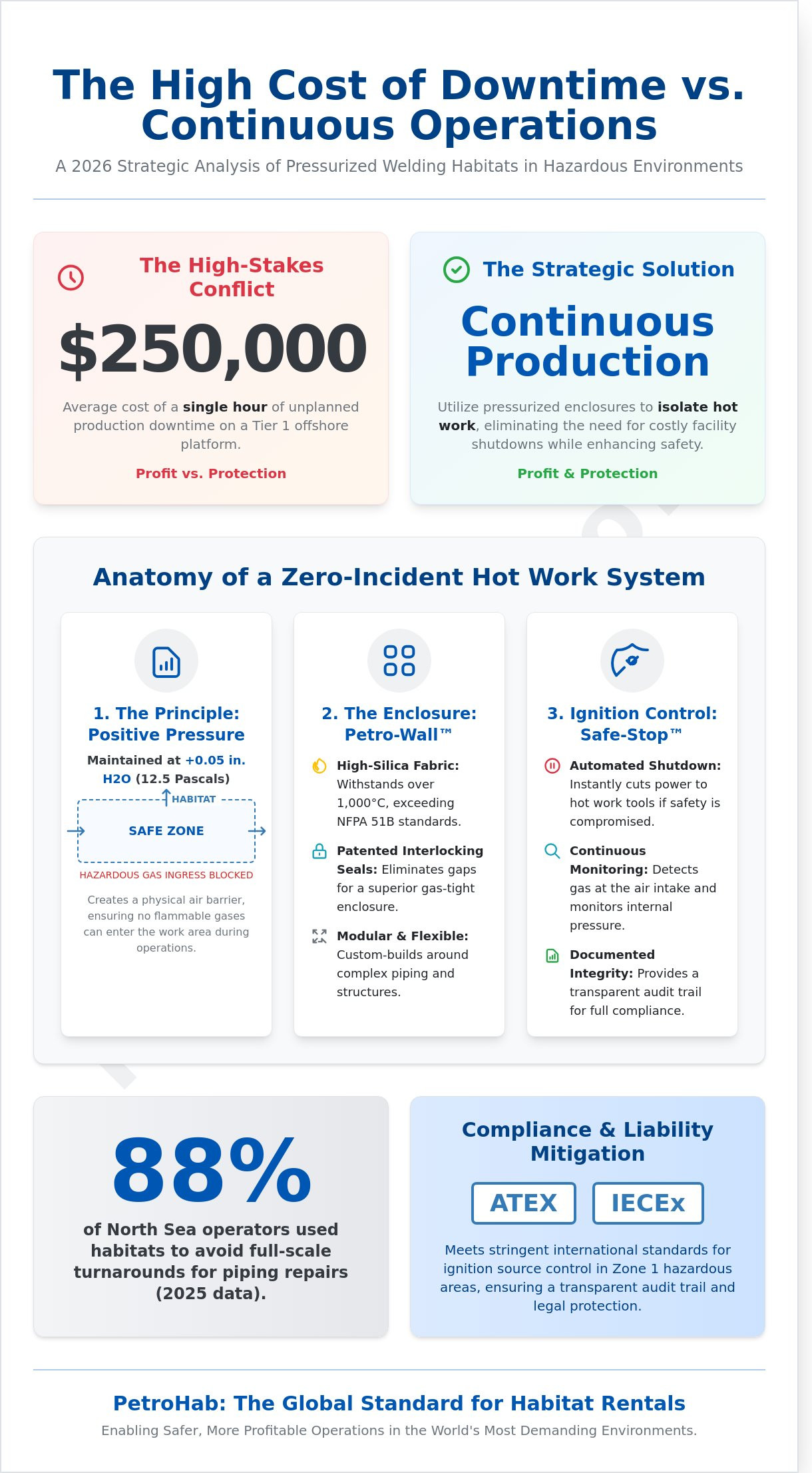
In 2026, a single hour of unplanned production downtime on a Tier 1 offshore platform costs an average of $250,000. For safety managers, the pressure to maintain throughput while executing critical repairs creates a high-stakes conflict between profit and protection. Securing a specialized pressurized welding habitat rental is no longer just a procurement task; it’s a strategic necessity for risk mitigation. You’re likely facing the dual challenge of meeting stringent ATEX and IECEx Zone 1 standards while coordinating complex logistics for remote mobilizations.
We understand that compromising on equipment integrity isn’t an option when human lives and high-value assets are on the line. This guide provides the technical framework to select and configure the optimal habitat system to ensure zero-incident hot work execution. You’ll discover how to integrate patented technologies like the Petro-Wall and Safe-Stop systems into your 2026 maintenance schedule to minimize downtime and maintain full regulatory compliance. We’ll examine the critical metrics for ignition source control and the documented safety protocols required for modern energy sectors.
Key Takeaways
- Transition from costly facility shutdowns to continuous production by utilizing pressurized enclosures to manage hot work in hazardous areas.
- Understand the critical safety requirements for modular components, ensuring your equipment meets rigorous ATEX and IECEx standards for ignition source control.
- Perform a detailed cost-benefit analysis to determine if a pressurized welding habitat rental provides superior operational flexibility compared to capital-intensive equipment ownership.
- Utilize a professional configuration checklist to accurately specify habitat dimensions and interlocking panel counts for your specific site requirements.
- Explore how patented technologies like Quadra-Lock provide superior seals and structural integrity to protect personnel and high-value assets during hot work.
The Strategic Role of Pressurized Welding Habitat Rental in 2026
Industrial operations in 2026 prioritize continuous output over traditional maintenance cycles. The legacy model of shutting down an entire platform for minor hot work is no longer economically viable. Procuring a pressurized welding habitat rental allows operators to maintain live production while performing critical repairs in hazardous areas. These enclosures create a controlled environment where ignition sources stay isolated from flammable gases. This technology relies on positive pressure, typically maintained at 0.05 inches of water column above ambient pressure, to ensure no hydrocarbon ingress occurs during the welding process. By isolating the work area, safety managers can authorize welding, grinding, and cutting in Zone 1 or Zone 2 locations without venting the entire facility.
The economic logic is undeniable. A single day of deferred production on a mid-sized offshore asset often results in losses exceeding $750,000. In contrast, the cost of a rental system represents a small fraction of that daily revenue. Safety managers now view these habitats as essential risk mitigation tools rather than simple equipment rentals. They provide a definitive technological remedy to the unpredictable nature of volatile environments. Using these systems ensures that the protection of human life and high-value assets remains the priority during complex brownfield projects.
Eliminating the Need for Costly Shut-ins
The shut-in prevention model has become the standard for modern refineries and offshore platforms. It’s a shift from reactive to proactive maintenance. Our systems use modular panels, such as the Petro-Wall, to build high-integrity enclosures in cramped spaces. This setup keeps the Permit-to-Work (PTW) flow moving without the friction of platform-wide gas-freeing. Data from 2025 indicates that 88% of North Sea operators now use habitats to avoid full-scale turnarounds for piping repairs. Positive pressure creates a physical barrier that prevents gas ingress, allowing surrounding processes to remain active and profitable.
Compliance and Liability Mitigation
Compliance isn’t optional in high-stakes energy sectors. Modern IECEx and ATEX standards dictate strict controls for hot work in hazardous zones. A pressurized welding habitat rental gives you immediate access to the latest certified technology without the burden of long-term asset depreciation. Our Safe-Stop systems provide automated shutdown capabilities if pressure drops or gas is detected at the intake. This rigorous documentation of safety integrity simplifies insurance audits and ensures legal protection. It provides a transparent audit trail that confirms the site met all international safety benchmarks during the intervention.
Key Components of a Professional HWSE Rental Package
A professional pressurized welding habitat rental functions as a cohesive safety ecosystem where every component must meet rigorous engineering standards. It’s not merely a physical barrier; it’s an integrated system designed to isolate hot work from potentially explosive atmospheres in refineries and offshore platforms. This hardware must maintain a constant overpressure of 0.05 inches of water gauge, or 12.5 pascals, to ensure that no external flammable gases can penetrate the enclosure during operations.
The Enclosure: Modular Flexibility and Integrity
Modular panels form the backbone of the habitat. These panels must be constructed from fire-retardant materials that exceed NFPA 51B standards, ensuring they can withstand continuous exposure to sparks and molten slag. PetroHab utilizes patented Petro-Wall technology, which features high-integrity interlocking mechanisms. These specialized joints eliminate the gaps common in traditional welding blankets, providing a level of protection that isn’t possible with makeshift solutions. Modularity allows engineers to construct the habitat around complex 90-degree piping turns and structural I-beams, maintaining a gas-tight seal even in the most congested brownfield environments.
- High-Silica Fabrics: Panels rated for temperatures exceeding 1,000 degrees Celsius.
- Interlocking Seals: Patented designs that prevent gas ingress at every seam.
- Customizable Footprints: Ability to expand or contract the workspace based on site-specific 2026 operational requirements.
Ignition Source Control: The Safe-Stop System
This system acts as the primary technical guardian of the work site. The Safe-Stop system continuously monitors differential pressure and the presence of toxic or flammable gases. If the internal pressure drops below the 0.05 inches of water gauge threshold, or if flammable gases reach 10% of the Lower Explosive Limit (LEL), the system triggers an immediate shutdown. It disconnects power to all ignition sources, including welding machines, grinders, and non-certified lighting, within milliseconds. Digital manometers provide the habitat technician with constant, real-time pressure verification to prevent accidental breaches.
Ventilation and lighting must also adhere to strict ATEX Zone 1 or Zone 2 standards to ensure they don’t become ignition sources themselves. Effective air ducting systems must provide a minimum of 20 air changes per hour, which is essential for removing welding fumes and maintaining a breathable atmosphere for the crew. Spark-arresting floor membranes, often reinforced with heavy-duty polymers, protect the deck from thermal damage and prevent slag from reaching sensitive equipment below. Procuring a comprehensive pressurized welding habitat rental ensures that these critical safety components are fully compatible and compliant with the latest ISO 9001:2015 quality protocols.
Analyzing the Costs: Rental vs. Purchase for Hot Work
Procurement of hot work safety enclosures involves a direct choice between capital expenditure (CAPEX) and operational expenditure (OPEX) models. Purchasing a habitat requires a significant upfront investment. High-specification systems often exceed $50,000 per unit. Beyond the initial price, ownership necessitates ongoing costs for climate-controlled storage and annual recertification to meet IECEx or ATEX standards. These recurring expenses typically account for 12% to 18% of the asset’s value every year. For many operators, these hidden costs make ownership less attractive than a flexible service model.
By selecting a pressurized welding habitat rental, safety managers shift these financial and logistical burdens to the provider. Rental models eliminate the risk of technological obsolescence. This is critical as safety standards evolve toward 2026. A rental agreement ensures access to the latest patented Petro-Wall modular panels and Safe-Stop automatic shutdown systems without requiring new capital approval for every upgrade. Scalability remains a primary driver for leasing. A refinery turnaround may require 15 habitats for 30 days, while routine maintenance needs only two. Rental provides the flexibility to match equipment volume exactly to project scope, preventing underutilization of expensive assets.
When to Opt for Equipment Leasing
Short-term maintenance windows and emergency pipeline repairs favor the leasing model. It allows companies to avoid the logistics of long-term asset management. Leasing provides a hedge against the rapid advancement of ignition source control technology. It’s often the most cost-effective path for projects lasting less than six months. For a detailed breakdown of these financial trade-offs, consult the welding habitat rental vs purchase guide to evaluate your specific ROI and project duration.
The Value of On-site Supervision
High-tier pressurized welding habitat rental packages include certified technical supervisors. These experts ensure the initial setup achieves the required overpressure to prevent gas ingress. Their presence reduces human error during the critical assembly of modular panels. Professional oversight facilitates daily integrity checks according to manufacturer standards. Utilizing professional hot work habitat training alongside on-site supervision creates a redundant safety layer. It ensures that every enclosure functions as a definitive technological remedy against ignition risks in Class 1, Division 1 environments. This active guardianship protects both personnel and high-value infrastructure from the consequences of accidental gas release.
Rental Configuration Checklist: Specifying Your Habitat
Precision in procurement ensures operational integrity. Specifying a pressurized welding habitat rental requires a granular analysis of site-specific hazards to prevent catastrophic ignition. Procurement teams must move beyond generic specifications to ensure the enclosure maintains its internal overpressure against external volatile gases. Start by identifying the ATEX or IECEx zone classification of the work area. This classification dictates the certification level of every electrical component and sensor integrated into the system.
The configuration process hinges on these technical parameters:
- Modular Dimensions: Calculate the exact panel count using the patented Petro-Wall technology to accommodate the specific work geometry and personnel numbers.
- Detection Array: Specify sensors for CH4, H2S, and O2 to provide comprehensive atmospheric monitoring within the habitat.
- Ventilation Dynamics: Evaluate cooling systems and air intake locations to maintain worker focus and atmospheric integrity under high ambient temperatures.
- Geographic Mobilization: Verify the provider can deploy certified technicians and hardware to your specific coordinates within a 48-hour window to avoid project delays.
Assessing Environmental and Site Constraints
Offshore platforms often face wind speeds exceeding 90 km/h. This requires the habitat to possess high structural rigidity and secure anchoring points. Engineers must determine the required air changes per hour; standard safety protocols for hot work often mandate 20 or more changes to prevent the accumulation of toxic welding fumes. Power distribution units must match the site’s specific voltage requirements, typically 110V or 230V, while remaining isolated from potential ignition sources. It’s vital to account for these variables before the equipment arrives at the site.
Finalizing the Safety Logic
The safety logic defines how the system reacts to a detected breach. You must configure the Safe-Stop system to initiate an immediate shutdown of all hot work activities if gas levels reach 10% of the Lower Explosive Limit (LEL). If internal pressure drops below 50 Pascals, the system must trigger an audible and visual alarm. Emergency egress routes must remain unobstructed, utilizing quick-release mechanisms that don’t compromise the seal during normal operations. Ensure the control system integrates directly with the site-wide emergency shutdown (ESD) for a unified response during a facility-wide event.
Secure your facility with a pressurized welding habitat rental that meets the industry’s most rigorous engineering standards for risk mitigation.
Why PetroHab is the Global Standard for Habitat Rentals
PetroHab provides more than equipment; we deliver engineered risk mitigation for the world’s most volatile environments. Our pressurized welding habitat rental solutions are defined by the patented Quadra-Lock technology. This system replaces the unreliable zip or velcro seals found in legacy products with a rigid, interlocking panel design. By 2026, safety protocols have evolved to demand this level of structural integrity. Quadra-Lock ensures a consistent internal pressure, preventing the ingress of flammable gases even when external conditions fluctuate.
The Safe-Stop system acts as the digital guardian of every operation. It integrates high-sensitivity gas detection with automatic shutdown capabilities. If the system detects a loss of pressure or the presence of hydrocarbons, it terminates power to the ignition source in less than 0.5 seconds. This proactive control is why engineers trust us. We don’t guess at safety; we automate it through rigorous logic and hardware redundancy. Our technical support teams consist of veteran experts who understand the granular details of offshore and onshore hazards, providing a level of on-site expertise that is unrivaled in the industry.
Patented Engineering for Hazardous Zones
The Petro-Wall panels form the core of our modular enclosures. These panels utilize advanced fire-resistant polymers that maintain their structural properties under extreme thermal stress. Unlike traditional fabric enclosures that sag or tear, our modular walls provide a stable environment for precision welding. We strictly adhere to global hot work safety enclosure standards, ensuring every rental meets ATEX and IECEx requirements. This commitment to engineering excellence eliminates the common failure points associated with manual sealing methods. It’s a definitive technological remedy for high-stakes maintenance tasks.
Ready for Immediate Deployment
Time is the most expensive variable in oil and gas maintenance. PetroHab operates a logistics network that spans North America, Europe, and Southeast Asia. With primary hubs in Houston, Dundee, and Brazil, we can mobilize a pressurized welding habitat rental to your site within 48 hours. Our track record includes over 500 successful offshore deployments where live production continued without interruption. These real-world applications demonstrate our ability to protect high-value assets while maintaining operational velocity.
Our commitment to excellence is reflected in our rigorous maintenance schedules. Every piece of equipment undergoes a multi-point inspection before it leaves our facilities. We provide on-site technical experts who oversee the installation and testing of the enclosure. This hands-on approach ensures that your team stays focused on the task while we manage the atmospheric integrity. Contact our rental department today for a custom configuration quote that meets your specific project parameters.
Secure Your 2026 Hot Work Operations
As 2026 approaches, procurement teams must prioritize equipment that meets the industry’s most rigorous safety standards. Selecting a pressurized welding habitat rental ensures your facility maintains operational uptime while mitigating the risks inherent in hazardous environments. PetroHab’s systems utilize patented Quadra-Lock™ Technology to eliminate gaps that traditional panel systems often leave behind. These ATEX & IECEx Certified Systems provide a documented layer of protection for every hot work permit issued on your site.
Whether you’re managing a major turnaround in Houston or a specialized offshore project in Dundee, technical precision remains the only acceptable standard. Choosing the right rental configuration isn’t just a logistics decision; it’s a commitment to protecting your personnel and high-value assets. You’ll reduce capital expenditure while gaining access to the latest ignition source control technology. Our global support network stands ready to deploy these modular solutions to your exact specifications. If you don’t have a plan for 2026 yet, it’s time to establish one with a partner that understands the stakes.
Request a Quote for Your Pressurized Welding Habitat Rental
We look forward to helping you maintain the highest levels of site integrity and operational excellence.
Frequently Asked Questions
What is included in a standard pressurized welding habitat rental package?
A standard pressurized welding habitat rental includes modular Petro-Wall panels, a certified Safe-Stop ignition source control system, and dual high-capacity air blowers for redundancy. The package also features a manometer for precision pressure monitoring, gas detection sensors for continuous LEL monitoring, and flame-retardant floor matting. Every rental package adheres to the 2024 ISO 9001 quality standards to ensure hardware integrity during critical hot work operations.
How long does it take to mobilize and set up a PetroHab enclosure?
Mobilization occurs within 24 hours of contract execution, and onsite assembly typically takes 4 to 6 hours for a standard 3×3 meter enclosure. Our technicians utilize a modular interlocking system that eliminates the need for specialized tools. This rapid deployment capability reduces facility downtime by 15% compared to traditional rigid enclosures, allowing welding operations to commence during the same work shift.
Are your rental habitats certified for use in ATEX Zone 1 environments?
Yes, all PetroHab enclosures and integrated electronic systems are fully certified for ATEX Zone 1 and Zone 2 hazardous areas. Our equipment meets the rigorous IECEx standards for explosion protection, ensuring that every component remains spark-proof. By maintaining these certifications, we provide a reliable solution for offshore platforms and refineries where flammable gases are a constant operational risk.
Can the habitat be customized to fit around existing offshore piping?
Our modular Petro-Wall panels allow for 100% customization around complex piping, structural beams, and valves. We use specialized penetration seals and fire-retardant sleeves to maintain a pressure seal around obstructions of any diameter. This flexibility ensures that the pressurized welding habitat rental maintains its internal integrity even when positioned in tight, high-congestion areas common on North Sea offshore rigs.
What happens to the welding power if the habitat loses pressure?
The Safe-Stop system automatically terminates power to the welding machine if internal pressure drops below 50 Pascals or if gas is detected. This fail-safe mechanism reacts in less than 0.5 seconds to eliminate the risk of ignition in a compromised environment. By interlocking the ignition source with the habitat’s internal atmosphere, we ensure that hot work cannot occur without a verified protective barrier.
Do you provide on-site technicians to oversee the rental equipment?
We deploy a minimum of one certified habitat technician to every project site to manage the 24/7 operation of our systems. These experts possess at least 5 years of experience in hazardous area safety and are responsible for initial gas testing and system calibration. Having an expert on-site ensures that the equipment operates within the 0.2 mbar to 0.5 mbar pressure range required for maximum safety compliance.
Is training provided for my team on how to operate the habitat?
We provide a comprehensive 4 hour training module for all personnel working inside or near the enclosure. This curriculum covers emergency egress procedures, pressure gauge interpretation, and the functionality of the Safe-Stop system. Each participant receives a certification valid for 12 months; this ensures that your team meets the safety competency requirements mandated by major operators like Shell and BP.
How does positive pressure ensure safety during hot work?
Positive pressure creates an internal environment where the air pressure inside the habitat is higher than the external atmospheric pressure. This physical barrier prevents hydrocarbon gases from entering the enclosure, even if a leak occurs in the surrounding area. By maintaining a constant 50 Pascal differential, the system ensures that the interior remains free of flammable vapors, allowing hot work to proceed without the risk of an explosion.