Pressurized Welding Habitats: The Definitive Guide to HWSE Technology
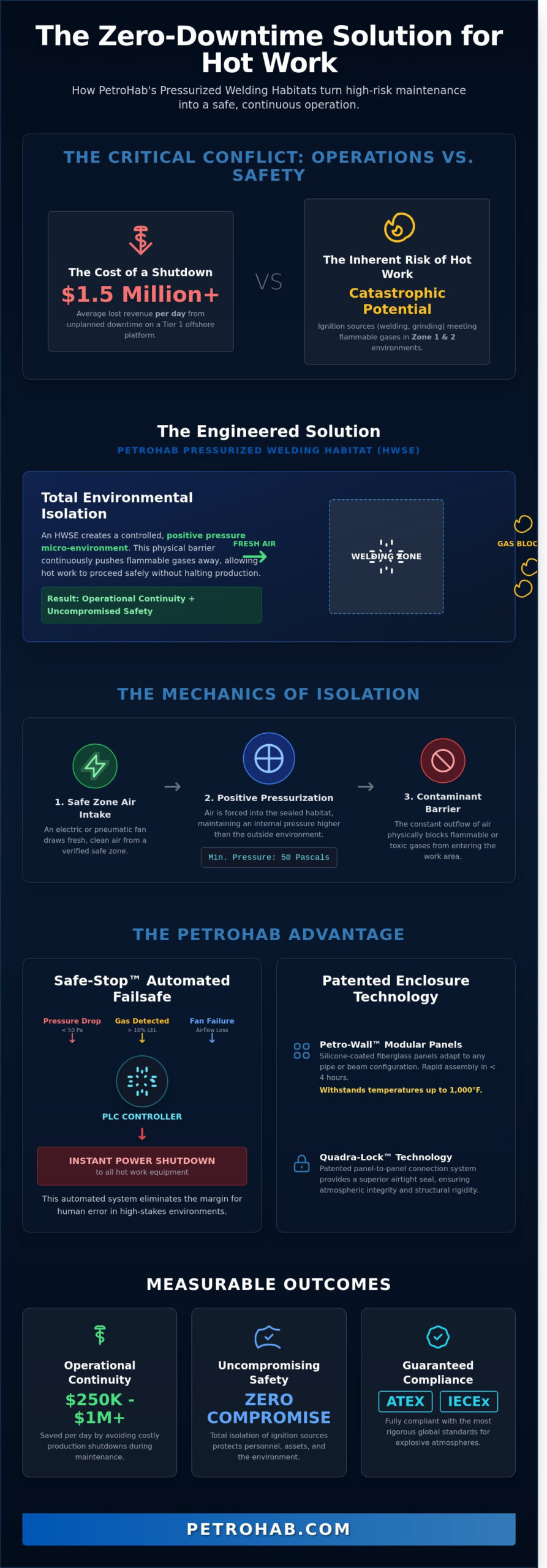
A single day of unplanned production downtime on a Tier 1 offshore platform averages over $1.5 million in lost revenue. For safety managers, the choice between maintaining operational continuity and meeting BSEE hot work requirements often feels like a zero-sum game. You know that ignition source control is non-negotiable in hydrocarbon-rich environments, yet the logistical burden of a full facility shutdown is often unsustainable. Integrating a pressurized welding habitat into your maintenance strategy eliminates this conflict by creating a controlled, overpressure environment that physically isolates sparks from flammable gases.
It’s clear that your priority is protecting human life without sacrificing the bottom line. This guide demonstrates how PetroHab’s Hot Work Safety Enclosure (HWSE) technology enables your team to perform critical repairs while the facility remains fully online. You’ll learn the technical protocols that ensure 100% compliance with ATEX and IECEx standards, providing a definitive remedy for hazardous zone maintenance. We will examine the patented engineering behind our Petro-Wall and Safe-Stop systems, which function as the industry’s gold standard for asset protection and operational integrity.
Key Takeaways
- Understand how a pressurized welding habitat isolates ignition sources from flammable gases to maintain operational continuity in high-risk zones.
- Learn the technical principles of positive pressure and how adherence to IEC 60079-13 and ATEX standards ensures rigorous regulatory compliance.
- Discover how to integrate Hot Work Safety Enclosures into existing Permit-to-Work systems through comprehensive pre-work site surveys and risk assessments.
- Explore the engineering advantages of patented Quadra-Lock technology, which provides a superior airtight seal compared to traditional modular systems.
What is a Pressurized Welding Habitat (HWSE)?
A pressurized welding habitat, also known as a Hot Work Safety Enclosure (HWSE), is a modular, portable structure engineered to manage ignition sources in hazardous Zone 1 and Zone 2 environments. Unlike a standard welding tent that merely deflects sparks, an HWSE functions as a sophisticated positive pressure enclosure. It maintains an internal atmospheric pressure higher than the external environment, effectively preventing the ingress of flammable gases. By isolating the work area, operators execute grinding, welding, and cutting tasks without halting production. This continuity saves operators an average of $250,000 to $1 million per day in avoided downtime costs on offshore assets.
The system’s core purpose is the total isolation of high-energy ignition sources from volatile hydrocarbons. While traditional fire blankets offer a passive barrier, they can’t stop gas migration. Our habitats create a controlled micro-environment where the atmosphere is continuously exchanged and monitored. This technology represents the gold standard in risk mitigation, transforming a potentially catastrophic scenario into a managed, routine maintenance task.
The Evolution of Hot Work Safety
Safety protocols have transitioned from passive containment to active, automated control. Passive methods offer zero protection against gas migration. Modern HWSE technology incorporates real-time gas detection and pressure sensors. If internal pressure drops below a set threshold of 0.1 inches of water gauge, or if the system detects gas at 10% of the Lower Explosive Limit (LEL), our Safe-Stop system automatically terminates power to the welding equipment. This rigorous approach eliminates the margin for human error in high-stakes oil and gas facilities.
Modular vs. Fixed Enclosures
Fixed structures lack the flexibility required for complex piping geometries found on aging platforms. Modular habitats use interchangeable panels, such as our patented Petro-Wall technology, to navigate structural obstacles. These panels consist of high-performance materials including silicone-coated fiberglass, capable of withstanding continuous temperatures of 500°F and intermittent exposure up to 1,000°F. The modularity allows for rapid assembly, often completed in under four hours by a two-person team. This design ensures that the pressurized welding habitat maintains structural integrity regardless of the workspace configuration.
- Rapid Deployment: Modular panels adapt to any pipe diameter or structural beam.
- Atmospheric Integrity: Continuous air changes prevent the buildup of toxic fumes or heat.
- Certified Safety: Systems comply with ATEX and IECEx standards for explosive atmospheres.
The Mechanics of Positive Pressure and Ignition Control
A pressurized welding habitat functions as a primary containment barrier through the application of fluid dynamics. It utilizes an overpressure technique where the internal atmosphere is kept at a higher pressure than the surrounding ambient air. This physical delta prevents the ingress of hydrocarbons and toxic gases. An electric or pneumatic intake fan, positioned in a verified safe zone, forces fresh air through flame-retardant ducting into the enclosure. This constant airflow creates a positive pressure environment that effectively displaces potential ignition hazards. Integrating a pressurized welding habitat into your workflow ensures that hot work doesn’t compromise the safety of the wider facility. If you’re looking to enhance your site safety, you can explore our modular enclosure options to see these systems in action.
Maintaining the Pressure Differential
Precision monitoring is vital for maintaining the integrity of the safety zone. Digital manometers constantly measure the difference between the internal and external environments. If the pressure drops due to a seal breach or fan failure, the system triggers an immediate audible and visual alarm to alert the welding team. The system must maintain a minimum pressure differential of 50 Pascals (0.2 inches of water column) to satisfy Zone 1 safety requirements. This specific pressure level ensures that even in high-wind offshore conditions, the habitat’s internal atmosphere remains untainted by external flammable vapors.
Automatic Shutdown Systems (Safe-Stop™)
The Safe-Stop™ system acts as the central intelligence of the enclosure. It employs a Programmable Logic Controller (PLC) that serves as a fail-safe gatekeeper for all hot work equipment. This controller receives continuous data from a suite of sensors:
- LEL Sensors: Monitor flammable gas levels to prevent ignition.
- H2S Sensors: Detect toxic gas presence to protect personnel.
- O2 Sensors: Ensure oxygen levels remain within the safe 19.5% to 23.5% range.
Compliance with OSHA hot work regulations requires that ignition sources are isolated before hazardous conditions peak. Standard industrial logic dictates a two-stage response: a warning alarm at 25% LEL and an instantaneous power shutdown to all welding machines and grinders at 50% LEL. This automated intervention removes the risk of human error in high-stress scenarios.
Certification Standards and Regulatory Compliance
Industrial safety in explosive atmospheres hinges on adherence to rigorous international frameworks. The primary benchmark for these systems is IEC 60079-13. This standard specifies the requirements for the design, construction, assessment, and testing of pressurized rooms. For any pressurized welding habitat to operate safely, it must also carry ATEX or IECEx certifications. These aren’t mere badges of quality. They’re technical mandates that ensure every component, from the fan units to the gas detection sensors, won’t become an ignition source in a hazardous environment.
In US offshore waters, the Bureau of Safety and Environmental Enforcement (BSEE) maintains strict oversight. Under 30 CFR 250, hot work is generally prohibited within 10 feet of pressurized process equipment. However, PetroHab systems facilitate a formal waiver process. By deploying a certified HWSE, operators can bypass the 10-foot restriction. This allows for critical repairs to be performed without a total facility shutdown. Avoiding such a shutdown can save operators over $500,000 per day in lost production revenue.
Zone 1 vs. Zone 2 Classifications
Zone 1 environments carry a high risk where explosive atmospheres are likely to occur during normal operation. Zone 2 involves areas where such atmospheres are unlikely or infrequent. A pressurized welding habitat used in Zone 1 requires redundant safety systems and higher air exchange rates than Zone 2 setups. Third-party certification from bodies like DNV or ABS is essential to mitigate liability. PetroHab designs its modular systems to exceed these benchmarks. Every Petro-Wall panel and Safe-Stop control system is engineered to maintain structural and atmospheric integrity under extreme pressure differentials.
NFPA 51B and OSHA Guidelines
Compliance extends beyond international standards to local regulatory bodies. The National Fire Protection Association (NFPA) 51B standard dictates the management of fire risks during welding, cutting and heating (hot work). OSHA 1917.152 reinforces these protocols by requiring strict fire watches and post-work inspections. A fire watch must remain on-site for at least 30 minutes after the work concludes to monitor for smoldering fires. PetroHab integrates these requirements into its operational procedures. Our systems ensure that the habitat functions as a controlled environment where ignition sources are isolated from surrounding hydrocarbon risks.
- IEC 60079-13: Defines the protection of equipment by pressurized rooms.
- ATEX/IECEx: Ensures electrical and non-electrical equipment is safe for explosive atmospheres.
- 30 CFR 250: Federal regulations governing offshore oil and gas operations.
- NFPA 51B: The standard for fire prevention during welding and other hot work.
Integrating HWSE into Operational Workflows
Successful deployment of a pressurized welding habitat begins with a rigorous pre-work site survey. Technicians analyze localized airflow patterns and identify potential gas ingress points within a 15-meter radius. They also map physical obstacles like piping manifolds and cable trays that might compromise the seal of the modular panels. This data determines the exact configuration of the enclosure and the strategic placement of the air intake system. Habitats are central to the Permit-to-Work (PTW) and Job Safety Analysis (JSA) protocols. A JSA for a PetroHab installation identifies 100% of ignition sources and establishes the specific shutdown parameters for the Safe-Stop system, ensuring that any detection of LEL (Lower Explosive Limit) at 10% triggers an immediate power isolation.
On-site supervision by a certified habitat technician is mandatory for maintaining operational integrity. These experts manage daily 12-point inspection checklists and monitor the system’s pressure differential in real-time. Personnel entering the enclosure must complete a 4-hour competency training module. This training covers emergency egress, gas detector response, and the technical limits of the fire-resistant Petro-Wall panels. It’s a requirement that ensures every welder understands the safety thresholds that protect their life and the facility’s high-value assets.
Minimizing Downtime During Turnarounds
A 48-hour localized repair using a pressurized welding habitat often prevents a full 120-hour facility shutdown. For a mid-sized offshore platform, this efficiency saves an estimated $2.5 million in lost production revenue. Logistics teams must coordinate the 4-to-6-hour assembly time with other maintenance tasks to avoid conflicts with heavy lifts or crane operations. Rapid strike-down capabilities ensure the site returns to normal operations immediately after the hot work is certified, and the system doesn’t require extended cooldown periods.
The Role of Air Ducting and Ventilation
Ventilation maintains atmospheric integrity and worker safety in hazardous environments. Air intakes are positioned in designated “Safe Zones” at least 10 meters from potential hydrocarbon sources. This configuration ensures a constant 50 Pascal overpressure while extracting toxic welding fumes at the source. The system also manages thermal conditions, keeping internal temperatures within 5 degrees Celsius of ambient levels to prevent crew heat stress. You can ensure peak safety on your next project by partnering with PetroHab for habitat solutions.
The PetroHab Advantage: Patented Quadra-Lock Technology
PetroHab represents the gold standard in hot work safety enclosures (HWSE). While many systems rely on zippers or Velcro fasteners that can fail under mechanical stress or heat exposure, the PetroHab pressurized welding habitat utilizes a superior mechanical connection. The patented Quadra-Lock™ panel system provides a structural integrity that fabric-only fasteners cannot match. This system ensures that the enclosure remains a rigid, impenetrable barrier against the hazardous external atmosphere.
Durability is a core requirement in oil and gas environments. Petro-Wall panels are constructed from premium silicone-coated fiberglass cloth. These panels are engineered to withstand continuous exposure to sparks and molten slag at temperatures reaching 550°C (1000°F). This thermal resistance prevents burn-through incidents that could otherwise introduce ignition sources to a potentially explosive environment. By choosing PetroHab, safety managers invest in a system that has been proven in the most demanding offshore and onshore facilities across the globe.
Engineered for Integrity
Traditional habitats often suffer from the chimney effect, where thermal currents pull gas through gaps in the floor or walls. The interlocking Quadra-Lock™ design eliminates these vulnerabilities by creating a continuous, overlapping seal. The modular nature of the system allows it to be built around 48-inch valves, complex pipe manifolds, and structural steel beams with ease. The patented Quadra-Lock mechanism serves as the definitive structural anchor to ensure the habitat maintains its pressure seal integrity regardless of external wind speeds or internal movement. This adaptability makes it the preferred pressurized welding habitat for brownfield modifications and refinery turnarounds.
Comprehensive Safety Support
PetroHab delivers a full spectrum of ignition source control services that extend beyond equipment delivery. We provide comprehensive training programs to certify your personnel or can dispatch our own highly skilled technicians to manage habitat operations on-site. This flexibility allows operators to maintain 100% compliance with local safety regulations without straining their internal resources.
Choosing the right commercial model is essential for project efficiency. PetroHab offers both rental and purchase options to suit different operational needs. For a 21-day maintenance shutdown, our rental fleet provides a cost-effective solution with immediate mobilization. For long-term asset management, purchasing a dedicated HWSE fleet ensures your team always has the industry’s best protection on hand. With strategic logistical hubs in Houston, Texas, and Dundee, Scotland, we provide rapid response times and technical support to every major energy corridor. Contact PetroHab for a specialized HWSE quote to learn how our technology can secure your high-risk operations.
Standardizing Safety Through Advanced Ignition Control
Operational integrity in the oil and gas sector depends on the precise management of hazardous variables. Implementing a pressurized welding habitat ensures that hot work occurs within a strictly controlled environment, effectively neutralizing the threat of hydrocarbon ignition. This technological shift relies on the integration of automated gas detection and positive pressure mechanics to maintain a safe working zone. PetroHab delivers this level of protection through our patented Quadra-Lock™ technology, providing a modular enclosure system that outperforms conventional safety barriers. It’s a definitive solution for high-stakes environments.
Our engineering team maintains rigorous ATEX and IECEx certified systems to guarantee compliance across every jurisdiction. With primary hubs in Houston and Dundee, we offer the 24/7 global reach required for complex offshore and onshore projects. You’ll protect your personnel and high-value assets from avoidable industrial accidents. Move forward knowing your facility is guarded by the industry’s most reliable safety architecture. Secure Your Facility with PetroHab Hot Work Safety Enclosures
Frequently Asked Questions
What is the difference between a welding habitat and a pressurized welding habitat?
Pressure is the primary differentiator between these two systems. A standard habitat is a simple fire-retardant enclosure, while a pressurized welding habitat maintains a positive pressure differential of at least 0.05 mbar relative to the external atmosphere. This overpressure creates a physical barrier that prevents flammable hydrocarbon gases from entering the work area. It ensures that the ignition source remains isolated from the surrounding hazardous environment at all times.
Can a pressurized welding habitat be used in Zone 0 areas?
No, you can’t use these enclosures in Zone 0 environments. Zone 0 represents an area where an explosive atmosphere is present continuously or for long periods, exceeding 1,000 hours per year. According to IEC 60079-10-1 standards, hot work is strictly prohibited in these locations. PetroHab systems are designed to mitigate risks in Zone 1 and Zone 2 areas, where explosive gases are only expected to occur occasionally.
What happens if the gas detector inside the habitat identifies a leak?
The system triggers an immediate automatic shutdown through the Safe-Stop logic controller. If gas concentrations reach 10% of the Lower Explosive Limit, the Safe-Stop system cuts power to all welding machines, grinders, and other ignition sources within milliseconds. This rapid response prevents an ignition event before gas reaches dangerous levels. The system also activates audible and visual alarms to alert the 24-hour safety watch and all personnel inside.
How much time does it take to assemble a standard PetroHab HWSE?
A standard 2m x 2m x 2m enclosure typically requires 2 to 4 hours for full assembly by a trained two-person crew. This timeframe includes the physical installation of the patented Petro-Wall panels and the integration of the Safe-Stop control system. More complex configurations involving multiple pipe penetrations or larger footprints might extend this duration to 6 hours. The modular design ensures that setup doesn’t cause significant delays to project timelines.
Is an automatic shutdown system (Safe-Stop) required by law?
While specific national laws vary, international safety standards like IEC 60079-13 require functional safety systems for pressurized enclosures in hazardous areas. PetroHab’s Safe-Stop system ensures compliance with these rigorous protocols. Using a pressurized welding habitat without an automatic shutdown mechanism often fails the risk assessment requirements of major operators like Shell or ExxonMobil. These companies demand the highest level of ignition source control to protect their multi-billion dollar assets.
Do I need a special permit to use a pressurized habitat offshore?
Yes, you must obtain a Hot Work Permit from the platform’s Person in Charge before starting operations. The pressurized welding habitat serves as a primary risk control measure that simplifies the permitting process for Zone 1 areas. Without this technology, many offshore operators would require a total platform shutdown for any welding activity. Using our HWSE technology often reduces the required safety stand-down time by 75% compared to traditional methods.
What certifications should I look for when renting a welding habitat?
You should verify that the equipment carries ATEX and IECEx certifications for use in explosive atmospheres. PetroHab systems meet ISO 9001:2015 quality standards and comply with the ANSI/ASSE Z117.1 safety requirements for confined spaces. These specific certifications ensure that the enclosure panels and electronic control systems have undergone rigorous independent testing. Never accept equipment that lacks documented proof of compliance with these international engineering standards.
Can PetroHab habitats be customized for extremely large vessels?
PetroHab uses a modular design that allows for the construction of enclosures of virtually any size. Our patented Petro-Wall panels interlock to surround vessels exceeding 10 meters in diameter or height. This flexibility ensures that even the most complex industrial configurations maintain a pressurized, gas-free environment for safe hot work. We’ve successfully deployed custom configurations on massive FPSO units and large-scale refinery crackers where standard off-the-shelf solutions would fail to provide adequate coverage.