
Blog Posts
The Critical Limitations of Fire Blankets for Pipeline Welding in 2026
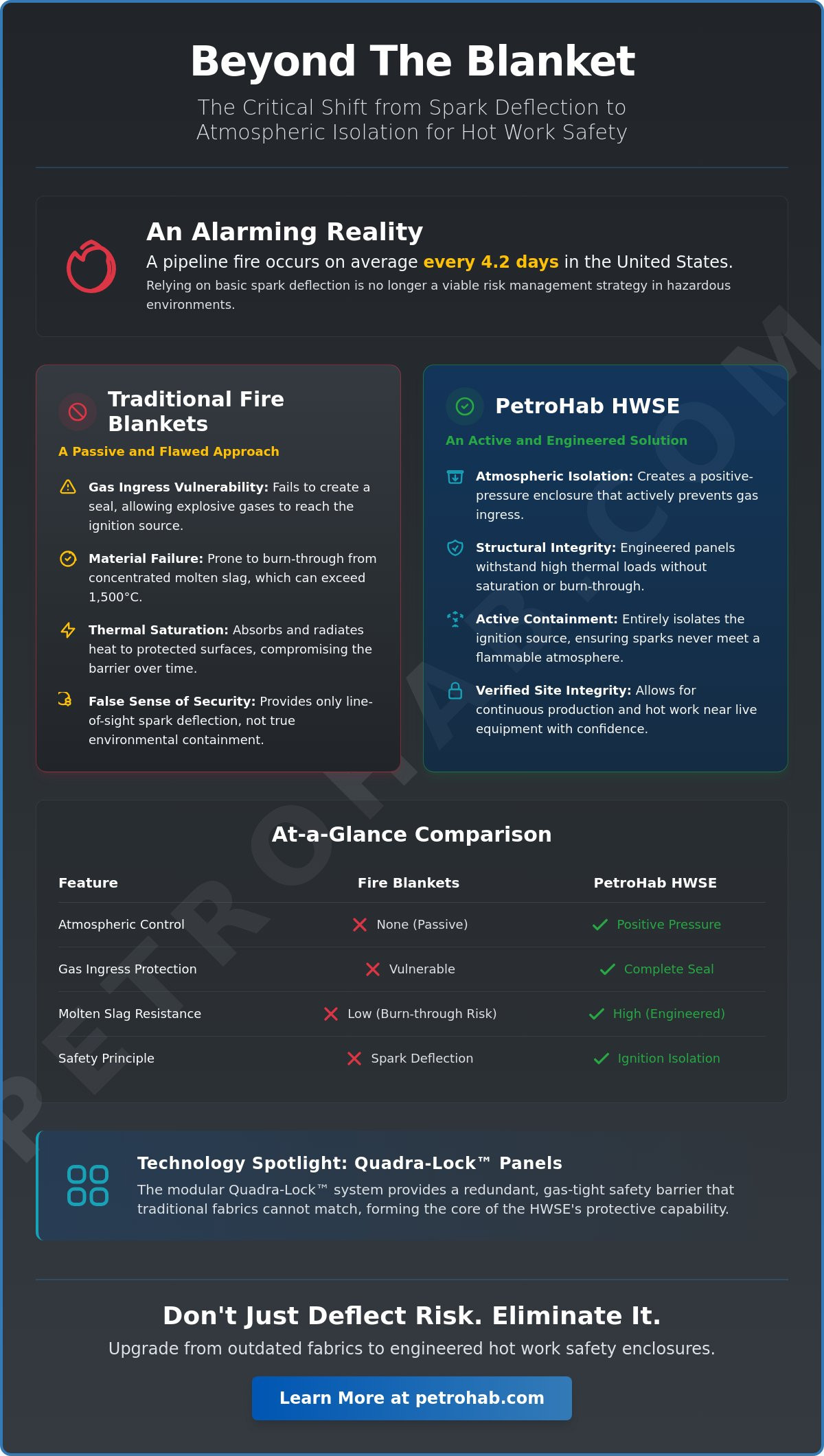
With a pipeline fire occurring on average every 4.2 days in the United States, relying on basic spark deflection is no longer a viable risk management strategy. While fire blankets remain a staple on many sites, they are fundamentally limited in their ability to prevent catastrophic ignition in hazardous environments. Understanding the limitations of fire blankets for pipeline welding is critical for engineers who must maintain compliance with the 2024 edition of NFPA 51B and mitigate the risk of explosive gas ingress.
It’s understandable that you prioritize established protocols to protect your personnel and high-value assets. However, traditional fabrics cannot provide the positive-pressure isolation necessary for high-stakes hot work in gas-prone zones. This article explains why basic equipment fails to meet 2026 safety standards and how engineered solutions like the PetroHab Hot Work Safety Enclosure (HWSE) bridge this gap. We will examine the technical deficiencies of ANSI/FM 4950 rated materials and provide a clear framework for upgrading to pressurized habitats featuring Quadra-Lock panels to ensure absolute site integrity.
Key Takeaways
- Distinguish between simple spark deflection and true atmospheric isolation to prevent catastrophic ignition in hazardous environments.
- Analyze why standard ANSI/FM 4950 fabric ratings often fail under the weight of concentrated molten slag during overhead welding operations.
- Identify the critical limitations of fire blankets for pipeline welding when operating in ATEX-classified or gas-prone zones.
- Evaluate the operational advantages of upgrading to pressurized Petro-Habitats to maintain production schedules near live equipment.
- Understand how Quadra-Lock Panels and Safe-Stop systems provide a redundant, gas-tight safety barrier that traditional fabrics cannot match.
The Role and Misconceptions of Fire Blankets in Pipeline Welding
Safety managers often conflate fire suppression tools with hot work protection systems. A standard Fire blanket is engineered to extinguish small, incipient fires by smothering the flame and cutting off oxygen. In contrast, welding blankets are designed to deflect sparks and molten slag. This distinction is critical in pipeline environments where the presence of hydrocarbons demands more than simple deflection. Relying on blankets as a primary safety barrier creates a dangerous false sense of security. It leads teams to believe they’ve mitigated ignition risks when they’ve actually only moved them. 2026 safety standards are increasingly moving away from these passive tools toward active containment solutions that offer a definitive technological remedy.
To visualize the differences in performance and application, review this technical comparison:
The transition toward 2026 safety standards reflects a shift from passive spark management to active containment. Passive systems don’t manage the surrounding atmosphere. They only attempt to shield it. This is one of the primary limitations of fire blankets for pipeline welding. When dealing with pressurized systems, a spark that ricochets off a blanket edge can still find a gas pocket. True safety requires a system that isolates the ignition source from the environment entirely. This ensures that even if a spark escapes the immediate weld point, it remains trapped within a controlled space.
Passive Spark Deflection vs. Active Containment
Blankets function on a line-of-sight principle. They only protect what they physically cover. In the complex geometries of pipeline manifolds or compressor stations, molten spatter rarely follows a linear path. Sparks can bounce, roll, or find gaps in overlapping fabrics. Active containment systems, unlike blankets, create a sealed environment. They don’t just redirect sparks; they ensure the spark never encounters a flammable medium. This proactive approach is the benchmark for modern industrial safety and risk mitigation.
Material Limitations and Thermal Saturation
Most industrial blankets utilize fiberglass with vermiculite or silicone coatings. These materials have finite thermal thresholds. During prolonged hot work, thermal saturation occurs. The blanket absorbs energy until it begins radiating heat directly to the substrate it’s meant to protect. This hidden degradation is a major factor in the limitations of fire blankets for pipeline welding. By the time a failure is visible, the integrity of the barrier is already compromised. Engineered enclosures solve this by using modular panels, such as Quadra-Lock, which maintain structural integrity under high thermal loads without the risk of saturation or burn-through.
Thermal and Structural Failures: Why Blankets Aren’t Enough
Pipeline welding operations demand extreme temperatures, often exceeding 1,500°C at the arc. Standard industrial fabrics rated for spark protection frequently fail when subjected to the concentrated thermal mass of molten metal. This physical vulnerability highlights the fundamental limitations of fire blankets for pipeline welding. Unlike flat work surfaces, a pipeline’s cylindrical geometry causes spatter to roll or pool in unpredictable patterns. When slag accumulates on a horizontal section of fabric, it creates a localized heat sink that rapidly exceeds the material’s structural limits.
The Physics of Molten Spatter
High-amperage welding produces spatter with sufficient energy to penetrate standard fiberglass weaves. As molten metal accumulates, it doesn’t just bounce; it adheres and transfers heat directly into the fibers. Burn-through threshold is the critical point where material failure occurs due to concentrated thermal load. Once this threshold is breached, the barrier is compromised, allowing ignition sources to reach the substrate or surrounding environment. Adherence to OSHA Fire Prevention Standards requires the use of guards that effectively contain all sparks and slag, yet blankets often lack the density to perform this role under heavy-duty conditions.
Environmental Displacement and Rigging Failures
Securement remains a persistent challenge on offshore platforms and exposed pipeline segments. High-wind conditions frequently displace blankets, even when they are wired or clamped in place. This displacement creates hazardous gaps in “tenting,” allowing sparks to escape toward lower decks or gas-prone equipment. Human error also complicates the use of these passive barriers. Overlapping multiple blanket sections correctly is a meticulous, time-consuming process. If a single seam is left loose or a corner is improperly secured, the entire safety protocol fails.
Reusing blankets is another common but dangerous industry practice. Microscopic tears and chemical degradation from previous hot work sessions are often invisible to the naked eye. These structural weaknesses mean a blanket that passed a visual inspection yesterday might suffer a catastrophic failure today. Engineered solutions like pressurized habitats eliminate these variables by utilizing rigid, interlocking components that don’t shift in the wind or degrade like traditional fabrics. This transition from flexible materials to a structured enclosure ensures a consistent, gas-tight seal that passive blankets cannot achieve.
The Critical Safety Gap: Gas Ingress and Environmental Containment
Fire blankets are engineered to manage solids, not gases. This distinction represents the most dangerous of the limitations of fire blankets for pipeline welding. While a high-quality blanket may successfully deflect a spark, it possesses no mechanism to prevent the ingress of flammable hydrocarbons into the welding arc. In ATEX-classified zones, being “spark-proof” is functionally irrelevant if the atmosphere isn’t controlled. True safety requires an explosion-proof strategy that addresses the volatile atmospheric conditions surrounding the weld. A blanket is a porous, non-sealed barrier. It can’t stop a pressurized gas plume from drifting into the immediate vicinity of an ignition source. This lack of a gas-tight seal means even a perfectly deployed blanket leaves the site vulnerable to catastrophic ignition.
The Myth of the “Safe” Open Weld
Refineries and offshore rigs are dynamic environments where gas plumes shift based on wind and pressure changes. Relying on a draped fabric to protect a hot work site assumes that the environment remains static. It doesn’t. Because blankets can’t maintain positive pressure, they offer zero resistance to hydrocarbon displacement. They’re purely reactive tools. To understand the engineering required for true isolation, safety managers should consult Pressurized Welding Habitats: The Definitive Guide to HWSE Technology. These systems replace passive drapes with active environmental control. By utilizing a continuous flow of clean air, these enclosures ensure that the internal atmosphere remains non-hazardous regardless of external leaks or plumes.
Interference with Gas Detection Protocols
The physical presence of a fire blanket often complicates standard safety monitoring and gas detection protocols. Blankets can inadvertently trap heavy gases, such as Hydrogen Sulfide (H2S), near the welder’s breathing zone or the weld pool itself. This phenomenon, known as “pocketing,” occurs when gas accumulates in the deep folds or “tents” of a draped blanket. Because the fabric acts as a physical shield, it often prevents external gas detection sensors from accurately reading the atmosphere at the actual point of work.
Safety managers frequently struggle to verify a non-hazardous atmosphere behind these barriers. This creates a critical blind spot where an explosive mixture can reach the Lower Explosive Limit (LEL) without triggering an alarm. Without the rigid, interlocking structure of Quadra-Lock panels to maintain a defined, manageable space, safety monitoring remains a matter of guesswork rather than technical certainty. Relying on blankets in these zones isn’t just a technical limitation; it’s a fundamental failure of the risk mitigation chain. Modern safety protocols demand active barriers that support, rather than hinder, the performance of gas detection systems.
Comparing Fire Blankets to Engineered Hot Work Safety Enclosures
Evaluating the safety of a pipeline welding site requires a shift from simple spark deflection to comprehensive atmospheric isolation. While fire blankets are often viewed as an industry standard for portable welding, they are fundamentally passive. They don’t integrate with the facility’s broader safety infrastructure. In contrast, a PetroHab Hot Work Safety Enclosure (HWSE) functions as a primary engineering control. This distinction is vital when considering the limitations of fire blankets for pipeline welding in high-risk environments. Unlike blankets, an HWSE integrates directly into the Permit-to-Work (PTW) system as a documented containment barrier, providing safety managers with a verifiable method of risk reduction that simple fabrics cannot replicate.
Production continuity often depends on the ability to perform hot work near live equipment. Fire blankets rarely provide the level of protection necessary to satisfy rigorous risk assessments in these scenarios. When a blanket is the only barrier, safety protocols often mandate a complete shutdown of adjacent pressurized systems. An engineered enclosure allows these systems to remain operational by creating a controlled, internal environment. This transition from a reactive “shield” to an active “habitat” is the hallmark of modern industrial safety excellence.
Operational Efficiency and Downtime Reduction
Utilizing an HWSE significantly reduces the operational footprint of a repair. Traditional methods often require a massive fire watch radius and extensive plant shutdowns to manage the risk of stray sparks. Because a pressurized habitat contains all ignition sources within a gas-tight perimeter, it minimizes the required fire watch area. This efficiency allows for minor pipeline repairs without interrupting the output of the entire facility. For a deeper technical analysis of these benefits, see A Comprehensive Guide to Advanced Hot Work Safety Systems in 2026. These systems aren’t just safety tools. They’re operational assets that protect your bottom line.
Compliance with NFPA 51B Standards
The 2024 edition of NFPA 51B mandates strict precautions for hot work within 35 feet of flammable materials. Fire blankets are frequently insufficient for this rule in Tier 1 industrial facilities because they lack a verifiable seal. Modular panels, such as the Quadra-Lock system, provide a documented safety barrier that survives rigorous audits. Positive isolation is the physical separation of an ignition source from a potential fuel source through a verifiable, pressurized barrier. While blankets are often treated as disposable waste after a single heavy-duty use, HWSE components are engineered for longevity and consistent performance across multiple projects.
Choosing the right containment system is a calculation of reliability and personnel protection. If you’re ready to move beyond the technical failures of passive shielding, explore our range of pressurized welding enclosures to secure your next project site.
Transitioning to Pressurized Habitats for Maximum Risk Mitigation
Adopting an engineered containment strategy is the definitive response to the high-stakes risks inherent in energy sector maintenance. PetroHab Hot Work Safety Enclosures (HWSE) provide the technical remedy required to overcome the documented limitations of fire blankets for pipeline welding. By moving away from passive shielding, facilities implement a proactive safety architecture that actively manages the environment. This transition isn’t merely an equipment upgrade. It’s a fundamental shift toward absolute risk mitigation and the protection of high-value assets. The integration of pressurized habitats ensures that hot work remains isolated from potential ignition sources, regardless of the external atmospheric conditions.
The Quadra-Lock Advantage
The structural integrity of a Petro-Habitat relies on patented Quadra-Lock technology. Unlike traditional fabrics that shift or degrade under thermal load, Quadra-Lock Panels utilize a sophisticated interlocking mechanism to create a seamless, gas-tight seal. This modular design provides several critical advantages over conventional barriers:
- Structural Resilience: Panels maintain their form under positive pressure, preventing the “tenting” and gaps common in draped blankets.
- Adaptability: The system easily configures around complex pipeline diameters, manifold obstructions, and structural steel.
- Superior Durability: Engineered materials resist the cumulative damage and microscopic tearing that compromise the safety of reused welding fabrics.
These panels don’t just deflect sparks. They provide a verifiable physical barrier that stands up to the rigors of heavy-duty industrial environments. The result is a consistent, reliable safety perimeter that eliminates the variables of human error during rigging.
Proactive Safety with Safe-Stop
True environmental containment requires more than just physical panels. It demands real-time monitoring and automated response. The Safe-Stop Automatic Shutdown System acts as the active guardian of the hot work site. It continuously monitors internal pressure and gas levels, ensuring the atmosphere remains within non-hazardous parameters. If the system detects a loss of pressure or the presence of hydrocarbons, the automated shutdown mechanism immediately cuts power to the welding machine. This level of automated safety integration is something that passive barriers simply cannot provide.
Implementing this technology effectively eliminates the “critical safety gap” where an explosive mixture could reach the welding arc undetected. Safety managers gain absolute confidence through a system that provides both a physical seal and an electronic fail-safe. Transitioning your facility from antiquated blankets to modern pressurized habitats is a structured process that begins with a comprehensive site assessment. It’s time to replace reactive measures with a definitive safety solution. To begin your transition to an industry-leading safety standard, consult with PetroHab to secure your next pipeline welding project.
Securing the Future of Pipeline Maintenance
Modern industrial safety standards demand a shift from passive spark deflection to active atmospheric containment. We’ve identified the technical limitations of fire blankets for pipeline welding; specifically their structural vulnerability under concentrated thermal loads and their inability to prevent gas ingress. Relying on basic fabrics in ATEX-classified zones creates a documented safety gap that only engineered solutions can bridge. Passive measures are no longer sufficient for Tier 1 facilities operating in 2026.
By integrating PetroHab Hot Work Safety Enclosures (HWSE), you transition to a safety protocol trusted by global oil and gas majors. Our systems utilize patented Quadra-Lock technology to ensure a verifiable, gas-tight seal that supports your broader Permit-to-Work requirements. These ATEX and IECEx compliant systems provide the redundant protection necessary to safeguard your personnel and high-value assets. Don’t leave your site’s integrity to chance when definitive technological remedies are available.
Request a Quote for PetroHab Hot Work Safety Enclosures to establish an uncompromising standard of safety on your next project. We look forward to partnering with you to achieve operational excellence and site-wide security.
Frequently Asked Questions
Can fire blankets be used as the primary safety barrier for offshore welding?
Fire blankets aren’t suitable as primary barriers offshore because they lack the structural integrity to resist high wind speeds and the ability to isolate hazardous gases. While they offer basic spark protection, they don’t provide the environmental containment necessary for volatile offshore platforms. Relying on them in these environments ignores the risk of gas ingress and physical displacement.
What is the maximum temperature rating for a professional-grade welding blanket?
Professional-grade silica blankets often carry ratings up to 3,000°F (1,650°C), but these ratings don’t account for the concentrated thermal mass of pooling slag. Molten metal can exceed these limits during high-amperage welding, leading to the thermal failures discussed earlier. These ratings reflect intermittent spark contact rather than the sustained heat of concentrated molten metal.
Why do fire blankets fail to meet ATEX Zone 1 safety requirements?
Fire blankets fail ATEX Zone 1 requirements because they’re non-sealed, porous materials that cannot prevent the ingress of flammable gases. ATEX standards demand a barrier that prevents an ignition source from contacting an explosive atmosphere. This task exceeds the capabilities of any passive fabric, which lacks the gas-tight seal required for hazardous zone compliance.
How does a pressurized welding habitat differ from a simple welding tent?
The primary difference is the use of positive pressure to create a gas-tight seal against the external environment. A pressurized welding habitat, such as a Petro-Habitat, actively forces clean air into the workspace to displace hydrocarbons. A welding tent is merely a passive shelter for wind or rain and offers no protection against explosive gas plumes.
Are fire blankets reusable after being hit by heavy welding spatter?
Reusing blankets after heavy spatter exposure is dangerous because microscopic damage and thermal saturation compromise their structural integrity. One of the primary limitations of fire blankets for pipeline welding is their tendency to degrade invisibly, making them unreliable for subsequent high-stakes hot work. Safety managers should treat heavily used blankets as disposable to avoid catastrophic failure.
What happens if gas accumulates behind a fire blanket during hot work?
Gas accumulation behind a blanket creates a localized explosive atmosphere that is often shielded from external gas detectors. This pocketing effect means a welder could be working inside a cloud of hydrocarbons that has reached the Lower Explosive Limit (LEL) without any warning. This creates a high risk of ignition that passive barriers cannot detect or prevent.
Does NFPA 51B specifically recommend enclosures over fire blankets?
NFPA 51B mandates effective isolation but fire blankets are often insufficient for the 35-foot rule in high-risk Tier 1 facilities. Engineered enclosures are preferred because they provide a verifiable, documented seal that satisfies the standard’s requirement for preventing spark escape. Habitats offer a higher level of compliance by ensuring the atmosphere is controlled throughout the operation.
How do Quadra-Lock panels provide better protection than traditional rigging?
Quadra-Lock panels utilize an interlocking mechanism that ensures the enclosure remains gas-tight and structurally sound even in high-wind conditions. Unlike traditional rigging, which relies on clamps and wire that can slip or fail, these panels create a rigid, redundant barrier. This engineering ensures the enclosure integrates seamlessly with automated shutdown systems for absolute site security.