Blog Posts
ATEX Compliant Pressurized Habitats: Integrating POB Systems for 2026 Safety Standards
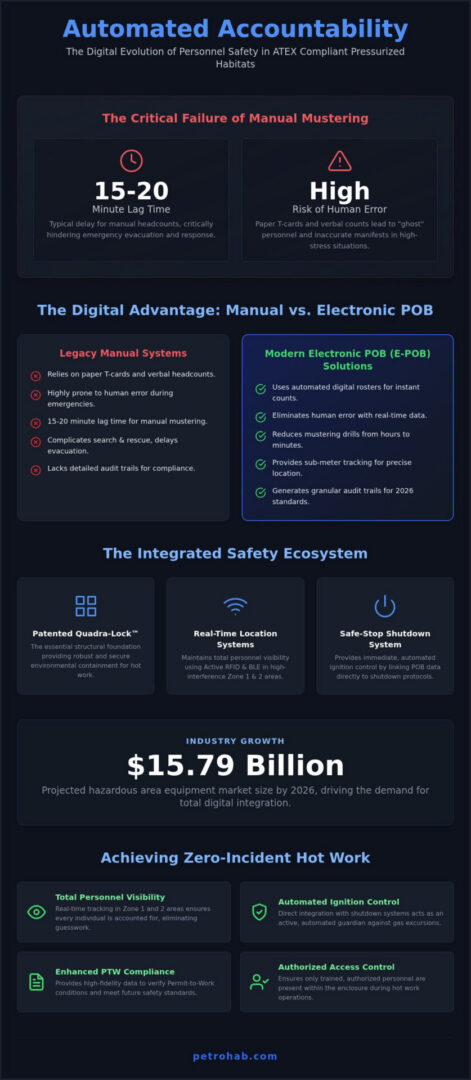
In a high-pressure Zone 1 environment, a five-minute delay in manual mustering isn’t just an administrative lapse; it’s a critical failure in your safety chain of command. Relying on paper T-cards or verbal headcounts during an emergency shutdown creates unacceptable risk for personnel operating within ATEX compliant pressurized habitats. As the hazardous area equipment market grows to a projected $15.79 billion in 2026, the industry is moving toward total digital integration to eliminate human error during hot work operations.
You recognize that maintaining environmental containment is only half the battle if you can’t account for every technician inside the enclosure the moment a gas sensor triggers. We’ll show you how to integrate digital personnel tracking with habitat hardware to ensure total accountability and automated ignition control in hazardous zones. This guide examines the technical synergy between Quadra-Lock panel integrity, the Safe-Stop Automatic Shutdown System, and the latest electronic POB tracking standards for 2026. You’ll learn how to achieve zero-incident hot work by linking real-time personnel data directly to your automatic shutdown protocols. This approach ensures that your safety systems act as an active, automated guardian of your high-value assets and your team.
Key Takeaways
- Understand the critical transition from manual T-card manifests to automated digital rosters to eliminate human error during emergency mustering.
- Learn how to integrate real-time location systems (RTLS) with atex compliant pressurized habitats to maintain total personnel visibility in Zone 1 and 2 areas.
- Discover the technical requirements for linking POB data directly to the Safe-Stop Automatic Shutdown System for immediate ignition control during gas excursions.
- Explore how electronic POB solutions provide the granular audit trails necessary to meet 2026 safety standards and verify Permit-to-Work compliance inside enclosures.
- See why patented Quadra-Lock technology serves as the essential structural foundation for housing advanced digital tracking and environmental containment hardware.
What is an ATEX POB System and Why is it Critical in 2026?
An ATEX Personnel on Board (POB) system is an electronically integrated solution designed to track individuals within potentially explosive atmospheres. In 2026, the industry has transitioned away from the inherent inaccuracies of manual T-card boards and paper manifests. These legacy methods fail to provide the immediate visibility required during a critical incident. Modern systems utilize intrinsically safe hardware to monitor personnel movement in real time, ensuring that every soul on a platform is accounted for without human intervention. This technology aligns with the ATEX directives, which mandate strict controls over any equipment that could act as an ignition source in hazardous environments.
Regulatory bodies in the North Sea and the Gulf of Mexico now demand high-fidelity data to support safety audits and emergency response protocols. Digital POB systems are no longer optional accessories; they’re foundational components of the Permit-to-Work (PTW) ecosystem. When atex compliant pressurized habitats are deployed for hot work, the POB data confirms that only authorized, trained personnel are present within the enclosure. This precision prevents unauthorized access and ensures that the total headcount never exceeds the design limits of the life-saving equipment available.
Understanding ATEX Zone Classifications for Personnel Tracking
Tracking hardware must meet specific requirements based on the severity of the hazardous atmosphere. In Zone 1 and Zone 2 areas, where flammable gases are likely or possible during normal operations, beacons and anchors must be rigorously certified to prevent spark or heat generation. POB systems must maintain their operational integrity even if the surrounding atmosphere becomes volatile. ATEX POB compliance for offshore rigs requires all tracking hardware to be explosion-proof and intrinsically safe to prevent ignition while providing continuous personnel location data.
The Cost of Inaccuracy: Manual Headcounts vs. Real-Time Data
Manual mustering during a high-stress emergency often leads to “ghost” personnel or missing contractors, which delays the launch of lifeboats and complicates search and rescue efforts. Inaccurate headcounts can lead to dangerous overcrowding or under-utilization of lifeboat capacity. By using real-time data within atex compliant pressurized habitats, safety managers receive an instant, automated roster. This eliminates the 15 to 20 minute lag time typical of manual counts, allowing for a decisive and safe evacuation when every second counts.
Core Technologies Powering Modern ATEX POB Systems
Modern Personnel on Board (POB) systems rely on Real-Time Location Systems (RTLS) to maintain a digital safety perimeter. Unlike traditional methods, RTLS uses a network of anchors and beacons to triangulate personnel coordinates with high fidelity. In the context of atex compliant pressurized habitats, these systems must overcome significant signal attenuation caused by dense steel structures and modular Quadra-Lock panels. Active RFID is the preferred choice for these high-interference environments. It provides the necessary signal strength to penetrate metallic barriers that would otherwise block passive RFID frequencies, ensuring continuous visibility of every technician.
Hardware durability is a non-negotiable requirement for tags used during hot work. These devices must survive the elevated temperatures and electromagnetic interference common in welding operations. Bluetooth Low Energy (BLE) has emerged as a viable standard in ATEX zones due to its low power consumption and high compatibility with mobile monitoring devices. However, engineers must ensure these tags are housed in industrial-grade, heat-resistant casings to maintain operational integrity inside the enclosure. This resilience prevents hardware failure at the exact moment a safety event occurs.
Hands-Free Mustering and RTLS Accuracy
Automated mustering technology transforms emergency response by reducing drill times from hours to mere minutes. By utilizing sub-meter tracking, safety officers can pinpoint the exact location of a technician within complex modular structures or atex compliant pressurized habitats. This precision allows for immediate verification of headcount without manual intervention. It effectively solves the problem of signal dead spots by strategically placing anchors around the perimeter of the work site. The system automatically updates the muster list as personnel move, removing the delays associated with manual card swiping or verbal reporting.
Battery Life and Connectivity in Hazardous Areas
Power management is critical for any tracking device operating in a remote or hazardous environment. Tags must feature ATEX-certified lithium batteries capable of lasting multiple years to minimize maintenance risks and battery replacement cycles in explosive atmospheres. These systems often comply with U.S. Coast Guard electrical requirements for marine environments to ensure maximum reliability and safety. Mesh networking provides a more resilient communication backbone than standard Wi-Fi by allowing data to hop between nodes. This architecture ensures that if one anchor fails, the rest of the system remains online. For high-risk operations, fail-safe local data storage on the anchors prevents data loss during primary network outages. If you’re planning a complex maintenance project, you can explore PetroHab’s integrated safety systems to see these technologies in action.
Comparing Manual Headcounts vs. Electronic POB (E-POB) Solutions
The operational shift from manual manifests to electronic personnel on board (E-POB) systems is a response to the increasing complexity of offshore maintenance. While paper-based systems were once the industry norm, they lack the speed required for modern, high-intensity shift turnovers. E-POB solutions provide the granular auditability mandated by 2026 hazardous environment standards. This digital infrastructure allows for instantaneous verification of crew status. This is particularly vital when operating atex compliant pressurized habitats on live production platforms. By removing the manual logging process, facilities reduce the time spent on administrative muster checks during every crew change.
Evaluating the cost-benefit of E-POB involves looking beyond the initial CAPEX. The long-term safety ROI is realized through the elimination of human error and the optimization of emergency response times. Automated systems ensure that safety managers have a definitive record of all individuals within the work scope. This digital oversight reinforces the physical protection provided by Quadra-Lock panels. The investment creates a more resilient safety ecosystem where documentation is generated automatically rather than reliant on manual entry. It’s a fundamental upgrade from legacy protocols to a data-driven safety culture.
The Limitations of Legacy T-Card Systems
Legacy T-card systems present several vulnerabilities during high-stress scenarios. Physical cards can be misplaced, forgotten, or incorrectly flipped. These errors lead to a flawed headcount that endangers lives during an evacuation. Tracking personnel movement between interconnected vessels or within atex compliant pressurized habitats is notoriously difficult with manual methods. There is also the persistent issue of “dead time.” This is the period between a person boarding a facility and their data being manually updated in the central roster. These informational gaps can lead to critical delays in search and rescue efforts when every second counts.
E-POB: The New Standard for Offshore Accountability
E-POB systems provide real-time dashboards that offer Offshore Installation Managers (OIMs) a live view of platform population. These dashboards highlight unauthorized entry into high-risk zones, triggering alerts before a safety breach can occur. Integrating these platforms with hot work safety systems ensures that any hot work activity is immediately visible to the control room. This level of transparency guarantees that accountability is maintained across all work shifts. It provides a level of oversight that manual systems simply cannot match. Automated rosters allow for precise lifeboat capacity management, ensuring that evacuation resources are never over-allocated.
Integrating POB Data with Hot Work Safety and Emergency Shutdowns
The integration of real-time POB data with physical safety hardware represents the pinnacle of hazardous area management. While software awareness provides visibility, true protection occurs when this data triggers a physical response. In pressurized welding habitats, POB systems serve as a secondary validation layer for Permit-to-Work (PTW) protocols. By cross-referencing tracking data with active permits, the system ensures only qualified technicians occupy the enclosure during high-risk activities. If an unauthorized individual enters the work zone, the system can automatically inhibit ignition sources to prevent potential accidents.
Engineers must ensure that the installation of POB sensors doesn’t compromise the environmental seal of atex compliant pressurized habitats. Every sensor mount and cable penetration must meet rigorous ATEX standards to maintain the required positive pressure differential. This ensures that the tracking system provides safety data without introducing a new leak path or ignition risk. By linking personnel density data to the emergency shutdown (ESD) logic, operators can prioritize evacuation zones and life-saving resources during a platform-wide event.
POB and the Safe-Stop Automatic Shutdown System
The Safe-Stop Automatic Shutdown System acts as the central intelligence for environmental monitoring, but its efficacy increases when synchronized with personnel tracking. Safe-Stop detects gas excursions or pressure loss, while the POB system identifies the specific individuals within the danger zone. This synchronization allows for immediate, automated emergency protocols when personnel are detected in areas where gas concentrations exceed safety thresholds. The system monitors the environment while POB monitors the people, creating a dual-layered defense. Individual worker tracking tags can receive haptic or visual alerts the moment Safe-Stop triggers a shutdown, ensuring every technician is notified instantly regardless of ambient noise levels.
Personnel Accountability Within Pressurized Habitats
Maintaining a precise headcount inside a hot work safety enclosure is critical for managing ventilation requirements and emergency egress. The structural integrity provided by Quadra-Lock panels ensures a secure boundary, while internal tracking anchors provide a continuous data stream to the control room. This setup prevents the “ghost personnel” phenomenon often encountered during manual headcounts. POB data enhances HWSE safety audits by providing an immutable, time-stamped record of every individual’s entry and exit from the pressurized environment. This automated oversight removes the administrative burden from the fire watch, allowing them to focus entirely on ignition prevention and habitat monitoring.
To secure your next offshore project with fully integrated containment and tracking, contact PetroHab to discuss our Safe-Stop and Quadra-Lock solutions.
PetroHab’s Role in Enhancing Offshore POB and Personnel Safety
PetroHab LLC defines the industry standard for personnel protection by merging physical containment with advanced digital monitoring. Our commitment to a “Safety First” philosophy drives the development of systems where atex compliant pressurized habitats and the Safe-Stop Automatic Shutdown System function as a single, cohesive unit. This integration provides safety managers with the environmental context necessary to make informed decisions during hot work operations. By combining real-time personnel data with habitat pressure and gas detection metrics, we eliminate the blind spots that often lead to industrial accidents.
The Synergy of Quadra-Lock and Digital Tracking
The patented Quadra-Lock technology is the preferred choice for modular safety enclosures because it provides a superior interlocking seal. These fire-resistant panels create a definitive barrier between technicians and external ignition hazards in ATEX zones. Unlike generic containment solutions, the modular design of a PetroHab LLC HWSE is engineered to accommodate modern digital tracking hardware. Antennas and beacons are integrated into the structure in a way that preserves the enclosure’s positive pressure. The materials used in Quadra-Lock panels are tested for long-term durability, ensuring that tracking equipment remains operational even in high-heat welding environments. This structural resilience ensures that the physical protection of the habitat doesn’t interfere with the digital visibility of the crew.
Deployment and Training for Integrated Safety Systems
Successful integration of POB tracking and atex compliant pressurized habitats depends on precise installation and personnel competency. PetroHab LLC provides expert on-site supervision to oversee the setup of integrated habitats, ensuring that all Safe-Stop sensors and tracking anchors are positioned for maximum efficacy. We train your team to operate within this framework, focusing on how to respond to automated alerts and shutdown triggers. This hands-free mustering capability only reaches its full potential when the workforce understands the underlying safety logic. We offer global availability for both leasing and sales, providing the necessary technical support to offshore projects in every major energy corridor. Our veteran technicians bring decades of field experience to your site, acting as critical safety partners from project inception to completion. If you’re ready to upgrade your hot work protocols, contact PetroHab LLC for a comprehensive assessment of your safety requirements.
Advancing Industrial Safety Through Integrated Containment
The transition toward automated personnel tracking and real-time environmental monitoring is the definitive standard for 2026. By integrating digital POB systems with atex compliant pressurized habitats, safety managers eliminate the latency and inaccuracy inherent in manual headcounts. This technological synergy ensures that your workforce is protected by patented Quadra-Lock technology while remaining continuously visible to control room operators. These systems work together to transform safety from a reactive protocol into a proactive, automated defense mechanism.
The Safe-Stop Automatic Shutdown System provides the critical link between environmental data and personnel location, allowing for immediate ignition control during gas excursions. Maintaining this level of technical precision is essential for zero-incident hot work operations in high-stakes offshore environments. PetroHab provides the expertise, global on-site supervision, and specialized training required to ensure your safety protocols are executed flawlessly. This comprehensive approach to risk mitigation protects your most valuable assets and ensures the welfare of every technician on site.
Request a Quote for Pressurized Welding Habitat Rental and Integrated Safety Systems to upgrade your site’s safety architecture. We look forward to helping you achieve total operational excellence and a zero-incident workplace.
Frequently Asked Questions
What does an ATEX POB system actually track?
An ATEX POB system tracks the real-time identity, location, and movement of personnel within hazardous environments. It utilizes intrinsically safe tags to monitor when individuals enter or exit specific work areas. In atex compliant pressurized habitats, the system verifies that only authorized Permit-to-Work holders are present. The data provides timestamped logs and precise coordinates to ensure total accountability during emergency mustering or routine shift turnovers.
Can POB systems function during a total power failure on an offshore rig?
Yes, industrial-grade tracking systems include redundant power solutions to maintain visibility. ATEX-certified anchors and gateways often feature internal battery backups or connect directly to the facility’s uninterruptible power supply. This ensures that personnel tracking remains active even during a platform-wide blackout. Local data caching on individual nodes prevents the loss of tracking history if the primary network connection is severed during a power excursion.
Is an ATEX POB system mandatory for all offshore hot work?
While not a universal legal mandate, digital POB is increasingly required by regional standards in the North Sea and Gulf of Mexico. Many operators now include electronic tracking as a mandatory engineering control within their Safety Management Systems. Using these systems alongside atex compliant pressurized habitats provides the necessary audit trail to prove compliance with international safety regulations and internal risk mitigation policies.
How do POB systems handle personnel movement between a vessel and a platform?
Modern systems use geofencing and bridge-mounted anchors to detect transition points automatically. As a technician crosses the gangway, the system transfers their status from the vessel roster to the platform manifest without manual intervention. This automation removes the “dead time” associated with manual T-card updates. It ensures that Offshore Installation Managers have an accurate, real-time count of every person currently on the asset.
What is the difference between ATEX Zone 1 and Zone 2 POB hardware?
Zone 1 hardware is engineered for areas where an explosive atmosphere is likely to occur during normal operation. It requires more rigorous intrinsic safety or flameproof certifications to prevent ignition. Zone 2 hardware is suitable for environments where flammable gases are only present under abnormal conditions. Both types prevent ignition, but Zone 1 equipment undergoes more stringent testing to ensure it cannot produce a spark or heat sufficient to cause an explosion.
How does PetroHab’s Quadra-Lock technology interact with tracking signals?
Quadra-Lock panels are engineered to provide a superior physical seal without creating a total signal shield. While dense steel structures cause signal attenuation, the modular nature of these panels allows for the strategic placement of antennas and beacons. This ensures that tracking signals maintain high fidelity inside the enclosure. The system is designed to provide sub-meter accuracy even when personnel are working behind these fire-resistant barriers.
Can the Safe-Stop system be integrated with third-party POB software?
Yes, the Safe-Stop Automatic Shutdown System features an open architecture to facilitate integration with various digital safety platforms. It can export environmental data, such as gas levels and pressure metrics, to third-party software via standard industrial communication protocols. This allows operators to view personnel locations and habitat status on a single unified dashboard, which streamlines the decision-making process during a critical shutdown event.
What are the maintenance requirements for ATEX tracking tags?
Maintenance primarily involves periodic battery checks and physical inspections for casing integrity. Many tags are designed with a battery life exceeding three years in ATEX environments to minimize maintenance cycles. Technicians should inspect tags for damage that could compromise their intrinsic safety rating, such as cracks in the heat-resistant housing. Regular firmware updates and signal strength tests ensure that the tags continue to communicate reliably with the network anchors.