Blog Posts
Calculating ROI for Welding Habitats: A Strategic Guide for Safety Managers
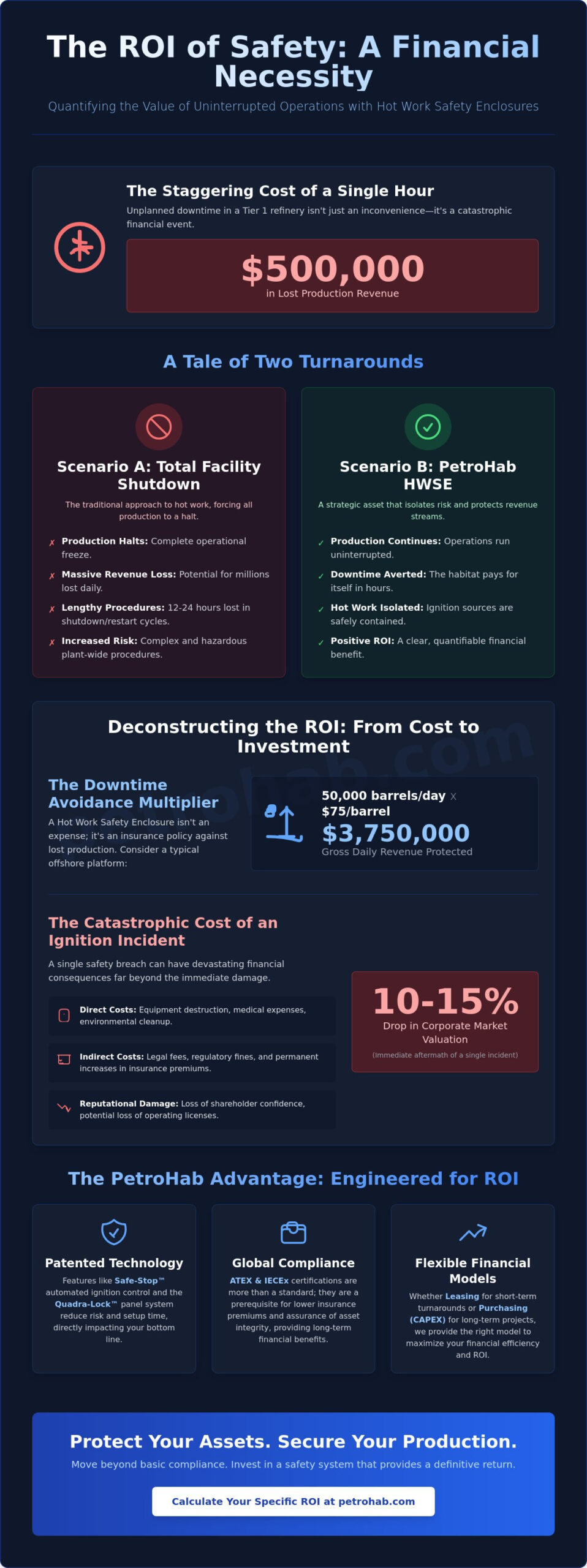
A single hour of unplanned downtime in a Tier 1 refinery can result in $500,000 of lost production revenue. You recognize that while safety remains the absolute priority, the pressure to maintain operational continuity during critical turnarounds is constant. Complex permit-to-work delays and the potential for catastrophic financial loss from ignition incidents often turn maintenance into a significant operational bottleneck. This guide provides a rigorous framework for calculating ROI for welding habitats, allowing you to quantify the fiscal benefits of downtime reduction and risk mitigation.
You’ll learn how implementing pressurized Hot Work Safety Enclosures (HWSE) like the patented Petro-Wall system protects high-value assets while allowing production to continue. We’ll examine the technical methodologies for measuring the impact of our Safe-Stop technology on insurance premiums and liability risks. This analysis moves beyond basic compliance to demonstrate how modular, ATEX-certified systems ensure the integrity of your site during high-stakes hot work. By applying these metrics, you can present a definitive case for safety investments that align with your facility’s bottom line.
Key Takeaways
- Quantify the fiscal difference between the controlled investment of Hot Work Safety Enclosures and the catastrophic costs associated with total facility shutdowns.
- Utilize a technical framework for calculating ROI for welding habitats by comparing equipment purchase against leasing and evaluating the efficiency of modular systems.
- Apply the Downtime Avoidance Multiplier to determine the precise production value preserved by maintaining operational continuity during critical maintenance.
- Assess the long-term financial impact of ATEX and IECEx compliance on corporate insurance premiums and the protection of high-value industrial assets.
- Reduce operational overhead by leveraging patented Quadra-Lock setup efficiencies and the Safe-Stop system’s automated ignition source control.
The Financial Logic of Hot Work Safety Enclosures
Return on investment in high-hazard environments is fundamentally different from standard industrial calculations. When safety managers begin calculating ROI for welding habitats, they must shift their perspective from simple capital expenditure to a model of loss avoidance. In the oil and gas sector, a single hour of unplanned downtime on a production platform can cost between $40,000 and $100,000. These figures make the initial cost of safety equipment secondary to the preservation of the production stream. Traditional welding ROI calculators often fail because they focus on electrode consumption and labor hours while ignoring the critical variable of ignition source control.
Implementing a Positive pressure enclosure allows for the execution of “hot work” without the necessity of a total facility shutdown. This capability transforms the habitat from a simple tool into a strategic asset. By isolating the ignition source from the surrounding explosive atmosphere, PetroHab systems ensure that maintenance doesn’t dictate the production schedule. This logic applies to both offshore platforms and onshore refineries where the cost of purging lines and halting volatile processes far exceeds the operational cost of the enclosure itself.
Revenue Protection vs. Equipment Expense
A typical offshore platform generates significant daily revenue; for instance, a facility producing 50,000 barrels per day at $75 per barrel generates $3.75 million in gross daily revenue. Halting this production for routine maintenance is a massive financial burden. PetroHab habitats function as an operational insurance policy. They allow technicians to perform essential repairs while “cold” production processes continue uninterrupted. This approach ensures that the habitat pays for itself within the first few hours of a shift by preventing a “shutdown-restart” cycle that often results in 12 to 24 hours of lost productivity.
The True Cost of Ignition Incidents
- Direct Costs: These include immediate equipment destruction, medical expenses for injured personnel, and the massive price tag of environmental remediation following a leak or fire.
- Indirect Costs: Legal fees, OSHA or equivalent regulatory fines, and a permanent increase in insurance premiums can plague a company for decades.
- Reputational Damage: The loss of shareholder confidence and the potential forfeiture of future operating licenses represent long-term financial erosion.
When calculating ROI for welding habitats, it’s vital to recognize that a single safety breach acts as a negative multiplier that can reduce a corporation’s total market valuation by 10% to 15% in the immediate aftermath of an incident. PetroHab’s patented technologies, such as the Petro-Wall and Safe-Stop systems, provide the technical integrity required to prevent these catastrophic financial events. Our systems meet ATEX and IECEx standards, ensuring that your investment is backed by globally recognized safety certifications.
Quantifying Direct Costs: Rental vs. Purchase vs. Efficiency
Accurately calculating ROI for welding habitats requires a granular breakdown of both tangible assets and operational shifts. The initial investment encompasses the modular Petro-Wall panels, specialized air ducting, and the integrated Safe-Stop ignition source control systems. These components represent the technical foundation of a Hot Work Safety Enclosure (HWSE). Beyond the hardware, safety managers must factor in the cost of certified on-site supervision and technician training to ensure compliance with rigorous safety standards. This upfront cost is a strategic allocation intended to mitigate the catastrophic financial risks associated with unplanned shutdowns or ignition events. It’s a calculation that shifts from simple procurement to comprehensive risk management.
Leasing vs. Capital Expenditure (CAPEX)
Short-term maintenance turnarounds, often lasting 14 to 45 days, typically favor a leasing model to preserve liquid capital. This approach allows facilities to access the latest patented technologies without the long-term storage and maintenance obligations. Conversely, for multi-year offshore projects or permanent refinery installations, a capital expenditure (CAPEX) approach offers a lower total cost of ownership. Procurement teams should identify the break-even point by comparing cumulative rental fees against the depreciable life of a permanent HWSE. Selecting the right partner is critical for these long-term investments; consult our guide on Choosing the Right Hot Work Safety Enclosure Suppliers for strategic procurement insights.
Labor Productivity in Controlled Habitats
A controlled environment directly influences the bottom line through enhanced welder output. High-spec welding requires precision that external environmental variables often compromise. Pressurized habitats utilize thermoregulation and constant ventilation to reduce welder fatigue, which increases arc time in extreme conditions. Adherence to OSHA hot work regulations ensures that safety remains the priority while maintaining operational flow. Automated shutdown systems, such as PetroHab’s Safe-Stop, can reduce the labor requirement for dedicated fire watches by providing continuous electronic monitoring of the atmosphere. This technological oversight minimizes human error and decreases the frequency of costly re-work in high-integrity piping systems.
By optimizing the workspace, calculating ROI for welding habitats becomes a matter of measuring the gap between standard field welding and the high-efficiency output achieved within a protected enclosure. Reducing re-work by even 10% on a major project can save hundreds of man-hours. You can explore our engineered safety solutions to see how these systems integrate into your existing workflow to drive these efficiencies.
The Downtime Avoidance Multiplier
The primary driver when calculating ROI for welding habitats is the elimination of unnecessary facility shutdowns. When hot work occurs in proximity to hydrocarbon risks, the traditional response is a full process isolation. This halts production entirely. To quantify the financial impact, safety managers should follow a four-step diagnostic approach that translates safety protocols into balance sheet assets.
- Step 1: Identify the daily production value of the specific work area. For a mid-sized offshore asset, this often exceeds $1,000,000 in gross revenue.
- Step 2: Estimate the project timeline under shutdown conditions. Traditional methods might require a 72-hour cooling and purging period before work begins.
- Step 3: Calculate the operational window using a pressurized Hot Work Safety Enclosure (HWSE). PetroHab’s modular systems install in a fraction of the time required for bespoke hoarding, allowing work to commence while the plant remains live.
- Step 4: Subtract the total cost of the habitat system, including rental and technician fees, from the revenue preserved by avoiding a shutdown.
Streamlining the Permit-to-Work (PTW) Process
Pressurized habitats fundamentally alter the risk profile of Zone 1 and Zone 2 environments. By providing a controlled atmosphere, these systems simplify the administrative burden of safety approvals. Adhering to OSHA Hot Work Requirements ensures compliance, but PetroHab technology goes further by automating gas detection and shutdown protocols. This integration saves an average of 3.5 hours of administrative labor per shift. Utilizing Advanced Hot Work Safety Systems allows for faster permit issuance, as the inherent safety of the pressurized environment reduces the need for constant manual fire watches in isolated areas.
Turnaround Time Reduction
Efficiency in calculating ROI for welding habitats also depends on the speed of deployment. Traditional tarps and scaffolding are slow and offer zero ignition source control. PetroHab’s patented Quadra-Lock technology utilizes a modular 1-meter by 1-meter panel system. This allows for rapid assembly around complex piping geometries. In a 2023 refinery maintenance project, the use of modular habitats reduced a projected 10-day shutdown to just 2 days of live work. The ability to perform concurrent tasks, such as welding while nearby systems remain pressurized, optimizes the maintenance schedule and restores full operational capacity 80% faster than sequential scheduling methods. It’s a calculated approach that prioritizes both the protection of high-value assets and the continuity of production.
Intangible ROI: Compliance, Safety, and Asset Integrity
Measuring the true value of a pressurized habitat requires looking beyond direct labor hours. High-stakes environments in the oil and gas sector demand a rigorous approach to risk management. When calculating ROI for welding habitats, safety managers must account for the catastrophic costs of failure that are avoided through technical precision. Insurance underwriters frequently offer more favorable terms to operators who utilize ATEX and IECEx certified equipment. These certifications serve as quantifiable proof of risk reduction, which can lead to lower annual premiums and reduced deductibles.
Long-term asset integrity is another critical factor. Stray sparks and heat transfer cause micro-damage to sensitive instrumentation that often remains undetected until a system failure occurs. PetroHab’s pressurized habitats prevent this collateral damage. By maintaining a controlled environment, these systems protect the structural integrity of the facility. This proactive protection prevents the total loss of high-value offshore assets, where a single fire event can result in billions of dollars in damages and environmental remediation costs.
Regulatory Compliance as a Profit Center
Avoiding the Stop Work Order is essential for maintaining project profitability; this is the ultimate ROI killer. Aligning your operations with Hazardous Environment Standards ensures global project mobility and prevents costly regulatory interventions. Third-party certifications like ISO and ATEX streamline the process by significantly reducing the time and personnel costs associated with complex safety audits. Compliance isn’t just a legal requirement; it’s a strategic asset that keeps your site operational.
Asset Protection and Ignition Source Control
Effective ignition source control is the foundation of offshore safety. PetroHab systems utilize positive pressure to exclude flammable gases from the work area, ensuring that hot work doesn’t compromise the surrounding infrastructure. This prevents damage to nearby electrical components and high-pressure lines. Maintaining this level of control is a primary consideration when calculating ROI for welding habitats, as it safeguards the long-term operational life of the platform or refinery.
The human element of ROI shouldn’t be ignored. A robust Safety Culture dividend manifests in higher employee retention and improved morale. Workers in high-risk zones perform with greater focus when they trust their protective systems. This reduces turnover costs, which often reach 33% of a worker’s annual salary in the energy sector. By deploying unrivaled safety technology, you signal a definitive commitment to the protection of human life.
Contact PetroHab today to request a technical consultation on integrating pressurized habitats into your safety protocol.
Implementing the PetroHab ROI Framework
PetroHab provides a structured approach to fiscal and operational safety. Achieving a positive return on investment requires more than just purchasing equipment; it involves deploying specific technologies designed to eliminate waste. Our patented Quadra-Lock technology serves as the primary driver for lowering labor setup costs. Unlike traditional interlocking systems that require extensive tools and specialized crews, Quadra-Lock allows for rapid, tool-free assembly. This efficiency reduces the man-hours required for habitat construction by 30% compared to legacy panel designs. Safety managers can reallocate these labor resources to high-priority maintenance tasks, maximizing the utility of the existing workforce.
Integrating the Safe-Stop automatic shutdown system further optimizes the budget. By automating ignition source control, facilities reduce the need for constant manual monitoring personnel. This system monitors pressure and gas levels with 99.9% reliability, preventing the costly false-positive shutdowns that frequently plague inferior systems. Every hour of avoided downtime contributes directly to the bottom line. When calculating ROI for welding habitats, safety managers must account for the extended lifecycle of our fire-resistant materials. PetroHab panels withstand higher thermal stress and mechanical wear, meaning they require replacement 40% less often than standard industry alternatives. This longevity ensures that the initial capital expenditure delivers value across multiple years of service.
The PetroHab Technological Advantage
Modularity defines our logistical strategy. PetroHab’s compact design reduces transport and logistics costs by 25% for remote offshore sites. This allows for easier mobilization on helicopter decks or supply vessels where space is at a premium. The Safe-Stop system maintains operational integrity by ensuring hot work only continues when atmospheric conditions are verified. For detailed technical specifications on these systems, consult the Definitive Guide to HWSE.
Next Steps for Procurement and Engineering
To finalize the business case, present a “Protected Revenue” model to stakeholders. This model shifts the focus from the cost of the habitat to the revenue saved by avoiding a total facility shutdown. Start by conducting a site-specific risk and revenue assessment. Engaging PetroHab for on-site supervision ensures your team maximizes operational efficiency from day one. Our experts help in calculating ROI for welding habitats by providing tailored projections based on your facility’s specific production data.
Contact PetroHab for a custom ROI analysis and quote to secure your operations and protect your high-value assets.
Securing Operational Continuity Through Technical Precision
Safety managers must view hot work safety enclosures as strategic assets rather than mere line items. When calculating ROI for welding habitats, organizations move beyond simple cost-per-day metrics to a model that accounts for total risk mitigation. Utilizing ATEX and IECEx certified systems ensures adherence to international safety standards. Our patented Quadra-Lock technology provides the structural integrity required for high-pressure environments. Operational data confirms that avoiding a single day of unplanned shutdown pays for the habitat system multiple times over. With global support hubs in Houston, Dundee, and Brazil, PetroHab provides the technical expertise to maintain asset integrity in the most demanding offshore and onshore locations. Protecting human life and high-value equipment isn’t just a regulatory requirement; it’s a fundamental pillar of profitable operations. Our systems offer a definitive technological remedy to hazardous conditions.
Request a Custom ROI Projection for Your Next Hot Work Project
We look forward to partnering with you to elevate your site’s safety standards.
Frequently Asked Questions
How does a welding habitat reduce the cost of hot work permits?
A welding habitat reduces hot work permit costs by reclassifying hazardous zones as non-hazardous environments during active operations. This shift eliminates the need for facility-wide shutdowns, which often cost operators 100% of their production capacity during the maintenance window. By using a pressurized enclosure, managers reduce the required number of fire watches and gas testers. This streamlined administrative process accelerates permit issuance by up to 50% based on field efficiency reports.
Can the use of an HWSE actually lower my insurance premiums?
Implementing a Hot Work Safety Enclosure (HWSE) serves as a proactive risk mitigation strategy that underwriters recognize when calculating premiums. Insurance providers assess the probability of ignition and subsequent asset loss. By utilizing PetroHab’s ATEX and IECEx certified systems, operators demonstrate a commitment to ISO 45001 safety standards. This technical rigor reduces the facility’s risk profile, potentially leading to lower liability costs compared to sites using less stringent ignition source controls.
What is the typical payback period for a purchased PetroHab system?
The typical payback period for a purchased PetroHab system occurs within the first 2 to 3 major maintenance turnarounds. When calculating ROI for welding habitats, managers must compare the initial capital expenditure against the recurring costs of external rentals and lost production time. High-frequency users often see a full return on investment within 12 months. This timeline accelerates when factoring in the 20 year lifespan of our patented Petro-Wall panels.
How do modular panels like Quadra-Lock impact labor costs?
Modular panels like the patented Quadra-Lock system reduce labor costs by minimizing the man-hours required for habitat assembly and disassembly. Traditional scaffolding or custom enclosures require specialized crews and extended setup times. The Quadra-Lock design allows a 2 person team to secure the enclosure’s integrity without specialized tools. This efficiency shortens the critical path of a project, allowing skilled welders to begin work 30% faster than with non-modular alternatives.
What is the financial risk of performing hot work without a pressurized enclosure?
The financial risk of performing hot work without a pressurized enclosure includes catastrophic asset loss and regulatory fines that can exceed millions of dollars. According to CSB reports, ignition events in hazardous areas lead to long-term operational suspension and massive legal liabilities. Without a habitat, a single spark can trigger an explosion, resulting in 100% loss of high-value equipment. Using a PetroHab system mitigates these existential financial threats by providing a definitive technological remedy.
How does the Safe-Stop system contribute to ROI?
The Safe-Stop system contributes to ROI by providing automated ignition source control that prevents costly accidents before they occur. This patented technology monitors internal pressure and gas concentrations, instantly cutting power to welding equipment if a breach is detected. By automating the safety protocol, it reduces reliance on human observation. This reliability ensures that work only stops when a genuine hazard exists, maintaining high productivity while protecting the facility’s structural integrity and personnel.
Are there tax advantages or depreciation benefits to purchasing a habitat?
Purchasing a PetroHab system allows companies to leverage capital equipment depreciation benefits under standard accounting practices. Since the habitat is a tangible asset used in business operations, it qualifies for tax deductions over its useful life. These annual depreciation write-offs improve cash flow and lower the net cost of ownership. Safety managers should consult their financial departments to apply specific tax codes that favor investments in certified industrial safety technology and ignition source control.
How do I calculate the ‘cost of inaction’ when considering habitat rental?
Calculating the cost of inaction involves quantifying the financial impact of production downtime and increased risk exposure. If you don’t use a habitat, you’re often forced to shut down nearby operations, losing daily revenue that can reach six figures in the offshore sector. Add the cost of extended permit wait times and the potential for seven figure fines following a safety incident. These combined expenses far outweigh the daily rental rate when calculating ROI for welding habitats.