
Blog Posts
Fire Watch Requirements for Industrial Hot Work (2026)
Could a single 30-minute oversight cost your facility over $161,000 in regulatory fines and millions in lost production? In 2026, the margin for error in hazardous environments has effectively vanished. You likely understand that monitoring for ignition sources is essential, yet the friction between OSHA 1910.252 and the more stringent NFPA 51B 2024 Edition often leads to permit-to-work rejections and heightened liability. Managing these complex fire watch requirements demands more than just a checklist; it requires a rigorous integration of personnel training and engineered containment systems.
By reading this guide, you’ll master the regulatory mandates and operational protocols necessary to ensure total site compliance and safety. We’ll examine the specific duties of the fire watch, the critical 60-minute post-work mandate, and the transition into extended fire monitoring. You’ll also learn why industry leaders deploy the PetroHab Hot Work Safety Enclosure (HWSE) with Quadra-Lock technology to isolate ignition sources in Zone 1 and Zone 2 locations. This methodical approach ensures your operations remain disciplined, resilient, and fully protected against the volatile risks of industrial hot work.
Key Takeaways
- Distinguish between OSHA 1910.252 and NFPA 51B 2024 standards to ensure your facility maintains the mandatory 60-minute post-work surveillance period.
- Identify specific site conditions, such as combustibles within 35 feet or wall openings, that trigger mandatory fire watch requirements under current safety codes.
- Define the rigorous qualifications and continuous surveillance duties required of personnel to manage ignition risks effectively during hot work.
- Deploy engineered controls like the PetroHab HWSE and Quadra-Lock panels to isolate sparks and enhance the effectiveness of human fire watches.
- Leverage Safe-Stop automatic shutdown technology to provide digital monitoring and gas detection in high-risk Zone 1 and Zone 2 hazardous areas.
Understanding the Regulatory Framework for Fire Watch Requirements
A fire watch is the systematic surveillance of a work area to detect and prevent fire during and after Hot working processes. This protocol ensures that sparks, slag, or heat transfer don’t escalate into catastrophic events. In the heavy industry sector, fire watch requirements are defined by the intersection of federal law and technical safety standards. These mandates aren’t suggestions; they’re rigid protocols designed to protect high-value assets and personnel in volatile environments.
Safety managers must navigate the mandates set by the Occupational Safety and Health Administration (OSHA) and the National Fire Protection Association (NFPA). These bodies work in tandem to establish the protocols that protect industrial sites. While OSHA 1910.252 provides the federal mandate, NFPA 51B serves as the technical benchmark for fire prevention during welding, cutting, and other hot work. Failure to align with these standards exposes a facility to extreme financial and operational risk.
To better understand the practical application of these mandates, watch this helpful video:
The NFPA 101 Life Safety Code vs. NFPA 51B
NFPA 101, the Life Safety Code, generally addresses building-wide fire watch needs when fire protection systems fail. Conversely, NFPA 51B specifically governs fire prevention during welding, cutting, and other hot work. For oil, gas, and petrochemical facilities, NFPA 51B 2024 is the primary technical reference. In 2026, these standards have evolved to demand more robust documentation. Digital logs and verified training records are now essential to satisfy insurance underwriters and internal safety audits. Compliance requires a clear distinction between a general site watch and the task-specific vigilance required by NFPA 51B.
OSHA Enforcement and Compliance Standards
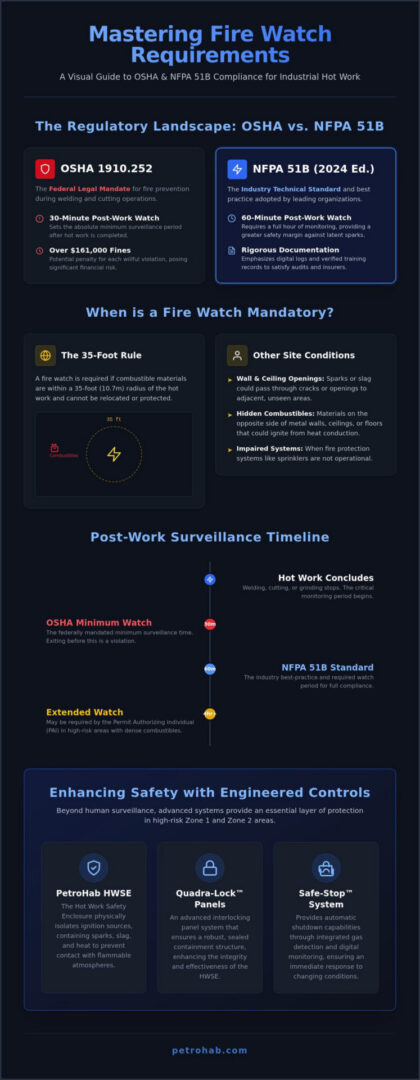
OSHA 1910.252 establishes the legal enforcement for industrial welding. One of its most critical mandates is the 35-foot rule. If combustible materials cannot be moved at least 35 feet from the point of operation, a dedicated fire watch is mandatory. Managing these fire watch requirements involves strict adherence to the 35-foot rule, as the legal consequences of non-compliance are severe. In 2026, OSHA willful-violation citations for failing to meet fire watch mandates can exceed $161,000 per instance. Beyond fines, record-keeping is a functional necessity. Your facility must maintain detailed fire watch logs and hot work permits to prove that surveillance was maintained for the required duration. This documentation acts as a vital layer of liability protection in hazardous environments.
Essential Duties and Qualifications of a Fire Watcher
Industrial fire watchers are the primary human defense against uncontrolled ignition. Unlike general security personnel, these specialists must maintain continuous surveillance, ensuring an unobstructed view of the hot work and all adjacent areas where sparks could migrate. This involves active monitoring for slag and heat transfer through bulkheads or walls. Per OSHA 29 CFR 1910.252, the fire watch must be equipped to extinguish fires within their capability and possess the training to sound the alarm if a situation escalates beyond their control.
Vigilance doesn’t end when the welding torch is extinguished. Smoldering embers can remain dormant for significant periods before igniting surrounding materials. Current fire watch requirements mandate that personnel remain on-site for at least 30 to 60 minutes after work concludes. While OSHA sets a 30-minute floor, the NFPA 51B 2024 standard requires a full 60-minute watch. This period may be extended to four hours if the Permit Authorizing Individual (PAI) determines that site hazards, such as high combustible density, warrant prolonged monitoring.
Technical Competency and Training Requirements
Effective fire watching requires specialized training that transcends basic observation. Personnel must demonstrate proficiency in fire extinguisher operation and understand the specific limitations of their suppression equipment. When a PetroHab Hot Work Safety Enclosure (HWSE) is deployed, the watcher must be trained to recognize habitat-specific hazards, such as loss of differential pressure. Reliable communication is equally critical. The use of intrinsically safe radios and standardized alarm systems ensures the fire watch can coordinate with the welder and the control room instantly if a hazard is detected.
The Fire Watcher’s Authority in the PTW System
In a Permit-to-Work (PTW) system, the fire watcher holds absolute authority over the site’s safety. They possess the power to revoke a Hot Work Permit (HWP) immediately if environmental conditions shift or if the containment integrity is compromised. This role requires direct interaction with the PAI and the welder to ensure all pre-work inspections remain valid throughout the shift. A qualified fire watcher must be dedicated solely to surveillance and have no other duties that distract from monitoring the hot work site. To ensure your team has the right physical barriers to support these duties, consider the advantages of pressurized welding enclosures that simplify spark containment and reduce the burden on surveillance personnel.
Trigger Events: When Industrial Sites Must Implement a Fire Watch
Identifying when a fire watch is legally required is a matter of environmental assessment. Per OSHA fire watch requirements, specific triggers mandate the presence of a dedicated watcher. The most common trigger is the presence of combustible materials within 35 feet of the hot work site. If flammable items can’t be relocated or shielded, the need for a dedicated watcher becomes absolute. This rule applies even if the materials are protected by fire-resistant tarps, as sparks often bypass temporary covers and ignite overlooked hazards.
Structural vulnerabilities also necessitate a watch. Sparks and slag travel through wall or floor openings, cracks, or unsealed pipe penetrations. These airborne hazards can travel considerable distances, often landing in areas where they remain undetected until a fire is fully established. If work occurs near metal partitions, heat transfer can ignite combustibles on the opposite side without the welder’s knowledge. Additionally, if a facility’s fire suppression or detection systems are offline for maintenance, a human fire watch is required to compensate for the system impairment. This human element acts as the fail-safe when automated safeguards are unavailable.
Hot Work in Hazardous Locations
In the energy sector, welding on live offshore platforms or near hydrocarbon processing equipment always triggers a fire watch. These environments possess a high potential for explosive atmospheres. To manage these high-risk triggers, safety managers deploy pressurized welding habitats. These systems provide a controlled environment that isolates the ignition source from the surrounding hazardous atmosphere. Evaluating the proximity of processing equipment is a critical step in the pre-work hazard assessment to ensure no flammable gases enter the work area.
Confined Space and Elevated Work Considerations
Complex industrial layouts present unique surveillance challenges. When performing hot work inside tank internals or vessels, specialized fire watch requirements apply to ensure the safety of personnel in confined spaces. These environments often trap heat and fumes, making rapid detection essential. Elevated work on multi-level structures requires a multi-dimensional approach to spark containment. Sparks can drop several levels, igniting materials far below the point of operation. The fire watch must maintain a clear line-of-sight across these levels. This often requires additional personnel to monitor different elevations simultaneously to prevent fire migration through deck gratings or stairwells.
Advanced Fire Watch Requirements in Zone 1 and Zone 2 Areas
Surveillance protocols in Zone 1 and Zone 2 hazardous areas demand an escalation beyond simple visual monitoring. These zones, defined by the potential presence of explosive gases, require the integration of continuous Lower Explosive Limit (LEL) monitoring into the fire watch’s duties. A human watcher can’t detect colorless or odorless hydrocarbons without technical assistance. Consequently, all surveillance personnel in these high-stakes environments must be equipped with portable gas detection systems that provide real-time atmospheric data. This technical layer ensures that even a minor gas leak is identified before it contacts a hot work ignition source.
Reliability in these environments depends on the integrity of the surveillance equipment. Every tool used by the fire watch, from radios to flashlights, must be ATEX or IECEx certified to prevent the device itself from becoming an ignition source. While the watcher monitors the perimeter, the PetroHab Hot Work Safety Enclosure (HWSE) utilizes Quadra-Lock panels to maintain positive pressure and prevent gas ingress. This engineered control creates a physical barrier that simplifies the watcher’s role by maintaining a controlled environment. When these systems are deployed, the watcher’s primary focus shifts to monitoring the differential pressure gauges and the containment’s external perimeter.
For secondary protection, fire watch requirements must interface with automatic shutdown systems. If the gas detectors identify a hazardous concentration or if the enclosure loses pressure, systems like Safe-Stop immediately terminate power to the welding equipment. This digital fail-safe acts as a backup to human intervention, ensuring that any breach in safety protocols results in an immediate cessation of work. It’s a necessary redundant layer that protects high-value assets and personnel when the margin for error is non-existent.
Managing Explosive Atmospheres (ATEX/IECEx)
In Zone 1 locations, where an explosive atmosphere is likely to occur during normal operations, a human fire watch is insufficient without engineered controls. The risk of a flash fire is too high to rely solely on a person with an extinguisher. For comprehensive details on maintaining Hazardous Environment Standards, safety managers must look toward global compliance frameworks that mandate redundant safety systems. On offshore drilling rigs, this redundancy is a functional requirement to prevent catastrophic asset loss and ensure that hot work doesn’t compromise the platform’s integrity.
Communication Protocols in High-Noise Environments
Industrial sites are rarely quiet. High-noise levels on production platforms can render verbal commands useless during an emergency. Fire watch requirements in these areas necessitate standardized hand signals to ensure coordination between the watcher and the welder. Additionally, visual alarms and high-intensity strobes must be used to signal an immediate work stoppage. Every occupant of a hot work habitat must also be briefed on specific emergency evacuation routes that account for the unique footprint of the enclosure. Clear communication ensures that the transition from work to evacuation is disciplined and rapid.
To ensure your facility meets these advanced standards, integrate Safe-Stop Automatic Shutdown Systems into your next hot work project to provide an essential digital fail-safe.
Enhancing Fire Watch Effectiveness with PetroHab HWSE Technology
Human vigilance remains the cornerstone of industrial safety, but the technical limitations of manual observation in high-risk environments necessitate engineered support. Integrating PetroHab technology transforms the fire watch from a purely observational role into a multi-layered defense strategy. By deploying a PetroHab Hot Work Safety Enclosure (HWSE), safety managers provide their personnel with the physical infrastructure needed to meet rigorous fire watch requirements. This integration ensures that the human element is supported by a resilient, technical fail-safe that operates with mathematical precision.
The patented Quadra-Lock panels provide the physical integrity required for effective containment. These interlocking panels create a continuous, fire-resistant barrier that prevents sparks and slag from escaping the work area. By physically confining the hazard, this technology simplifies the fire watch’s task of monitoring spark migration. While the watcher remains focused on the site’s perimeter, the Safe-Stop Automatic Shutdown System acts as a digital fire watch. It continuously tracks gas concentrations and internal pressure levels, terminating power to welding equipment instantly if a breach is detected. This automated response eliminates the delay inherent in human reaction times.
Pressurized habitats maintain an internal environment that is protected from gas ingress. This pressurized state reduces the cognitive burden on fire watchers by ensuring that the internal atmosphere remains controlled regardless of external fluctuations. To support this, PetroHab provides on-site supervision and training. This ensures that every fire watcher is fully competent in HWSE operation and understands how to interpret technical data from the monitoring systems. Competence in these technologies is a prerequisite for maintaining operational excellence in 2026.
The Synergy Between Human Surveillance and HWSE
Advanced hot work safety systems provide a measurable safety margin that human surveillance alone cannot achieve. Automated gas detection and shutdown protocols significantly reduce the potential for human error in explosive atmospheres. In 2026, insurance underwriters increasingly demand the use of engineered controls like the HWSE to mitigate the liability of hot work. Maintaining enclosure integrity isn’t just a safety protocol; it’s a functional requirement for site compliance and financial risk management.
Implementing Quadra-Lock Technology for Compliance
The interlocking Quadra-Lock system is the recognized industry standard for habitat integrity. Unlike outdated containment methods that rely on loosely fitted fire blankets or tarps, these modular enclosures provide a repeatable, fire-rated seal. This technology allows facilities to perform critical maintenance without the need for total plant shutdowns. It represents a shift from reactive monitoring to proactive containment. Optimize your fire watch protocols with PetroHab HWSE solutions today.
Securing Your Hot Work Operations for 2026
Adhering to fire watch requirements is a fundamental component of industrial risk management. It’s no longer enough to rely on human observation alone when the financial and safety stakes are this high. By integrating the NFPA 51B 2024 standards with advanced physical containment, safety managers can effectively eliminate the variables that lead to ignition. This methodical approach ensures that your facility maintains total site compliance while protecting high-value assets from the risks inherent in welding and cutting.
PetroHab offers the technical solutions necessary to maintain this level of operational excellence. Our systems utilize patented Quadra-Lock technology for maximum containment, ensuring global compliance with both OSHA and NFPA 51B standards. We support your team with certified on-site supervision and training services to bridge the gap between human duty and technical precision. Don’t leave your site’s safety to chance; choose the gold standard in environmental containment. Request a Quote for Pressurized Welding Habitat Rental and secure your facility with confidence. Protecting your personnel and assets starts with a commitment to uncompromising safety standards.
Frequently Asked Questions
How long must a fire watch stay after welding is finished?
A fire watch must remain on-site for a minimum of 60 minutes following the conclusion of hot work activities according to NFPA 51B 2024 standards. While OSHA 1910.252 requires only a 30-minute post-work surveillance, following the more stringent NFPA mandate is considered industry best practice to prevent smoldering fires. The Permit Authorizing Individual (PAI) may extend this duration for up to four hours if hazardous conditions or high combustible density are present at the site.
Can the welder also serve as their own fire watch?
No, the fire watch must be a dedicated individual with no other duties that distract from monitoring the site. Fire watch requirements explicitly state that the person performing the hot work cannot simultaneously fulfill surveillance responsibilities. This separation ensures that one person focuses entirely on the technical task while the other maintains continuous surveillance for sparks, slag, and heat transfer. In high-risk environments, this dedicated role is essential for immediate emergency response and work stoppage.
What specific training does a fire watcher need according to OSHA?
OSHA mandates that fire watchers receive specific training in the use of fire extinguishing equipment and the limitations of such tools. They must also be instructed on how to sound an alarm and coordinate with emergency services. Training must cover the recognition of hazards associated with hot work, such as spark migration and heat conduction. Personnel should also be familiar with the operation of safety systems like the PetroHab HWSE and its Quadra-Lock panel integrity.
Are fire watches required for all types of hot work?
A fire watch is required whenever hot work is performed in a location where a fire other than a minor one might develop. This is specifically triggered when combustible materials are within 35 feet of the point of operation or if openings in walls or floors expose combustibles in adjacent areas. It’s also mandatory when fire suppression systems are impaired. Using a pressurized welding enclosure can help mitigate these risks, but it doesn’t eliminate the legal requirement for human surveillance.
What is the “35-foot rule” in fire watch requirements?
The “35-foot rule” is a regulatory threshold established by OSHA and NFPA. It mandates that a fire watch is necessary if combustible materials in the building or site cannot be moved at least 35 feet away from the hot work area. If these materials are within this radius, they must be protected with fire-retardant covers or shielded by a physical barrier. The rule ensures that sparks and slag, which can travel significant distances, don’t ignite surrounding hazards.
Can one fire watcher monitor multiple hot work locations simultaneously?
A single fire watcher may only monitor multiple locations if they maintain an unobstructed, 360-degree view of all active hot work sites and their respective perimeters. In complex industrial layouts or multi-level structures, this is rarely feasible. If the watcher’s line-of-sight is blocked by equipment, walls, or partitions, additional personnel must be stationed to ensure continuous surveillance. Maintaining the integrity of fire watch requirements often necessitates one watcher per individual hot work permit to ensure total site safety.
What equipment is a fire watcher required to carry?
Fire watchers must be equipped with appropriate fire extinguishing equipment, such as a portable extinguisher or a charged fire hose, which they are trained to use. In hazardous locations, they must carry intrinsically safe communication devices and gas detectors to monitor Lower Explosive Limits (LEL). When working with PetroHab systems, watchers also monitor differential pressure gauges. All tools used in Zone 1 or Zone 2 areas must carry ATEX or IECEx certification to prevent them from becoming ignition sources.
How do fire watch requirements change for offshore platforms?
On offshore platforms, fire watch requirements escalate due to the high density of hydrocarbon processing equipment and the potential for explosive atmospheres. Surveillance must include continuous gas monitoring and the use of pressurized habitats to isolate ignition sources. These environments often mandate redundant safety systems, such as the Safe-Stop automatic shutdown system, to provide a digital fail-safe. Documentation requirements under the Permit-to-Work (PTW) system are also more rigorous to satisfy international safety certifications and insurance mandates.