Blog Posts
Hot work safety enclosure rental options for access and shade
Access control and shade are practical features to consider when arranging a hot work safety enclosure rental. Keypads can control entry to the enclosure, while shade can lower ambient temperature by 10 to 25 degrees. For crews working outdoors for long hours on hot days, reducing heat exposure matters because heat stress can lead to heat illness, including heat stroke.
Keeping access controlled and managing heat are both important parts of planning hot work in demanding conditions. This article explains how keypad entry can support site access procedures, what to consider when selecting an enclosure, and how shade can help reduce heat stress. It also outlines the rental enclosure options available for different work environments, so you can match the setup to the task and its hazards.
Key Takeaways
- Compare enclosure configurations by the work environment, containment needs, and access-control requirements before choosing a rental setup.
- Assess rental options by how well the enclosure can be matched to the task and site conditions.
- Review the enclosure’s fire-resistance documentation and applicable safety standards as part of planning the work.
- Set permit and fire-watch procedures around the hot work hazards, site rules, and conditions inside and around the enclosure.
3. What types of hot work enclosures are available for rent?
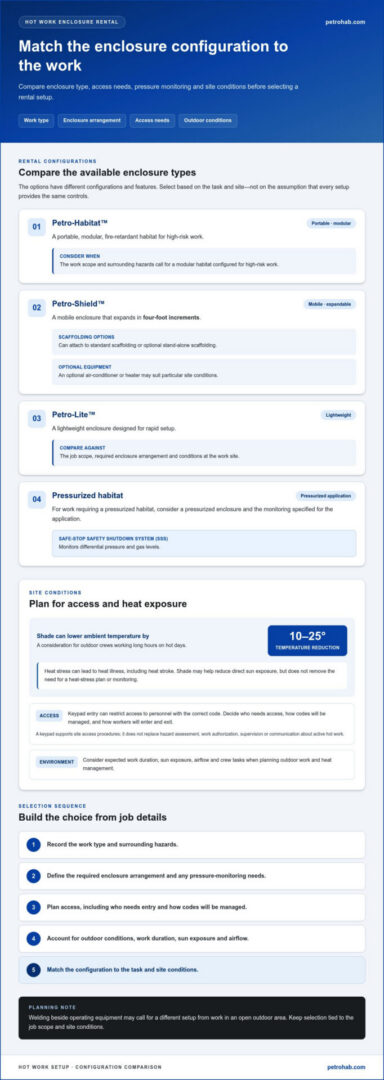
Compare rental options by enclosure configuration, pressure monitoring, and site conditions. PetroHab LLC offers modular hot work safety enclosures, including the Petro-Habitat™, Petro-Shield™, and Petro-Lite™. The Petro-Habitat™ is a portable, modular, fire-retardant habitat for high-risk work; the Petro-Shield™ is a mobile enclosure that expands in four-foot increments; and the Petro-Lite™ is a lightweight enclosure designed for rapid setup. For work requiring a pressurized habitat, PetroHab LLC offers pressurized enclosures. Define the work, surrounding hazards, and required configuration before choosing. Welding beside operating equipment may call for a different setup from work in an open outdoor area.
Access is another practical distinction. A rental enclosure with keypad entry can restrict access to personnel with the correct code. This helps coordinate entry with the site’s work procedures. Decide who needs access, how codes will be managed, and how workers will enter and exit. A keypad controls entry; it does not replace hazard assessment, work authorization, or supervision. Include the access arrangement in the site plan, especially where multiple crews share the work area. Avoid treating a lock or keypad as a substitute for communicating active hot work to affected personnel.
Environmental conditions shape the enclosure setup. For outdoor work, consider whether shade can reduce direct sun exposure around the work area. Shade can lower ambient temperature by 10 to 25 degrees. Crews working outdoors for long hours on hot days face heat stress and heat illness risks, including heat stroke. A shaded configuration may therefore be relevant alongside containment and access planning. The expected work duration, sun exposure, airflow, and crew tasks all affect how heat is managed. Shade does not remove the need for a heat-stress plan or monitoring.
To compare rental configurations, first record the work type, enclosure arrangement, access needs, and outdoor conditions. Then match the setup to the task and site. For example, the Petro-Shield™ can expand in four-foot increments and attach to standard scaffolding or optional stand-alone scaffolding. Its optional air-conditioner or heater may suit particular site conditions. Keep the selection tied to the job scope, rather than assuming every configuration provides the same features or controls.
4. Which suppliers rent hot work enclosures in the United States?
In the United States, look for suppliers specializing in hot-work containment and welding habitats. These providers focus on equipment intended for industrial hot work, rather than general-purpose tents or standard site shelters. Some manufacturers also lease their equipment. That model can connect selection with the system’s intended application. For example, a refinery maintenance crew may need a pressurized habitat, while another task requires a modular enclosure. Define the work type before comparing suppliers.
PetroHab manufactures and leases its hot work safety enclosures, and also offers them for sale. Its product range includes the Petro-Habitat™, Petro-Shield™, and Petro-Lite™. A general equipment shelter is not necessarily a hot work enclosure, so compare the proposed product’s documented features with the job requirements. For a pressurized application, consider a pressurized habitat and the Safe-Stop Safety Shutdown System (SSS), which monitors differential pressure and gas levels.
Compare the proposed enclosure with the same project details: work location, welding activity, enclosure arrangement, access needs, and site constraints. At a remote facility, transport and setup may be central to planning; at a congested plant, footprint and access routes may matter more. PetroHab offers leasing, on-site supervision, and training. Align the equipment and services with the project’s work plan and rental terms.
Use a consistent screening process: identify specialist suppliers, confirm the equipment category, and match the proposed configuration to the job scope. Record the selected enclosure, included components, delivery responsibilities, and rental period. For a hot work safety enclosure rental, this record supports coordination of site access, installation, and work planning. Keep the decision tied to documented project needs, not broad claims or assumptions about standard equipment.
PetroHab manufactures and leases industrial hot-work equipment and offers pressurized welding habitats and modular enclosures. Its products include the Petro-Habitat™, Petro-Shield™, and Petro-Lite™. Choose a configuration based on the work and site conditions.
For a hot work safety enclosure rental, PetroHab offers modular enclosures and pressurized habitats for industrial hot work. Match the selected product to the task, site conditions, and required configuration, rather than treating a general-purpose shelter as equivalent.
3. What fire-resistance and safety standards must hot work enclosures meet?
There isn’t one universal standard to apply to every hot work enclosure. The relevant requirements depend on the work, site procedures, and governing jurisdiction. Start with the project’s hot work permit process and applicable safety requirements. Then compare the enclosure’s documented fire-resistance performance with the hazards identified for the task. A material described as fire-resistant is not, by itself, proof of compliance with a particular standard. Require documentation that identifies the tested material, its performance, and the conditions covered.
Review the enclosure as a complete assembly, not just its fabric or panels. Examine seams, entry closures, viewing areas, and penetrations for cables or welding leads. These locations can affect how the enclosure performs during work. Confirm that the documentation applies to the actual components planned for the site. For example, a report covering a panel material may not describe an assembly with different seams or openings. Record the documents reviewed and connect them to the selected configuration.
Use a defined review sequence before mobilization:
- Identify the hot work process and nearby combustible or hazardous materials.
- Record the enclosure’s materials, configuration, and documented fire-resistance performance.
- Compare that evidence with site requirements and the permit conditions.
- Inspect the installed enclosure for damaged panels, gaps, or altered components.
For pressurized work, review the monitoring and shutdown system as part of the equipment selection. PetroHab’s Safe-Stop Safety Shutdown System (SSS) monitors differential pressure and gas levels, and can be equipped with oxygen and/or carbon-dioxide detectors. Include the system in the work plan and brief workers on the site’s response procedures before work begins.
Document the decision by keeping the enclosure configuration and relevant product records with the site assessment, permit, and inspection findings. This gives the team a clear basis for planning and briefing workers. If the work or setup changes, reassess the configuration before proceeding.
4. What permits and fire-watch requirements apply to hot work in an enclosure
Permit requirements depend on the site’s hot work procedure and applicable rules. Before welding or cutting, document the task, location, hazards, and controls. For example, work near process equipment may require the plan to identify nearby combustible materials and isolation measures. State who authorizes the work and who can suspend it. An enclosure is one part of the planned setup, not a substitute for the permit or hazard review.
Make the permit specific to the enclosure configuration and activity. Record the work boundaries, entry arrangements, ventilation or pressure controls, and communication method. Identify how the crew will respond to alarms or changing site conditions. For a maintenance job, the permit should connect the welding area with nearby operations that could affect the work. Review the permit with workers before starting, then update it if the task, location, or conditions change.
- Name the person authorizing the hot work and the crew performing it.
- Describe the welding or cutting task and enclosure location.
- Record identified fire hazards and the controls selected for them.
- Set the fire-watch role, communication method, and escalation procedure.
A fire watch should have a defined assignment, not an assumed one. Identify the person responsible and explain what areas they must observe, including locations where sparks could travel beyond the enclosure. Provide a reliable way to alert workers and stop the job. The site permit should specify when the watch begins and ends, based on the work and site procedure. Don’t assume the enclosure removes the need to assess surrounding areas.
Before work starts, walk the enclosure perimeter with the permit issuer and fire-watch person. Check access points, nearby combustibles, and the agreed communication method. Confirm that everyone knows who can halt welding if conditions change. Keep the permit available at the worksite and close it through the site’s established process. For enclosure planning that supports controlled hot work, review the PetroHab enclosure options.
PetroHab: PetroHab Hot Work Safety Enclosure (HWSE)
PetroHab offers modular Hot Work Safety Enclosures for industrial hot work, including the Petro-Habitat™, Petro-Shield™, and Petro-Lite™. The Petro-Habitat™ is designed for high-risk work where ignition is likely; the Petro-Shield™ is a mobile enclosure for field hot work; and the Petro-Lite™ is a lightweight option designed for rapid setup. For pressurized work, PetroHab offers pressurized habitats and the Safe-Stop Safety Shutdown System (SSS), which monitors differential pressure and gas levels. Match the configuration to the task, site conditions, and established procedures. Contact PetroHab to discuss a hot work safety enclosure rental, sale, or the training and on-site supervision your project needs.
Turn Your Enclosure Decision Into a Work Plan
The next step is to connect the enclosure choice to the project’s operating plan. Assign responsibility for coordinating equipment setup, site access, crew briefing, and changes during the work. Clear ownership helps prevent gaps between the rental arrangement and the procedures crews follow onsite. Include the planned work area, communication process, and handoff between shifts in the project documentation.
For a hot work safety enclosure rental, treat the equipment decision as part of project readiness, not an isolated purchase. Align the selected configuration with the job scope and the people responsible for implementing site controls. That preparation gives the crew a defined starting point before work begins.
PetroHab’s enclosure offering can be considered as you develop that plan. Explore PetroHab’s hot work enclosure options and take the next step toward a coordinated setup.
Frequently Asked Questions
What is a hot work safety enclosure and when is it required?
A hot work safety enclosure is a modular structure for welding and similar work in hazardous environments. Its configuration helps establish a defined work area. Whether a site needs one depends on the hazard assessment, hot work procedures, and permit conditions. For example, a facility may specify an enclosure for welding near equipment or materials that could be affected by sparks or heat.
What equipment and services are included in a hot work enclosure rental?
PetroHab offers the Petro-Habitat™, Petro-Shield™, and Petro-Lite™ Hot Work Safety Enclosures, as well as the Safe-Stop Safety Shutdown System (SSS) and Quadra-Lock® Panels. Safe-Stop monitors differential pressure and gas levels. Before mobilization, align the selected equipment with the work plan and identify what the rental arrangement includes. PetroHab also offers on-site supervision and training; discuss the services needed for the project.
How do rental terms, delivery, setup, and pickup typically work?
Compare the supplier’s written rental terms and rental period, and confirm who is responsible for delivery and setup. Coordinate installation with the site plan; pickup arrangements should be confirmed with the supplier.