Blog Posts
Welding on Live Pipelines Safety Procedures: A Technical Guide for 2026
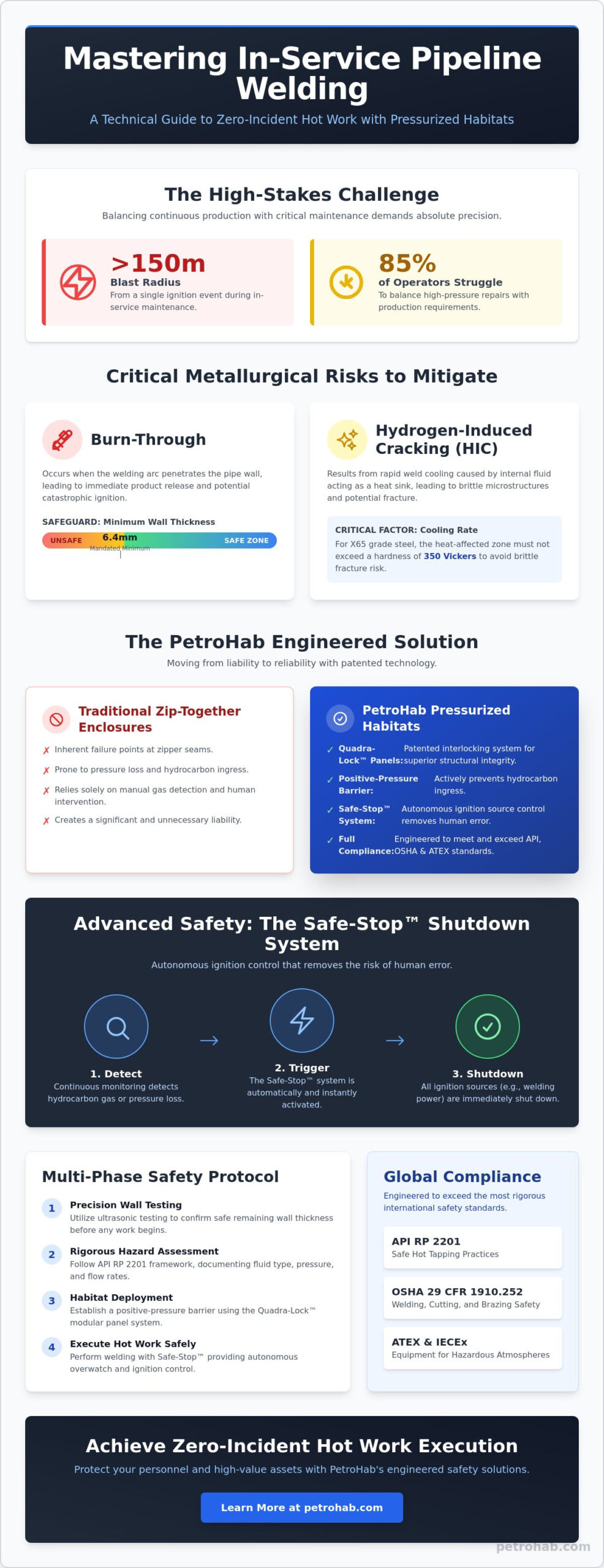
A single ignition event during in-service maintenance can result in a blast radius exceeding 150 meters, yet 85% of pipeline operators still struggle to balance high-pressure repairs with continuous production requirements. You know that shutting down a primary transmission line is a last resort that compromises operational efficiency and triggers significant throughput losses. Maintaining the structural integrity of your assets demands a rigorous approach to welding on live pipelines safety procedures that leaves no room for human error or mechanical failure.
This technical guide provides the protocols necessary to master pressurized habitat technologies and mitigate ignition risks effectively. By implementing our patented Quadra-Lock modular systems and Safe-Stop ignition control logic, you’ll achieve zero-incident hot work execution while remaining in full compliance with API 2201 and 2026 OSHA standards. We’ll examine the specific engineering controls and automated gas detection sequences required to protect your personnel and high-value assets during critical maintenance cycles.
Key Takeaways
- Identify and mitigate critical metallurgical hazards, including burn-through and Hydrogen-Induced Cracking (HIC), to maintain structural integrity during in-service operations.
- Master the technical application of pressurized habitats to establish a definitive positive-pressure barrier against hydrocarbon ingress in hazardous environments.
- Implement rigorous welding on live pipelines safety procedures by following a multi-phase protocol that begins with precision ultrasonic wall thickness testing.
- Utilize the Quadra-Lock modular panel system to eliminate the inherent failure points found in traditional zip-together welding enclosures.
- Integrate Safe-Stop automatic shutdown systems to provide autonomous ignition source control and remove the risk of human error in gas detection.
Core Risks and Regulatory Standards for In-Service Pipeline Welding
In-service welding and hot tapping represent high-stakes operations essential for modern pipeline maintenance and monitoring. In the 2026 energy landscape, maintaining product flow while performing repairs is critical to global energy security and grid stability. These procedures involve welding onto a pressurized pipe without shutting down the system, presenting unique engineering challenges that require absolute precision. PetroHab remains the gold standard in hot work safety by providing modular solutions that mitigate these volatile risks through engineered control.
Two primary metallurgical threats dominate the application of welding on live pipelines safety procedures. Burn-through occurs when the welding arc penetrates the pipe wall, leading to immediate product release and potential ignition. Conversely, Hydrogen-Induced Cracking (HIC) results from rapid weld cooling caused by the internal fluid acting as a heat sink. Engineers must balance heat input to prevent penetration while avoiding the brittle microstructures that lead to cracking in the heat-affected zone.
To better understand the technical execution of these repairs, watch this helpful video:
API RP 2201 and ASME B31.8 dictate the rigorous safety framework required for these operations. API RP 2201 specifies that a thorough hazard assessment must precede any arc strike, requiring the identification of fluid type, pressure, and flow rates. These standards ensure that the integrity of the pipe isn’t compromised by the thermal cycles of the weld. PetroHab’s role as an active guardian involves integrating these standards into the deployment of every hot work safety enclosure.
Understanding Burn-Through and Wall Thickness Limits
Calculating the safe remaining wall thickness requires precision ultrasonic testing before work begins. While some standards allow for thinner walls, approximately 85% of North American operators mandate a minimum of 6.4mm for high-pressure gas lines to provide a sufficient safety buffer. The internal fluid velocity serves as a significant heat sink, directly accelerating the weld cooling rate and increasing the risk of HIC. The critical cooling rate for X65 grade steel is the specific cooling velocity at which the heat-affected zone reaches a hardness exceeding 350 Vickers, significantly increasing the risk of brittle fracture.
Global Compliance: API, OSHA, and ATEX Requirements
Global compliance relies on the Permit-to-Work (PTW) process, which must document gas testing results and emergency shutdown (ESD) integration. Operating in Zone 1 or Zone 2 environments requires strict adherence to hazardous environment standards to prevent accidental ignition. PetroHab’s pressurized habitats utilize patented Quadra-Lock panels to maintain interlocking integrity. This system, coupled with the Safe-Stop technology, ensures that any loss of pressure or detection of hydrocarbons results in an immediate, automatic shutdown of the welding power source.
Implementing Pressurized Habitats for External Ignition Control
Open-air welding on live lines represents a catastrophic risk profile that modern safety standards no longer tolerate. By 2026, regulatory scrutiny and the inherent unpredictability of gas migration have made uncontained hot work a liability. Pressurized Hot Work Safety Enclosures (HWSE) provide the primary defense against hydrocarbon ingress. These systems don’t just shield the weld; they fundamentally transform the immediate environment into a controlled workspace. A pressurized welding habitat utilizes modular, flame-retardant panels like the Quadra-Lock system to create a rigid boundary. This engineering ensures that the integrity of the enclosure remains intact even when subjected to the high-vibration environments common in midstream operations.
The Principle of Positive Pressure Isolation
Engineers must maintain a constant overpressure between 0.1 and 0.5 inches of water gauge relative to the external atmosphere. This pressure differential ensures that air only moves from the inside out, which effectively neutralizes the threat of the Lower Explosive Limit (LEL) by preventing flammable hydrocarbons from entering the workspace. Adhering to EPA guidelines on pipeline hot taps is a critical component of these procedures to manage emissions and maintain site safety. To prevent the accumulation of hazardous welding fumes, the system requires a minimum of 20 air changes per hour. This high exchange rate maintains breathable air quality while cooling the work area for the technician.
Ignition Source Control and Gas Monitoring
Rigorous welding on live pipelines safety procedures require the seamless integration of gas detection with automatic shutdown systems like Safe-Stop. Technicians must place gas sensors at the air intake to monitor the purity of the incoming air supply and inside the habitat to detect any localized leaks from the pipeline itself. Manometers provide continuous verification of the enclosure’s integrity, providing a clear visual and digital record of the pressure status. The constant modulation of intake fan speeds ensures that internal pressure remains stable despite fluctuating external wind loads or localized atmospheric changes. If the system detects gas or a loss of pressure, it immediately isolates power to all ignition sources. This failsafe mechanism removes the variable of human reaction time during an emergency. For more information on securing your high-risk site, explore the technical specifications of our modular safety systems.
Engineering Integrity: The Quadra-Lock Panel Advantage
Traditional “zip-together” welding habitats represent a critical risk factor in modern oil and gas operations. These legacy systems often fail at the seams when subjected to internal pressure or external wind loads, leading to pressure loss and potential ignition source exposure. The Quadra-Lock modular panel system addresses these failure points through a patented interlocking design that provides unrivaled structural rigidity. This engineering ensures that the enclosure maintains a constant positive pressure, which is a fundamental requirement for welding on live pipelines safety procedures in hazardous Zone 1 and Zone 2 areas.
Quadra-Lock vs. Traditional Enclosures
The transition from flexible, zip-based enclosures to Quadra-Lock panels marks a significant evolution in hot work safety. Traditional enclosures struggle with pressure retention when faced with the complex geometries of T-junctions or manifold systems. Quadra-Lock panels offer modular flexibility, allowing technicians to construct a rigid, pressurized environment around any pipeline configuration. This system serves as the definitive alternative to outdated modular concepts that lack interlocking integrity. By providing a stable, flame-retardant barrier, it meets the rigorous demands of PHMSA in-service welding regulations, ensuring that every weld occurs within a controlled and monitored atmosphere. The interlocking mechanism facilitates superior pressure retention, which is vital for preventing the ingress of hydrocarbons during active line maintenance.
Material Science in Hot Work Containment
Material selection is the first line of defense against thermal breakthrough and environmental degradation. PetroHab uses high-grade silicone-coated fiberglass that complies with ANSI/FM 4950 standards for welding curtains and blankets. These specialized fabrics prevent molten slag and sparks from exiting the enclosure, even during prolonged arc-welding sessions. Thermal conductivity is strictly limited to protect the integrity of the habitat panels and the safety of personnel outside the enclosure.
For projects in extreme environments, such as offshore platforms in the North Sea or desert pipelines in the Middle East, these materials undergo rigorous durability testing. The panels demonstrate 100% UV resistance over extended 12-month deployment cycles, preventing the embrittlement common in standard industrial fabrics. This durability ensures that welding on live pipelines safety procedures remain effective throughout the entire duration of a maintenance campaign, regardless of the climate. The Quadra-Lock system provides a stoic defense against the elements, ensuring that safety managers can execute high-stakes repairs with absolute confidence in their containment technology.
Step-by-Step Safety Procedures for Live Pipeline Welding
Executing hot work on pressurized systems requires a methodical approach that prioritizes ignition source control and structural integrity. Adhering to rigorous welding on live pipelines safety procedures ensures that every thermal application remains contained within a controlled environment. This five-phase process mitigates the risks of burn-through and hydrocarbon ignition.
Pre-Welding Inspection and Wall Integrity
Phase 1 focuses on the physical state of the pipeline. Technicians perform ultrasonic testing (UT) across the entire weld zone to detect internal lamination or localized corrosion. It’s vital to calibrate UT equipment for high-temperature surfaces, as pipe temperatures often exceed 60 degrees Celsius in active service. This data allows engineers to calculate the Safe Operating Pressure. Welding shouldn’t proceed if the wall thickness is less than 4.8 mm or if internal flow velocities are insufficient to dissipate heat.
Phase 2 involves the assembly of the hot work safety enclosure. We utilize Quadra-Lock panels to construct a modular, flame-retardant barrier around the work area. Each Quadra-Lock component is inspected for seal integrity before the habitat is pressurized. This modular system allows for rapid deployment even in the congested footprints of offshore platforms.
Habitat Stabilization and Monitoring
Phase 3 transitions to environmental stabilization. The enclosure must be secured against wind loads, particularly on elevated pipe racks where gusts can compromise the structural seal. Technicians calibrate gas detectors to sense LEL (Lower Explosive Limit) levels both inside and outside the habitat.
Phase 4 is the execution of the hot work. During this phase, the Safe-Stop system monitors the internal atmosphere. If the internal pressure drops below 50 Pascals, or if any gas is detected, the system triggers an emergency shutdown of all welding equipment. Fire watch personnel maintain a constant vigil, following these protocols:
- Continuous monitoring of the differential pressure gauge to ensure a minimum 50 Pascal overpressure.
- Maintaining a 30-minute post-weld watch to identify any latent smoldering.
- Verifying that all spark-producing activities remain within the pressurized Quadra-Lock enclosure.
Phase 5 concludes the operation with post-weld cooling and decommissioning. The enclosure must remain pressurized until the weld bead temperature falls below 200 degrees Celsius. This prevents the hot metal from acting as an ignition source if the habitat is dismantled while flammable vapors are present in the ambient air. Following these welding on live pipelines safety procedures ensures that high-risk maintenance doesn’t result in asset loss.
Protect your personnel and infrastructure with the industry’s most reliable pressurized habitats. Consult with our safety engineers today to implement Quadra-Lock technology on your next project.
Advanced Safety Integration: Safe-Stop and Automatic Shutdown
The landscape of industrial maintenance has shifted from manual oversight to proactive, automated defense. Manual gas monitoring once served as the primary line of defense, but the evolution of hot work safety systems has introduced a level of technical precision that effectively removes human error from the equation. PetroHab’s Safe-Stop system functions as a digital sentry, monitoring the environment with relentless consistency. When welding on live pipelines safety procedures are executed, the margin for error remains zero. These automated systems ensure the welding power source is isolated before a hazard develops into a catastrophic event.
Safe-Stop systems eliminate the latency associated with manual shutdowns. In high-stakes environments, a few seconds of delay can determine the difference between a controlled operation and an ignition event. By integrating gas detection directly with the ignition source, PetroHab provides a definitive technological remedy to the risks of hydrocarbon release. This system protects the welder and the asset by maintaining absolute control over the work environment.
Safe-Stop Automatic Shutdown Functionality
The Safe-Stop system creates a direct, hard-wired interface between gas detection arrays and the welding power source. It doesn’t merely alert operators; it takes immediate action. If hydrocarbon levels reach 10% of the Lower Explosive Limit (LEL), the system triggers visual and audible alarms to warn the crew. Should levels reach 25% LEL, the system instantly terminates power to the welding machine. This fail-safe logic is also designed for total power loss situations. If the control system loses its own power supply, the welding circuit automatically opens, ensuring no ignition source remains active. This logic follows strict ATEX and IECEx standards for ignition source control.
Training and On-site Supervision
Technology is only as effective as the personnel who manage it. High-risk live work demands the presence of PetroHab-certified technicians who understand the granular details of offshore and onshore hazards. These specialists manage the complex welding on live pipelines safety procedures and ensure the integrity of the enclosure. Their expertise covers every aspect of the setup, from the precise Quadra-Lock assembly to the meticulous calibration of Safe-Stop sensors.
Operator training focuses on ensuring every component of the modular habitat is airtight and pressurized. Technicians are trained to interpret sensor data and verify that the system is functioning within its calibrated parameters. PetroHab maintains a stoic commitment to zero-incident operations. We act as a trusted safety partner, providing the technical expertise and durable equipment necessary to protect human life and high-value assets in the most demanding environments on earth.
Securing Operational Continuity Through Technical Precision
Executing successful in-service repairs in 2026 requires a meticulous commitment to welding on live pipelines safety procedures. Operators must prioritize the deployment of ATEX and IECEx compliant systems to mitigate the inherent risks of ignition in volatile environments. The integration of pressurized habitats serves as the definitive remedy for external gas hazards, ensuring that hot work proceeds without catastrophic failure. PetroHab’s patented Quadra-Lock technology provides a modular, interlocking barrier that maintains structural integrity under rigorous field conditions.
Reliability is further reinforced by the Safe-Stop automatic shutdown system, which acts as an active guardian against atmospheric changes. These technologies aren’t optional; they’re the gold standard in hot work safety for modern energy infrastructure. With global 24/7 technical support, we ensure your project adheres to the strictest ISO standards. Don’t leave your asset integrity to chance when proven engineering solutions are available.
Request a Technical Consultation for Your Live Pipeline Project
Your team’s safety is the foundation of every successful project.
Frequently Asked Questions
Is it safe to weld on a pipeline containing flammable gas?
Yes, welding on live pipelines containing flammable gas is safe when executed according to API RP 2201 standards and utilizing pressurized hot work safety enclosures. These systems maintain internal pressure at a minimum of 0.05 mbar higher than the external atmosphere. This pressure differential prevents flammable gases from entering the workspace. PetroHab’s Quadra-Lock panels ensure a gas-tight seal, mitigating the risk of ignition during critical maintenance operations.
What is the minimum wall thickness required for in-service welding?
API 1104 standards specify a minimum wall thickness of 4.8 mm (0.189 inches) for in-service welding to prevent burn-through and hydrogen cracking. Engineers must verify thickness using ultrasonic testing before commencing work. Maintaining proper flow rates within the pipe is also essential. These welding on live pipelines safety procedures ensure that the heat from the arc is dissipated effectively, protecting the structural integrity of the pressurized vessel.
How do pressurized habitats prevent explosions during hot work?
Pressurized habitats prevent explosions by maintaining a positive pressure environment that physically blocks hazardous gases from entering the enclosure. The system uses centrifugal blowers to intake air from a verified source. If the internal pressure drops below the 0.05 mbar threshold, the Safe-Stop system automatically terminates power to the welding equipment. This immediate ignition source control eliminates the possibility of a fire within the workspace during hot work.
What happens if gas is detected near a welding habitat?
When gas detectors identify hydrocarbons at concentrations as low as 10% of the Lower Explosive Limit (LEL), the Safe-Stop system triggers an immediate emergency shutdown. This protocol cuts power to all hot work equipment in less than 0.5 seconds. Simultaneously, audible and visual alarms alert the workforce to evacuate. This automated response ensures that no ignition source remains active when a gas excursion occurs in the vicinity of the habitat.
What is the difference between hot tapping and in-service welding?
In-service welding refers to the process of welding a fitting or repair sleeve onto a pipeline while it remains under pressure. Hot tapping is the subsequent procedure where a hole is drilled through the pipe wall using a specialized machine to create a new connection. Both processes require rigorous adherence to welding on live pipelines safety procedures to manage heat input and prevent structural failure of the pressurized pipe.
Are PetroHab habitats ATEX and IECEx certified?
Every PetroHab hot work safety enclosure is engineered to meet or exceed ATEX and IECEx certification standards for use in Zone 1 and Zone 2 hazardous areas. These international certifications confirm that the habitat components, including the lighting and ventilation systems, are explosion-proof. Adhering to these rigorous benchmarks ensures that our equipment provides unrivaled protection for personnel and assets in high-risk oil and gas environments.
Can welding be performed on live pipelines in offshore environments?
Welding is frequently performed on live pipelines in offshore environments, including platforms and FPSOs, using specialized modular enclosures. These environments demand the high-tier protection offered by the Quadra-Lock system to withstand harsh maritime conditions. Because offshore space is limited, the modularity of our habitats allows for custom configurations around complex piping geometries. This flexibility ensures that maintenance doesn’t require a total facility shutdown or production loss.
How does the Quadra-Lock system improve habitat safety?
The Quadra-Lock system improves safety by utilizing a patented interlocking panel design that creates a more robust and gas-tight seal than traditional zip-up habitats. Each panel is constructed from high-temperature resistant materials that withstand sparks and molten slag. This structural integrity ensures the pressurized environment remains stable even in turbulent weather. It’s the gold standard for securing hot work areas against the ingress of flammable vapors.