
Blog Posts
Gas Detection for Welding in Hazardous Areas: 2026 Guide
In a high-risk hydrocarbon environment, a gas detector that only sounds an alarm is a liability rather than a safeguard. True protection requires a definitive technological remedy that bridges the gap between detection and immediate power isolation. You recognize the stakes when implementing a gas detection system for welding during critical maintenance turnarounds. The constant pressure to balance operational uptime with uncompromising safety standards like NFPA 51B and OSHA often feels like a zero-sum game. The fear of ignition remains a primary concern for every safety manager overseeing high-value assets.
This 2026 guide demonstrates how integrated monitoring transforms hazardous zones into controlled, pressurized environments. You’ll learn how the Safe-Stop automatic shutdown system works in tandem with PetroHab LLC Petro-Habitats to eliminate ignition risks by monitoring LEL levels in real time. We’ll examine the engineering behind PetroHab LLC Quadra-Lock panels and explain how these ATEX-certified components ensure regulatory compliance while significantly reducing downtime. This overview provides the technical roadmap for achieving zero-incident hot work execution in the most demanding industrial settings.
Key Takeaways
- Understand how a gas detection system for welding must be integrated with automatic power-isolation to eliminate ignition risks in hydrocarbon-rich environments.
- Learn why ATEX and IECEx certified components are critical for maintaining compliance with international safety standards in high-risk industrial zones.
- Discover the role of pressurized Petro-Habitats and Quadra-Lock technology in providing continuous environmental containment during hot work operations.
- Identify the operational benefits of replacing manual fire watches with the Safe-Stop automatic shutdown system to ensure zero-incident execution.
- Explore how modular Hot Work Safety Enclosures (HWSE) reduce maintenance turnaround downtime while meeting rigorous NFPA 51B and OSHA requirements.
The Critical Role of Gas Detection in Industrial Hot Work
Industrial hot work within refineries and offshore platforms demands a rigorous approach to ignition prevention that far exceeds standard workshop protocols. While a typical fabrication shop focuses on worker health via fume extraction, high-risk environments prioritize the containment of explosive atmospheres. A specialized gas detection system for welding serves as the primary barrier between a high-energy ignition source and fugitive hydrocarbon emissions. Passive monitoring is insufficient; in these environments, the delay between detection and manual intervention can lead to catastrophic failure.
Safety managers must identify and mitigate the presence of combustible hydrocarbons, specifically methane and propane. These gases often settle in low-lying areas or migrate through ducting, creating invisible hazards. Modern gas detection systems provide the continuous oversight necessary to operate safely alongside live processes. Relying on periodic manual checks is a dangerous gamble that ignores the volatile nature of industrial sites. Technical precision in detection is the only way to ensure asset integrity.
Beyond Fume Extraction: Ignition Prevention
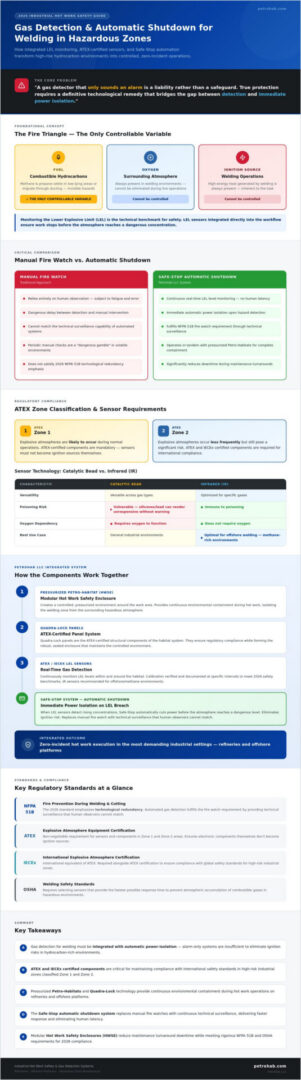
Effective hot work safety requires a deep understanding of the fire triangle, which consists of fuel, oxygen, and an ignition source. Welding operations provide the heat, while the surrounding environment often contains oxygen. The only controllable variable in a hazardous zone is the fuel. Monitoring the Lower Explosive Limit (LEL) is the technical benchmark for safety. If LEL levels rise, the environment becomes primed for ignition. You can find more detail on these requirements in our guide to Hazardous Environment Standards. By integrating LEL sensors directly into the workflow, engineers ensure that work stops before the atmosphere reaches a dangerous concentration.
Key Regulations: NFPA 51B and ATEX
Regulatory compliance is the foundation of every safety protocol. NFPA 51B establishes strict requirements for fire prevention during welding and cutting operations. Traditionally, this involved a manual fire watch. However, the 2026 standard emphasizes technological redundancy. Automated gas detection fulfills the fire watch requirement by providing technical surveillance that human observers cannot match. This is especially critical in areas classified under ATEX Zone 1, where explosive atmospheres are likely to occur, or Zone 2, where they occur less frequently but still pose a significant risk. Utilizing a gas detection system for welding ensures that your site remains compliant while protecting high-value assets and personnel from the unpredictable nature of hydrocarbon-rich zones.
Understanding ATEX-Certified Gas Detection Mechanisms
In hazardous industrial environments, the technical specifications of a gas detection system for welding determine the survival of both personnel and high-value assets. ATEX certification is a non-negotiable requirement for sensors operating in Zone 1 and Zone 2 areas. This certification ensures that the electronic components themselves don’t become an ignition source. For 2026 safety protocols, calibration must be verified and documented at specific intervals to meet evolving industrial safety benchmarks. Reliability is built on the foundation of rigorous testing and hardware that can withstand the corrosive atmospheres of refineries and offshore rigs.
Catalytic vs. Infrared Sensors for Welding Sites
Safety engineers must choose between catalytic bead and infrared (IR) technologies based on the specific hydrocarbon risks present. Catalytic bead sensors are versatile but vulnerable to “poisoning” from substances like silicones or lead. This contamination can render them unresponsive without warning. In contrast, IR sensors are immune to such poisoning and don’t require oxygen to function. This makes IR the optimal choice for offshore welding where harsh environmental conditions and specific combustible gases like methane are prevalent. Adhering to OSHA welding safety standards requires selecting sensors that provide the fastest possible response time to prevent atmospheric accumulation.
Placement Strategy for Maximum Coverage
A robust gas detection system for welding relies on strategic sensor positioning to eliminate blind spots. Sensors must be placed at the primary air intake of the pressurized habitat and at the exhaust exits. This dual-point monitoring ensures that the “fresh air” source is free of contaminants and that no gas has bypassed the enclosure’s seals. Gas density is a critical factor in this strategy. Light gases like methane require sensors at higher elevations. Heavier hydrocarbons like propane necessitate low-level placement near the floor or deck.
For a deeper dive into hardware configuration, consult our Advanced Hot Work Safety Systems guide. Maintaining enclosure integrity through Quadra-Lock panels works in tandem with these sensors to create a secure environment. When sensors detect a concentration as low as 10% LEL, the system must trigger an immediate response. This level of technical oversight is what separates a professional safety operation from a high-risk liability.
Manual Monitoring vs. Automatic Shutdown Systems
Human “Fire Watches” are a traditional component of hot work safety, but they possess inherent limitations in high-risk industrial environments. A person cannot smell or see methane or propane at low concentrations before they reach dangerous LEL levels. Reaction time is another critical failure point. Even the most vigilant technician cannot isolate power sources fast enough to prevent ignition once a leak occurs. This is why a modern gas detection system for welding must be integrated with an automated response mechanism. Relying on manual intervention in a Zone 1 or Zone 2 area is a gamble that ignores the speed of explosive combustion.
The Safe-Stop Automatic Shutdown System replaces human fallibility with technical precision. It operates on a “Fail-Safe” logic: if the system loses power, if a sensor is disconnected, or if communication is interrupted, the system immediately cuts power to all connected equipment. This ensures that no work can proceed unless the safety environment is actively verified and stable. By removing the burden of detection from personnel, you eliminate the risks associated with fatigue, distraction, or delayed reaction. This technological remedy provides the unwavering protection required for high-value asset management.
The Safe-Stop Mechanism: From Detection to Isolation
When the LEL sensors detect a gas concentration at the programmed threshold, the Safe-Stop system triggers a power isolation event in milliseconds. This isn’t limited to the welding machine itself. The system simultaneously cuts power to grinders, high-intensity lighting, and any other potential ignition sources within the habitat. It also controls automatic gas shutoff valves to stop the flow of fuel gases immediately. This comprehensive isolation is a fundamental requirement for maintaining OSHA welding safety standards in live industrial zones where the fire triangle must be broken instantly.
Cost-Benefit Analysis of Automation
Investing in automated shutdown technology provides a clear economic advantage over traditional manual monitoring. While a specialized safety technician represents a recurring operational cost, an integrated system offers total reliability without the overhead of human labor. Beyond direct costs, the insurance and liability benefits are substantial. Using certified shutdown hardware demonstrates a commitment to risk mitigation that can lower premiums and protect against the staggering costs of a site incident. For those evaluating equipment options, our guide on HWSE procurement strategies outlines how to select systems that meet these rigorous 2026 standards. This transition from manual to automated safety is a fundamental shift toward zero-incident execution.
Integrating Gas Detection with Pressurized Habitats
Integrating a gas detection system for welding within a Hot Work Safety Enclosure (HWSE) creates a controlled environment in the middle of a hazardous zone. The core principle relies on positive pressure. By maintaining a higher internal air pressure than the surrounding atmosphere, the habitat physically prevents the ingress of flammable gases. This protection is only as reliable as the monitoring system behind it. If the pressure fails or the air supply becomes contaminated, the isolation must be instantaneous. This setup is essential for refineries and offshore platforms where live processes continue adjacent to hot work activities.
Technical synchronization is required between the manometer, which tracks pressure differentials, and the LEL sensors. The Safe-Stop system monitors these data streams concurrently. If the manometer detects a pressure drop below the required threshold, or if the intake gas sensor identifies hydrocarbons, the system executes a total power shutdown. This dual-verification protocol ensures that work only continues when the environment is technically secure. It’s a calculated remedy for the risks inherent in high-energy industrial tasks.
Step-by-Step: Setting Up an Integrated System
Deployment follows a rigid sequence to ensure operational excellence and regulatory compliance:
- Step 1: Conduct a comprehensive site gas hazard assessment to identify potential leak points and specific hydrocarbon risks.
- Step 2: Position the HWSE and intake fans so the air source is located in a verified clean area, away from known vents or process lines.
- Step 3: Calibrate and link all gas sensors to the Safe-Stop controller, ensuring the “Fail-Safe” logic is active across all channels.
- Step 4: Verify positive pressure levels and confirm sensor-to-controller communication before the welder strikes an arc.
Maintaining Integrity with Quadra-Lock Technology
The physical structure of the Petro-Habitat is critical to maintaining environmental control. We utilize patented Quadra-Lock panels to ensure enclosure integrity during high-energy tasks. These panels feature a specialized interlocking design that eliminates gaps at the seams, preventing gas ingress and maintaining the necessary pressure differential. In the high-stakes environments of 2026, the use of advanced fire-resistant and heat-reflective materials is a standard requirement for all HWSE components. This engineering ensures the habitat remains a resilient barrier against external hazards even during prolonged maintenance turnarounds. This modularity allows for rapid site configuration without compromising safety. For a technical breakdown of these enclosures, read our Pressurized Welding Habitats guide. To secure your site with these advanced containment solutions, contact PetroHab for a specialized consultation.
PetroHab Safe-Stop: The Industry Standard for Ignition Prevention
PetroHab provides a definitive technological remedy for the inherent risks of hot work in high-stakes environments. Our approach centers on the seamless integration of environmental monitoring and power isolation. The Safe-Stop system serves as the central intelligence for a gas detection system for welding, ensuring that any atmospheric deviation results in immediate equipment shutdown. This technology is compatible with a broad range of industrial tools, including electric welding machines, grinders, and lighting systems. Since 2011, PetroHab has maintained a global track record, securing assets on offshore platforms and onshore refineries across the energy sector.
Reliability extends beyond hardware. We emphasize the value of on-site supervision and rigorous personnel training. Our technicians understand the granular details of industrial hazards, providing a level of situational awareness that hardware alone cannot replicate. This partnership ensures that safety protocols aren’t just followed but optimized for the specific configuration of each site. Technical expertise combined with durable equipment creates a safety partnership that protects both lives and high-value infrastructure.
Safe-Stop Technical Capabilities
The Safe-Stop system provides simultaneous monitoring for multiple combustible gas types, including methane and propane. Its control interface is designed for modularity, allowing it to scale from small maintenance tasks to large-scale turnaround projects. Every component within the PetroHab line carries ATEX and IECEx certifications, ensuring that the equipment meets the most stringent international quality and safety benchmarks. This compliance profile is a linguistic anchor for our commitment to asset protection and personnel safety. By utilizing high-integrity sensors, the system eliminates the common failure points associated with lower-tier detection alternatives.
The Future of Hot Work Safety
As we move through 2026, the industry is shifting toward more autonomous and intelligent safety enclosures. PetroHab continues to innovate in the HWSE space by refining the synchronization between gas detection and environmental containment. Our engineering team focuses on enhancing the durability of pressurized habitats and Quadra-Lock panels, ensuring they remain the benchmark for ignition prevention. This commitment to excellence ensures that our partners can execute hot work with total confidence, even in the most volatile conditions. To secure your facility with the industry’s most reliable protection, contact PetroHab for a specialized gas detection and HWSE quote.
Advancing Operational Safety in Hazardous Zones
Achieving zero-incident hot work requires moving beyond manual observation toward integrated technological remedies. You’ve seen how a gas detection system for welding must be synchronized with automatic power isolation to eliminate the risk of ignition in Zone 1 and Zone 2 environments. By combining ATEX and IECEx certified components with the structural integrity of patented Quadra-Lock panels, safety managers can maintain continuous environmental containment. This approach doesn’t just meet NFPA 51B and OSHA standards; it sets a benchmark for operational reliability.
PetroHab remains a critical safety partner by providing expert on-site supervision and resilient pressurized habitats worldwide. The transition to automated shutdown technology represents the most effective path to minimizing downtime during maintenance turnarounds. Request a Quote for Safe-Stop Gas Detection Systems to implement these advanced safeguards at your facility. Protecting your personnel and high-value assets is a duty that demands the most rigorous engineering available. Your commitment to safety excellence starts with the right equipment.
Frequently Asked Questions
What is the required LEL setpoint for an automatic shutdown system?
The standard LEL setpoint for the Safe-Stop automatic shutdown system is 10%. When gas concentrations reach this threshold, the system executes an immediate power isolation event to prevent ignition. This conservative limit ensures that work stops long before the atmosphere reaches a combustible state. Technicians configure these settings during the initial site hazard assessment to align with specific facility safety protocols and international regulatory standards.
Can gas detection systems for welding operate in Zone 1 environments?
A specialized gas detection system for welding is specifically engineered to operate within Zone 1 environments. All electronic components within the PetroHab safety line, including sensors and controllers, carry ATEX and IECEx certifications. These certifications verify that the equipment is explosion-proof and won’t act as an ignition source. This allows for critical maintenance on live offshore platforms and refineries where explosive atmospheres are likely to occur.
How often should gas sensors in a welding habitat be calibrated?
Industrial sensors require calibration at regular intervals to maintain technical precision. For 2026 safety standards, sensors should be bump-tested before every shift and undergo full calibration at the start of each new project or every six months. Environmental factors in refineries, such as sensor poisoning from silicones, can affect accuracy. Regular verification ensures the gas detection system for welding remains a reliable guardian for your personnel and high-value assets.
Does a gas detection system replace the need for a Fire Watch?
Automated systems fulfill the technical requirements of a fire watch but don’t entirely remove the need for human oversight. NFPA 51B requires a designated person to monitor the area for fires during hot work. However, the Safe-Stop system provides a level of continuous gas monitoring that manual watches cannot achieve. PetroHab offers on-site supervision and training to ensure that human observers work in tandem with automated detection for maximum risk mitigation.
What happens to the welding arc if gas is detected outside the habitat?
If gas is detected at the air intake or outside the habitat, the Safe-Stop system isolates all power sources within milliseconds. This prevents the welding arc, grinders, or lighting from becoming an ignition source for the external hazard. The system also monitors for pressure loss within the habitat. This dual-monitoring approach ensures that work only proceeds when the internal environment is physically separated from external volatile gases and potential fuel sources.
Are PetroHab gas detection systems ATEX and IECEx certified?
Every critical component of the PetroHab safety line is ATEX and IECEx certified. This includes the Safe-Stop control unit and the various gas sensors deployed around the Hot Work Safety Enclosure. These international certifications serve as anchors for quality and compliance. They provide safety managers with absolute confidence that the equipment meets rigorous engineering standards for use in the most demanding hydrocarbon-rich industrial zones and offshore energy facilities.
Can these systems detect oxygen deficiency as well as combustible gases?
While the primary focus is ignition prevention through LEL monitoring, PetroHab systems can integrate sensors for oxygen deficiency and toxic gases. Maintaining a breathable atmosphere is critical for worker safety inside a pressurized habitat. The modular nature of the control interface allows for the simultaneous monitoring of multiple atmospheric hazards. This ensures that the enclosure remains a secure environment for personnel during high-energy welding, cutting, and grinding tasks.
How does positive pressure affect gas sensor accuracy inside a habitat?
Positive pressure acts as a physical barrier that prevents gas ingress, which enhances overall sensor reliability. By maintaining a higher pressure inside the habitat using Quadra-Lock panels, the system ensures that only fresh air from a verified source reaches the sensors. The manometer works in synchronization with the gas sensors to confirm that the pressure differential is stable. If pressure drops, the system assumes a potential breach and triggers an immediate power shutdown.