Blog Posts
Managing Air Supply for Pressurized Habitats: A Technical Guide for 2026
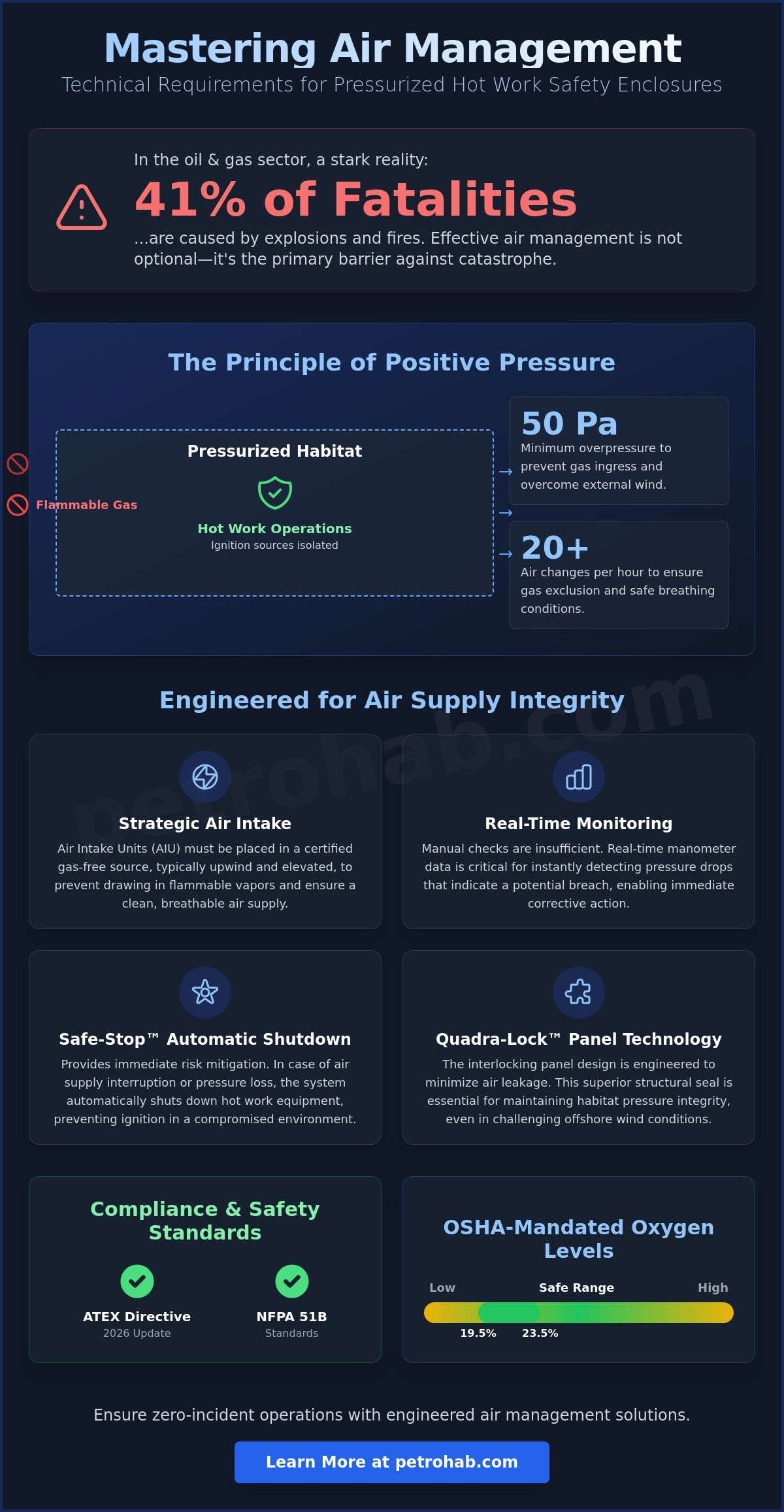
In 2024, explosions and fires caused 41% of fatalities in the oil and gas exploration sector, a statistic that underscores why “near enough” isn’t an option for hazardous site management. Managing air supply for pressurized habitats is the primary technical barrier between a routine welding operation and a catastrophic ignition event. You understand the difficulty of maintaining a consistent positive pressure of 50 Pascals when high-velocity offshore winds or complex fume extraction protocols threaten to compromise your enclosure’s integrity. Relying on manual monitoring is no longer a viable strategy for high-stakes environments.
This guide provides the precise technical requirements needed to maintain air quality and pressure within your hot work safety enclosures. By implementing these protocols, you’ll ensure full compliance with the updated 2026 ATEX Directive and NFPA 51B standards. We’ll detail intake placement in verified gas-free areas, the integration of automated Safe-Stop systems, and how the interlocking design of Quadra-Lock panels maintains the structural seal required for zero-incident operations. Mastering these air management variables is essential for protecting your personnel and high-value assets during continuous production cycles.
Key Takeaways
- Understand the technical requirements for maintaining a constant 50 Pascal overpressure to prevent gas ingress during hot work operations.
- Learn the engineering protocols for managing air supply for pressurized habitats, including strategic intake placement in certified gas-free areas.
- Identify why real-time manometer data is critical for detecting pressure differentials that manual monitoring protocols often overlook.
- Master the integration of the Safe-Stop Automatic Shutdown System to provide immediate risk mitigation during air supply interruptions.
- Evaluate how Quadra-Lock panel technology minimizes air leakage to maintain habitat integrity even in challenging offshore environments.
The Fundamentals of Positive Pressure in Hazardous Zones
Positive pressure is a fundamental engineering control designed to isolate ignition sources from potentially explosive atmospheres. It functions by maintaining a higher pressure inside the enclosure than in the surrounding environment. This pressure differential ensures that air always flows outward through any gaps or openings, effectively blocking the ingress of flammable gases. When managing air supply for pressurized habitats, the primary objective is to create a controlled environment where hot work can proceed without risk of fire or explosion.
A Positive pressure enclosure serves as a critical safety barrier in high-risk sectors such as offshore oil platforms and petrochemical refineries. By continuously pumping clean air into the structure, the system displaces hazardous vapours and ensures the internal atmosphere remains breathable and gas-free. This constant air exchange is also vital for fume extraction, removing hazardous welding smoke that would otherwise compromise the health of the technicians inside.
The following technical overview illustrates the integration of these principles in a field environment:
The Mechanism of Gas Exclusion
Preventing gas ingress requires more than just a sealed box. It relies on the velocity of air escaping through seams and door seals. In Zone 1 and Zone 2 hazardous areas, standard protocols generally mandate a minimum overpressure of 50 Pascals. This specific pressure level is calculated to overcome external wind speeds and atmospheric fluctuations. Managing air supply for pressurized habitats requires matching the air volume to the habitat’s size to maintain this pressure while providing the required air exchange rate. Most international safety standards recommend a minimum of 20 air changes per hour to ensure both gas exclusion and safe breathing conditions.
Ventilation vs. Pressurization
It’s vital to distinguish between simple ventilation and safety-critical pressurization. While ventilation focuses on cooling and air quality, pressurization acts as a structural safety shield. Without a constant, monitored overpressure, a habitat is merely a tent that offers no protection against gas leaks. Safety managers must ensure the air intake source is located in a verified gas-free area to prevent pumping contaminants into the workspace. A pressurized welding habitat is an engineered enclosure that utilizes a continuous flow of clean air to maintain an internal pressure higher than the external atmosphere, thereby preventing the entry of flammable vapours. This ensures that oxygen levels remain within the OSHA-mandated range of 19.5% to 23.5%, protecting the safety of the personnel inside.
Strategic Air Intake Placement and Ducting Infrastructure
Managing air supply for pressurized habitats requires a meticulous approach to intake positioning and ducting design. The system’s ability to exclude hazardous gases is only as reliable as the air it breathes. If the Air Intake Unit (AIU) is poorly positioned, it risks drawing in flammable vapours, effectively bypassing the habitat’s safety features. Engineers must identify a certified gas-free source, typically located upwind and at an elevated position away from potential leak points or exhaust vents. This placement ensures the habitat is pressurized with clean, breathable air at all times.
Compliance with OSHA 1910.307 requires rigorous classification of hazardous locations to ensure that electrical equipment, including the AIU, matches the specific environmental risk level. Positioning requires a calculated horizontal and vertical separation from any known ignition sources or process equipment. Real-time wind direction data must dictate the initial setup and any subsequent adjustments. If wind shifts, the intake’s status as a gas-free source may be compromised. Incorporating secondary gas monitoring at the intake provides an essential layer of redundancy that manual checks cannot match.
Ducting infrastructure must be equally robust to maintain the pressure integrity of the PetroHab HWSE. High-performance systems use fire-resistant and anti-static materials to prevent static discharge in explosive atmospheres. Friction loss remains a significant technical challenge in complex industrial layouts. As ducting length increases or diameter decreases, the pressure drop can become significant. Safety managers must calculate the required fan power to overcome this resistance while maintaining the mandatory 50 Pascal overpressure within the enclosure.
Positioning the Air Intake Unit (AIU)
Intake units should be placed at least 15 metres from the habitat and elevated to avoid ground-level gas accumulation. Horizontal separation prevents the draw of heavier-than-air gases like hydrogen sulfide. Monitoring the intake point with a dedicated LEL (Lower Explosive Limit) detector ensures that any gas detection immediately triggers a system shutdown before contaminants reach the work area. This proactive approach is a cornerstone of modern risk mitigation.
Ducting Integrity and Maintenance
Securing every connection point is mandatory to prevent pressure leaks across the line. Spiral-wound ducting offers superior crush resistance, which is critical when navigating the dense steel structures of offshore platforms. Routine inspections must check for tears, loose couplings, or internal obstructions. A single compromised segment can lead to a rapid loss of pressure integrity, rendering the habitat unsafe for hot work. Meticulous maintenance ensures the Quadra-Lock panels receive the consistent airflow required to maintain the safety seal.
Monitoring Pressure Differentials: The Role of Manometers
Manual monitoring is a reactive strategy that introduces unacceptable risks into hazardous operations. In the high-stakes environment of offshore oil and gas, managing air supply for pressurized habitats requires the precision of digital manometers. These instruments provide real-time data on the pressure differential between the enclosure and the external atmosphere. Relying on a technician to periodically check a gauge is insufficient; modern safety standards demand continuous, automated oversight to detect a pressure drop before gas ingress occurs.
The OSHA Compressed Air Standard 1926.803 provides a framework for safety in pressurized environments, emphasizing the need for reliable instrumentation. Manometers must be calibrated to remain accurate in extreme temperatures, as thermal expansion and contraction can affect sensor sensitivity. If the internal pressure falls below the 50 Pascal threshold, the system must provide an immediate warning to the operator. This ensures that any breach in the enclosure’s integrity is met with a definitive safety response rather than a delayed manual intervention.
Implementing a Dual-Monitoring Protocol
A rigorous monitoring protocol follows a structured sequence to ensure absolute reliability. First, the operator establishes the baseline atmospheric pressure at the site. Second, the internal manometer is configured to the specific target overpressure required for the zone. Third, the system integrates visual and audible alarms that trigger the moment pressure deviates from set parameters. Finally, all pressure data is logged digitally. This log serves as a tamper-proof record for permit-to-work compliance and post-operation audits, providing verifiable proof of safety excellence.
Visual Inspection of Habitat Integrity
Hardware monitoring must be supported by a disciplined visual inspection of the physical structure. The “bulge” test is a primary indicator of Quadra-Lock panel tension; a correctly pressurized habitat will show a distinct outward curvature in its walls. Technicians should also identify “dead spots” where air circulation might be stagnant, potentially allowing fumes to accumulate. Particular attention is required for the seals around pipe penetrations and structural beams. These complex junctions are common failure points where air leakage can compromise the entire pressure management system. Maintaining these seals ensures the air supply is distributed effectively throughout the enclosure.
Mitigating Risks: Managing Air Supply Failures and Gas Ingress
Managing air supply for pressurized habitats is a continuous operation where failure isn’t an option. An interruption in the airflow leads to an immediate loss of the 50 Pascal overpressure barrier, exposing the internal workspace to the surrounding hazardous atmosphere. In these scenarios, the delay between a pressure drop and manual intervention can be the difference between a safe shutdown and a major incident. Relying on personnel to detect a failure and manually terminate hot work is a high-risk strategy that modern engineering controls aim to eliminate. The risk of gas ingress during a pressure loss is immediate, requiring a system that reacts faster than human perception.
The implementation of an automatic shutdown system provides the definitive technological remedy for air supply failures. These systems act as a vigilant guardian, constantly processing data from pressure sensors and gas detectors. If the system identifies a breach in pressure integrity or the presence of hydrocarbons at the intake, it executes an instantaneous power cut-off to all ignition sources. This automated logic ensures that hot work ceases before flammable vapours can reach the ignition point. Secondary gas detection serves as a vital redundant safety layer, monitoring the internal environment even when the primary intake sensors report clear conditions.
Safe-Stop Integration
The Safe-Stop system integrates directly into the habitat’s power distribution. It functions by monitoring air supply and gas levels simultaneously, creating a redundant safety loop that protects personnel and assets. By utilizing automated logic controllers, the system removes the dangerous variable of human error during emergency events. When an alarm threshold is hit, the power to welding machines and grinders is severed in milliseconds. This level of control is essential when protecting high-value assets in volatile environments. To secure your site with these advanced controls, you can explore PetroHab’s Safe-Stop technology for your next project.
Emergency Response Protocols
When a pressure loss occurs, personnel must follow a structured evacuation procedure. The immediate priority is the safe egress of all workers from the habitat to a designated muster point. Once the enclosure is evacuated, the site must be re-evaluated to ensure it’s gas-free before any attempt to re-establish pressure. This process involves a thorough inspection of the Quadra-Lock panels and ducting to identify the source of the failure. A post-incident analysis is mandatory to prevent recurrence, focusing on the root cause of the air supply interruption. This methodical approach to risk mitigation ensures that every failure becomes a data point for future safety excellence.
PetroHab HWSE: Engineered for Air Supply Integrity
The PetroHab Hot Work Safety Enclosure (HWSE) serves as the industry benchmark for environmental containment in high-hazard zones. While previous sections detailed the physics of overpressure and the necessity of monitoring, the physical enclosure remains the primary barrier against disaster. Managing air supply for pressurized habitats requires a structure that minimizes leakage to maintain a stable internal environment. Traditional habitats often rely on generic fabrics and overlapping flaps that struggle to retain pressure in high-wind conditions. PetroHab addresses these vulnerabilities through superior engineering and the use of high-performance materials designed for the rigours of the energy sector.
The integration of the Safe-Stop Automatic Shutdown System with the modular HWSE creates a unified safety ecosystem. This combination ensures that the physical barrier and the electronic oversight work in tandem to protect personnel and high-value assets. By utilizing a system designed for rapid deployment and absolute reliability, safety managers can execute hot work operations with total confidence in their risk mitigation strategy. The enclosure doesn’t just house the work; it actively manages the risk through controlled air distribution and structural integrity.
The Quadra-Lock Advantage
Quadra-Lock technology represents a significant advancement in habitat design. Unlike traditional systems that use velcro or zippers, Quadra-Lock panels utilize a patented interlocking mechanism that creates a superior pressure seal. This interlocking design significantly reduces air loss, allowing the air intake unit to maintain the mandatory 50 Pascal overpressure with greater efficiency. Reducing air leakage also ensures that the volume of air exchange remains consistent, effectively removing welding fumes and heat from the workspace. Each panel is constructed from fire-resistant materials that meet the most stringent international safety requirements, ensuring the enclosure remains a protective shield even under extreme thermal stress. This modularity allows engineers to customize the habitat size to the specific task, optimizing air distribution and eliminating the “dead spots” common in oversized enclosures.
Operational Excellence with PetroHab
Safety excellence requires both advanced hardware and specialized technical knowledge. PetroHab provides comprehensive global support and training to ensure that air supply technicians understand the granular details of habitat management. This expertise is critical for maintaining compliance with evolving hazardous environment standards. Our on-site supervision ensures that every component, from the AIU to the Quadra-Lock panels, is configured for maximum safety and operational efficiency. We act as a critical safety partner, providing the tools and training necessary to achieve zero-incident operations in the world’s most challenging industrial environments. Contact PetroHab for a technical consultation on your next project to learn how our engineered solutions can secure your site.
Advancing Your Site Safety Through Engineered Air Integrity
Effective risk mitigation in 2026 demands a shift from manual oversight to automated engineering controls. You now understand that maintaining a 50 Pascal overpressure isn’t just about airflow; it’s about the precision of your intake placement and the structural seal of your enclosure. Managing air supply for pressurized habitats requires a rigorous approach to ducting friction loss and real-time digital monitoring to ensure gas exclusion remains absolute. By prioritizing these technical requirements, you protect your personnel from the documented 41% of industry fatalities caused by fires and explosions.
PetroHab provides the definitive technological remedy for high-stakes hot work. Our systems feature patented Quadra-Lock technology for superior sealing and seamless Safe-Stop automatic shutdown integration to neutralize risks instantly. With global compliance across ATEX and IECEx standards, our habitats are built for the most demanding offshore and onshore environments. Secure your operational future and maintain continuous production without compromising safety. Request a Quote for PetroHab Pressurized Habitats today to implement the industry benchmark in ignition prevention.
Frequently Asked Questions
What is the minimum pressure required for a pressurized welding habitat?
The industry standard minimum overpressure is 50 Pascals, which is equivalent to 0.2 inches of water column. This specific pressure differential ensures that air velocity at all enclosure openings effectively prevents the ingress of flammable vapours. It’s a critical safety threshold that must be maintained regardless of external wind speeds or atmospheric fluctuations to ensure the habitat remains gas-free during hot work.
How often should the air supply ducting be inspected?
Air supply ducting requires a thorough inspection before the start of every shift and following any significant weather event. Technicians must examine the entire run for punctures, tears, or loose couplings that could cause a pressure drop. Managing air supply for pressurized habitats relies on the absolute integrity of these distribution lines to ensure the required volume of clean air reaches the enclosure without loss.
Can a pressurized habitat be used in Zone 0 environments?
No, pressurized habitats are not engineered for use in Zone 0 environments where explosive atmospheres are present continuously. These systems are designed to provide a temporary gas-free workspace within Zone 1 and Zone 2 areas. You must always verify your site’s hazardous area classification and ensure your equipment’s ATEX or IECEx certification matches the specific risks of the work location before beginning operations.
What happens if the air supply fails during welding?
An immediate loss of internal overpressure occurs, which requires the instantaneous cessation of all hot work. In systems integrated with a Safe-Stop Automatic Shutdown System, the power to welding machines and other ignition sources is severed automatically. Personnel must then execute an orderly evacuation to a designated muster point. Work cannot resume until the air supply is restored and the internal atmosphere is re-certified as gas-free.
How is the air intake location determined on an offshore platform?
The air intake location is determined by identifying a certified gas-free source situated at least 15 metres from the work area. Engineers typically position the intake unit upwind and at an elevated level to avoid drawing in heavier-than-air gases like hydrogen sulfide. Continuous LEL monitoring at the intake point is essential to detect any gas migration caused by shifting wind patterns or process leaks.
Is an automatic shutdown system mandatory for pressurized habitats?
While some regional regulations may still allow manual monitoring, an automatic shutdown system is the current industry benchmark for high-hazard environments. It eliminates the risk of human error in emergency scenarios by providing a deterministic response to pressure loss or gas detection. Most major energy operators now mandate these systems to comply with the rigorous “due diligence” standards expected in 2026 industrial safety protocols.
How do you manage fumes while maintaining positive pressure?
Fumes are managed by maintaining a high air exchange rate, typically exceeding 20 changes per hour. This constant influx of clean air displaces welding smoke and pushes it toward controlled exhaust points. Managing air supply for pressurized habitats requires a precise balance where the volume of incoming air always exceeds the volume being exhausted, ensuring the 50 Pascal safety barrier remains intact while protecting worker respiratory health.
What are the benefits of using Quadra-Lock panels for air retention?
Quadra-Lock panels utilize a patented interlocking mechanism that provides a superior physical seal compared to traditional zipper or velcro connections. This design significantly reduces air leakage, which allows the intake unit to maintain the required overpressure more efficiently. The robust, fire-resistant construction of these panels ensures that the habitat maintains its structural integrity and pressure barrier even when subjected to high-velocity offshore winds or internal pressure surges.