Blog Posts
Offshore Platform Decommissioning Hot Work: Safety Protocols and HWSE Integration
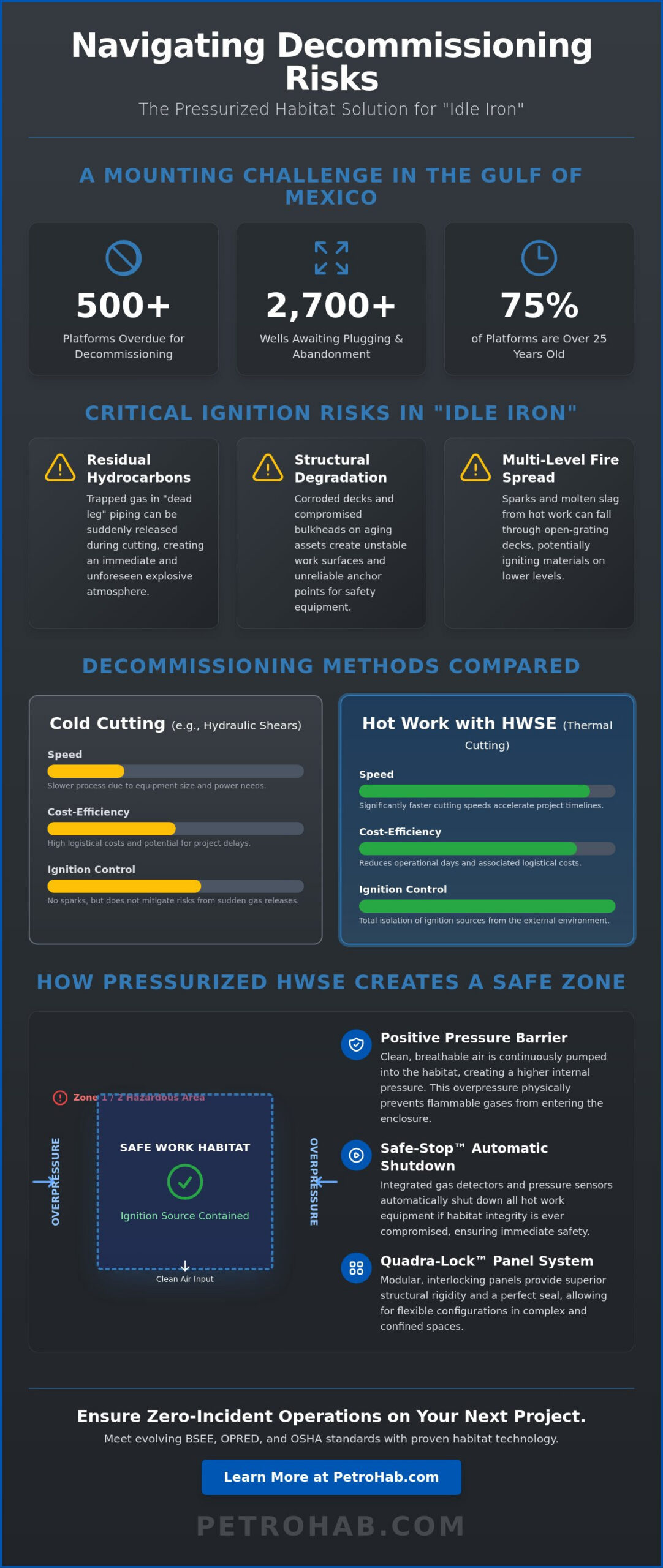
With over 2,700 wells and 500 platforms currently overdue for decommissioning in the Gulf of Mexico, the industry faces an unprecedented safety challenge as it tackles a backlog of aging, volatile structures. Managing offshore platform decommissioning hot work requires more than standard production-phase safety protocols. It demands a rigorous, calculated approach to neutralizing residual hydrocarbon risks in degraded “Idle Iron” environments. You’re likely aware of the mounting regulatory pressure from BSEE and OSHA to maintain absolute compliance while attempting to section and remove these assets without a single ignition event.
It’s clear that the potential for explosive atmospheres in aging infrastructure makes every spark a critical threat to personnel and high-value assets. This article provides a technical guide to managing these ignition risks through the integration of pressurized Hot Work Safety Enclosures (HWSE) and automated shutdown systems. We’ll examine how to maintain habitat integrity using Quadra-Lock panels and Safe-Stop technology to ensure zero-incident operations. By following these established protocols, safety managers can minimize decommissioning timelines and satisfy international safety standards without increasing operational risk.
Key Takeaways
- Identify the specific ignition risks associated with structural degradation and residual hydrocarbons in “Idle Iron” environments during asset retirement.
- Learn how pressurized HWSE systems utilize overpressure to safely facilitate offshore platform decommissioning hot work in Zone 1 and Zone 2 classified areas.
- Evaluate the cost-efficiency and speed advantages of thermal cutting within a Petro-Habitat compared to the logistical delays of hydraulic shears and cold cutting.
- Discover how the integration of Safe-Stop automatic shutdown systems and Quadra-Lock panels ensures absolute habitat integrity during heavy sectioning.
- Understand the operational protocols required to meet evolving regulatory standards from OPRED and BSEE during global platform removal projects.
The Critical Challenges of Offshore Platform Decommissioning Hot Work
Transitioning an offshore oil platform from its production lifecycle to final asset retirement introduces a unique set of ignition variables. Offshore platform decommissioning hot work involves the intensive use of welding, grinding, and torch cutting to section massive steel structures for heavy lift removal. Unlike routine maintenance performed during active production, these operations occur on “Idle Iron.” These are assets that have been dormant but often retain hazardous characteristics that aren’t present in active facilities. While production safety focuses on steady-state operations, decommissioning safety must account for the unpredictable nature of degraded systems and residual energy.
Regulatory bodies like the Bureau of Safety and Environmental Enforcement (BSEE) enforce strict mandates under Subpart Q, requiring operators to manage these risks meticulously. With approximately 75% of platforms in mature basins like the Gulf of Mexico being over 25 years old, structural integrity is a primary concern. Corroded decks and compromised bulkheads make it difficult to establish stable anchor points for safety equipment or pressurized enclosures. Engineers must navigate these OSHA-regulated hazardous zones with a strategy that prioritizes environmental containment and active risk mitigation over mere observation.
To better understand the technical scale of these operations, watch this overview of the decommissioning process:
Residual Hydrocarbons and Gas Pockets
Even after rigorous flushing and pigging, “dead legs” in complex piping networks can harbor residual hydrocarbons. These pockets of gas often remain trapped until a torch cut breaches the line. Standard gas monitoring provides a snapshot of the atmosphere but doesn’t protect against the sudden release of pressurized gas during sectioning. Without a pressurized habitat to isolate the ignition source, these localized gas releases can quickly escalate into a catastrophic event. Safety managers shouldn’t rely on historical data for these aging structures; they must assume that every cut has the potential to encounter trapped fuel.
The Complexity of Multi-Level Sectioning
Dismantling a topside involves simultaneous work across multiple deck levels to maintain the project timeline. This verticality creates a significant fire spread risk as molten slag and sparks can fall through open-grating decks to lower levels where other hazardous materials may be present. Managing hot work permits becomes a logistical challenge as different phases of dismantling overlap. It’s essential to implement a system that provides physical containment and automatic shutdown capabilities to prevent ignition across these interconnected zones. Using modular Quadra-Lock panels allows for flexible enclosure configurations even in the most confined offshore spaces.
How Pressurized HWSE Mitigates Ignition Risks
Establishing a controlled environment in Zone 1 or Zone 2 classified areas is a fundamental requirement for maintaining safety during asset retirement. While the risks of residual hydrocarbons are inherent to aging structures, they’re manageable through the application of pressurized Hot Work Safety Enclosures (HWSE). These systems provide a definitive technological remedy by creating a physical barrier between ignition sources and potentially explosive atmospheres. In the context of offshore platform decommissioning hot work, where the structural state of the asset is often uncertain, this isolation is the primary defense against catastrophic incidents.
The Decommissioning regulation authority provides the framework for these safety requirements, emphasizing the need for robust environmental containment. By integrating these habitats with advanced hot work safety systems, operators ensure that any loss of pressure or detection of gas results in an immediate, automatic shutdown of all ignition sources. This proactive approach normalizes the work environment, allowing for the use of high-heat tools in areas that would otherwise be far too hazardous for such operations.
The Mechanics of Positive Pressure
Positive pressure operates on a rigorous physical principle. By maintaining a higher internal pressure relative to the external atmosphere, the habitat acts as a functional seal that prevents the ingress of flammable gases. Air intake systems pull from verified non-hazardous locations to ensure that only clean, breathable air enters the workspace. Calculating the required air exchange rates is vital for personnel safety and effective fume extraction during heavy sectioning. Real-time monitoring of pressure differentials allows safety managers to detect enclosure breaches instantly, ensuring the habitat’s integrity remains uncompromised throughout the shift.
Containment of Ignition Sources
Containing sparks and molten slag is the second pillar of ignition prevention. During the dismantling of topside steel, the heat output from torch cutting is intense. Using Quadra-Lock panels ensures a seamless, spark-proof barrier that withstands high temperatures without compromising habitat integrity. These panels interlock to eliminate gaps that could allow slag to escape and ignite secondary fires on lower decks. Effective floor protection and penetration sealing around structural beams are equally essential to maintain overpressure and protect the platform’s substructure. If you’re planning a complex dismantling project, implementing a Petro-Habitat provides the necessary protection for your crew and assets.
Cold Cutting vs. Hot Work with HWSE: A Comparative Analysis
Choosing between cold cutting methods and thermal hot work is a strategic decision that dictates both the safety profile and the financial viability of a project. Cold cutting, which utilizes hydraulic shears, diamond wire saws, or high-pressure water jets, is often perceived as the default choice for high-risk environments because it doesn’t produce an immediate ignition source. However, these mechanical methods are inherently slow and often struggle with the complex geometries found in aging topside structures. In contrast, offshore platform decommissioning hot work using oxy-fuel or plasma torches offers unparalleled speed and precision. When these thermal methods are executed within a pressurized habitat, the ignition risk is technically neutralized, providing a controlled environment that matches the safety of cold methods while far exceeding their efficiency.
The risk profiles of these two approaches differ significantly. Cold cutting carries risks related to mechanical failure, equipment entanglement, and high-pressure hydraulic leaks. Hot work presents ignition risks, but these are manageable through environmental isolation. Engineers must determine when cold cutting is mandatory, such as during initial pipe penetration where residual gas pressure is unknown, versus when a pressurized enclosure provides a superior alternative for bulk sectioning. By normalising the work area with a Petro-Habitat, operators can utilize the most efficient tools available without compromising the rigorous safety standards required for asset retirement.
Operational Efficiency in Platform Removal
Thermal cutting significantly accelerates the dismantling of topside modules compared to mechanical methods. This speed is critical when considering the daily standby costs of heavy-lift vessels (HLVs), which can reach hundreds of thousands of dollars. Every hour saved during the sectioning phase directly reduces the overall project spend. Protected hot work allows for continuous operation, ensuring that the dismantling schedule remains on track even in complex, multi-level environments. Reducing the decommissioning timeline is not just a matter of convenience; it’s a financial necessity in a market where regulatory deadlines are tightening.
Safety and Risk Mitigation Framework
Many projects attempt to implement a “zero hot work” policy, but this is often a myth in large-scale dismantling where mechanical tools simply cannot reach or cut through heavy structural members. A more realistic approach involves evaluating pressurized welding habitats as a primary risk control measure. These habitats allow for a hybrid strategy: use cold cutting for initial access and verification, then switch to thermal cutting once the environment is stabilized and enclosed. This methodology ensures that the most hazardous phase of the project is met with a definitive technological remedy. Utilizing Quadra-Lock panels within these habitats ensures that the enclosure is as resilient as the structure it is protecting.
Operational Protocols for Decommissioning Habitat Setup
Successful execution of offshore platform decommissioning hot work begins with a meticulous pre-work site assessment. On aging assets, identifying stable anchor points is a significant challenge due to decades of marine corrosion and structural fatigue. Engineers must verify the load-bearing capacity of the deck and surrounding members before any equipment is staged. This phase ensures that the habitat remains secure even as the platform’s center of gravity shifts during sectioning. Rigorous planning at this stage prevents habitat displacement and maintains the integrity of the pressurized environment.
Deploying hot work safety enclosures in confined offshore spaces requires a modular approach. Decommissioning crews often face irregular geometries and obstructed work areas that standard habitats cannot accommodate. Crews must be trained specifically for these high-stakes environments, focusing on habitat maintenance and the technical operation of ignition prevention systems. This expertise is critical for identifying potential pressure leaks or structural shifts in the enclosure before they become safety hazards.
Habitat Installation on Degraded Structures
Overcoming the irregular geometry of a dismantling site is achieved through the use of modular Quadra-Lock panels. These panels allow for custom configurations that adapt to complex platform layouts, ensuring a seamless barrier even around heavy structural beams. It’s essential to account for the degraded state of the steel when securing the enclosure. Using specialized fasteners and penetration seals, technicians create an airtight environment that maintains overpressure despite the surrounding decay. This adaptability is the hallmark of a professional safety strategy, ensuring that protection is never compromised by the structural condition of the asset.
Automatic Shutdown and Gas Detection
Integrating automatic shutdown systems like Safe-Stop is a non-negotiable protocol for offshore platform decommissioning hot work. Strategic placement of gas sensors around the work zone and at the air intake ensures that any trace of hydrocarbons is detected before it reaches the ignition source. Safe-Stop is configured to isolate power and air supplies instantly upon gas detection or loss of pressure. This technological redundancy protects the crew and prevents ignition in the event of an atmospheric change. Emergency egress protocols must be clearly defined and practiced, allowing welders to exit the habitat safely without compromising the broader site’s safety status. To ensure your project meets these rigorous standards, explore our PetroHab decommissioning safety solutions today.
PetroHab Solutions for Global Decommissioning Projects
PetroHab provides the technological foundation required for zero-incident offshore platform decommissioning hot work across every major energy basin. From the mature assets of the Gulf of Mexico to the high-latitude, high-risk environments of the North Sea, our systems protect personnel while maintaining operational momentum. We provide dedicated on-site supervision to ensure habitat integrity is maintained under the most hazardous conditions. This expert oversight guarantees that every enclosure meets the rigorous hazardous environment standards required by international regulators. Our technicians act as critical safety partners, verifying pressure differentials and sensor calibration throughout the dismantling lifecycle.
Engineered for Resilience
PetroHab systems utilize specialized, high-grade fire-resistant materials that are non-negotiable for high-stakes offshore salvage. Our Quadra-Lock technology provides a superior interlocking seal that withstands the corrosive effects of salt spray and high-velocity winds. These panels don’t just provide a barrier; they create a resilient structure that maintains its shape even when subjected to the intense heat of heavy-duty sectioning. We provide customized enclosure designs that address the specific structural challenges of each platform removal project. Whether dealing with irregular deck layouts or severely corroded substructures, our engineering team delivers a definitive remedy that isolates ignition sources with absolute reliability. This durability ensures that the habitat remains functional throughout the entire dismantling phase, regardless of the maritime climate’s severity.
Partnering for Safety Excellence
Reducing liability is a primary objective for any decommissioning operator facing the complexities of “Idle Iron.” By deploying a Petro-Habitat, you implement a proven risk mitigation strategy that satisfies both internal safety audits and external regulatory inspections from bodies like BSEE or OPRED. We offer both leasing and purchase options to accommodate diverse asset retirement programs. This flexibility allows for scalable protection across single-platform removals or multi-year plugging and abandonment campaigns. Our role as an active guardian ensures that your offshore platform decommissioning hot work proceeds without the threat of explosive atmosphere ignition. Our stoic commitment to safety excellence means we don’t just provide equipment; we provide the confidence that your crew is protected by the industry’s most rigorous safety protocols. Contact PetroHab for a specialized decommissioning safety assessment to evaluate your specific project requirements.
Normalizing Safety in Complex Asset Retirement
Managing offshore platform decommissioning hot work requires a transition from passive observation to active environmental control. We’ve established that while aging assets present unpredictable hydrocarbon risks, the application of pressurized HWSE technology effectively normalizes these hazardous environments. By integrating patented Quadra-Lock technology with ATEX and IECEx certified systems, operators can achieve zero-incident sectioning without compromising project timelines. This disciplined approach ensures absolute compliance with international safety standards while protecting your most valuable assets: your personnel.
PetroHab remains a committed safety partner, providing global support for the energy industry across all major decommissioning hubs. Our engineered solutions provide the reliability needed to dismantle complex structures safely and efficiently. If you’re ready to secure your next dismantling phase, Request a technical consultation for your decommissioning project. You’ll gain access to seasoned experts who understand the granular details of industrial hazards. Together, we can ensure every offshore removal project is completed with technical precision and an unwavering commitment to safety excellence.
Frequently Asked Questions
What is the primary risk of hot work during offshore decommissioning?
The primary risk is the ignition of residual hydrocarbons trapped within “Idle Iron” infrastructure. Dormant systems often contain gas pockets in dead legs and unpurged piping that remain volatile long after production ceases. Offshore platform decommissioning hot work introduces intense ignition sources that can trigger explosions if these trapped gases are released during structural sectioning.
How does a pressurized habitat prevent explosions on a platform?
A pressurized habitat creates a physical barrier by maintaining internal overpressure relative to the external atmosphere. This pressure differential ensures that external hazardous gases cannot enter the workspace where ignition sources are present. Air is drawn from verified non-hazardous locations and circulated through the enclosure to ensure a constant flow of clean air for the personnel inside.
Can hot work be performed in Zone 1 areas during decommissioning?
Hot work is permissible in Zone 1 and Zone 2 areas when using a certified Hot Work Safety Enclosure (HWSE). The habitat normalizes the immediate environment by isolating welding or cutting activities from the surrounding hazardous atmosphere. This allows for efficient dismantling in areas where open-flame work would otherwise be strictly prohibited by safety regulations.
What is the difference between Quadra-Lock and standard habitat panels?
Quadra-Lock panels provide a rigid, interlocking seal that is far more durable than the flexible zippers or hook-and-loop fasteners found on standard habitats. This patented design eliminates gaps where sparks or slag could escape. It also ensures the habitat maintains a consistent pressure profile even when subjected to the mechanical stresses of heavy dismantling operations.
How does the Safe-Stop system integrate with decommissioning hot work?
Safe-Stop integrates by providing an automated layer of protection that monitors the habitat’s integrity in real time. The system connects directly to the welding and cutting equipment. If gas sensors detect hydrocarbons or if internal pressure drops below a safe threshold, Safe-Stop immediately terminates power and air supply to the ignition source.
Is hot work habitat rental available for global offshore projects?
PetroHab offers global deployment and rental options for large-scale asset retirement programs. Our footprint extends across major energy hubs, including the North Sea and the Gulf of Mexico. We provide technical supervision on-site to verify that every offshore platform decommissioning hot work phase meets the highest safety and compliance benchmarks.
What regulatory standards govern hot work on decommissioned platforms?
Operations must comply with BSEE Subpart Q mandates in U.S. waters and OPRED regulations in the UK sector. These standards require rigorous risk assessments and the use of certified safety equipment. Equipment should carry ATEX or IECEx certifications to guarantee performance in explosive atmospheres and satisfy international safety audits.
How do you maintain positive pressure in high-wind offshore environments?
Maintaining pressure in high winds requires high-capacity air intake systems and secure structural anchoring. The rigidity of Quadra-Lock panels prevents the habitat from deforming under wind loads. This structural integrity ensures the seals remain airtight, allowing the blowers to maintain the required pressure differential regardless of the maritime weather conditions.