Blog Posts
Refinery Turnaround Safety: Engineering Risk Mitigation for Hot Work in 2026
If you rely solely on administrative controls to prevent ignition during a shutdown, you’re essentially gambling with a high-value industrial asset. Safety managers currently face immense pressure to maintain refinery utilization rates near 98% while managing massive, transient workforces. The persistent threat of hydrocarbon leaks makes hot work during refinery turnaround a complex engineering challenge rather than a simple procedural task. You likely recognize that human error remains the most volatile variable in your safety equation during these high-stakes periods.
This guide provides the technical protocols and advanced containment strategies required to eliminate ignition risks entirely. You’ll master the deployment of pressurized welding enclosures and the integration of the Safe-Stop automatic shutdown system to mitigate hazardous conditions. We will detail how to utilize Quadra-Lock technology to maintain environmental integrity and ensure full compliance with 2026 NFPA 51B and OSHA standards. By engineering out the ignition source, you can achieve zero-incident performance without compromising your aggressive maintenance schedules or risking the $161,000 penalties associated with willful safety violations.
Key Takeaways
- Identify the fatal hazards associated with hot work during refinery turnaround and the protocols required to maintain 98% utilization rates in 2026.
- Understand how pressurized welding enclosures utilize positive pressure to create a definitive physical barrier against flammable gas ingress.
- Discover the structural advantages of Quadra-Lock panels in maintaining seal integrity across complex refinery piping and vessel geometries.
- Master the integration of Safe-Stop automatic shutdown systems into your Permit-to-Work (PTW) protocols to ensure 2026 NFPA 51B compliance.
- Evaluate the operational efficiency of modular Petro-Habitats to reduce downtime and improve safety performance during high-pressure maintenance cycles.
Navigating the High-Stakes Environment of Refinery Turnaround Safety
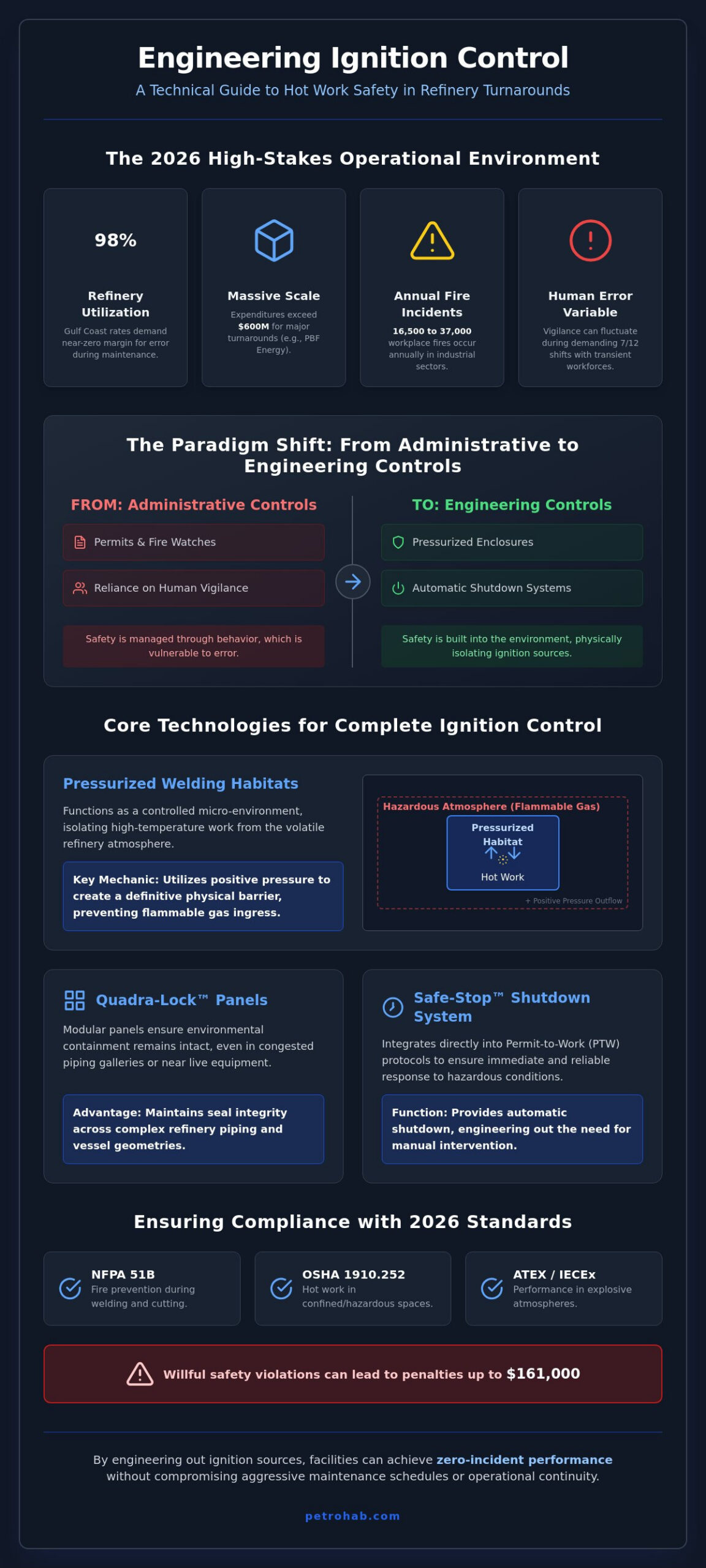
The 2026 refining landscape demands unprecedented operational continuity. With Gulf Coast refinery utilization rates reaching 98.0% in mid-2026, the margin for error during maintenance cycles has effectively vanished. Operators like PBF Energy are projecting expenditures exceeding $600 million for turnarounds this year, emphasizing the massive scale of these projects. Balancing essential structural repairs with the need to return units to service requires a rigorous approach to risk management that prioritizes personnel protection and asset integrity.
Execution of hot work during refinery turnaround represents the most significant threat to facility safety. The presence of residual hydrocarbons and the potential for unplanned gas releases create a volatile environment where a single spark can lead to catastrophic failure. Adhering to established Hot work safety practices is the baseline requirement, yet traditional methods often fall short during the chaotic peak of a shutdown. Identifying fatal hazards early in the planning phase is critical to preventing the 16,500 to 37,000 workplace fires that occur annually across industrial sectors.
To better understand the operational reality of these environments, watch this helpful video:
Modern safety management has undergone a necessary shift from administrative controls to engineering controls. While permits and fire watches are necessary, they rely on human vigilance, which can fluctuate during demanding 7/12 shifts. Engineering solutions, such as pressurized enclosures, provide a definitive technological remedy. These systems physically isolate ignition sources from the surrounding atmosphere, ensuring that safety is built into the work environment rather than managed through behavior alone.
The Complexity of Shutdown Operations
Managing the influx of thousands of third-party contractors and specialized welding teams creates logistical and safety challenges. Unplanned discoveries during vessel inspections often force immediate changes to the safety schedule, increasing the risk profile of the entire unit. Maintaining consistency in safety protocols across diverse work zones requires modular equipment that can adapt to varying geometries. Our Quadra-Lock panels ensure that environmental containment remains intact even when work must occur in congested piping galleries or near live equipment.
Regulatory Compliance and Standards
Compliance is not optional; it’s a critical anchor for quality and reliability. In 2026, safety managers must strictly adhere to the NFPA 51B standard for fire prevention during welding and cutting operations. OSHA’s 29 CFR 1910.252 remains the primary enforcement framework for hot work in confined and hazardous spaces. To ensure your facility meets the latest hazardous environment standards, all pressurized habitats must carry appropriate certifications, such as ATEX or IECEx, to validate their performance in explosive atmospheres.
Engineering Ignition Control: The Mechanics of Pressurized Welding Habitats
Relying on personal protective equipment alone is insufficient when managing the ignition risks of hot work during refinery turnaround. While flame-resistant clothing protects the technician, it does nothing to prevent the ignition of a localized hydrocarbon pocket. True risk mitigation requires a pressurized welding habitat. This system functions as a controlled environment, engineered to isolate high-temperature activities from the volatile refinery atmosphere. It transforms a hazardous area into a manageable workspace by creating a definitive physical barrier.
Refinery engineers are moving away from administrative protocols that rely on human vigilance. They’re opting for engineered containment systems that provide a definitive physical barrier. These systems don’t just mark a perimeter; they control the air within it. This transition is essential for maintaining operational safety in 2026, where the cost of a single day of unplanned downtime on a Tier 1 platform averages $1.5 million. Implementing PetroHab HWSE solutions ensures that these high-stakes operations proceed without compromising the facility’s safety profile.
The Mechanics of Positive Pressure
The core of habitat safety is the principle of positive pressure. By maintaining an internal pressure higher than the external atmosphere, the enclosure prevents the ingress of flammable gases. Technicians use manometers to monitor differential pressure in real-time, ensuring the integrity of the enclosure remains constant. According to OSHA hot work regulations, maintaining a specific overpressure, typically at least 0.05 inches of water gauge, is vital for safety. Engineers must also calculate specific air exchange rates to ensure both worker safety and the efficient extraction of welding fumes.
Automated Monitoring and Shutdown
Human error is a persistent variable in industrial accidents. The Safe-Stop automatic shutdown system removes this variable by providing continuous, automated oversight. This system integrates Lower Explosive Limit (LEL) sensors directly into the habitat environment. If flammable gas is detected or if internal pressure drops below the 0.05 inches water gauge threshold, the system triggers an immediate response. Automatic gas shutoff valves reduce response times to milliseconds, instantly de-energizing welding equipment and stopping the flow of fuel gases. This level of automation is a critical component of 2026 safety protocols, ensuring that any breach in containment results in a safe state before an ignition event can occur.
Quadra-Lock Technology vs. Traditional Paneling
Traditional enclosure construction often involves significant setup time and carries the risk of gaps in the containment barrier. Quadra-Lock technology eliminates these vulnerabilities through its precision-engineered joints. These interlocking panels resist high-pressure air leaks and external drafts, maintaining a stable internal environment. The speed of assembly is a critical factor during a turnaround; this system allows for rapid deployment without compromising the structural integrity required by the OSHA Process Safety Management Guidelines. Faster setup translates directly to reduced downtime while ensuring a robust physical barrier is always in place.
Durability in Extreme Conditions
Refinery environments are physically demanding. Enclosures must withstand mechanical stress, high temperatures, and environmental factors like salt air in coastal facilities. Every hot work safety enclosure utilizes fire-resistant materials tested for extreme heat and mechanical strength. These panels don’t just provide a barrier; they endure the rigors of heavy industrial use. During long shutdowns, maintenance and inspection protocols are simplified by the durable nature of the HWSE components. Regular checks ensure that the seal integrity remains at peak performance throughout the maintenance cycle, protecting both personnel and assets during hot work during refinery turnaround.
Operational Integration: Deploying HWSE within the 2026 TAR Schedule
Integrating safety technology into a Turnaround and Reliability (TAR) schedule requires meticulous planning. Safety managers shouldn’t treat safety enclosures as an afterthought; they must align habitat deployment with the project’s critical path. This strategic integration ensures that hot work during refinery turnaround doesn’t become a bottleneck. By incorporating hot work safety systems directly into the Permit-to-Work (PTW) protocol, you establish a verifiable standard for risk mitigation. The PTW should mandate that engineering controls are fully operational and Safe-Stop systems are calibrated before any ignition source is introduced.
Turnaround coordinators face a logistical choice between leasing and purchasing equipment. While leasing provides flexibility for short-term maintenance cycles, the industry is seeing a shift toward a sales and training model. Purchasing HWSE units allows facilities to build in-house expertise and reduces long-term operational costs for recurring maintenance. Regardless of the acquisition model, ensuring 24/7 technical support is paramount. During the peak of a shutdown, immediate access to expert habitat monitoring prevents minor sensor alerts from halting production. Our global presence ensures that technical expertise is always available to support your operations during these high-pressure phases.
Step-by-Step Habitat Deployment
Systematic deployment starts with site-specific risk assessments for every planned hot work zone. Engineers then determine the modular configuration of Quadra-Lock panels to fit the specific refinery vessel or piping geometry. Once the layout is confirmed, certified technicians manage the setup and Safe-Stop calibration procedures. Reliability is maintained through rigorous daily inspections and pressure verification during every shift change. This disciplined routine ensures that the integrity of the habitat remains constant throughout the work window, protecting both the workers inside and the high-value assets nearby. These inspections confirm that the internal atmosphere remains free of flammable gas and that differential pressure stays above the required threshold.
Reducing Downtime through Specialized Containment
Engineered containment facilitates concurrent work by protecting nearby personnel from sparks, slag, and radiant heat. This approach minimizes the size of exclusion zones, maintaining traffic flow in congested refinery corridors. Pressurized habitats reduce repair windows by 20% by allowing maintenance to proceed without requiring a total shutdown of adjacent equipment. Implementing these systems turns a hazardous maintenance task into a predictable, scheduled event. To secure your facility’s operational continuity and eliminate unplanned downtime, contact our turnaround specialists to discuss your 2026 equipment needs.
Strategic Risk Mitigation with PetroHab Solutions
PetroHab maintains a profound commitment to refinery turnaround excellence. We recognize that in the high-stakes environment of 2026, safety managers don’t just need advice; they require definitive technological remedies. Our role as an active guardian of industrial sites is defined by our ability to engineer out ignition sources. Executing hot work during refinery turnaround requires more than a permit. It demands a partnership with a veteran safety leader that understands the granular details of industrial hazards. By utilizing our patented Quadra-Lock technology, you ensure the protection of both personnel and high-value assets throughout the maintenance cycle.
Our global footprint provides the reliability your facility requires. With operational hubs in Houston, Brazil, and the UK, we offer localized support for major refining corridors. This infrastructure allows us to deliver equipment and technical expertise exactly when your TAR schedule demands it. Turnaround coordinators have the flexibility to choose between leasing and purchasing options. While leasing is effective for isolated projects, the long-term ROI of purchasing HWSE units is significant. Owning your pressurized habitats allows for immediate deployment during unplanned maintenance, ensuring that asset integrity is never compromised by logistical delays.
The PetroHab Advantage
The reliability of the Safe-Stop system is the benchmark for hazardous zone gas monitoring. Unlike manual fire watches, this automated system provides unwavering vigilance, reacting to LEL fluctuations in milliseconds. We don’t offer generic solutions; our engineers provide custom engineering for unique refinery vessels, boilers, and heat exchangers. This meticulous approach ensures that every enclosure fits the specific geometry of your site perfectly. As one of the premier hot work safety enclosure suppliers, we maintain a legacy of innovation that prioritizes risk mitigation above all else.
Next Steps for Your Turnaround
Planning for a 2026 turnaround should begin well in advance of the first permit application. Consulting with our engineers during the pre-planning phase allows us to integrate our systems into your critical path effectively. We can help you identify high-risk zones and determine the optimal modular configuration for your Quadra-Lock panels. Once your requirements are defined, you can request a technical quote for HWSE leasing or purchase tailored to your facility’s specific layout. Taking these steps ensures your refinery meets 2026 global safety benchmarks and achieves zero-incident performance during hot work during refinery turnaround operations. Our team is ready to act as your critical safety partner in protecting your workforce and your production timeline.
Securing Operational Excellence in 2026
Managing the volatility of hot work during refinery turnaround requires a fundamental shift from administrative oversight to definitive engineering controls. You’ve seen how pressurized habitats isolate ignition sources and protect personnel while maintaining the facility’s critical path. By prioritizing technical precision through the integration of automated monitoring systems, you eliminate the variable of human error. This approach doesn’t just meet compliance; it establishes a new benchmark for industrial safety and asset integrity.
PetroHab remains your critical safety partner in this high-stakes environment. Our patented Quadra-Lock technology ensures superior seal integrity across complex geometries, while the Safe-Stop Automatic Shutdown System provides real-time atmospheric monitoring. Every system we deploy maintains global compliance with ATEX and IECEx standards, reflecting our unwavering commitment to protection. Contact PetroHab today to secure your refinery turnaround safety equipment and ensure your next shutdown achieves zero-incident performance. We’re ready to help you navigate your most complex maintenance challenges with absolute confidence.
Frequently Asked Questions
What is the primary risk during a refinery turnaround?
The primary risk during a refinery turnaround is the unintended ignition of residual or leaking hydrocarbons. Shutdown operations involve purging and venting vessels, which can create localized pockets of flammable gas. Managing hot work during refinery turnaround requires a rigorous approach to isolating these ignition sources from the surrounding atmosphere to prevent catastrophic failure.
How does a pressurized welding habitat prevent ignition?
A pressurized welding habitat prevents ignition by creating an environment of positive pressure. By maintaining an internal pressure higher than the external atmosphere, the system ensures that flammable gases cannot penetrate the enclosure. This physical barrier effectively isolates the heat source from any potentially explosive gases present in the facility.
What is the Safe-Stop automatic shutdown system?
The Safe-Stop system is an automatic shutdown technology that provides real-time monitoring of gas concentrations and internal pressure. If the system detects gas at a predefined percentage of the Lower Explosive Limit (LEL) or a drop in pressure below 0.05 inches water gauge, it instantly de-energizes all hot work equipment. This removes the variable of human error from the safety equation.
Why should I use Quadra-Lock panels instead of generic safety barriers?
Quadra-Lock panels provide superior seal integrity and air retention compared to generic barriers. The patented interlocking design eliminates gaps and weak points where air leaks or gas ingress could occur. This structural precision ensures that the habitat maintains the necessary overpressure even in high-wind or high-draft environments common in refineries.
What standards regulate hot work in refineries?
Hot work is primarily regulated by the NFPA 51B standard and OSHA’s 29 CFR 1910.252. These regulations establish mandatory requirements for fire prevention, hazard testing, and the use of specialized enclosures in hazardous locations. Compliance in 2026 also necessitates that habitats carry ATEX or IECEx certifications to validate their performance in explosive atmospheres.
Can I use a Hot Work Safety Enclosure for offshore turnarounds?
Yes, a PetroHab Hot Work Safety Enclosure is fully compatible with offshore turnaround operations. These modular systems are designed to adapt to the congested deck space of offshore platforms and FPSOs. They allow for essential structural repairs and welding to proceed safely without requiring a full platform shutdown.
How much does it cost to lease an HWSE for a shutdown?
The cost to lease an HWSE depends on several factors, including the enclosure’s configuration, the duration of the turnaround, and the level of technical support required. While leasing offers a flexible, operational expense model, the exact cost is determined by the specific technical requirements of your facility. You should request a custom quote to ensure all project variables are considered.
What training is required for personnel using a pressurized habitat?
Personnel involved in the operation of a pressurized habitat must undergo specialized technical training. This training covers the correct assembly of Quadra-Lock panels, the calibration of Safe-Stop sensors, and the continuous monitoring of differential pressure. PetroHab provides these training programs to ensure that your safety teams can maintain the enclosure’s integrity throughout the project.