Blog Posts
Welding Habitat for Tank Farm Maintenance: The 2026 Safety & Engineering Guide
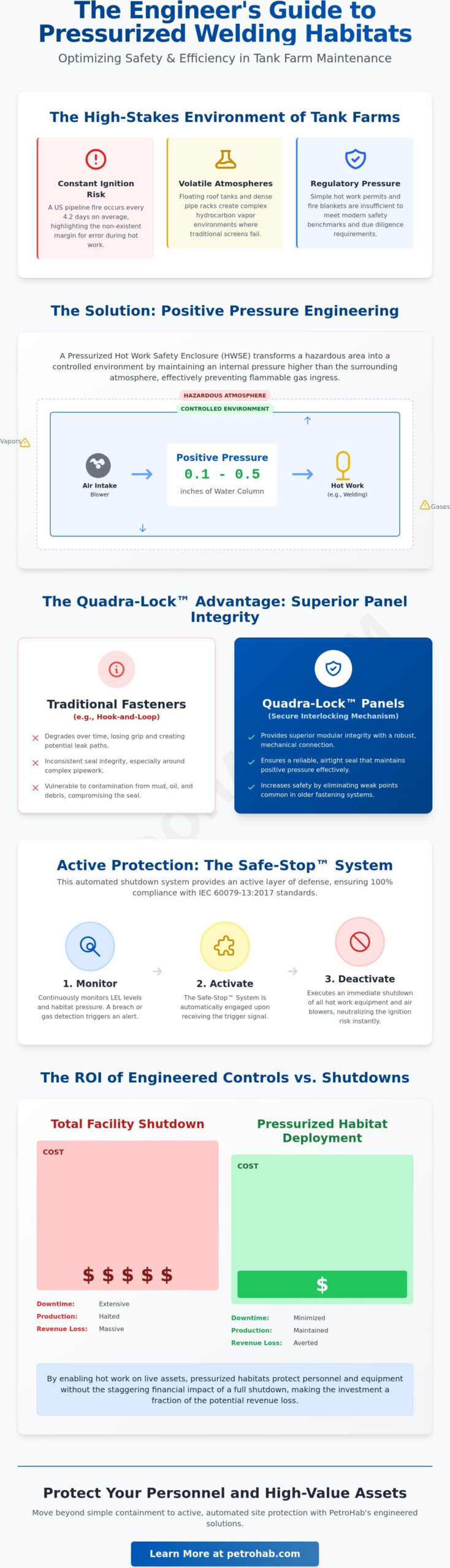
With a pipeline fire occurring in the United States every 4.2 days on average, the margin for error when deploying a welding habitat for tank farm maintenance is non-existent. You recognize that the financial impact of operational downtime is immense, yet the risk of a catastrophic fire in a hydrocarbon-rich environment is a liability no engineer can ignore. Relying on a signed hot work permit or basic fire blankets is no longer sufficient to meet modern safety benchmarks or demonstrate due diligence under increasing regulatory pressure.
Deploying a specialized hot work safety enclosure allows you to maintain production while isolating ignition sources with surgical precision. This 2026 guide explores how pressurized systems mitigate risks and optimize turnaround efficiency during critical maintenance cycles. We will examine how the integration of Quadra-Lock Panels and the Safe-Stop Automatic Shutdown System ensures 100% compliance with IEC 60079-13:2017 standards. This approach protects your personnel and high-value assets without the need for a total facility shutdown. By adopting these engineered controls, you move beyond simple containment into a regime of active, automated site protection.
Key Takeaways
- Understand how a pressurized welding habitat for tank farm maintenance isolates ignition sources from volatile floating roof vapors and high-density pipe racks.
- Learn the engineering principles behind maintaining positive pressure between 0.1 and 0.5 inches of water column to prevent hazardous gas ingress.
- Discover how Quadra-Lock panel technology provides superior modular integrity by replacing traditional hook-and-loop fasteners with a secure interlocking mechanism.
- Identify the critical role of the Safe-Stop Automatic Shutdown System in monitoring LEL levels and executing immediate equipment deactivation during pressure loss.
- Gain insights into effective turnaround planning through precise gas hazard mapping and the strategic placement of air intake blowers.
Mitigating Ignition Risks: The Role of a Welding Habitat for Tank Farm Maintenance
A welding habitat for tank farm maintenance is a specialized, pressurized Hot Work Safety Enclosure (HWSE) designed to isolate ignition sources from flammable hydrocarbon atmospheres. Tank farms present unique engineering challenges that traditional safety measures often fail to address. Floating roof tanks frequently release vapors during normal operation, and the dense proximity of interconnected pipe racks creates a complex network of potential leak points. The primary objective of an HWSE is to transform a hazardous area into a controlled environment, effectively enabling “Hot Work in a Cold Zone” through the continuous application of positive pressure. This method ensures that even if a gas leak occurs nearby, the flammable atmosphere cannot penetrate the enclosure where welding or grinding is underway.
Engineers utilize these systems as active guardians of industrial sites. By establishing a rigid, monitored boundary, an HWSE provides a definitive technological remedy to the risk of catastrophic fire. These enclosures are not simple tarps; they are engineered systems that integrate with gas detection and automated shutdown protocols. This rigorous approach to safety is essential in environments where a single spark could lead to a massive asset loss. The deployment of a welding habitat for tank farm maintenance represents a shift from passive observation to active risk mitigation, ensuring that maintenance personnel operate within a strictly controlled safety ecosystem.
Why Traditional Welding Screens Fail in Tank Farms
Standard welding screens and fire blankets provide physical barriers against sparks, but they offer zero protection against gas ingress. In a vapor-rich tank farm, wind patterns can easily carry flammable gases behind a screen or underneath a hanging curtain. These non-pressurized solutions lack the mechanical capability to displace hazardous atmospheres. Without a Positive pressure enclosure, maintenance crews remain vulnerable to flash fires if a localized leak occurs or if atmospheric conditions change. Environmental factors like unpredictable gusts bypass simple curtains, making them insufficient for high-stakes tank farm operations. Pressurization is the only reliable way to ensure that the internal atmosphere remains free of hydrocarbons throughout the duration of the hot work.
The ROI of Pressurized Habitats vs. Facility Shutdowns
The financial implications of a full facility shutdown are staggering. When maintenance requires welding on live assets, the choice is between suspending production or deploying engineered controls. Utilizing PetroHab’s pressurized welding habitats allows operators to maintain production levels while performing critical repairs on individual tanks or headers. This localized approach significantly reduces the logistical burden of “Permit-to-Work” (PTW) protocols. Instead of waiting for a complete plant purge and the associated loss of revenue, engineers can execute hot work in a confined, monitored space. This efficiency minimizes operational downtime and ensures that maintenance schedules remain on track without compromising site-wide safety standards. The cost of deploying an HWSE is a fraction of the revenue lost during a total site shutdown.
Engineering the Controlled Environment: How Pressurized HWSEs Function
The functional core of a welding habitat for tank farm maintenance is the maintenance of a controlled overpressure. By delivering a continuous supply of fresh air via high-capacity intake blowers, the system maintains an internal pressure typically between 0.1 and 0.5 inches of water column. This slight differential creates a physical barrier. It ensures that the internal atmosphere remains at a higher pressure than the surrounding hazardous environment. Consequently, if a gas leak occurs in the vicinity, the pressurized air within the enclosure forces itself out through any available gaps. This prevents flammable vapors from entering the workspace where hot work is performed. This engineering principle aligns with OSHA 1910.252 welding safety standards regarding fire prevention and protection during hot work operations.
Achieving this integrity requires a combination of specialized components. Fire-resistant panels, such as the Quadra-Lock system, form the primary structure. These panels must be coupled with high-grade seals around pipe penetrations and structural interfaces to minimize air loss. Intake blowers, located in a confirmed non-hazardous location, push air through flame-retardant ducting into the enclosure. This setup allows for precise atmospheric control. For those planning complex maintenance cycles, selecting the right pressurized welding enclosure configuration is a critical first step in asset protection. These systems don’t just contain sparks; they actively manage the environment to eliminate the possibility of an explosive mixture reaching the ignition source.
Maintaining Positive Pressure Integrity
Manometers provide the necessary data for real-time monitoring. They offer a definitive visual and electronic confirmation of the pressure differential. If the pressure drops below the 0.1-inch threshold, the risk of gas ingress increases immediately. The “air curtain” effect is another vital safety feature. When personnel enter or exit the habitat through the airlock, the outward flow of air acts as a dynamic shield. Modular designs, specifically those utilizing Quadra-Lock technology, mitigate common leak points found in traditional, less rigid systems. These interlocking panels ensure a tighter seal around complex tank farm geometries, maintaining the pressure boundary even in high-wind conditions.
Ventilation and Air Quality for Welders
Safety isn’t limited to external ignition control. It also involves the internal environment. High air exchange rates are mandatory to remove welding fumes, ozone, and excessive heat. This constant flow ensures that the welder has a continuous supply of breathable air. In hazardous zones, the blowers themselves must be ATEX or IECEx certified to prevent the equipment from becoming an ignition source. Effective ventilation systems prevent the buildup of toxic gases produced during the welding process, maintaining a productive and compliant workplace within the enclosure’s boundaries. This dual-purpose engineering keeps both the facility and the individual worker protected.
The Quadra-Lock Advantage: Modular Efficiency for Complex Tank Layouts
Engineering excellence in a welding habitat for tank farm maintenance depends on absolute structural integrity. Quadra-Lock technology is the current industry benchmark for high-risk environments. Unlike rudimentary systems, these panels use a proprietary interlocking mechanism. This design removes the inherent weaknesses of hook-and-loop fasteners. Velcro often degrades in oil-saturated environments, leading to sudden pressure loss and safety violations. By using a mechanical interlock, the system ensures a consistent, gas-tight seal that withstands the mechanical stresses of a live refinery. It’s a definitive technological remedy for the failure points of legacy habitats.
Congested pipe racks and narrow tank stairs often prevent the use of standard enclosures. The modular nature of Quadra-Lock allows for rapid assembly in these “tight-fit” scenarios. Technicians can build around existing infrastructure without compromising the pressure boundary. This speed of deployment is critical for meeting aggressive turnaround schedules. It ensures that safety protocols don’t become a bottleneck for operational progress. Each panel acts as a durable, fire-resistant shield that stays secure in high-wind conditions typical of coastal tank farms. The system’s rigidity provides a stable environment for precision welding, even in exposed locations.
Customizing Enclosures for Tank Farm Obstacles
Tank farms are rarely uniform. Protruding pipes, structural beams, and irregular valves create significant containment hurdles. The Quadra-Lock system provides a “puzzle-piece” flexibility that other systems lack. This allows engineers to configure the habitat to the specific geometry of the work site. Generic solutions often leave dangerous gaps near complex junctions, which can lead to gas ingress. In contrast, this system permits a tailored fit that maintains atmospheric control regardless of structural obstructions. It’s a calculated remedy for the unpredictable layouts of older facilities where standard dimensions don’t apply.
Material Science: Heat Resistance and Longevity
Durability in harsh industrial zones is a requirement, not an option. Quadra-Lock panels consist of high-tenacity silicone-coated fiberglass. This construction provides the necessary continuous temperature ratings for heavy-duty industrial welding and grinding. These panels resist the corrosive effects of hydrocarbons and UV exposure, ensuring they don’t become brittle over time. For a deeper technical analysis of these materials, consult our hot work safety enclosure guide. This specialized fabric prevents burn-through and maintains the enclosure’s physical barrier throughout the most demanding maintenance cycles. It protects both the worker and the asset from thermal hazards.
Turnaround Planning: Deploying a Welding Habitat for Tank Maintenance
Operational efficiency during a turnaround depends on a structured deployment framework. Successful integration of a welding habitat for tank farm maintenance begins with a comprehensive site survey and gas hazard mapping. Engineers must identify potential release points, such as flange connections or atmospheric vents, to establish the correct hazardous area classification. This initial data determines the strategic placement of air intake blowers. These blowers must be situated in a confirmed non-hazardous location to ensure the delivery of clean, breathable air to the work area. This proactive planning minimizes the risk of unexpected gas ingress and protects the project timeline from safety-related delays.
Assembly of the HWSE follows a strict procedural sequence. Technicians utilize Quadra-Lock panels to construct the enclosure around the work site, ensuring all seals and penetration points are airtight. Once the physical structure is complete, the Safe-Stop Automatic Shutdown System is integrated into the setup. This involves positioning a sensor array to monitor LEL gas levels and internal pressure triggers. Before hot work commences, the system undergoes a final inspection and rigorous pressure testing. This verification step confirms that the enclosure maintains the required overpressure, providing a definitive technological remedy for ignition risks. For professional assistance with your next turnaround, consult with PetroHab’s engineering team to optimize your safety infrastructure.
The Role of On-Site Supervision and Training
Certified technicians are essential for the correct installation and operation of pressurized habitats. Their expertise ensures that the enclosure’s integrity isn’t compromised by improper panel alignment or faulty ducting. Beyond setup, training ‘Fire Watch’ personnel is a critical component of habitat operations. These individuals must understand how to interpret manometer readings and respond to automated alarms. Daily safety checks and regular manometer calibration ensure the system remains within its operational parameters throughout the maintenance cycle. Meticulous supervision transforms the equipment from a passive barrier into an active safety ecosystem.
Compliance with Global Standards (ATEX, IECEx, NFPA)
Deployment must strictly adhere to hazardous environment standards to satisfy both regulatory bodies and insurance requirements. All electrical components, including blowers and monitoring systems, must maintain ATEX Zone 1 or 2 compliance depending on the site’s classification. This ensures that the safety equipment itself doesn’t become a source of ignition. Additionally, adherence to NFPA 51B requirements for fire prevention is mandatory. Following these international benchmarks provides a linguistic anchor for quality and demonstrates an unwavering commitment to personnel protection and asset integrity during complex tank maintenance.
PetroHab Solutions: Beyond the Enclosure with Safe-Stop Technology
The integration of the Safe-Stop Automatic Shutdown System transforms a passive enclosure into an active safety ecosystem. While the physical structure of a welding habitat for tank farm maintenance provides the primary barrier, the Safe-Stop system serves as a critical second layer of defense. This technology continuously monitors the internal and external environment to ensure that hot work only proceeds under optimal safety conditions. It’s a calculated technological remedy that addresses the unpredictable nature of hydrocarbon-rich zones. By linking the habitat’s atmospheric integrity directly to the power source of the welding equipment, operators gain an uncompromising level of control over potential ignition events.
The system utilizes a sophisticated sensor array designed to detect Lower Explosive Limit (LEL) gas concentrations and monitoring internal pressure triggers. If the system identifies a gas ingress or a significant pressure loss, the fail-safe mechanism activates immediately. It cuts power to the welding machine or grinding tool in seconds, eliminating the ignition source before a hazardous atmosphere can reach a critical point. This rapid response is essential in tank farms where vapor clouds can migrate quickly due to wind or equipment failure. The Safe-Stop system doesn’t just alert the operator; it takes definitive action to protect personnel and high-value assets.
How Automatic Shutdown Prevents Catastrophic Failure
Consider a scenario where a nearby valve seal fails, releasing a plume of methane. In this situation, the Safe-Stop system’s external sensors detect the rise in gas levels before the vapors reach the habitat’s air intake. The system executes an immediate shutdown of all hot work activities. This proactive response prevents the intake blowers from drawing flammable gases into the enclosure. Modern systems also utilize multi-gas detection, monitoring for H2S, CH4, and O2 levels to ensure a breathable and non-explosive atmosphere. For a deeper analysis of these protective layers, refer to our guide on advanced hot work safety systems. This level of automated oversight is a requirement for maintaining the highest safety benchmarks in 2026.
Leasing vs. Purchasing Your HWSE Fleet
Determining whether to lease or purchase a welding habitat for tank farm maintenance depends on your facility’s long-term operational strategy. Leasing is an ideal solution for short-term turnarounds or specific repair projects, providing access to the latest Quadra-Lock and Safe-Stop technologies without a significant capital expenditure. Conversely, purchasing a fleet is a strategic investment for sites with continuous maintenance requirements. PetroHab maintains global availability to ensure rapid deployment regardless of your location. Our engineering team is available to provide project-specific consultations, helping you select the configuration that best suits your facility’s unique geometry and hazard profile. This partnership ensures you remain a leader in industrial safety and operational excellence.
Advancing Operational Safety in Hazardous Environments
Deploying a welding habitat for tank farm maintenance is a definitive requirement for modern engineers who refuse to compromise on asset integrity. You’ve seen how positive pressure creates a mechanical barrier against gas ingress and how the Safe-Stop system provides an automated fail-safe. These engineered controls move beyond passive protection; they offer a proactive solution to the complex hazards of live refinery operations. By prioritizing technical precision, you eliminate the risk of catastrophic failure during critical turnarounds.
Our patented Quadra-Lock technology ensures modular stability in congested pipe racks, while our ATEX/IECEx certified systems provide the technical anchor for global safety compliance. With global 24/7 technical support, your site remains under the guardianship of seasoned industry experts. This commitment to engineering excellence protects your personnel and ensures your high-value assets remain operational without interruption. It’s the most reliable way to maintain production while upholding an unwavering commitment to site safety.
Request a Technical Consultation for Your Tank Farm Turnaround
Implementing these rigorous safety protocols today ensures your facility is ready for the challenges of tomorrow.
Frequently Asked Questions
What is the primary difference between a welding habitat and a welding curtain?
A welding habitat is an engineered, pressurized enclosure, whereas a welding curtain is a passive physical barrier. Curtains only block sparks and UV light but offer no protection against flammable gas ingress. In contrast, a welding habitat for tank farm maintenance uses positive pressure to actively displace hazardous vapors. This ensures the internal atmosphere remains non-explosive even if a leak occurs nearby, providing a level of protection curtains cannot match.
How does a pressurized habitat prevent explosions in a tank farm?
It prevents explosions by maintaining an internal pressure higher than the external atmospheric pressure, typically by 0.1 to 0.5 inches of water column. This pressure differential ensures that air flows only from the inside out. If hydrocarbon vapors are present in the tank farm, the positive pressure prevents them from entering the enclosure and reaching the ignition source. This effectively isolates the hot work from the surrounding hazardous environment.
Is an automatic shutdown system mandatory for hot work in ATEX zones?
International standards like IEC 60079-13:2017 strongly emphasize the use of engineered controls for pressurized rooms in hazardous areas. A signed permit alone is no longer considered sufficient due diligence in modern industrial settings. Using a system like the Safe-Stop Automatic Shutdown System provides the necessary automated oversight to meet rigorous safety benchmarks. It’s an essential component for risk mitigation in Zone 1 and Zone 2 environments.
How long does it take to assemble a PetroHab HWSE on a tank roof?
Assembly time typically ranges from one to four hours depending on the enclosure size and the complexity of the roof’s geometry. The modular Quadra-Lock panel system accelerates this process by eliminating the need for complex fasteners. Because the panels interlock mechanically, technicians quickly secure the boundary around vents or handrails. This ensures the maintenance schedule remains on track while establishing a high-integrity safety barrier for the project.
Can a welding habitat be used in confined spaces like storage tank interiors?
Yes, pressurized habitats are frequently deployed inside storage tanks to facilitate internal repairs while the surrounding facility remains live. This application requires meticulous planning regarding air intake placement and exhaust routing. The intake blowers must be positioned in a confirmed non-hazardous location outside the tank to ensure a continuous supply of fresh air. This prevents the buildup of welding fumes or hazardous gases within the confined work area during maintenance.
What certifications should I look for in a hot work safety enclosure supplier?
You should prioritize suppliers whose equipment is certified to international standards such as IEC 60079-13 for pressurized rooms and ATEX/IECEx for electrical components. Look for fire-resistance ratings that meet NFPA 51B requirements. These certifications serve as anchors for quality and reliability. They ensure the system has undergone rigorous technical testing to withstand the high-stakes environments of the oil and gas sector, providing absolute confidence to safety managers.
How is the air quality maintained for workers inside the habitat?
Air quality is maintained through a high rate of continuous air exchange provided by ATEX-certified intake blowers. These blowers force fresh air into the enclosure, which simultaneously maintains positive pressure and flushes out welding fumes and heat. This constant ventilation ensures the internal atmosphere remains within breathable limits. It prevents the accumulation of toxic byproducts generated during the welding or grinding process, protecting the health of the personnel inside the enclosure.