
Blog Posts
Catalytic Reformer Maintenance Without Shutting Down Heaters
Keeping a catalytic reformer heater online does not make hot work routine. Reassuring refinery operations during live catalytic reformer piping modifications means treating heat, flammable atmospheres, and the active process as connected hazards. Live hot-spot repairs may help avoid an interruption, but the work scope and controls must reflect conditions at the unit.
Operations teams understand the stakes: protecting people and equipment comes before preserving production. This article explains how live furnace hot-spot repairs and online maintenance can be planned while heaters remain in operation, including the roles of work-area containment, atmosphere monitoring, and shutdown safeguards. It also describes the conditions that shape whether this approach is suitable, helping engineers and safety managers assess the work with risk control in focus.
Key Takeaways
- Understand how maintenance can be planned around an operating heater, with the work scope and hazard controls considered together.
- Distinguish live piping modifications from routine maintenance and see why process conditions shape the approach.
- Learn how applicable standards and site procedures frame work on operating refinery piping without treating one rule as a substitute for engineering review.
- See how hot-work containment and shutdown safeguards can support controlled work when hot tapping or in-service welding is being assessed.
Online maintenance while heaters remain in operation
Online maintenance allows selected refinery equipment to keep operating while a defined repair proceeds. A disciplined plan supports reassuring refinery operations during live catalytic reformer piping modifications by connecting the work scope to current process conditions and controls.
Meaning of Live Piping Modification
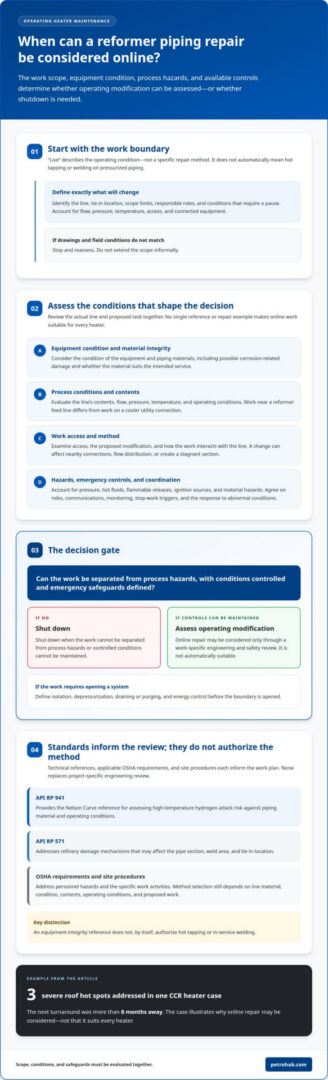
A live catalytic reformer piping modification changes or repairs a line while the connected process remains in operation. The heater and related process circuits continue running, so the work boundary must account for flow, pressure, temperature, and access. “Live” describes the operating condition, not a specific repair method. It does not automatically mean hot tapping or welding on pressurized piping. Clear scope limits help operations and maintenance coordinate the work.
Choosing Shutdown or Operating Modification
Shut down when the work cannot be separated from process hazards or controlled conditions cannot be maintained. In one CCR heater case, three severe roof hot spots were addressed while the next turnaround was more than 8 months away. That example shows why online repair may be considered, not that it suits every heater. Equipment condition, material integrity, work access, and emergency controls all shape the decision.
Standards and In-Service Welding
API RP 941 provides the Nelson Curve reference for assessing high-temperature hydrogen attack, and API RP 571 addresses refinery damage mechanisms. These references inform engineering assessment; they do not authorize hot tapping or in-service welding by themselves. The work plan must also address applicable OSHA requirements and site procedures. Method selection depends on the line’s material, condition, process contents, operating conditions, and proposed work.
Process Hazards and Energy Control
Live piping can involve pressure, hot fluids, flammable releases, ignition sources, and corrosion-related material hazards. If work requires opening a system, the plan must define isolation, depressurization, draining or purging, and energy control before the boundary is opened. Operations and maintenance coordinate through agreed roles, communications, and stop-work triggers. Monitoring tracks relevant process and atmosphere conditions, while the response plan explains how to stop work during an abnormal event. These controls are central to reassuring refinery operations during live catalytic reformer piping modifications.
What does live catalytic reformer piping modification mean in refinery operations?
In refinery operations, a live catalytic reformer piping modification changes a line or connection while the unit continues operating. The heater, reactor vessels, and connected process circuits remain in service during the defined work. “Live” describes the operating condition, not a specific repair method. It does not automatically mean hot tapping or welding directly onto a pressurized line.
The work may involve rerouting a pipe, replacing a connection, or adding a branch. Each task interacts with the line’s contents, temperature, pressure, and metallurgy. For example, work near a reformer feed line differs from work on a cooler utility connection. Process drawings and field identification help define the affected boundary and reveal connected equipment that could influence the task.
This distinction matters because even a small physical change can affect more than the immediate spool. A new branch may alter flow distribution or create a stagnant section. A replacement may need to be compatible with the existing piping materials and operating environment. Engineers define the intended change, examine the connection points, and assess potential effects on process continuity before choosing a method.
For operations teams, the modification also creates a temporary interface between ongoing production and controlled work. The work package should identify the exact line, tie-in location, scope limits, responsible roles, and conditions that require a pause. If drawings do not match field conditions, the basis for the work has changed. Stop and reassess rather than extending the scope informally. This boundary-focused approach keeps decisions tied to the actual reformer configuration.
Where hot-work containment is part of the planned scope, pressurized welding enclosures are one relevant option to consider.
What API and OSHA standards apply to modifying piping on an operating catalytic reformer?
API references and OSHA standards address different parts of a reformer piping work plan. The engineering basis identifies applicable technical guidance, while the work plan addresses personnel hazards. Neither replaces a project-specific review of the line, materials, process conditions, and modification scope. A standard relevant to equipment integrity does not, on its own, authorize welding on operating piping.
API RP 941 is a reference for using the Nelson Curve to assess high-temperature hydrogen attack risk. For a proposed change, engineers consider the piping material and operating conditions against that damage mechanism. The assessment helps inform whether the existing material remains suitable for the intended service. It does not establish that a particular live-work method is acceptable; that decision requires a separate evaluation of the actual work and conditions.
API RP 571 provides a reference for refinery damage mechanisms. Its relevance is practical: the work review should consider how degradation could affect the pipe section, weld area, and tie-in location. For example, a line with suspected material damage presents a different engineering question from an alteration to sound piping. Identifying the mechanism helps direct inspection and material assessment before the modification method is selected.
Consider OSHA standards alongside the engineering review, focusing on the specific work activities and personnel exposures. The work package should connect each task with its hazards, controls, responsible roles, and stop-work conditions. For hot work, address ignition sources and the work environment; for isolation work, define the energy-control boundary. Applicable provisions depend on the task and site conditions, so a general reference cannot replace a job-specific review.
Use API RP 941 and API RP 571 as technical inputs, then document how the chosen controls address the actual piping modification. That separation keeps equipment integrity, worker protection, and operating decisions visible in the same work plan.
Operating context also matters: standard catalytic reformer feed is hydrotreated straight-run naphtha containing C 6 through C 11 paraffins, naphthenes and aromatics. The US Environmental Protection Agency mandates gasoline RVP levels that apply during the summer driving season, while proposed US Tier 3 gasoline sulfur standards were expected to go into effect in 2017. A refinery reported an approximately 90% reduction in flange leaks after applying flange and bolting improvements.
When is hot tapping or in-service welding permitted on refinery process piping?
Hot tapping and in-service welding are distinct methods, not blanket permissions to work on any operating line. Hot tapping creates a connection to piping that remains in service; in-service welding applies welding heat to operating equipment or piping. Either method requires a job-specific engineering assessment before selection. The decision depends on line condition, material, process contents, operating conditions, and the precise weld or connection location.
Start by defining the proposed work boundary. Engineering review identifies the pipe material, wall condition, known damage mechanisms, and process conditions at the work point. It also assesses whether welding could cause burn-through, alter material properties, or ignite a released flammable substance. A line with uncertain thickness or active degradation raises different concerns from one with a documented condition and defined scope. If the assessment cannot establish a controlled basis, the live method is unsuitable.
Hot tapping requires assessment of the fitting, connection design, and cutting operation as a single system. The planned sequence must account for process pressure and temperature, equipment compatibility, containment, and what to do if the operation does not proceed as intended. In-service welding also requires a reviewed welding procedure and controls for heat input, personnel exposure, and ignition sources. A work permit alone does not resolve these engineering questions.
Before mobilization, operations and maintenance teams establish authorization, communication, monitoring, and stop-work triggers. They define who can pause the job, how changes in process conditions are reported, and how the site responds to leakage or another abnormal condition. A change in flow, pressure, temperature, or visible piping condition requires reassessment against the approved work basis. Decisions must reflect actual conditions, not schedule pressure.
For projects that require welding containment, discuss pressurized welding enclosures as part of the work-area control plan.
Reformer service can add material-specific concerns to that review. A Type 405 stainless-steel reactor containing 14.3% chromium failed in a brittle manner after long service at about 900°F (482°C) due to 885°F (473°C) embrittlement. A reformer reactor design intended for service above 538°C uses stainless steel internals to meet high-temperature strength and hydrogen-attack resistance requirements. Such operating history and design details belong in the job-specific basis, rather than being treated as general permission for live work.
PetroHab LLC
PetroHab LLC supports refinery hot-work planning with containment and shutdown-control equipment for hazardous work areas. Its offerings include the PetroHab Hot Work Safety Enclosure (HWSE), pressurized welding enclosures, pressurized habitats, Quadra-Lock Panels, and the Safe-Stop Automatic Shutdown System. Safe-Stop monitors gas levels and pressure, helping teams include shutdown controls in work planning.
For catalytic reformer piping modifications, PetroHab’s enclosures and Safe-Stop system are relevant when the scope includes hot work and calls for a defined containment or monitoring approach. The configuration depends on the work area and project requirements. Equipment supports, but does not replace, engineering review and site procedures.
Contact PetroHab LLC to discuss hot-work safety equipment for your refinery project.
Set the Next Work Decision Before Mobilization
A plan for reassuring refinery operations during live catalytic reformer piping modifications should remain practical as field conditions change. Before mobilization, translate the engineering basis into a clear readiness decision: define the approved scope, the conditions for proceeding, and the changes that require work to pause. Keep that decision aligned with operations’ current understanding of the unit, not just the original work package.
This creates a practical handoff between planning and execution. If the field configuration differs from the design basis, or operating conditions move outside the reviewed limits, stop and reassess before continuing. Clear authority to pause work helps keep schedule pressure from replacing technical judgment. It also gives operations and maintenance a shared basis for deciding whether the planned method remains suitable.
For hot-work containment equipment relevant to your project, Contact PetroHab LLC to discuss your project. A disciplined readiness decision gives the team a clear next step and supports deliberate execution.