Blog Posts
How to Gain Shift Superintendent Approval for Live Process Area Grinding
A clear work plan, not urgency, is what makes a grinding request ready for review. Gaining shift superintendent approval for live process area grinding means explaining the task and exact location, identifying process hazards, and showing how ignition risks, personnel exposure, and quality will be controlled. Present the proposed safeguards, monitoring responsibilities, stop-work triggers, and coordination needs before requesting a decision.
A superintendent must weigh production continuity against the consequences of uncontrolled hot work. A concise, evidence-based request makes those trade-offs clear without minimizing risk. This guide explains how to define the scope, coordinate with operations and safety specialists, address likely concerns, and document oversight. It also covers communicating changing conditions so approval remains tied to the actual site conditions and agreed controls.
Key Takeaways
- Build an approval request around the work scope, process conditions, responsibilities, and clear stop-work triggers.
- Show how qualified oversight will protect both personnel and product quality throughout the grinding task.
- Identify the site-specific permit and authorization steps, and address nearby flammable or combustible materials before work begins.
- Understand when a PetroHab Hot Work Safety Enclosure (HWSE) or related containment equipment may support hot-work risk controls.
Leadership, communication, and problem-solving
- Define the grinding scope before requesting a decision. Identify the equipment, exact work location, task boundaries, and operating conditions. Gaining shift superintendent approval for live process area grinding starts with explaining why the work is needed now and what changes if it is deferred. Make the proposed scope specific enough to evaluate.
- Present the request in operational terms. Shift superintendents lead production workers and supervisors, manage resources, and monitor performance. State the expected work sequence, staffing needs, equipment impacts, and coordination points. For example, explain whether the task overlaps with a planned maintenance window. Separate known conditions from assumptions so the superintendent can assess priorities without relying on incomplete information.
- Involve the right specialists in the decision. A superintendent’s role does not replace specialist safety, engineering, or quality authority. Identify which process owners and technical personnel need to review the scope. Discuss proposed changes to methods, settings, layouts, or operating instructions with engineering and process owners before implementation. Assign trained personnel to their respective tasks, and arrange authorized staffing adjustments when needed.
- Make problem-solving visible. If conditions change, stabilize the situation, gather reliable facts, and involve the relevant specialists. Explain the operational impact and the decision needed instead of presenting an unresolved problem without context. For example, if equipment performance changes, coordinate maintenance support and protect the approved maintenance window from informal schedule changes. Record decisions and communicate revised priorities to affected supervisors.
- Close the loop across shifts. A useful handover identifies operating status, restrictions, unfinished work, and decisions needed by the next team. Confirm who owns each follow-up and where the current work status is recorded. Shift superintendents assess safety, quality, delivery, downtime, labor, and improvement actions together. Use these factors to explain operational trade-offs, then carry approved actions and open issues into the next handover.
Quality control and safety oversight
Apply the OSHA requirements relevant to the task and facility procedures. The permit and hazard review define fire-watch, spark-containment, and fire-protection measures.
-
Confirm Required Permits and Approvals
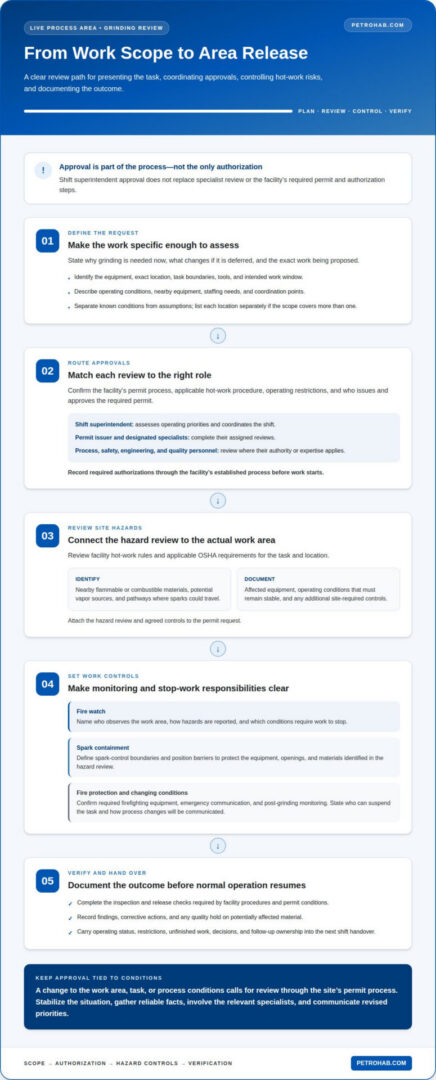
Identify the permits and authorizations required for the grinding scope. Review the facility’s hot-work procedure, work-permit process, and operating restrictions. Confirm who approves the work and which process, safety, and quality roles must review it. Record the approved location, task boundaries, conditions, and required controls. Shift approval does not replace specialist review or required authorization.
-
Check Applicable Hot Work Rules
Review the facility’s hot-work rules for the work location and nearby materials. Identify flammable or combustible materials, potential vapor sources, and pathways where sparks could travel. Confirm how the permit addresses these hazards and which operating conditions must remain stable. Include any additional controls required by site procedures or applicable OSHA requirements in the work plan before approval.
-
Plan Fire Watch and Spark Containment
Define fire-watch responsibilities and spark-control boundaries in the permit. Specify who observes the work area, how that person reports a hazard, and which conditions require work to stop. Position spark barriers to protect nearby equipment, openings, and materials identified during the hazard review. Establish how the area will be monitored after grinding, according to facility procedures and permit conditions.
-
Verify Fire Protection Measures
Confirm the fire-protection measures identified by the site assessment. Ensure the crew knows where required firefighting equipment is located and how to use the site’s alarm or emergency communication method. Keep access to response equipment clear. Define inspection and release checks before returning the affected area to normal operation. Document findings, corrective actions, and any quality hold on potentially affected material.
What permits and approvals are required for grinding in a live process area?
- Identify the facility’s permit process before scheduling the work. Grinding may fall under site hot-work controls because it can produce sparks and heat. Confirm which permit applies, who issues it, and which operating conditions it covers. Applicable OSHA requirements and facility procedures depend on the task and location. Shift superintendent approval is not the only authorization.
- Define the proposed work precisely in the permit request. Record the equipment, process area, grinding activity, tools, and intended work window. Describe nearby operating equipment and materials that could affect the hazard review. If the scope includes multiple locations, identify each one separately. Any change to the work area or task requires review through the site’s permit process.
- Map the approval chain to the decisions each role controls. The shift superintendent assesses operating priorities and coordinates the shift. The permit issuer and designated safety, engineering, or process personnel conduct their assigned reviews. Quality personnel may need to participate when grinding could affect product or equipment condition. Record each required authorization through the facility’s established process before work starts.
- Attach the hazard review and controls to the permit. Include the fire-watch plan, spark containment, fire-protection measures, affected equipment, and stop-work triggers. State how changing process conditions will be communicated and who can suspend the task. For example, a new operating restriction or unexpected nearby activity should trigger reassessment under site procedures, not informal continuation.
- Complete the authorization process before mobilization. Confirm that the permit is approved for the specified location, task, and conditions, and communicate restrictions to the crew and affected operators. Keep the permit and supporting records available at the worksite as facility procedures require. At completion, document outstanding issues and obtain the required release before returning affected equipment or material to normal use.
What hot work rules apply to grinding near flammable or combustible materials?
- Apply the facility’s hot-work procedure to the actual grinding location. Identify flammable liquids, combustible solids, process releases, and nearby equipment. Include adjacent areas where sparks or hot particles could travel. The permit’s hazard assessment should address these conditions and specify controls. A rule from another unit or facility may not apply unchanged to this worksite.
- Control potentially ignitable materials before authorizing the task. Remove combustible items from the work area when site procedures allow. Protect items that cannot be moved with suitable spark barriers, and check openings, drains, and equipment gaps. A barrier that blocks direct sparks, for example, may leave another path exposed. Include those pathways in the hazard review.
- Assess process conditions with operations before grinding begins. Identify equipment that could release flammable material and any operating change that could affect the work. Follow site isolation, monitoring, and stop-work procedures where applicable. If conditions change, suspend the task and reassess the permit controls. Production pressure must not override established isolation or release checks.
- Set fire-watch and response arrangements in the permit. Assign a responsible observer, define how the observer reports a hazard, and identify the required fire-protection equipment. Follow facility rules for fire-watch coverage and post-work monitoring. Keep access routes clear. Ensure the grinding crew understands the alarm method and knows when to stop work.
- Brief the crew on the controls before tools are used. Cover the work boundary, spark direction, nearby combustible materials, communication method, and stop-work triggers. Confirm that operators know the task is underway and understand any restrictions. If containment needs extend beyond the work area, review hot-work containment options as part of planning. Resume only under the applicable site authorization.
PetroHab
PetroHab LLC offers hot-work enclosure systems for projects where site planning identifies a need for controlled grinding or welding work. Its PetroHab Hot Work Safety Enclosure (HWSE), pressurized welding enclosures, and Quadra-Lock Panels provide enclosure options for hazardous industrial environments. The Safe-Stop Automatic Shutdown System monitors gas levels and pressure within applicable systems.
Consider an enclosure when the work plan calls for a controlled hot-work environment. PetroHab offers habitats for lease or sale, along with training and maintenance services. These systems complement, rather than replace, the facility’s permit process, hazard assessment, fire watch, or shift superintendent’s approval. Select an enclosure to suit site conditions and the controls established by facility personnel.
Contact PetroHab LLC to discuss your hot-work enclosure requirements.
Turn approval into a controlled start
Gaining shift superintendent approval for live process area grinding means treating the decision as an operational commitment, not a final formality. Before work begins, make sure the approved scope is understood by everyone whose actions could affect the task. Clear ownership helps keep the work aligned with the decision as crews and operating conditions change.
Use the transition from approval to execution to reinforce accountability. Confirm who holds the go-ahead, who communicates a change, and who can pause the work when conditions no longer match the agreed plan. That clarity helps the shift respond deliberately instead of relying on assumptions. For project-specific hot-work enclosure needs, contact PetroHab LLC to discuss your project. Careful coordination gives your team a stronger basis for moving forward with control.
Frequently Asked Questions
What information should a grinding job safety analysis include?
Include the task sequence, work location, equipment, personnel roles, and hazards at each stage. Note how sparks, abrasive dust, noise, nearby operations, and changing process conditions could affect people or assets. For example, identify who controls the grinder, who monitors surrounding conditions, and what event requires a pause. Link each hazard to a specific control and responsible person.
What gas testing and monitoring are required before and during live-area grinding?
Use facility procedures to determine whether testing is needed, where sampling is required, and whether monitoring must continue during grinding. The method should reflect process hazards and potential gas sources near the work. Identify who performs and interprets tests, how results are communicated, and what change triggers a stop. Follow site-established criteria rather than assumptions.
What isolation, lockout/tagout, and process safeguards are needed for grinding near operating equipment?
Identify energy sources and equipment that could affect the work, then apply the facility’s established isolation and lockout/tagout process where required. Responsible personnel should define the isolation boundary and complete applicable verification before work starts. Consider adjacent equipment, automatic starts, and process changes. Never bypass isolation controls or resume work before required release checks are complete.
What PPE and grinder safety requirements apply to industrial grinding work?
Determine PPE through the task hazard assessment and site rules, considering eye, face, hearing, hand, and respiratory exposures as applicable. Inspect the grinder, wheel, guard, power supply, and workpiece before use. Confirm the wheel suits the tool and task, and keep personnel clear of its travel path. Remove damaged equipment from service according to facility procedures.
What conditions require stopping or postponing grinding in a process area?
Stop or postpone work when actual conditions no longer match the approved controls. Examples include an unexpected process release, failed monitoring equipment, loss of required isolation, ineffective spark containment, or an unplanned nearby operating change. Pause if assigned personnel cannot maintain their roles or communication fails. Escalate the condition through site procedures, then reassess before restarting.
How should a shift superintendent review and document a grinding work permit?
Review whether the permit matches the specific location, equipment, task, and operating window. Check that required specialist reviews and control assignments are recorded and that unresolved hazards have an owner. Document the decision, restrictions, revisions, suspensions, and final status in the facility’s record system. If a shift handover occurs, give the incoming superintendent a clear account of open conditions and decisions.