
Blog Posts
Safehouse Habitat vs PetroHab Quadra-Lock for Hot Work
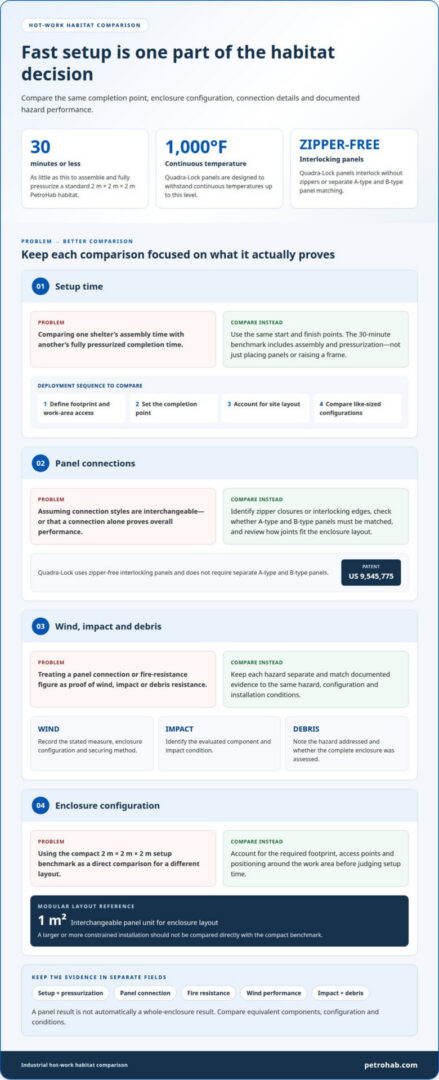
The fastest habitat to assemble isn’t automatically the right choice for hot work. When evaluating a Safehouse habitat versus the PetroHab LLC Quadra-Lock system, focus on documented panel performance, setup time, and how the connections close: Quadra-Lock panels interlock without zippers, and a standard PetroHab LLC habitat measuring 2 m × 2 m × 2 m can be assembled and fully pressurized in as little as 30 minutes. Its panels are designed to withstand continuous temperatures up to 1,000°F.
Fire resistance, setup, and secure panel connections all matter when hot work takes place around ignition hazards. The right fit depends on the enclosure requirements and performance specifications for the job, not on one feature alone.
This safehouse habitat vs petrohab quadra-lock comparison explains what the stated panel temperature and assembly figures mean, how zipper-free connections affect habitat setup, and which operational factors should guide your decision. It also shows where PetroHab LLC hot work safety enclosures and related systems fit when you need a pressurized habitat designed for industrial hot work.
Key Takeaways
- Compare habitat setup by the work sequence and enclosure configuration, not assembly speed alone.
- Understand how zipper-free panel connections can affect assembly and panel selection.
- Identify the wind, impact, and debris-resistance evidence needed to assess habitat suitability for your site.
- Account for site conditions, installation steps, and local permitting requirements when planning deployment.
Habitat assembly time
Elapsed setup time matters, but compare the same completion point for each habitat. A standard habitat measuring 2 m × 2 m × 2 m can be assembled and fully pressurized in as little as 30 minutes. That benchmark includes pressurization, not merely placing panels or raising the enclosure frame. It gives planners a defined reference for a compact configuration.
For a PetroHab Quadra-Lock deployment comparison, define the start and finish points before comparing setup time. For example, start when components arrive at the installation area and finish when the habitat is assembled and pressurized. Apply the same scope to each system.
Configuration also affects the work sequence. Interchangeable panels measuring 1 m² provide a defined modular unit for enclosure layout. The required footprint, access points and positioning around the work area shape how those units are arranged. A larger or more constrained installation should not be compared directly with the 2 m × 2 m × 2 m benchmark.
Use this practical sequence when estimating deployment:
- Define the enclosure: Record the required footprint and work-area access.
- Set the completion point: Include assembly and pressurization in the time being compared.
- Allow for the site layout: Account for how the chosen configuration fits around the hot work.
- Compare like with like: Keep habitat size and completion criteria consistent across options.
The 30-minute figure is an “as little as” assembly and pressurization benchmark, not a universal duration for every site or configuration. A proper deployment assessment should focus on the complete sequence and required enclosure size, rather than treating one time figure as decisive. Site layout and the selected configuration determine how useful a setup-time comparison is for planning hot work.
Quadra-Lock zipper-free panel connections
Quadra-Lock panels interlock without zippers, and the system does not require separate A-type and B-type panels. That connection design is covered by US Patent 9,545,775. For a habitat comparison, assess the actual joining method: zipper closures and interlocking panel connections create different assembly interfaces. Don’t assume another shelter uses either method without documented product details.
A panel connection alone does not establish eligibility for FEMA funding or an insurance discount. Funding depends on the applicable program criteria, while discounts depend on the insurer’s terms and assessment.
An interlocking connection can simplify panel arrangement during assembly and enclosure changes. PetroHab’s Quadra-Lock® panels join without zippers, so there is no need to match A-type and B-type panels before connecting them. This feature can simplify panel handling, but it does not establish total setup time or prove that two habitats offer equivalent fire resistance.
Use these steps when comparing a Safehouse habitat with PetroHab’s interlocking design:
- Identify the connection: Determine whether panels use zippers or interlocking edges.
- Check panel compatibility: Note whether the system requires A-type and B-type distinctions.
- Review the enclosure layout: Consider how connections meet at corners, access points and changes in direction.
- Separate features from performance: Treat connection design and fire-resistance data as distinct comparison criteria.
When planning an enclosure around a work area, consider whether panels connect without first matching A and B types. PetroHab’s Quadra-Lock® panels join without zippers, which informs panel handling but does not replace a review of material specifications or site requirements. Compare the same connection details for each proposed shelter, and assess funding or insurance separately from panel design.
How do their wind, impact, and debris-resistance ratings compare?
Wind, impact, and debris resistance are separate performance measures. A panel connection alone does not establish a shelter’s rating for any of them. For a fair Safehouse comparison, match each shelter’s documented performance to the same hazard, enclosure configuration, and installation conditions. Do not treat a connection design as proof of wind or impact resistance.
Start with wind performance. Compare the stated criteria, tested enclosure configuration, and method of securing the shelter. A rating for one installation arrangement may not apply to another with different openings or supports. Record whether the evidence covers the complete shelter or individual components, so a panel result is not mistaken for a whole-enclosure result.
Assess impact and debris separately. Identify the object or impact condition covered by the evidence, which part of the shelter was evaluated, and whether the result applies to panels, connections, or the assembled enclosure. A panel’s ability to connect to another does not establish how the structure responds to impact. Likewise, a fire-resistance rating does not address wind loading or debris.
Use a comparison table with one row for each hazard:
- Wind: Record the stated performance measure, configuration, and securing method.
- Impact: Identify the evaluated component and the impact condition.
- Debris: Note the debris hazard addressed and whether the complete enclosure was assessed.
Compare like with like. If one document describes a panel and another describes a complete shelter, the results are not equivalent. Keep connection design, fire resistance, and wind or impact performance in separate fields. This makes the Safehouse habitat vs PetroHab Quadra-Lock assessment specific to the worksite hazard, rather than treating one feature as a substitute for performance evidence.
Petro-Habitat floor tiles can resist temperatures up to 1,500°F. Treat that temperature figure as a separate thermal detail when reviewing performance evidence; it does not, by itself, establish wind, impact, or debris resistance. Keep it distinct from the hazard-specific results in the comparison, and avoid using a floor-tile temperature limit to infer how a panel, connection, or assembled enclosure performs under wind or impact conditions.
What installation, site preparation, and permitting does each shelter require?
Plan installation around the shelter configuration, work area, and facility procedures. Safehouse and modular panel shelters may use different assembly sequences, so do not assume their labor, access, or preparation requirements match. Define the work footprint, entry points, nearby equipment, and route for moving enclosure components to the worksite.
Begin site preparation by assessing the installation location. Identify the surface, overhead constraints, access routes, and nearby operations that could affect positioning. A shelter beside fixed process equipment, for example, may need a different panel layout from one in an open work area. These conditions shape assembly planning but do not determine permitting requirements on their own.
Permitting depends on the location and project. The review should account for the site jurisdiction, facility rules, proposed work, and whether the installation changes the site or its use. Do not infer approval requirements from a shelter’s portability or panel design. Keep permit review separate from hot work authorization, which addresses the work activity rather than shelter installation.
- Define the scope: Record the enclosure footprint, access needs, work location, and planned configuration.
- Review the site: Identify ground conditions, overhead obstructions, nearby equipment, and component access routes.
- Plan assembly: Map the panel sequence and position the shelter to support the intended work area.
- Resolve approvals: Identify applicable facility procedures and local permitting steps before installation begins.
Apply the same planning sequence to both options, then compare panel handling, site access, and approval pathways. A clearly defined scope helps separate shelter-specific installation needs from worksite conditions. It also prevents a short assembly estimate from being mistaken for a complete deployment plan.
For project-specific habitat planning, discuss your installation requirements.
PetroHab: Safe-Stop Automatic Shutdown System
PetroHab’s Safe-Stop Automatic Shutdown System monitors habitat overpressure and scans for flammable and hazardous gases inside and outside the enclosure. When it detects unsafe conditions, it automatically shuts down hot work operations and provides audio and visual alarms, with manual emergency shutdown buttons available.
This system is relevant when hot work takes place in a pressurized habitat and pressure or gas conditions require active monitoring. It complements the physical enclosure with monitoring and shutdown functions; it does not replace safe work procedures or assessment of site-specific hazards. PetroHab’s Hot Work Safety Enclosures provide the enclosure context for evaluating these controls.
Discuss your planned hot-work requirements with PetroHab to find the right enclosure and monitoring setup for your operation.
Turn Your Habitat Criteria Into a Project Plan
A Safehouse habitat vs PetroHab Quadra-Lock comparison is a starting point for defining what your hot-work operation requires. Next, align enclosure selection with the work scope, site conditions, and controls in your safety plan. Keeping these requirements together helps ensure the habitat supports the job and deployment plan.
PetroHab offers Hot Work Safety Enclosures, Quadra-Lock® panels, and the Safe-Stop Safety Shutdown System. Each addresses a different part of the hot-work setup: the enclosure, panel connections, or monitoring and shutdown functions. Consider which of these your operation requires when planning the habitat.
Discuss habitat options with PetroHab and take the next step toward a hot work setup that fits your project.
Frequently Asked Questions
What is the PetroHab Quadra-Lock shelter and how does it work?
PetroHab’s pressurized Hot Work Safety Enclosures are modular habitats for hazardous hot-work operations. Their panels connect through patented Quadra-Lock® technology, and a pneumatic air supply supports the pressurized enclosure. Configurations can include window panels and panels designed for intrusions or protrusions, helping adapt the layout to equipment and work-area features.
What are the differences in materials, construction, and maintenance?
PetroHab Quadra-Lock panels interlock without zippers and do not require A-type and B-type distinctions; interchangeable panels measure 1 m² and are designed for continuous temperatures up to 1,000°F. Maintenance details and Safehouse construction specifications are not available here.
What warranty and certifications does each manufacturer offer?
Petro-Habitat panels meet the ANSI/FM 4950 fire resistance and ignition prevention standard. Safe-Stop is certified to IEC 60079-13:2017 and is third-party ATEX certified; warranty details and Safehouse certifications are not available here.
How do Safehouse Habitat and PetroHab Quadra-Lock compare in dimensions and capacity?
A standard Petro-Habitat measures 2 m × 2 m × 2 m and can be assembled and fully pressurized in as little as 30 minutes. The information available gives no Safehouse dimensions or capacity.