
Blog Posts
Hot Work Safety Enclosure Guide for Hazardous Zones
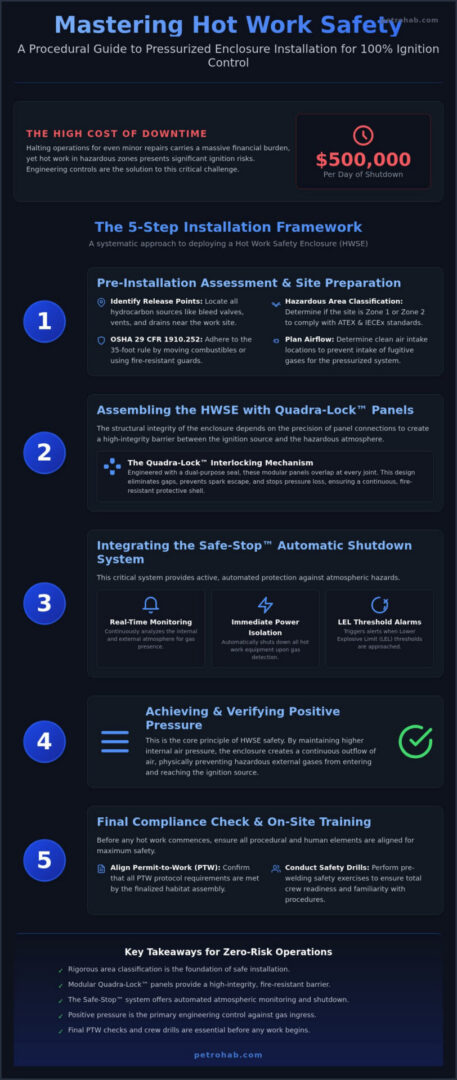
A single day of production shutdown for minor repairs can cost an offshore platform or refinery as much as $500,000. You recognize that halting operations for necessary maintenance is a massive financial burden, yet the risk of an ignition event in a hazardous zone makes hot work feel like a dangerous gamble. This tension between operational continuity and absolute safety is where engineering controls become vital. Mastering the technical nuances of hot work safety enclosure installation is no longer optional for safety managers who demand zero-risk environments.
You’ve likely felt the pressure of navigating complex 2026 ATEX and IECEx standards while trying to avoid costly downtime. This guide provides the authoritative procedural steps for installing a pressurized hot work safety enclosure to ensure 100% ignition control. We’ll detail how to deploy modular Quadra-Lock panels to create a hermetic seal and how to integrate the Safe-Stop Automatic Shutdown System for continuous atmospheric monitoring. By the end of this article, you’ll have a logical framework for protecting personnel and high-value assets during live-site welding operations without compromising your site’s regulatory standing.
Key Takeaways
- Learn how to conduct rigorous hazardous area classification checks to identify hydrocarbon release points before beginning any hot work safety enclosure installation.
- Understand the engineering advantages of modular Quadra-Lock panels for creating high-integrity, fire-resistant barriers in custom-sized configurations.
- Master the integration of the Safe-Stop Automatic Shutdown System to provide real-time atmospheric monitoring and immediate power isolation during gas detection.
- Discover the technical requirements for achieving and verifying positive pressure to maintain a protective internal environment against external hazardous atmospheres.
- Review essential steps for aligning Permit-to-Work (PTW) protocols with finalized habitat assembly and conducting pre-welding safety drills for crew readiness.
Pre-Installation Assessment and Site Preparation
A successful hot work safety enclosure installation begins with a rigorous technical audit of the facility. You can’t treat site preparation as a secondary task; it’s the foundational step that ensures the containment system performs as engineered. The assessment process requires a precise identification of all hydrocarbon release points, such as bleed valves, vents, or open drains, located within the immediate vicinity of the proposed work site.
The engineering team must evaluate the structural integrity of the installation area. Offshore decks and refinery skids have specific load limits that must accommodate the weight of the modular panels and the personnel inside. You must also account for the 35-foot rule specified in OSHA 29 CFR 1910.252, which requires moving combustible materials or providing fire-resistant guards. Integrating Hot work safety principles into this initial phase allows for the creation of a comprehensive risk mitigation strategy.
Mapping ATEX and IECEx Zone Requirements
Identifying whether the site is classified as Zone 1 or Zone 2 is a critical safety benchmark. This classification dictates the certification levels required for the equipment and the frequency of atmospheric monitoring. Compliance with the 6th Edition of the ATEX 2014/34/EU guidelines, updated in January 2026, ensures that your safety protocols align with the latest international standards. You must establish clear Lower Explosive Limit (LEL) thresholds for the local atmosphere before any work begins. For a full breakdown of these requirements, refer to our Hazardous Environment Standards guide.
Logistics and Footprint Planning
Calculating the enclosure dimensions requires a balance between the necessary work space and the physical constraints of the site. The footprint must allow for clear emergency egress paths and sufficient room for technicians to move without compromising the integrity of the enclosure walls. Proper logistics planning for a hot work safety enclosure installation includes mapping the airflow pathways. Site-specific ventilation planning is essential for pressurized systems to ensure that clean air is consistently sourced from a non-hazardous location. You must determine the exact air intake locations for the ducting to prevent the intake of fugitive gases. This preparation ensures that once the pressurized system is active, the internal environment remains entirely free of contaminants.
Assembling the HWSE with Quadra-Lock Panels
The structural integrity of a pressurized habitat depends entirely on the mechanical connection of its components. During a hot work safety enclosure installation, technicians must prioritize the precision of the panel interface to maintain the required internal pressure. Unlike generic fire blankets or non-rated industrial curtains, the Quadra-Lock system uses a specific interlocking geometry designed to eliminate gaps at every junction. This engineered approach ensures that the habitat functions as a high-integrity barrier between the ignition source and the external hazardous atmosphere.
Assembly begins with the establishment of a level base frame, followed by the systematic attachment of the wall panels. Each section must be securely fastened to withstand the operational stressors of heavy industry. In offshore environments, the enclosure must remain stable against high-wind loads and vibration. The modular nature of these components allows for the encapsulation of complex shapes, including large production vessels or overhead pipe racks, providing a versatile solution for varied maintenance scopes. For projects requiring bespoke configurations, our technical team provides guidance on customizing modular habitats for maximum site efficiency.
The Quadra-Lock Interlocking Mechanism
The engineering behind Quadra-Lock panels focuses on a dual-purpose seal. These panels overlap at every joint, creating a physical barrier that prevents sparks or molten slag from escaping while simultaneously restricting the egress of pressurized air. The fastening process secures the panels without compromising their fire-resistant properties, ensuring a continuous protective shell. This interlocking design is the primary defense against pressure loss, allowing the system to maintain the precise CFM requirements needed for safety compliance. By utilizing this modular architecture, operators can scale the enclosure size to fit the specific hot work area without sacrificing structural rigidity.
Sealing and Integrity Verification
Achieving a hermetic seal requires meticulous attention to site-specific penetrations. Pipes, structural beams, and scaffolding often intersect the habitat footprint, creating potential leak points that can undermine the entire system. Technicians use high-performance, fire-resistant sealing materials to close these irregular gaps, ensuring the internal environment remains isolated. Before initiating the pressurization sequence, you must conduct a full perimeter inspection to verify the seal’s quality. Adhering to OSHA hot work regulations regarding fire protection and containment is mandatory during this phase. For more detailed technical specifications on maintaining habitat seals, consult our guide on Pressurized Welding Habitats.
Integrating the Safe-Stop Automatic Shutdown System
The physical assembly of the habitat provides the barrier, but the Safe-Stop Automatic Shutdown System provides the active intelligence required for 100% ignition control. A technical hot work safety enclosure installation isn’t complete until the monitoring hardware is fully integrated into the site’s power and safety infrastructure. This system acts as an autonomous safety layer, continuously evaluating the environment to prevent accidents before they occur. You must treat the control unit as the central nervous system of the operation, linking atmospheric data directly to the power supply of your ignition sources.
Installation technicians begin by mounting the Safe-Stop control unit in an accessible location outside the enclosure. From this hub, you’ll deploy a network of gas and pressure sensors. Strategic placement is mandatory for effective risk mitigation. One gas detector must be positioned at the air intake for the blower system to ensure that no fugitive hydrocarbons are drawn into the habitat. A second detector is placed inside the enclosure to monitor for internal leaks or gas buildup. These sensors must be calibrated to detect even minor concentrations of combustible gases, typically reaching a threshold of 10% Lower Explosive Limit (LEL).
Atmospheric Monitoring and Sensor Calibration
The Safe-Stop system is engineered for ATEX-certified zone operation, ensuring reliability in high-risk environments. Calibration involves setting the differential pressure sensors to recognize the specific requirements of the enclosure’s volume. These sensors detect minor drops in habitat integrity that could indicate a breach in the Quadra-Lock panels or a blower failure. The Safe-Stop system provides an autonomous safety layer that removes the variable of human error from the monitoring process, ensuring that the environment remains within specified safety parameters at all times.
Hardware Integration and Fail-Safe Testing
The final stage of the hot work safety enclosure installation involves the physical connection of the welding power source and grinders to the Safe-Stop unit. You’ll route the primary power through the system’s internal contactors, allowing for an instantaneous power-cut if an alarm is triggered. Technicians must verify the automatic power-cut mechanism through a series of controlled tests before work commences. Configure the system to trigger audible and visual alarms at 5% LEL, providing an early warning before reaching the critical shutdown threshold at 10% LEL. You must also test the emergency shutdown (ESD) interface with the facility’s broader safety systems to ensure a coordinated response to any site-wide event. For a deeper analysis of these configurations, consult our technical overview of Advanced Hot Work Safety Systems.
Achieving and Verifying Positive Pressure
Positive pressure is the fundamental engineering principle that transforms a physical barrier into a dynamic safety system. In the context of a hot work safety enclosure installation, positive pressure refers to maintaining an internal atmosphere at a higher pressure than the surrounding environment. This pressure differential creates a pneumatic seal. If a breach occurs, air flows exclusively from the clean internal environment to the hazardous external area, preventing flammable gases from entering. Engineers determine the required Cubic Feet per Minute (CFM) by calculating the total volume of the enclosure and ensuring a sufficient rate of air exchange to displace welding fumes and maintain the pressure gradient.
Achieving this state requires the deployment of high-capacity, explosion-proof blowers and anti-static air ducting. Technicians must secure all ducting runs to structural supports to prevent collapse or accidental disconnection during high-wind events or heavy vibration. The system typically targets a pressure differential between 0.1 and 0.5 inches of water. This range is sufficient to block gas ingress without causing structural strain on the Quadra-Lock panels. To ensure your site meets these rigorous standards, you can lease certified pressurized welding enclosures engineered for high-stakes industrial applications.
Ventilation and Airflow Management
The integrity of the internal atmosphere depends on the quality of the intake air. Technicians must position air intakes in verified non-hazardous areas, located upwind and at a significant distance from potential hydrocarbon release points. This placement ensures that the blower system only introduces clean, breathable air into the habitat. Proper airflow management also addresses the physiological needs of the personnel inside. The system must provide continuous cooling and effective fume extraction to maintain visibility and safety for welders. Secure all ducting connections with industrial-grade tensioning straps to maintain a consistent CFM delivery throughout the work shift.
Pressure Maintenance and Monitoring
Continuous verification is mandatory to ensure the habitat remains a valid engineering control. Operators use calibrated manometers to monitor the pressure differential in real-time. The Safe-Stop Automatic Shutdown System is configured to trigger an immediate power isolation if the internal pressure falls below 0.05 inches of water. This fail-safe threshold ensures that hot work cannot continue if the pneumatic seal is compromised. Maintaining this pressure requires strict procedural control during technician ingress and egress. Use the following checklist to manage habitat integrity:
- Verify that the airlock doors are never opened simultaneously.
- Monitor manometer readings every 30 minutes and record them in the safety log.
- Inspect ducting for kinks or restricted airflow at the start of every shift.
- Confirm that the blower intake remains clear of obstructions or localized gas pockets.
Final Compliance Check and On-site Training
The completion of the hot work safety enclosure installation marks the critical transition from engineering setup to operational execution. You must validate the finalized installation against the specific Permit-to-Work (PTW) requirements for your facility. This process isn’t a mere formality. It is the final verification that the Quadra-Lock panels and Safe-Stop system function as a single, cohesive safety unit. The Safety Officer or Offshore Installation Manager (OIM) must review the entire setup to ensure it meets all regulatory benchmarks. This includes adhering to the 2024 NFPA 51B standard, which mandates a minimum 60-minute fire watch after hot work is completed.
Before work begins, the habitat crew must execute a comprehensive pre-welding safety drill. This exercise simulates emergency scenarios, ensuring every technician understands their role if a gas detection event occurs. You’re not just testing the equipment; you’re testing the human response to the technology. The goal is absolute protection of personnel and high-value assets through disciplined adherence to established safety protocols.
PetroHab On-site Supervision and Training
High-risk projects demand more than just compliant hardware. Leveraging certified PetroHab technicians for on-site supervision ensures that the installation integrity is validated by experts who understand the granular details of habitat engineering. Professional training for the client’s crew significantly reduces the risk of human error during live operations. Training outcomes focus on several key competencies:
- Executing precise Safe-Stop sensor calibration and testing.
- Managing airlock protocols to maintain positive pressure during ingress.
- Interpreting LEL alarms and emergency shutdown triggers.
- Maintaining the 35-foot rule for combustible materials as per OSHA 1910.252.
This hands-on instruction ensures that the habitat crew can operate the system with absolute confidence, even in the most demanding offshore or refinery environments.
The Final Safety Checklist
Before the first arc is struck, the habitat must pass a definitive technical inspection. This checklist serves as the final barrier against operational failure. You must confirm that all Quadra-Lock panels are correctly overlapped and that every pipe or beam penetration is hermetically sealed. Verify that the Safe-Stop unit has a clear, uninterrupted connection to the power source of all welding machines and grinders. For a complete operational overview, refer to The Definitive Guide to HWSE.
Final sign-off requires confirming that the manometer readings are stable within the 0.1 to 0.5 inches of water range. You must also verify that the Safe-Stop system is configured to isolate power immediately if pressure drops below the 0.05 inches of water threshold. Once the OIM or Safety Officer provides the final signature, the hot work safety enclosure installation is officially certified for live-site operations. This methodical approach suggested by our veteran experts ensures that your maintenance schedule proceeds with zero downtime and total ignition control.
Securing Your Operational Future with Pressurized Containment
Maintaining operational continuity in hazardous environments requires a disciplined approach to risk mitigation. You’ve seen how a successful hot work safety enclosure installation relies on the technical synergy between structural integrity and autonomous monitoring. By prioritizing site preparation and utilizing patented Quadra-Lock technology, you eliminate the risk of spark escape while maintaining a hermetic seal. The integration of the Safe-Stop system ensures that even minor pressure drops or trace gas detections result in an immediate, fail-safe shutdown.
These engineering controls are essential for meeting global ATEX and IECEx compliance standards. Relying on expert on-site supervision further reduces the margin for human error, protecting your high-value assets and personnel from ignition events. You don’t have to choose between maintenance and production uptime when you deploy a solution designed for the most demanding industrial zones.
Take the next step in establishing a fully compliant, pressurized work environment. Request a Quote for HWSE Leasing or Purchase to secure your site today. Your commitment to safety is our priority.
Frequently Asked Questions
How long does it typically take to install a hot work safety enclosure?
Installation duration varies based on the enclosure size and site complexity. A standard modular setup using Quadra-Lock panels is engineered for rapid deployment. The interlocking mechanism allows for efficient assembly compared to non-modular systems. Factors like the number of pipe penetrations and the structural support availability on offshore decks will influence the final timeline. On-site supervisors ensure the process remains methodical and compliant with facility safety protocols.
What is the minimum pressure required inside a pressurized welding habitat?
A pressurized welding habitat typically maintains an internal pressure differential between 0.1 and 0.5 inches of water. This positive pressure ensures that air only flows outward from the enclosure, preventing the ingress of flammable gases. The Safe-Stop system is configured to trigger an immediate power isolation if the pressure falls below the critical threshold of 0.05 inches of water. Continuous monitoring via manometers is mandatory to verify this pneumatic seal throughout the work shift.
Can a hot work safety enclosure be installed on a live offshore platform?
Yes, hot work safety enclosure installation is specifically designed for live-site operations in hazardous zones. These systems allow for essential maintenance, such as welding or grinding, without requiring a total production shutdown. The pressurized environment isolates the ignition source from the surrounding atmosphere. This capability prevents the massive financial losses associated with facility downtime, which can reach $500,000 per day on high-output offshore platforms or refineries.
What happens if the Safe-Stop system detects a gas leak outside the habitat?
If the Safe-Stop system detects hydrocarbons at the air intake or near the habitat, it initiates an instantaneous emergency shutdown. The system isolates the power supply to all ignition sources, including welding machines and grinders, before gas concentrations reach dangerous levels. Typically, alarms trigger at 5% LEL, with a full power-cut occurring at 10% LEL. This autonomous safety layer ensures that hot work is immediately halted if the external environment becomes compromised.
Are Quadra-Lock panels compatible with various scaffolding configurations?
Quadra-Lock panels feature a modular design that integrates seamlessly with most industrial scaffolding structures. The interlocking panels can be configured to encapsulate complex geometries, including irregular vessel shapes and overhead pipe racks. This flexibility allows for the creation of a high-integrity barrier regardless of the site’s physical constraints. Technicians use specialized fire-resistant materials to seal the gaps where scaffolding tubes penetrate the enclosure walls, maintaining the necessary positive pressure differential.
Is on-site supervision mandatory for HWSE installation?
While internal teams can manage some setups, certified on-site supervision is highly recommended for complex or high-risk hot work safety enclosure installation. Expert supervisors validate the structural integrity of the Quadra-Lock panels and ensure the Safe-Stop system is correctly integrated with facility safety systems. Their presence provides an additional layer of technical oversight, ensuring that every safety protocol is followed and that the final installation meets all ATEX and IECEx compliance standards.
How do you seal irregular pipe penetrations in the enclosure walls?
Irregular penetrations from pipes, beams, or cables are sealed using specialized fire-resistant containment materials. Technicians meticulously wrap and secure these materials around the penetration points to prevent pressure loss. The goal is to achieve a hermetic seal that maintains the internal pressure gradient. Every penetration is a potential leak point, so each must be inspected and verified during the pre-welding safety drill to ensure the enclosure remains a valid engineering control.
What certifications should I look for in a hot work safety enclosure?
You should prioritize equipment that holds international technical certifications, specifically ATEX and IECEx. These standards ensure the hardware is engineered to operate safely in explosive atmospheres. Compliance with NFPA 51B and OSHA 29 CFR 1910.252 is also essential for fire prevention and regulatory standing. These anchors of quality provide safety managers with the confidence that the pressurized system will perform reliably under the high-stakes conditions of heavy industry.