Blog Posts
Hazardous Area Requirements for Hot Work: A 2026 Safety Compliance Guide
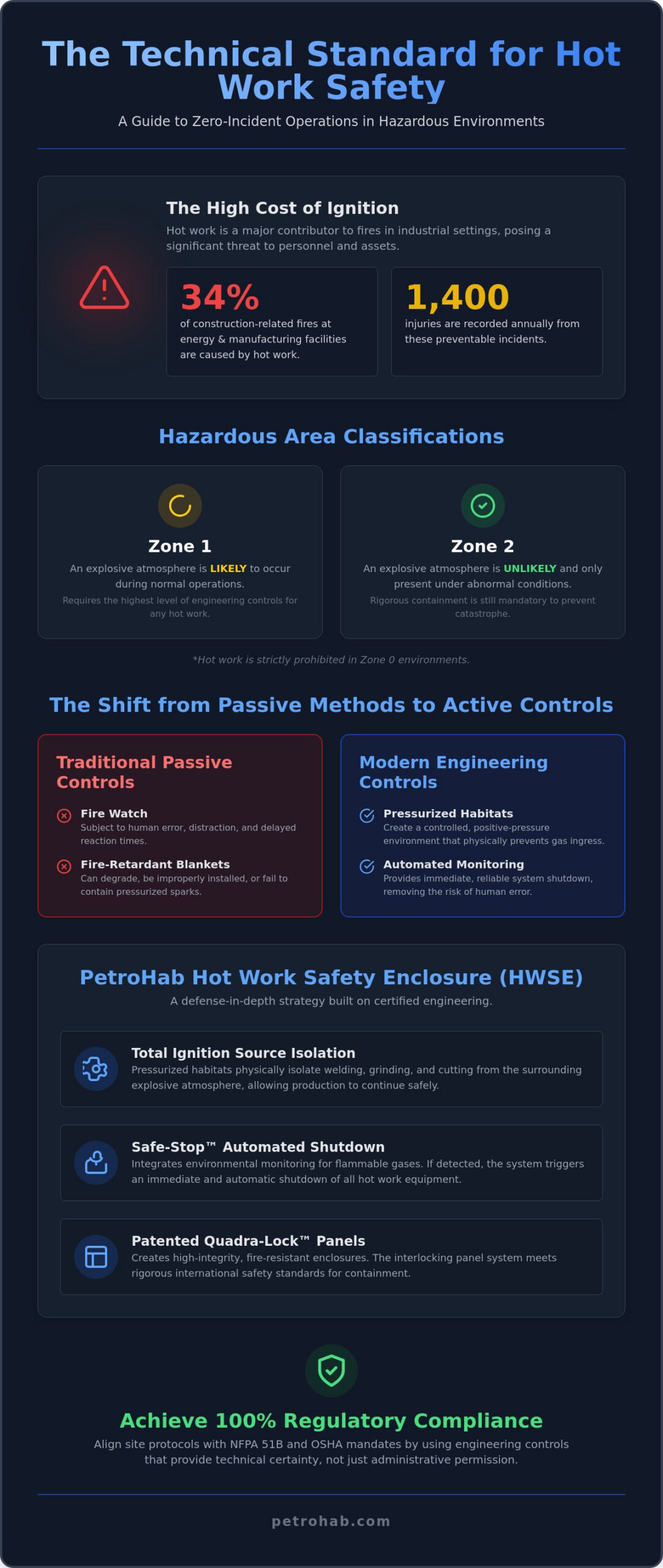
Industrial data from 2026 indicates that hot work accounts for 34% of all construction-related fires at manufacturing and energy facilities. In the volatile environment of a Zone 1 or Zone 2 classified area, a single ignition source represents a potential catastrophe for personnel and high-value assets. You understand the pressure of maintaining live production while adhering to complex hazardous area requirements for hot work. The cost of downtime during maintenance is high, but the cost of a safety failure is absolute.
This guide provides the technical expertise you need to achieve 100% regulatory compliance and zero-incident operations. You’ll learn how to integrate the latest standards from NFPA 51B and the 2026 IEC 60079-13 draft into your safety protocols. We’ll examine how engineering controls, specifically the PetroHab Hot Work Safety Enclosure (HWSE) featuring patented Quadra-Lock panels, provide the necessary environmental containment to isolate ignition sources. This overview details the transition from administrative permits to definitive technological remedies that protect your site without halting production.
Key Takeaways
- Identify the technical distinctions between Zone 1 and Zone 2 environments to determine the necessary engineering controls for ignition prevention.
- Align site protocols with the 2026 hazardous area requirements for hot work to ensure full compliance with NFPA 51B and OSHA mandates.
- Deploy pressurized welding habitats to isolate ignition sources and maintain continuous production during essential maintenance cycles.
- Integrate Safe-Stop technology for automated environmental monitoring and immediate system shutdown in the presence of flammable gases.
- Utilize patented Quadra-Lock panels to construct high-integrity enclosures that meet rigorous international safety and fire-resistance standards.
Understanding Hazardous Area Classifications and Hot Work Risks
Safe operations in explosive atmospheres depend on a precise understanding of the fire triangle: fuel, oxygen, and an ignition source. In hydrocarbon processing facilities, fuel and oxygen are often environmental constants. Hot work, which includes welding, thermal cutting, and grinding, introduces the final component required for combustion. When these activities occur in proximity to flammable vapors, the risk of a catastrophic ignition event increases exponentially. Engineers must treat every spark as a potential trigger for a site-wide emergency.
To visualize the specific challenges of maintaining safety in these high-stakes environments, watch this technical overview:
The severity of failure in these zones is documented and significant. National Fire Protection Association data from 2026 shows that industrial properties face approximately 37,000 fires annually. Hot work contributes to 34% of construction-related fires in these settings. These incidents result in roughly 1,400 injuries each year, highlighting the absolute necessity of rigorous engineering controls. Relying on administrative permits alone is insufficient when the objective is zero-incident performance.
Zone Classifications and Their Impact on Safety Protocol
Hazardous area requirements for hot work are dictated by the classification of the immediate environment. Zone 0 represents areas where an explosive atmosphere is present continuously or for long periods. Hot work is strictly prohibited in Zone 0. Zone 1 involves areas where explosive atmospheres are likely to occur during normal operations, while Zone 2 covers areas where such atmospheres are only present under abnormal conditions. Each classification demands a different tier of containment. In Zone 1 and 2, the primary objective is to isolate the ignition source from the surrounding atmosphere using pressurized enclosures.
The Limitations of Traditional Fire Watch Methods
Traditional safety measures often rely on human fire watches and fire-retardant blankets. These are administrative and passive controls that possess inherent failure points. A fire watch is subject to human error and delayed reaction times. Standard blankets can degrade or fail to contain pressurized sparks. Effective risk mitigation requires a shift toward a defense-in-depth strategy. This involves replacing passive barriers with active engineering solutions, such as pressurized habitats. These systems create a controlled micro-environment that physically prevents the ingress of flammable gases, ensuring that hazardous area requirements for hot work are met through technical certainty rather than human vigilance.
Regulatory Requirements for Hot Work Permits and Compliance
Compliance with hazardous area requirements for hot work begins with a rigorous administrative framework. The NFPA 51B standard (2024 edition) serves as the primary benchmark for fire prevention during welding and cutting operations. This latest revision emphasizes “documented” permits over traditional written forms, facilitating the transition to digital safety management systems. While the permit identifies the risk, it does not mitigate it. True compliance requires the physical application of engineering controls that meet the technical specifications outlined in the OSHA standard for hot work. This regulation mandates the removal of combustibles within a 35-foot radius or the implementation of fire-resistant guards when relocation is impossible.
A Permit-to-Work (PTW) system functions as the operational bridge between safety theory and site execution. It’s a formal risk assessment that must be completed before any ignition source enters a classified zone. In 2024, industry data indicated that 35% of ignition incidents resulted from inadequate permit handovers. This statistic underscores the necessity of integrating physical containment systems, such as a PetroHab Hot Work Safety Enclosure (HWSE), directly into the PTW workflow. By mandating the use of a pressurized habitat within the permit itself, safety managers ensure that the safety barrier is active rather than elective.
The Essential Elements of a Hot Work Permit
Every high-integrity permit must include specific technical data points to ensure the protection of personnel. These include:
- Atmospheric Testing: Continuous monitoring for flammable gases using calibrated, ATEX-certified detectors.
- Defined Roles: Clear designation of the Authorizing Supervisor and a dedicated Fire Watch who remains on-site for at least 30 minutes after work concludes.
- Equipment Certification: Verification that all pressurized welding enclosures and shutdown systems are maintained according to manufacturer specifications.
Global Standards for Hazardous Environment Compliance
Operating across international borders requires a sophisticated understanding of how hazardous environment standards vary by region. While OSHA governs US-based onshore activities, offshore operations and European sites frequently adhere to ATEX and IECEx directives. These frameworks dictate the protection levels for electrical equipment and non-electrical ignition sources. Utilizing modular systems equipped with Quadra-Lock panels ensures that your habitat meets these global benchmarks for fire resistance and structural integrity. If you are preparing for a large-scale turnaround, you might consider how PetroHab specialized supervision can streamline your compliance documentation and site safety audits.
Engineering Controls: Pressurized Habitats vs. Passive Methods
Passive safety measures, such as fire-retardant blankets, provide a secondary layer of defense but fail to address the primary risk of gas ingress. These methods are reactive. In contrast, pressurized habitats represent a proactive engineering control designed to eliminate the possibility of ignition at the source. Adhering to OSHA Standard 1915.14 requires strict atmospheric control before and during hot work in spaces that have contained combustible materials. While passive barriers might deflect a spark, they cannot prevent a flammable gas cloud from reaching a welding arc. Engineering containment actively manages the environment, ensuring that hazardous area requirements for hot work are satisfied through physical exclusion rather than administrative hope.
By creating this safe micro-environment, operators can significantly reduce the standard safe distance requirements typically mandated for hot work. This allows maintenance to proceed in close proximity to live production equipment. It minimizes the economic impact of shutdowns while maintaining an unwavering commitment to site safety. The transition from passive to active controls is the hallmark of a mature safety culture that prioritizes risk elimination over risk awareness.
How Positive Pressure Prevents Gas Ingress
The science of environmental containment relies on maintaining a positive pressure differential between the interior of the enclosure and the external hazardous atmosphere. By keeping the internal pressure higher than the surrounding air, the system creates a physical barrier. Flammable vapors cannot move against this pressure gradient. This technical approach is a cornerstone of meeting hazardous area requirements for hot work in high-risk facilities. To maintain this integrity, the air intake must be positioned in a verified non-hazardous location. Continuous monitoring ensures that if the differential pressure falls below a predetermined safety threshold, all hot work equipment de-energizes immediately. It’s a fail-safe mechanism that removes the element of human error from the safety equation.
Structural Integrity and the Quadra-Lock Advantage
A pressurized habitat is only as reliable as its weakest seal. Standard panel connections often suffer from air leakage or structural failure when subjected to the internal pressure necessary for safety or the external wind loads common on offshore platforms. The engineering behind the PetroHab HWSE addresses this vulnerability directly. The use of patented Quadra-Lock panels provides a superior interlocking mechanism that secures the enclosure without compromising fire-resistant properties. These panels allow for a modular configuration that adapts to complex site geometries while maintaining a gas-tight seal. Unlike makeshift barriers, this system provides a definitive technological remedy that withstands the rigorous demands of heavy industrial maintenance and extreme environmental conditions.
Critical Safety Components for Zone 1 and 2 Environments
While the physical habitat provides the primary barrier, the internal electronics serve as the site’s active guardian. Meeting the rigorous hazardous area requirements for hot work in Zone 1 and 2 environments necessitates the use of ATEX-certified gas detection. These sensors must be capable of detecting flammable vapors at concentrations well below the Lower Explosive Limit (LEL). In industrial settings, reliance on manual gas checks is insufficient. Real-time, continuous monitoring provides the only reliable data stream for maintaining safety during live production. The integration of these sensors into the broader safety ecosystem ensures that hazardous conditions are met with a definitive technological remedy before they escalate.
The integration of hot work safety systems ensures that any breach in the safety perimeter results in an immediate cessation of work. This is achieved through automatic shutdown technology that interlocks with the welding power source. If gas is detected or if the internal pressure drops, the system de-energizes the tools before an ignition can occur. This level of technical precision is mandatory for high-stakes environments where the risk of catastrophic failure is ever-present. It transforms the enclosure from a simple shelter into a sophisticated safety instrument.
Safe-Stop: The Role of Automatic Shutdown Systems
The Safe-Stop Automatic Shutdown System acts as the central intelligence of the enclosure. It continuously evaluates inputs from gas sensors and pressure manometers. When LEL thresholds are reached, typically set at 10% or 20% of the limit depending on site-specific protocols, the system reacts within milliseconds. This rapid response eliminates human error and ensures that the hazardous area requirements for hot work are maintained even in the event of an equipment malfunction or an external gas release. By automating the shutdown process, the system provides a level of reliability that manual fire watches cannot match.
Monitoring and Documentation Systems
Modern compliance demands more than just real-time safety; it requires verifiable data. Digital logging systems now record pressure levels and gas concentrations throughout the duration of the work shift. This documentation provides an audit trail for safety managers and regulatory bodies, proving that the enclosure maintained its integrity. In corrosive offshore environments, sensor calibration is a critical maintenance task to prevent drift and ensure accuracy. High-integrity systems include both visual and audible alarms to alert personnel to habitat integrity issues immediately. Using enclosures constructed with Quadra-Lock panels ensures the structural stability required for these sensors to function accurately under pressure.
To ensure your facility meets the highest global safety standards, contact the PetroHab engineering team for a technical consultation on Safe-Stop integration and habitat deployment.
Implementing PetroHab HWSE for Operational Excellence
Deploying a high-integrity containment system in a live facility is the definitive step in satisfying hazardous area requirements for hot work. Safety managers often face the conflict between maintaining production schedules and managing ignition risks. Engineering containment resolves this tension. By isolating the ignition source, you protect high-value assets without halting the flow of hydrocarbons. This operational continuity is the primary driver of ROI during critical repairs. It moves the facility toward a zero-incident environment while maintaining the pace of production.
Modular Deployment with Quadra-Lock Technology
Industrial facilities rarely offer uniform work spaces. Complex piping and structural steel require a modular approach that doesn’t compromise safety. The use of Quadra-Lock technology allows for the rapid assembly of a hot work safety enclosure that adapts to these irregular geometries. Unlike passive barriers, this interlocking system ensures a gas-tight seal even when internal pressure is high or external conditions are volatile. In offshore environments, structural integrity is paramount. High-wind loads can compromise standard panel connections, leading to pressure loss and potential gas ingress. The engineering behind the Quadra-Lock panels provides the necessary rigidity to withstand these forces, ensuring the micro-environment remains stable throughout the maintenance cycle.
Training and Certification for Safety Personnel
Technical hardware requires expert management to ensure long-term reliability. PetroHab provides comprehensive technician training and operator competency certification to ensure that personnel can manage hazardous area requirements for hot work with precision. This training covers the granular details of atmospheric monitoring and Safe-Stop system calibration. It’s not enough to have the equipment; the team must understand the procedural nature of the safety protocols it supports. For large-scale turnarounds, the logistics of rental vs. purchase depend on the frequency of maintenance cycles. Rental options provide access to the latest technology with the benefit of integrated on-site supervision. This partnership model places an expert safety veteran on your site to oversee habitat integrity and compliance auditing. It transforms the enclosure from a temporary structure into an active guardian of your facility’s safety and operational excellence.
Advancing Your Site Safety Strategy for 2026 and Beyond
Achieving operational excellence in high-stakes environments requires a transition from passive observation to active engineering protection. You’ve seen that while permits identify risk, only pressurized containment actively eliminates the ignition source. Modern hazardous area requirements for hot work demand more than standard fire watches. They require the technical certainty of automated shutdown systems and high-integrity structural barriers. By integrating Safe-Stop technology and Quadra-Lock panels, you ensure that your site remains compliant with 2026 standards while maintaining live production.
PetroHab remains the industry benchmark, trusted by Tier-1 Oil & Gas operators worldwide to protect high-value assets and personnel. Our patented Quadra-Lock structural technology and global support network provide the reliability your engineers demand. Whether you’re planning a routine repair or a major facility turnaround, our on-site supervision ensures that your safety protocols are executed with meticulous precision. We act as your critical safety partner, providing the durable equipment and expertise necessary to mitigate risk in the most challenging environments.
Request a Technical Consultation for Your Next Hot Work Project to secure your facility’s future. We look forward to partnering with you to eliminate workplace accidents and drive safety excellence across your global operations.
Frequently Asked Questions
What are the primary hazardous area requirements for hot work in 2026?
The primary hazardous area requirements for hot work in 2026 include mandatory documented permits under the NFPA 51B 2024 edition and the implementation of engineering controls defined in the IEC 60079-13 draft. Operations must strictly adhere to the 35-foot rule for combustible clearance and conduct continuous atmospheric testing. Using a Hot Work Safety Enclosure (HWSE) is often required to isolate ignition sources in Zone 1 and 2 environments during live production.
How does a pressurized welding habitat differ from a standard welding tent?
A pressurized welding habitat provides active environmental containment, whereas a standard welding tent offers only passive spark deflection. Habitats use positive pressure to physically exclude flammable gases from the work area. Standard tents lack the structural integrity and gas-tight seals necessary to prevent an explosive atmosphere from reaching an ignition source. This technical distinction is critical for maintaining safety in classified hazardous zones.
Is an automatic shutdown system mandatory for hot work in Zone 1?
Automatic shutdown systems are technically mandatory for hot work in Zone 1 to meet the risk mitigation levels required by international safety standards. These systems, like Safe-Stop, provide an essential fail-safe by de-energizing welding equipment if gas is detected or pressure is lost. Relying solely on manual intervention in Zone 1 is considered an unacceptable safety risk in modern industrial operations where high-value assets are at stake.
Can hot work be performed in a hazardous area without a shutdown?
Hot work can be performed in a hazardous area without a full facility shutdown by utilizing a pressurized Hot Work Safety Enclosure. This engineering control creates a safe micro-environment that isolates the welding activity from the surrounding explosive atmosphere. It allows maintenance to proceed on live equipment, maximizing operational uptime while ensuring 100% compliance with hazardous area requirements for hot work in Zone 1 and 2 locations.
What is the role of the Quadra-Lock system in enclosure safety?
The Quadra-Lock system provides the structural integrity required to maintain a gas-tight seal under internal pressure or external wind loads. Its patented interlocking technology ensures that modular panels remain securely connected without the failure points common in standard enclosures. This system is a definitive technological remedy that prevents the ingress of flammable vapors. It ensures the habitat remains a reliable barrier against ignition in the most demanding industrial environments.
How often should gas detection sensors be calibrated in a hot work habitat?
Gas detection sensors in a hot work habitat must be bump-tested before every work shift and calibrated according to the manufacturer’s rigorous specifications. In corrosive offshore environments, more frequent calibration cycles are often necessary to prevent sensor drift. Maintaining accurate LEL readings is vital for the Safe-Stop system to react correctly to potential gas ingress, ensuring continuous protection of personnel and high-value site assets.
What standard governs fire prevention during welding in the US?
The NFPA 51B Standard for Fire Prevention During Welding, Cutting, and Other Hot Work is the primary governance for these activities in the United States. The 2024 edition introduces key updates regarding documented permits and risk management definitions. Additionally, OSHA 29 CFR 1910.252 mandates specific safe practices, including the 35-foot rule and the requirement for a dedicated fire watch during and after the operation concludes.
How does positive pressure prevent the ingress of flammable gases?
Positive pressure works by maintaining a higher air pressure inside the enclosure than in the external hazardous environment. This pressure differential creates a constant outward flow of air through any minor openings. Because air only moves from areas of high pressure to low pressure, flammable gases are physically barred from entering the workspace. This mechanism ensures the ignition source remains isolated from the surrounding explosive atmosphere at all times during the work cycle.