Blog Posts
Welding Habitat Rental vs. Purchase: A 2026 Strategic Procurement Guide
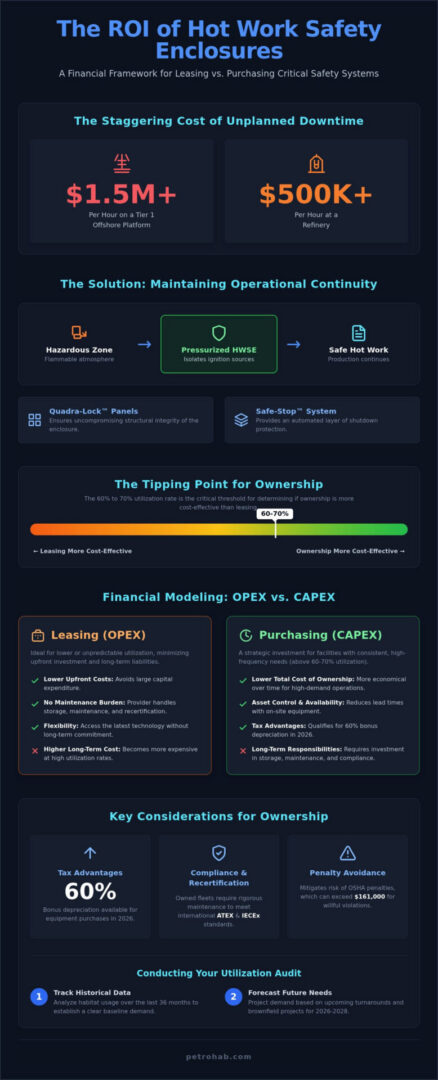
A single hour of unplanned downtime on a Tier 1 offshore platform now averages over $1.5 million in lost revenue. In high-stakes environments where ignition prevention is mandatory, the decision to lease or purchase pressurized hot work safety enclosures (HWSE) is a critical financial lever. You’re likely balancing the need for immediate operational continuity against the long-term logistical burden of maintaining specialized equipment. Executing an accurate welding habitat ROI calculation requires looking beyond the initial invoice to account for ATEX compliance, storage costs, and the 60% bonus depreciation available in 2026.
We recognize that safety managers need definitive data to justify CAPEX or OPEX allocations. This guide delivers a technical framework to evaluate the total cost of ownership for systems like PetroHab Quadra-Lock panels and Safe-Stop automatic shutdown units. You’ll learn how to weigh the 60% to 70% equipment utilization threshold against the risks of OSHA penalties that can exceed $161,000 for willful violations. We’ll break down the specific tax advantages and maintenance requirements that define a resilient procurement strategy for the coming year.
Key Takeaways
- Identify the 60% to 70% utilization threshold to determine if ownership or rental’s the most efficient path for your facility.
- Execute a precise welding habitat ROI calculation that balances upfront CAPEX with 2026 tax incentives and long-term storage costs.
- Understand the rigorous maintenance protocols and recertification cycles required to keep an owned fleet in compliance with international ATEX and IECEx safety standards.
- Learn how modular Quadra-Lock panels and Safe-Stop systems reduce logistical complexity while protecting high-value personnel and assets.
The Financial Imperative of Hot Work Safety Enclosures (HWSE)
In the high-risk energy and petrochemical sectors, the deployment of a PetroHab Hot Work Safety Enclosure (HWSE) is a fundamental engineering control. These systems allow for hot work like welding or grinding to occur in hazardous zones without requiring a total facility shutdown. Understanding what is a welding habitat is the first step in recognizing its role as a critical barrier against explosive atmospheres. By isolating ignition sources from flammable gases, operators can maintain production while performing essential maintenance.
The economic disparity between hot work and cold work is vast. Cold work often necessitates a complete depressurization of the line or a total plant shutdown, which stops the flow of revenue. Conversely, hot work conducted within a pressurized habitat maintains the facility’s operational integrity. Ignition incidents in hazardous zones carry catastrophic costs beyond immediate human life, including environmental remediation and legal liabilities. For a comprehensive welding habitat ROI calculation, one must factor in the avoidance of these tail-risk events and the preservation of high-value assets.
To better understand the financial fundamentals of this decision, watch this helpful video on calculating return on investment:
Downtime Avoidance: The Primary ROI Driver
Unplanned production halts in the offshore energy sector are financially devastating. Industry data indicates that a single hour of downtime on a Tier 1 offshore platform averages $1.5 million in lost revenue, while refineries often face costs exceeding $500,000 per hour. PetroHab’s HWSE technology enables welding on live platforms by creating a safe environment within the hazardous zone. Integrating these habitats into the site’s Permit-to-Work (PTW) system streamlines the transition from setup to execution. When the Safe-Stop Automatic Shutdown System is integrated, it provides an additional layer of automated protection. This integration ensures that safety protocols aren’t bottlenecks but rather facilitators of operational continuity in 2026’s high-pressure production schedules.
The Role of Pressurization in Asset Integrity
Pressurization serves as the active guardian of the worksite. By maintaining internal air pressure higher than the external atmosphere, the HWSE prevents the ingress of hydrocarbons or flammable gases. This mechanism protects high-value assets and may lead to more favorable insurance premiums by demonstrating a commitment to rigorous risk mitigation. An HWSE is a modular barrier designed to physically isolate ignition sources from potentially explosive environments. Utilizing Quadra-Lock Panels ensures the structural integrity of this barrier remains uncompromising. Proper deployment of these engineering controls is a prerequisite for maintaining asset integrity during multi-year maintenance contracts, ensuring that the welding habitat ROI calculation remains positive over the long term.
Determining Your Utilization Threshold: When to Invest in Ownership
Deciding between CAPEX and OPEX requires a granular analysis of operational demand. While some generalists suggest a 60% to 70% utilization rate as the tipping point for ownership, industrial reality is more complex. A comprehensive welding habitat ROI calculation must account for the specific geographic distribution of your assets and the frequency of your turnaround cycles. If your equipment sits in storage for six months of the year, the hidden costs of climate-controlled warehousing and specialized maintenance can quickly negate any rental savings.
The 5-Step Utilization Audit
To determine if purchasing a fleet is justifiable, safety and procurement managers should conduct a formal data audit. This process moves beyond simple day-rates to look at the total logistical footprint of the equipment.
- Step 1: Track historical habitat usage over the last 36 months to identify baseline demand.
- Step 2: Forecast upcoming turnarounds and brownfield projects for the 2026-2028 window.
- Step 3: Compare internal mobilization and storage costs against third-party rental logistics.
- Step 4: Evaluate the administrative cost of maintaining OSHA hot work safety regulations compliance for an owned fleet.
- Step 5: Apply the final data to your ROI model to identify the specific breakeven point for your region.
Geographic dispersion often dictates the outcome. If your operations are concentrated in a single hub, such as the Gulf of Mexico, owning equipment reduces repetitive mobilization fees. However, if your projects are global and sporadic, the logistics of moving owned habitats across international borders can erode the savings. You must also consider technical obsolescence; while HWSE technology is robust, 2026 standards for electronic recordkeeping and PPE are evolving. Renting ensures you always have access to the latest certified systems without the risk of owning an outdated fleet.
Technological Requirements and Quadra-Lock Versatility
Fleet versatility is a primary factor in the ownership equation. Using modular Quadra-Lock panels allows a single inventory to serve multiple configurations. This adaptability ensures that an owned system don’t become a “white elephant” when project specifications change. High-quality, fire-resistant materials in PetroHab habitats are engineered to withstand the corrosive environments of offshore platforms, extending the asset’s lifespan and improving the long-term welding habitat ROI calculation.
If your audit reveals high utilization across multi-year maintenance contracts, investing in a permanent fleet provides maximum operational control. For those still evaluating their 2026 requirements, reviewing modular HWSE configurations can help define your specific technical needs before you commit to a purchase.
Financial Modeling: Rental OPEX vs. Capital Expenditure (CAPEX)
Strategic procurement in 2026 hinges on whether an organization prioritizes long-term asset ownership or immediate operational agility. A robust welding habitat ROI calculation requires a clear distinction between Capital Expenditure (CAPEX) and Operating Expenditure (OPEX). For companies with stable, high-volume maintenance schedules, CAPEX offers significant tax advantages. Under 2026 regulations, the Section 179 deduction limit stands at $1,220,000; bonus depreciation remains available at a 60% rate. These incentives can drastically reduce the effective cost of purchasing PetroHab Hot Work Safety Enclosures for a permanent fleet.
However, ownership introduces administrative overhead that many models overlook. Beyond the purchase price, you must account for specialized insurance, climate-controlled storage, and the personnel required for rigorous inspection cycles. Compliance with NFPA 51B safety standards is non-negotiable. This requires documented proof of habitat integrity before every deployment. For organizations managing transient projects, OPEX through rental agreements provides a leaner alternative. Rental costs are fully deductible in the year they’re incurred and keep the technical burden of maintenance and recertification on the supplier.
Leasing vs. Direct Purchase: A Side-by-Side Analysis
A five-year Total Cost of Ownership (TCO) analysis often reveals that the price gap between renting and buying narrows when factoring in technical support. Rental agreements for PetroHab systems typically include the latest Safe-Stop technology and priority access to expert recertification services. This ensures your site always utilizes current, ATEX-certified hardware without the risk of capital lock-up. In a volatile energy market, the ability to scale your fleet up or down based on current project demand is a significant hedge against fiscal risk. Renting allows you to deploy the most advanced Quadra-Lock Panels for a specific turnaround without committing to the multi-year lifecycle of the equipment.
Implementing the PetroHab ROI Framework
The ‘Downtime Avoidance Multiplier’ is the most critical variable in our procurement model. This metric quantifies the revenue saved by performing hot work on live assets versus the cost of a total facility shutdown. When selecting a partner, consult our procurement guide to ensure your supplier can meet these technical demands. Integrating Safe-Stop Automatic Shutdown Systems into your habitat deployment significantly reduces liability-related financial risks by providing an automated response to gas ingress or pressure loss. This data-driven approach ensures your welding habitat ROI calculation reflects both immediate project savings and long-term risk mitigation.
Operational Realities: Maintenance, Compliance, and Recertification
Owning a fleet of pressurized habitats shifts the technical burden of safety from the manufacturer to the operator. This responsibility involves more than simple storage; it requires a dedicated infrastructure to manage recurring maintenance and legal compliance. Every unit in an owned fleet must undergo rigorous recertification cycles, typically every 12 months, to ensure it remains “fit for service” in hazardous zones. These costs, including non-destructive testing (NDT) of structural components and the replacement of fire-resistant materials, are often omitted from a superficial welding habitat ROI calculation but are essential for accurate financial modeling.
Liability is the most significant operational risk. If a purchased system fails on-site, the operator bears the full weight of the resulting legal and financial consequences. In contrast, rental agreements often include “compliance-as-a-service,” where the provider assumes the duty of maintaining the equipment’s ATEX and IECEx integrity. This transfer of risk ensures that safety managers can focus on project execution rather than the granular details of equipment recertification. 2026 standards also require stricter adherence to the 60-minute fire watch monitoring period, adding another layer of personnel cost to every hot work permit.
Managing ATEX Standards in 2026
The 2026 regulatory landscape demands a documented, auditable chain of custody for every component within a hazardous zone. You must stay current with the latest hazardous environment standards to avoid OSHA citations that now reach $16,131 per violation. Modern compliance requires digital recordkeeping and real-time monitoring of ignition source control measures. Rental providers typically integrate these digital tracking systems into their offerings, ensuring that your welding habitat ROI calculation accounts for the software and administrative savings associated with automated compliance reporting.
On-site Supervision and Training Requirements
Safe operation depends on the competency of the personnel installing and monitoring the habitat. You face a choice between certifying internal technicians or utilizing third-party supervisors. Training your own team requires a significant upfront investment in specialized certifications and ongoing competency assessments. Alternatively, utilizing PetroHab certified technicians ensures that every hot work safety enclosure is configured to meet site-specific safety plans and pressurization requirements. This professional oversight reduces the risk of human error, which remains a leading cause of industrial ignition incidents. To ensure your fleet meets these rigorous 2026 standards, contact our technical safety team for a compliance audit.
Strategic Sourcing with PetroHab: Modular Safety Solutions
Strategic procurement requires more than a binary choice between capital investment and rental agreements. For global operators, the most resilient strategy often involves a hybrid model that balances a core owned fleet with flexible rental support for peak turnaround periods. PetroHab facilitates this agility through modular technology designed for the most demanding industrial environments. By prioritizing systems that offer both technical precision and logistical flexibility, safety managers can optimize their welding habitat ROI calculation while maintaining an uncompromising stance on personnel protection.
The Quadra-Lock Technological Advantage
The foundation of PetroHab’s market leadership is the patented Quadra-Lock panel system. Unlike non-modular enclosures that rely on cumbersome frames or less reliable fastening methods, Quadra-Lock utilizes an interlocking design that ensures maximum pressure retention. This modularity directly reduces the “cost of failure.” If a single panel sustains damage during a high-intensity project, you can replace that specific component rather than decommissioning the entire enclosure. This granular repair capability extends the asset’s operational life and prevents the cascading costs associated with equipment downtime.
Integrating the Safe-Stop Automatic Shutdown System into this modular framework provides an automated response to hazardous conditions. This system acts as an active guardian, monitoring internal pressure and gas concentrations to trigger an immediate shutdown of the ignition source if safety parameters are breached. To understand the full scope of these engineering controls, read about advanced safety systems and their role in modern ignition prevention. This technological integration is a signature of innovation that distinguishes PetroHab from generalist equipment providers.
Global availability ensures that these safety standards remain consistent across your entire portfolio. Whether your operations are centered in Houston, Brazil, or the UK, PetroHab provides localized support to minimize mobilization times. This geographic reach is essential for maintaining a positive welding habitat ROI calculation, as it reduces the logistical friction of international equipment transfers. Our teams provide the technical precision required to deploy these systems in diverse climates, from corrosive offshore platforms to high-heat onshore refineries.
Next Steps for Safety Managers and Procurement
Transitioning to a more efficient procurement model begins with a technical audit of your projected 2026-2028 turnaround schedule. PetroHab works with your team to customize a hybrid model that aligns with your specific CAPEX and OPEX objectives. Before finalizing any habitat contract, we recommend a final review based on these three critical criteria:
- Does the system provide a documented, ATEX-certified interlocking mechanism like Quadra-Lock to ensure pressure integrity?
- Is the automatic shutdown technology fully integrated with the habitat to mitigate human error in gas detection?
- Does the provider offer localized technical support and recertification services in all your primary regions of operation?
Selecting PetroHab as your safety partner ensures that your procurement strategy is as durable and resilient as the equipment protecting your site. We remain committed to the elimination of workplace accidents through rigorous engineering and meticulous safety advocacy.
Optimizing Your 2026 Safety Procurement Strategy
The decision to rent or purchase a pressurized hot work safety enclosure is a strategic calculation that balances immediate capital liquidity against long-term operational control. A definitive welding habitat ROI calculation must account for the 60% bonus depreciation available in 2026 and the administrative overhead of maintaining ATEX and IECEx certifications. While ownership offers tax advantages for high-utilization fleets, rental models provide essential flexibility in a fluctuating energy market. You must weigh the logistical burden of storage and recertification against the benefits of having a core fleet ready for immediate deployment.
PetroHab remains your technical partner in navigating these financial complexities. Our patented Quadra-Lock technology and Safe-Stop systems ensure your site maintains maximum operational continuity regardless of your procurement path. With global support and expert on-site supervision, we help you eliminate industrial hazards while protecting your bottom line. Our modular solutions are engineered to withstand the most corrosive environments, ensuring your investment remains durable and compliant throughout its lifecycle. We stand ready to support your mission of operational excellence.
Request a Technical Consultation and Quote for HWSE Rental or Purchase to secure your facility’s safety and profitability for the upcoming turnaround season.
Frequently Asked Questions
What is the typical lifespan of a purchased PetroHab HWSE?
A purchased PetroHab HWSE typically provides an operational lifespan of five to ten years when maintained according to rigorous manufacturer specifications. The actual durability depends on the severity of the industrial environment and the frequency of deployment. Utilizing patented Quadra-Lock Panels ensures high structural resilience, though panels exposed to extreme corrosive elements or mechanical stress may require individual replacement to maintain the integrity of the pressurized environment.
Does rental include the Safe-Stop automatic shutdown system?
Rental agreements typically include the Safe-Stop Automatic Shutdown System as a core component of the safety package. This integration ensures that every leased habitat meets the highest ignition prevention standards without requiring separate capital allocation for the monitoring hardware. Providing the Safe-Stop system with the rental unit allows operators to deploy an ATEX certified, automated safety barrier immediately upon delivery to the industrial site.
Are Quadra-Lock panels compatible with other habitat brands?
Quadra-Lock Panels are not compatible with other habitat brands due to their proprietary interlocking design. This patented technology creates the specific, airtight seal required for consistent pressurization that generic fastening systems cannot replicate. To maintain the system’s ATEX and IECEx certification, you must use genuine PetroHab components. Mixing hardware from different manufacturers compromises structural integrity and invalidates safety compliance during hot work operations.
How often do pressurized habitats require ATEX recertification?
Pressurized habitats require formal recertification every 12 months to ensure they remain fit for service in hazardous environments. This cycle involves a comprehensive inspection of the fire resistant panels, the pressurization units, and the automated shutdown sensors. For an accurate welding habitat ROI calculation, safety managers must include the annual costs of these third party inspections and the potential replacement of worn components in their financial models.
Can I transition a rental agreement into a purchase (lease-to-own)?
PetroHab offers flexible procurement paths, including the potential to transition rental agreements into a purchase. This lease-to-own approach allows organizations to evaluate equipment performance during a specific project before committing to long term ownership. It provides a strategic bridge between OPEX and CAPEX, allowing you to build a core fleet while managing immediate cash flow requirements during multi-year maintenance contracts or brownfield projects.
What training is required for my crew to set up a purchased habitat?
Setup of a purchased habitat requires your crew to undergo specialized competency training and certification. PetroHab provides comprehensive training programs for supervisors and technicians to ensure they can correctly configure the Quadra-Lock system and calibrate the Safe-Stop sensors. This training is essential for maintaining the site’s Permit-to-Work (PTW) integrity and ensures that the engineering controls function as intended during live hot work operations in hazardous zones.
How do I calculate the ROI of a welding habitat for a specific project?
To perform a project-specific welding habitat ROI calculation, you must subtract the total cost of habitat deployment from the revenue preserved by avoiding a facility shutdown. Factor in the day rate of the rental or the amortized cost of ownership, plus labor and logistics. If the habitat prevents just four hours of downtime on a Tier 1 platform, the revenue saved often exceeds the entire procurement cost for that specific project.
What are the storage requirements for fire-resistant HWSE panels?
Fire resistant HWSE panels require storage in a clean, dry, and climate-controlled environment to prevent material degradation. Panels should be kept away from direct UV exposure and harsh chemical vapors that can compromise the fire-retardant coatings. Proper storage is a critical operational reality for owned fleets. Neglecting these requirements can lead to premature failure of the panels and the loss of ATEX compliance during the next annual recertification cycle.