Blog Posts
Hot Tapping High-Pressure Gas for Safe Live Connections
Pressure alone does not determine whether a live natural gas pipeline can be hot-tapped. Hot tapping creates a branch connection while the pipeline remains in service, but it is appropriate only when shutdown is not an option and an engineering assessment supports the work. Reassuring process engineers during hot tapping into high-pressure natural gas means clearly explaining how pressure, temperature, material condition, and welding risks inform that decision.
Continuous gas flow matters, but so does controlling the hazards of cutting into a pressurized line. This article explains how hot tapping works, how standards and risk assessments inform the work, and why pressure-related engineering affects the decision to proceed. It also covers how pipeline condition, operating conditions, monitoring, and emergency planning shape the work. The goal is to show how engineers can evaluate a live connection without treating uninterrupted service as the only priority.
Key Takeaways
- Hot tapping can maintain gas service while a branch connection is made, but it is considered when shutting down the pipeline is not an option.
- Standards provide a framework for equipment, welding, and operational planning; their application depends on the pipeline and governing requirements.
- Pipeline material, condition, operating pressure, and temperature shape the risk assessment, along with inspection and emergency planning.
- High-pressure work calls for engineered fittings and tools, with pressure and temperature monitored throughout the operation.
Hot tapping without interrupting pipeline service
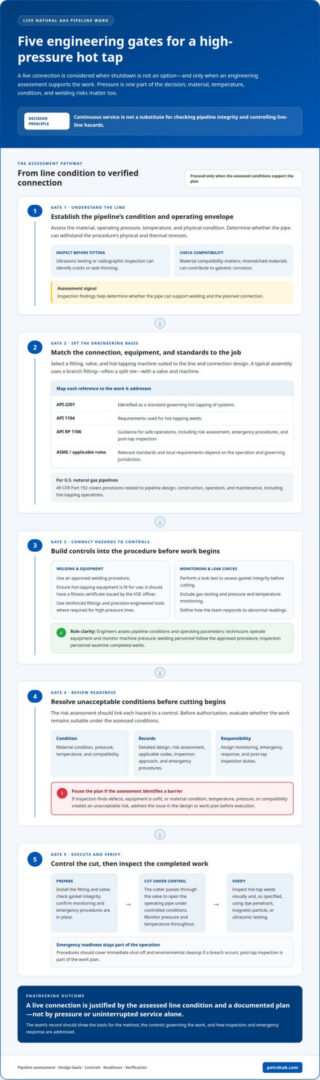
Hot tapping adds a branch to an operating natural gas line while service continues. It can avoid shutdown, gas venting, and supply interruption when isolation is not an option. But continuous service does not remove the need to assess pipeline integrity first. Ultrasonic testing and radiographic inspection can identify cracks or wall thinning before fitting installation. Those findings help determine whether the pipe can support welding and the planned connection.
A typical assembly consists of a branch fitting, often a split tee, a valve, and a hot-tapping machine. The cutter passes through the valve to open the pipe under controlled conditions. Before cutting, technicians perform a leak test to assess gasket integrity. For lines carrying fluids at hundreds or thousands of pounds per square inch, reinforced fittings and precision-engineered tools are needed. The fitting, valve, and machine must suit the line and connection design.
Welding an in-service pipeline requires an approved welding procedure and careful control of the work. Hot-tap welds may be inspected visually and by methods such as dye penetrant, magnetic-particle, and ultrasonic testing. Pipeline material, wall condition, operating pressure, and temperature inform the assessment. Equipment fitness matters too: hot-tapping equipment should have a fitness certificate issued by the HSE officer. If inspection identifies defects or equipment is unfit, the work plan must address the issue before cutting begins.
Hydrogen service requires its own compatibility assessment, rather than automatic use of a natural-gas procedure. Engineers assess the pipeline material, fittings, seals, and welding plan for the intended gas and operating conditions. In the United States, the cost of high-pressure natural gas hot tapping depends on project scope, line dimensions and pressure, fitting selection, access, and inspection requirements. The project price is established after a quote request. Planning weighs these factors against service continuity and the hazards of live-line work.
API hot-tapping standards
Hot-tap decisions use a standards framework, not a single rule for every pipeline. The American Society of Mechanical Engineers (ASME) and the American Petroleum Institute (API) are sources of engineering standards relevant to hot tapping. API-2201 is identified as a standard governing hot tapping of systems. Engineers use applicable standards to inform design, planning, welding, equipment selection, and inspection. The specific requirements depend on the operation and the rules that apply where the pipeline is located.
Different references address different parts of the work. API 1104 requirements are used for hot-tapping welds, while API RP 1106 provides guidance for safe hot-tapping operations, including risk assessment, emergency procedures, and post-tap inspection. These references should not be treated as interchangeable. The project team maps each relevant standard to the activity it governs, then records how procedures and checks address that activity.
In the United States, 49 CFR Part 192 covers provisions related to natural gas pipeline design, construction, operation, and maintenance, including hot-tapping operations. Applicable industry codes and local administrative requirements also shape the work. A standards review therefore starts by identifying the pipeline service and jurisdiction. The team then aligns its engineering basis, welding procedure, equipment controls, inspection plan, and emergency response with the applicable requirements.
Hot-tap operators and engineers need responsibilities suited to their roles, with execution assigned to trained professionals. Engineers assess pipeline conditions and operating parameters, while technicians operate the equipment and monitor machine pressure during the procedure. Welding personnel follow the approved procedure, and inspection personnel examine completed welds using specified methods. Clear role boundaries keep decisions, monitoring, and inspection accountable throughout the operation.
Planning and risk assessment for each hot tap
Planning begins with the pipeline’s material, operating pressure, temperature, and condition. Engineers assess whether the pipe can withstand the procedure’s physical and thermal stresses. Inspection findings inform the connection design and work plan. Ultrasonic testing or radiographic inspection can help identify wall thinning or cracks before work proceeds. Material compatibility matters too, since mismatched materials can contribute to galvanic corrosion.
The risk assessment should link each hazard to a control. Hot-tapping procedures include gas testing, pressure and temperature monitoring, and execution by trained professionals. The plan should define how the team monitors operating conditions and responds to abnormal readings. Emergency procedures should cover immediate shut-off and environmental cleanup if a breach occurs. Prepare these measures before the operation begins.
For a U.S. natural gas hot tap, planning records should document the detailed design, risk assessment, emergency procedures, applicable codes, and inspection approach. 49 CFR Part 192 covers provisions related to natural gas pipeline design, construction, operation, and maintenance, including hot-tapping operations. Applicable laws, regulations, and administrative codes shape the permit and notification path. Requirements depend on the governing jurisdiction and project conditions.
Before authorization, the team evaluates whether the work remains suitable under the assessed conditions. If material condition, temperature, pressure, or compatibility creates an unacceptable risk, the design or work plan must address it before execution. The plan should assign responsibility for monitoring, emergency response, and post-tap inspection. A clear record of decisions helps process engineers understand why the chosen method suits the line and which controls govern the work.
High-pressure engineering challenges
High-pressure design starts by separating line class from operating pressure. An ANSI 900# line class does not establish a universal hot-tap limit. One proposed tie-in involving a 1,600-psig line was not hot-tapped, among other reasons. That example shows why class designation alone cannot determine suitability. Engineers assess actual operating conditions, pipe material, wall condition, fitting design, and welding heat input together. Reassuring process engineers during hot tapping into high-pressure natural gas starts with making those design assumptions explicit.
No single pressure or temperature limit applies to every hot tap. Engineers determine allowable conditions based on pipeline material and condition, operating pressure and temperature, fitting capacity, and the welding procedure. They must assess these factors together: a fitting’s pressure rating alone cannot show whether the pipe wall can tolerate welding heat or whether the completed connection can withstand operating loads.
Pressure and burn-through are related, but they are separate engineering concerns. Reducing line pressure reduces hoop stress, but has little to do with preventing burn-through. Internal surface temperature and welding technique are the predominant factors in that risk. Reinforced fittings and precision-engineered tools address pressure loads at the connection, but they do not replace thermal assessment or qualified welding controls. Reassuring process engineers during hot tapping into high-pressure natural gas also means distinguishing between these mechanical and thermal failure modes.
Reported cases describe burn-through at 100 psi and 1,000 psi. These values are examples, not universal thresholds or operating limits. Their relevance depends on the pipeline’s material, wall thickness, internal conditions, and welding method. Engineers must evaluate the specific line rather than infer suitability from a single pressure figure. Pressure and temperature monitoring during the work helps identify changes against the operation’s defined limits.
The practical decision is whether the complete design can control both mechanical loading and welding heat under actual line conditions. If pressure, temperature, or pipe integrity falls outside the assessed basis, the work plan must change before cutting proceeds. For projects involving hot work near pressurized systems, explore pressure-related welding safety solutions as part of the site’s hazard-control planning.
PetroHab
PetroHab LLC helps industrial teams address hot-work hazards around high-risk natural gas operations with purpose-built containment and monitoring equipment. Its PetroHab Hot Work Safety Enclosure (HWSE) and pressurized welding enclosures support controlled work environments, while the Safe-Stop Automatic Shutdown System monitors gas levels and pressure. Quadra-Lock Panels are part of PetroHab’s enclosure offering. These products support site safety planning, but they do not determine whether a pipeline is suitable for hot tapping. That decision remains based on pipeline condition, engineering assessment, applicable standards, and the operation’s risk controls. Consider PetroHab’s enclosures and monitoring systems when hot-work hazards call for dedicated safeguards alongside engineering controls. Contact PetroHab to discuss the equipment and services for your project.
Plan the Next Live-Line Decision
Reassuring process engineers during hot tapping into high-pressure natural gas requires making assumptions, responsibilities, and operating controls clear before work begins. Bring the proposed connection, site hazards, and hot-work controls into one project review. This gives engineering and safety teams a shared basis for evaluating whether the planned work and its supporting safeguards align.
PetroHab safety equipment can form part of the broader site-control plan alongside the project’s engineering assessment. Focus the discussion on the hazards created by the work, the controls already in place, and where dedicated hot-work containment or monitoring may help. Ground the decision in the specific operation, not a general expectation that live-line work is suitable for every pipeline.
For a project-focused discussion of hot-tapping safety needs, contact PetroHab LLC about hot tapping. A clear review helps teams carry the next decision forward with purpose and discipline.
Frequently Asked Questions
What is hot tapping on a high-pressure natural gas pipeline?
Hot tapping creates a branch connection on a natural gas pipeline while it remains in service. A fitting and valve are installed on the pipe, then a hot-tapping machine cuts through the pipe wall within the branch. The method can maintain gas flow and avoid a shutdown, but engineers must assess whether the line and connection design can support the operation under actual conditions.
What engineering standards govern hot tapping on U.S. natural gas pipelines?
In the United States, 49 CFR Part 192 covers provisions for natural gas pipeline design, construction, operation, and maintenance, including hot-tapping operations. API-2201 is identified as a standard governing hot tapping. API 1104 addresses hot-tapping weld requirements, while API RP 1106 provides operational guidance. Engineers also consider relevant ASME standards and applicable local requirements for the specific project.
What pre-job engineering checks are required for hot tapping under pressure?
Before work begins, the engineering review should establish the pipeline’s material, condition, operating pressure and temperature, connection design, and material compatibility. It should also address gas testing, welding controls, equipment fitness, inspection, and emergency response. For example, assess the integrity of a proposed branch location and ensure the fitting suits the pipe and service. The resulting plan assigns monitoring and response responsibilities.
How are pipeline pressure, temperature, flow, and wall thickness verified before hot tapping?
Engineers establish and monitor the line’s pressure and temperature during the operation. The plan treats flow as an operating condition, and may consider pressure and flow reduction where appropriate. Ultrasonic testing and radiographic inspection can assess wall condition, including thinning or cracks. The findings inform fitting design and whether the selected location can support welding and cutting.
What are the step-by-step procedures for hot tapping a live gas pipeline?
The operation generally proceeds by installing a branch fitting or saddle, attaching a valve, and mounting the hot-tapping machine. Technicians leak-test the gasket before opening the valve and advancing the cutter through the pipe wall. The machine cuts and captures the coupon, which is then retrieved. The team verifies the connection and inspects completed welds according to the project’s defined procedures.
What are the main hot-tapping risks, including ignition, leaks, and cutter failure?
Key hazards include ignition during hot work, loss of containment at a gasket or weld, and problems cutting or retaining the pipe coupon. A leak test helps assess gasket integrity before cutting, while planned inspection addresses weld quality. Cutter operation and coupon retrieval also require defined controls. Gas testing, pressure and temperature monitoring, and emergency response planning help the team manage changing conditions during the work.