Blog Posts
Hot Work Habitat Technician Supervision for Safer Work
A permit alone cannot supervise a hot-work habitat. Effective hot work habitat technician supervision pairs a competent supervisor with clear work planning, active fire controls, and regular worker check-ins. At the University of Florida, only competent hot-work supervisors may authorize and approve hot work performed by UF staff.
That structure matters because conditions can change during a job, and workers need clear direction when they do. Supervisor training, employee awareness, relevant experience, practical planning, and consistent check-ins all support safer habitat operations. PetroHab’s hot-work safety equipment can form part of a broader control plan, alongside active supervision and site safeguards.
Key Takeaways
- Build supervision around role-specific training, clear authorization, and ongoing guidance so workers understand the controls before hot work begins.
- Plan how to manage flammable materials and fire hazards around the habitat, and keep those controls in view throughout the job.
- Match supervisory responsibility to relevant technical experience and the ability to guide workers and review their work.
- Adapt work plans to heat conditions, maintain communication, and check in regularly; habitat equipment can support these controls but doesn’t replace active supervision.
1. Supervisor training and employee awareness
Hot-work supervision starts with workers understanding the hazards, procedures, and responsibilities attached to each role. Before work begins, the supervisor should review the scope, ignition controls, communication method, and stop-work signals. At the University of Florida, only competent hot-work supervisors may authorize and approve hot work performed by UF staff. This illustrates why authorization should rest with someone trained to assess the task and its conditions.
In the United States, qualifications depend on assigned duties, site procedures, and applicable requirements. Technicians need training suited to their work; supervisors need the competence to direct the task and recognize changing conditions. At the University of California, Berkeley, supervisors and outdoor workers should complete Cal/OSHA heat illness prevention training. Although it addresses a separate exposure, include it in the preparation plan when habitat work takes place outdoors.
A training passport can organize the evidence. Record each worker’s completed instruction, practical assessments, assigned duties, and refresher training. Link each entry to a date, trainer, and competency topic. For example, a technician’s record might show training in habitat procedures and a supervisor’s assessment of the worker’s ability to follow them. The passport documents progress; it is not itself a qualification.
A four-level pathway can clarify progression: hazard awareness, supervised participation, demonstrated technician competency, and authorization to supervise. Define permitted duties and the evidence needed to advance at each level. A worker should not move from observing a task to directing it without an assessment of relevant skills.
Facility technician supervisors are expected to provide mentorship, guidance, and training. Use short pre-job reviews to explain procedures, then observe technicians applying them. End each review with specific feedback and record any training needs. This creates a traceable link between instruction, demonstrated competency, and assigned responsibility.
2. Flammable-material controls and fire protection
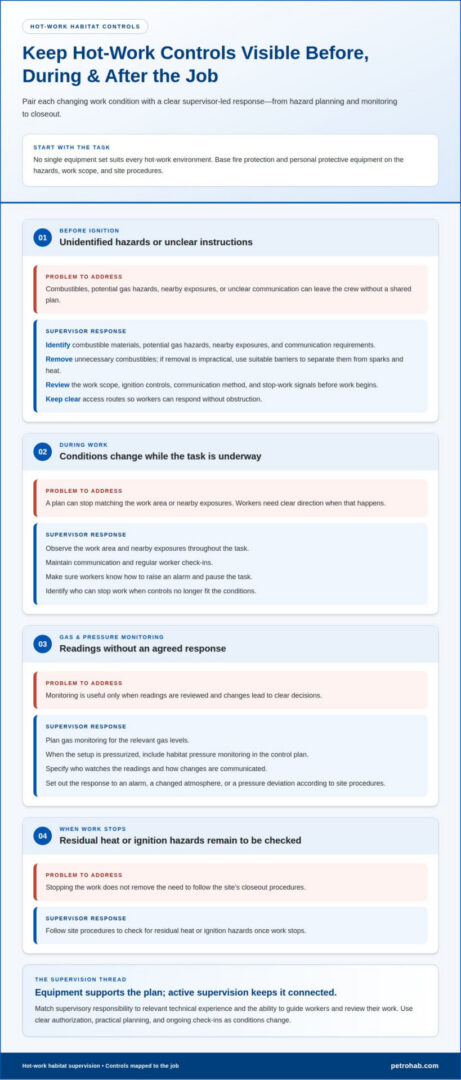
Base the equipment plan on the task’s hazards and the habitat’s operating procedures. No single equipment set suits every hot-work environment. Before starting, identify combustible materials, potential gas hazards, nearby exposures, and communication requirements. Remove unnecessary combustibles; where removal is impractical, use suitable barriers to separate them from sparks and heat. Keep access routes clear so workers can respond without obstruction.
What safety equipment and gas monitoring are required in a hot-work habitat? Select fire protection equipment and personal protective equipment according to the hazards, work scope, and site procedures. Gas monitoring should cover relevant gas levels, and habitat pressure should also be monitored when the setup is pressurized. Specify who watches the readings, how changes are communicated, and what conditions require work to stop.
Make controls easy to verify. Before ignition, the supervisor can confirm that combustibles are removed or shielded, barriers are in place, and fire-response equipment is accessible. Verify that workers know how to raise an alarm and pause the task. During work, observe the work area and nearby exposures. Once work stops, follow site procedures to check for residual heat or ignition hazards.
Gas monitoring is useful only when readings lead to clear decisions. Establish who reviews the readings and how the crew responds to an alarm, a changed atmosphere, or a pressure deviation. The planned response should identify who can stop work and how workers communicate that decision. Pressurized habitats add pressure monitoring to the control plan; the monitoring method and response steps should match the site’s operating procedures. For habitat containment options, see pressurized habitat solutions.
3. Habitat supervisor experience requirements
In the United States, experience thresholds vary by employer, role, and site procedures. One job description calls for 1-3 years as a technician in a related field and at least 1 year supervising technicians. Those are job-specific qualifications, not a universal hot-work requirement. Assess whether the candidate’s experience matches the habitat duties, work environment, and hazards they will oversee.
A separate Facility Technician Supervisor classification specifies six years of journey-level experience in skilled HVAC, electrical, plumbing, and mechanical installation, maintenance, and repair work, or an equivalent combination of education and experience. Such experience can help a supervisor assess equipment and site conditions, but facility experience alone does not establish competence in every habitat operation. Match the person’s technical knowledge to the actual work scope.
Supervision requirements depend on the applicable qualification pathway and site authorization. At the University of Florida, only competent hot-work supervisors may authorize and approve hot work performed by UF staff. Employers should define the supervisor’s authority, required competencies, and responsibilities in site procedures. A job title alone does not show whether someone can assess conditions, direct workers, and respond to changes.
Shipyards, offshore platforms, and industrial sites differ in work environment, nearby hazards, access, and operating procedures. These factors shape how supervisors assess tasks, coordinate with site personnel, and direct communication and emergency responses. Relevant experience means familiarity with the operation and its conditions, not simply time in a supervisory role.
Before assigning oversight, match the person’s records and demonstrated skills to the job. Confirm they can interpret the work plan, recognize changing conditions, direct technicians, and pause work when controls no longer fit. Facility Technician Supervisors are expected to oversee team projects and review technicians’ work. For habitat operations, active oversight should cover setup, execution, and closeout, with responsibilities clear to the crew.
4. High-heat work planning and worker check-ins
Heat changes the work plan, so supervisors should monitor conditions and worker status throughout the shift. Effective hot work habitat technician supervision includes planning for heat exposure alongside the task itself. At UC Berkeley, outdoor work plans should follow its Work Planning and Site Checklist when temperatures exceed 95°F. UC Berkeley also recommends cool-down breaks every two hours during outdoor work in high heat, or whenever workers need one. Build those pauses into the schedule rather than waiting for a worker to become unwell.
Who authorizes and monitors hot work inside a habitat? Authorization belongs to a competent supervisor designated under applicable site procedures. At the University of Florida, only competent hot-work supervisors may authorize and approve work performed by UF staff. During the task, the assigned supervisor monitors conditions, communication, and worker status, responding when a change requires work to pause.
How many technicians or fire-watch personnel are needed? Set staffing according to the work scope, visibility, communication needs, and the required observation coverage. For hot work habitat technician supervision, assign separate responsibilities when one person cannot perform the task and monitor hazards effectively at the same time. The work plan should state who performs the hot work, who watches for fire hazards, and how the crew signals a stop.
Acclimatization also belongs in scheduling. Complete heat acclimatization generally takes six to seven days, and new workers should increase heat exposure by no more than 20% on each additional acclimatization day. A returning employee should start with about half the normal workload on the first day back. Supervisors can use these steps to adjust assignments as workers build tolerance.
Set regular check-ins and a reliable communication method before work begins. UC Berkeley says supervisors must maintain communication and check in often with staff during high-heat conditions. Encourage workers to drink water every 15 to 20 minutes, even without thirst. For a stated amount, workers should drink approximately 250 millilitres every 20 minutes. Explore pressurized habitat options when planning controlled hot-work operations.
PetroHab: PetroHab Hot Work Safety Enclosure (HWSE)
PetroHab’s Hot Work Safety Enclosure (HWSE) provides a contained work area for hot-work operations in hazardous industrial environments. Consider an enclosure when the work plan calls for one alongside trained supervision, task-specific fire controls, and worker check-ins. It supports the safety plan but does not replace supervisor authorization or active oversight.
The Safe-Stop Safety Shutdown System monitors gas levels and pressure, supporting shutdown when monitored conditions require it. PetroHab also offers Quadra-Lock® panels and pressurized welding enclosures for habitat applications. Select equipment to suit the project’s operating environment and work requirements.
To discuss a PetroHab habitat solution for your hot-work plan, contact PetroHab about your project.
Make supervision part of the work design
Before mobilization, connect the supervision plan to the job’s operating sequence. Define who makes each decision, how changing conditions are reported to the responsible supervisor, and what triggers a pause or reassessment. This keeps hot-work habitat technician supervision active through setup, execution, and closeout, rather than treating it as a permit-stage task.
Use the planning discussion to align the work scope, site conditions, communication method, and habitat configuration. Clear interfaces among workers, supervisors, and safety controls help teams respond consistently when conditions shift. Record responsibilities in the project plan so everyone understands their role before work begins.
PetroHab can discuss how its hot-work enclosure systems fit your project requirements and operational plan. Contact PetroHab to discuss your project and define a practical next step for your site. A deliberate plan gives your team a stronger basis for controlled, well-coordinated work.
Frequently Asked Questions
What are the OSHA rules for hot work habitats and fire watch?
Apply the OSHA requirements relevant to the work and the site’s written hot-work procedures. Before ignition, make authorization, fire-watch responsibilities, observation coverage, and stop-work communication clear. The supervisor should coordinate these arrangements with the permit and job scope, then reassess them if conditions change. Treat the habitat as one control within the work plan, not as a substitute for required supervision or fire-protection measures.
What are the main hazards of hot work habitats and how are they controlled?
Key hazards include ignition, hazardous gas levels, pressure changes, and heat strain. Controls should account for how these risks interact during the specific job. A shift handover, for example, can leave workers unsure of current readings or who has stop-work authority. Record monitoring status, open issues, and assigned responsibilities at each handover so the incoming crew understands conditions before work resumes.
What does a hot work habitat technician do?
A hot-work habitat technician carries out assigned tasks in line with habitat procedures and the work plan. The technician should understand the hazards and controls, communicate with the crew, and follow stop-work directions when conditions change.
What are the steps for setting up, operating, and dismantling a hot work habitat?
Before work, identify hazards, remove or shield combustibles, position fire-response equipment, and establish monitoring and communication responsibilities for gas or pressure. During work, observe the work area and nearby exposures, monitor readings and worker status, and pause if conditions change. After work stops, follow site procedures to check for residual heat or ignition hazards.