Blog Posts
Hot Work Permit Requirements: A 2026 Guide to Industrial Compliance
A single day of unplanned production downtime on a Tier 1 offshore platform averages over $1.5 million in lost revenue. For safety managers and engineers, this financial pressure often clashes with the rigorous hot work permit requirements mandated by OSHA 29 CFR 1910.252 and the 2024 edition of NFPA 51B. You recognize that traditional administrative controls, such as a manual fire watch, are no longer sufficient to guarantee protection against catastrophic ignition events in high-hazard environments. Compliance isn’t just a legal necessity; it’s a critical component of asset integrity.
This guide provides the technical expertise needed to achieve 100% regulatory compliance without sacrificing operational continuity. You’ll master the essential engineering controls and documented permit systems required to secure hot work authorization in volatile zones. We’ll detail how to implement fail-safe ignition prevention using pressurized habitats and Quadra-Lock panel technology. By the end of this analysis, you’ll possess a definitive strategy for maintaining production during critical welding and grinding operations while upholding the highest standards of industrial safety.
Key Takeaways
- Understand the 2026 updates to OSHA 1910.252 and NFPA 51B, ensuring your documentation reflects the industry-wide shift toward digital permit-to-work systems.
- Identify the specific hot work permit requirements necessary for executing welding or grinding operations in hazardous environments without halting facility production.
- Deploy engineered controls like PetroHab LLC Hot Work Safety Enclosures to physically isolate ignition sources and satisfy stringent atmospheric safety standards.
- Execute a rigorous procedure for permit issuance, from conducting a Job Safety Analysis to the final verification of habitat integrity using Quadra-Lock technology.
- Automate mandatory fire watch protocols with the Safe-Stop system to provide continuous, sensor-based monitoring and fail-safe shutdown capabilities.
Essential Hot Work Permit Requirements for Hazardous Zones
Hot work encompasses any industrial process that generates a source of ignition, such as welding, torch cutting, or abrasive grinding. For a technical hot work overview, one must examine both the primary flame and the secondary thermal energy produced. The Permit-to-Work (PTW) system operates as the administrative backbone of industrial safety. It ensures that every high-risk task is documented, analyzed, and controlled. Meeting hot work permit requirements is a non-negotiable legal mandate designed to protect personnel and high-value assets from catastrophic ignition events.
The core legal requirement for any permit involves the rigorous identification of hazardous atmospheres and combustible materials. Before work commences, an Authorized Person (AP) must conduct a site evaluation. This individual carries the authority to sign off on permit conditions only after verifying that flammable gas concentrations are below 10% of the Lower Explosive Limit (LEL). They also ensure that all fire mitigation equipment is positioned and operational. This process transforms a dangerous task into a calculated, managed risk.
Identifying Hot Work Hazards in 2026
Ignition sources in modern industrial settings extend beyond visible flames. Slag and sparks travel significant distances, often bypassing traditional fire blankets. In 2026, the industry has moved beyond simply designating areas for work. Safety must be engineered into the site. Evaluating the presence of combustible dust or flammable vapors requires precise, continuous monitoring. Relying on administrative labels is insufficient for high-stakes environments. Operators must utilize a hot work safety enclosure, such as those utilizing Quadra-Lock panels, to physically isolate the work from the surrounding hazardous atmosphere. These controlled environments ensure that hot work permit requirements are met through physical containment rather than just procedural checklists.
The Duration and Scope of a Standard Permit
Every permit has a time-limited validity. Regulatory standards dictate that permits require re-evaluation at the start of every shift or whenever site conditions change. Scope creep presents a severe risk to facility integrity. Performing tasks outside the original permit description invalidates the safety analysis and increases the probability of an accident. It’s vital that the work remains within the boundaries established during the initial inspection. Closing out a permit is a critical final step. This phase includes a mandatory fire watch, typically lasting 60 minutes as per NFPA 51B, to ensure no smoldering embers remain. Utilizing pressurized welding habitats during this process provides an extra layer of protection, maintaining environmental integrity until the area is declared fire-safe.
Regulatory Standards: OSHA, NFPA 51B, and International Compliance
Industrial safety managers must reconcile disparate regulatory frameworks to validate hot work permit requirements. OSHA 1910.252 serves as the primary standard for general industry, while 1917.152 addresses the specific rigors of maritime and shipyard environments. These codes mandate that any spark-producing operation occurs either in a designated area or under a documented permit system. NFPA 51B remains the technical foundation for fire prevention, recently updated to accommodate digital documentation. Beyond OSHA, EPA hot work requirements under 40 CFR Part 68 demand that facilities include permit review dates in their Risk Management Plans to ensure ongoing procedural accuracy.
For global operators, compliance involves aligning local procedures with international hazardous environment standards such as ATEX and IECEx. Failure to adhere to these benchmarks invites significant legal exposure. This includes heavy regulatory fines, forced operational shutdowns, and massive liability in the event of an ignition. Maintaining rigorous standards is the only way to protect personnel and high-value assets during maintenance cycles.
The 35-Foot Rule and Its Limitations
NFPA 51B establishes the “35-foot rule,” requiring the removal of all combustibles within this radius of the hot work. In the high-density environment of an offshore platform or a live refinery, achieving this clearance is often physically impossible. Fixed equipment and structural components can’t be relocated. When physical distance isn’t an option, the standard allows for the use of fire-resistant covers or enclosures. Utilizing a pressurized welding habitat allows you to maintain production on nearby lines by creating a localized environmental seal. This engineered control effectively replaces the 35-foot clearance requirement with a physical barrier.
The Fire Watch Requirement
A trained fire watch is mandatory whenever hot work occurs where a fire might develop. This individual’s sole duty is to monitor for smoldering fires and initiate emergency shutdowns if conditions deteriorate. Crucially, the fire watch must remain on-site for at least 30 to 60 minutes after the work ends to detect delayed ignitions from heat transfer. You can enhance this human oversight by integrating the Safe-Stop Automatic Shutdown System. This system automates the fire watch’s most critical function by linking gas detection directly to the welding power source. If hazardous conditions are detected, Safe-Stop terminates the ignition source instantly, ensuring that hot work permit requirements for safety are met with technical precision.
Integrating Hot Work Safety Enclosures (HWSE) into the Permit Process
Engineering controls provide a definitive remedy for the inherent risks of ignition in hazardous zones. While administrative protocols establish the framework, a hot work safety enclosure (HWSE) delivers the physical isolation required to satisfy complex hot work permit requirements. By creating a controlled, pressurized environment, an HWSE separates the ignition source from any potentially flammable atmosphere. This capability is critical on Tier 1 offshore platforms and refineries where production cannot be halted. These enclosures allow for hot work on live assets, ensuring that maintenance doesn’t trigger a costly facility-wide shutdown.
The fundamental principle of these systems is positive pressure. By maintaining an internal pressure higher than the external atmosphere, the enclosure prevents the ingress of hydrocarbons or flammable vapors. This technological safeguard aligns with the “equivalent safety” provisions found in OSHA 1910.252. It transforms the work area from a high-risk zone into a manageable, isolated environment where technicians can operate with absolute confidence. Integrating these systems into the permit-to-work process moves safety from a checklist to a robust, engineered solution.
Habitat Integrity and Permit Approval
Securing permit approval for hot work in a hazardous zone requires verifiable proof of habitat integrity. Safety managers must verify the enclosure seal quality before any spark-producing activity begins. The use of manometers provides a continuous, documented record of positive pressure. If pressure drops below a pre-set threshold, the integrity is compromised. This data is essential for the documented permit system, providing the objective evidence needed to authorize work. Utilizing PetroHab’s Quadra-Lock panels ensures a superior mechanical seal compared to legacy zipper or Velcro systems, directly enhancing the reliability of the habitat’s physical barrier and simplifying the approval process for the Authorized Person.
Ventilation and Air Quality Standards
Personnel safety inside the habitat is as critical as ignition prevention outside of it. Engineered air ducting must provide a continuous supply of safe breathing air while simultaneously removing welding fumes and particulates. Monitoring oxygen levels and detecting any accumulation of toxic gases like carbon monoxide is a mandatory component of the permitting process. Continuous atmospheric monitoring ensures the interior remains habitable throughout the shift. This dual-focus on external containment and internal air quality ensures that all hot work permit requirements are met with technical precision, protecting both the workers and the facility’s high-value assets during high-stakes maintenance operations.
Step-by-Step Procedure for Issuing and Closing Hot Work Permits
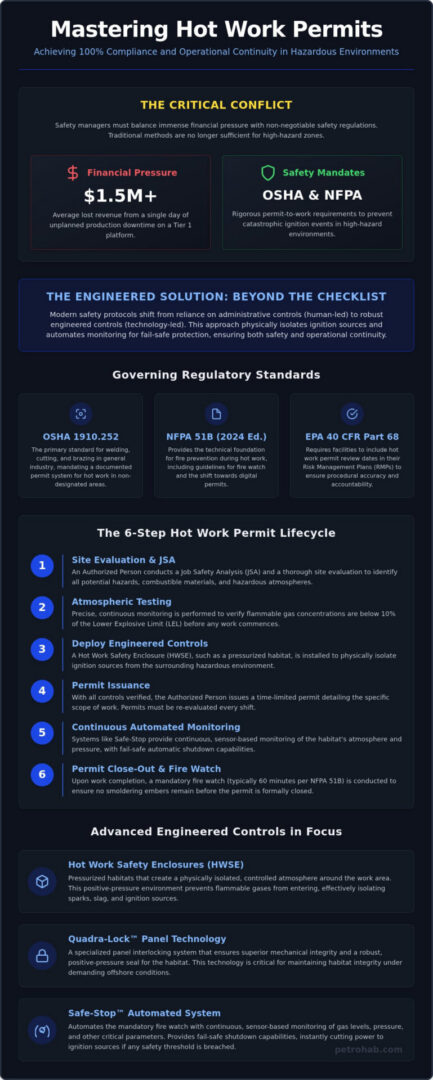
The administrative execution of hot work permit requirements demands a methodical, five-step approach. It begins with a comprehensive Job Safety Analysis (JSA). This site inspection identifies potential fuel sources and thermal hazards that could compromise the integrity of the operation. Once hazards are identified, the second step involves isolating the work area. Deploying engineered solutions like pressurized welding habitats is the most effective way to achieve this isolation in high-risk zones. These systems provide a physical barrier that administrative controls alone cannot match.
Following isolation, Step 3 requires rigorous atmospheric testing for Lower Explosive Limits (LEL), Oxygen levels, and Hydrogen Sulfide (H2S). Step 4 focuses on verifying the presence and functionality of fire suppression equipment and the correct positioning of the fire watch. Finally, Step 5 concludes with the Authorized Person signing the permit and displaying it prominently at the work site. This visibility ensures every personnel member is aware of the active ignition source and the established safety boundaries. It’s a transparent system designed to eliminate ambiguity in high-stakes environments.
Pre-Work Atmospheric Testing
Atmospheric verification is a critical safeguard that must be performed with calibrated, multi-gas detectors. For hot work permit requirements to be valid, detectors must undergo a bump test or full calibration according to manufacturer specifications before use. While spot checks are common, hazardous environments often necessitate continuous monitoring to detect sudden gas releases. Alarm thresholds are typically set to trigger a work stoppage if LEL levels reach 10%. This proactive threshold provides a necessary safety margin before a flammable concentration is reached. If the detector alarms, all hot work must cease immediately until the source of the gas is identified and mitigated.
Post-Work Inspection and Permit Closure
The process doesn’t end when the torch is extinguished. A final walk-through is essential to identify hidden sparks or areas of significant heat soak that could lead to a delayed ignition. The fire watch must remain vigilant for at least 60 minutes, as mandated by the 2024 edition of NFPA 51B. Only after this period can the Authorized Person formally sign off, returning the area to its normal operational status. Accurate record-keeping is the final technical requirement. Facilities must archive these documented permits to provide a transparent audit trail for regulatory inspections. To ensure your facility meets these rigorous standards, you can consult with PetroHab’s safety experts to integrate advanced habitat technology into your permit-to-work system.
Enhancing Permit Integrity with PetroHab’s Quadra-Lock Technology
Meeting hot work permit requirements is significantly streamlined when operators transition from administrative oversight to engineered automation. Advanced hot work safety systems deliver the objective data needed to satisfy safety managers and regulatory auditors alike. By integrating proprietary technologies like Quadra-Lock panels and the Safe-Stop system, facilities transform the permit-to-work (PTW) process into a fail-safe operation. In high-stakes environments, this transition has proven its value; Tier 1 operators report reducing permit-related downtime by 40% through the deployment of PetroHab HWSE. This efficiency stems from a system designed to eliminate the variables of human error and environmental volatility.
The integration of these technologies ensures that safety is an inherent part of the equipment rather than a secondary consideration. When technical systems manage the containment and monitoring, the administrative burden on the Authorized Person is reduced. This allows for a more efficient workflow that maintains the highest levels of risk mitigation. By moving beyond simple checklists, you establish a rigorous safety culture backed by the industry’s most reliable engineering controls.
The Quadra-Lock Advantage
Achieving a definitive seal is the primary challenge in habitat construction. The industry benchmark for this integrity is the patented Quadra-Lock panel system. These panels utilize a mechanical interlocking design that eliminates the failure points common in legacy zipper or Velcro enclosures. This modular flexibility allows technicians to adapt the enclosure around complex pipework and structural members without compromising the environmental seal. The fire-resistant materials used in Quadra-Lock panels are ANSI/FM 4950 certified, exceeding the standard fire prevention requirements set by NFPA and providing a superior barrier against sparks and slag. This mechanical integrity is a critical component in securing permit approval for hazardous zone operations.
Safe-Stop: Automating Emergency Procedures
The fire watch requirement, while essential, remains vulnerable to human delay. The Safe-Stop Automatic Shutdown System serves as the ultimate fail-safe for your PTW protocols. It provides an instant shutdown of all hot work tools if gas detectors identify a hazardous atmosphere or if the enclosure loses its positive pressure. By linking environmental monitoring directly to the power source, Safe-Stop automates the emergency response. It ensures the immediate cessation of work before an ignition event can occur. This level of technical precision provides safety managers with absolute confidence in their site’s integrity. To optimize your facility’s safety workflow and ensure compliance with the most rigorous hot work permit requirements, consult with a PetroHab expert today.
Securing Operational Continuity through Engineered Compliance
Maintaining facility integrity requires a transition from simple administrative checklists to robust, engineered safety systems. You’ve seen how modern hot work permit requirements demand more than just a manual fire watch; they require the physical isolation of ignition sources from hazardous atmospheres. By implementing patented Quadra-Lock technology and ATEX/IECEx certified monitoring systems, your facility can maintain production while upholding the highest safety benchmarks.
Rigorous adherence to OSHA and NFPA standards isn’t just about avoiding fines. It’s about protecting personnel and high-value assets during critical maintenance cycles. Automated shutdown systems like Safe-Stop eliminate the risks of human error, providing a definitive remedy for environmental hazards. PetroHab remains your essential partner in this mission, offering global 24/7 technical support to ensure your site stays operational and protected. This proactive approach ensures that maintenance work never compromises the safety of your personnel or the continuity of your operations.
Take the next step in optimizing your safety workflow today. Request a Quote for PetroHab HWSE and Safe-Stop Systems to secure your facility’s future. You have the tools to turn regulatory hurdles into a clear operational advantage.
Frequently Asked Questions
Is a hot work permit required for grinding and soldering?
Yes, grinding and soldering require a permit because they generate sparks or significant thermal energy. OSHA 1910.252 defines hot work as any activity involving open flames or heat producing sparks. Even if a flame isn’t visible, the potential for ignition remains high in hazardous environments. Grinding sparks travel significant distances. This necessitates strict adherence to safety protocols to ensure the area remains clear of all combustible materials.
How long is a standard hot work permit valid for?
A standard permit is generally valid for the duration of a single work shift, typically not exceeding 24 hours. If the scope of work changes or personnel rotate, the permit must be re-evaluated and re-authorized. NFPA 51B mandates that the area is inspected before work resumes after any break. This ensures that environmental conditions haven’t shifted, maintaining the integrity of the original safety analysis. Safety is non-negotiable.
Who is responsible for issuing a hot work permit on an offshore platform?
The responsibility for issuing the permit lies with the designated Authorized Person or Area Authority. On an offshore platform, this is often the Offshore Installation Manager or a senior safety lead. This individual must verify that all hot work permit requirements are satisfied, including atmospheric testing and the deployment of engineering controls. They hold the legal authority to halt operations if safety protocols aren’t strictly followed.
Can a hot work permit be issued in a Zone 1 hazardous area?
Yes, a permit can be issued for Zone 1 areas provided that engineered controls like a PetroHab Hot Work Safety Enclosure are deployed. These pressurized habitats create a localized environment that prevents the ingress of flammable gases. Without such containment, hot work in Zone 1 is generally prohibited due to the high probability of an explosive atmosphere. Using Quadra-Lock panels ensures the habitat maintains the necessary seal integrity for approval.
What is the 35-foot rule in hot work safety?
The 35-foot rule is an NFPA 51B requirement that mandates the removal of all combustible materials within a 35-foot radius of the hot work. If relocation isn’t possible, the materials must be protected with fire-resistant covers or shielded by a physical barrier. In congested industrial sites, this rule often necessitates the use of a pressurized habitat to isolate the ignition source when the 35-foot clearance can’t be maintained.
Does a pressurized habitat eliminate the need for a fire watch?
A pressurized habitat doesn’t eliminate the legal requirement for a dedicated fire watch. While the habitat provides a superior physical barrier, oversight remains mandatory to detect external hazards or equipment failure. Integrating the Safe-Stop Automatic Shutdown System automates the emergency response. It provides a fail-safe that terminates the ignition source instantly if gas is detected, significantly enhancing the effectiveness of the fire watch protocol.
What happens if gas is detected during a permitted hot work operation?
If gas is detected at levels exceeding 10% of the LEL, all work must stop immediately and ignition sources must be terminated. The permit is effectively suspended until the source of the gas is identified and mitigated. Systems like Safe-Stop automate this process by cutting power to welding tools the moment sensors trigger an alarm. This immediate response is a critical technical requirement for maintaining safety in high-risk industrial zones.
Are digital hot work permits legally acceptable in 2026?
Digital permits are legally acceptable and increasingly preferred in 2026. The 2024 update to NFPA 51B transitioned the terminology from written to documented permits, specifically to accommodate digital safety management systems. These electronic records provide a more reliable audit trail and ensure that all hot work permit requirements are verified in real-time. They improve audit transparency and reduce the risk of lost paperwork during regulatory inspections.