
Blog Posts
Interlocking Panel Installation for Frontline Welders
Velcro may appear straightforward, but frontline welders need to understand how an enclosure’s panels are secured. Building frontline welder trust in mechanical interlocking panels over Velcro starts with a clear explanation of the connection: FL100 panels use concealed fasteners, and the installation method should be understood before work begins.
That confidence comes from practical details, not broad assurances. Crews need to see how panels align, how concealed fasteners hold the assembly together, and how the installation approach fits the demands of the worksite.
This article explains how FL100 interlocking panels are installed and compares weld-up and bolt-up systems. You’ll learn what distinguishes the two approaches, what each means for assembly, and why mechanical interlocking offers a different way to secure enclosure panels. The aim is to give safety managers and welding teams a precise basis for evaluating panel installation, with attention to the details that matter in a frontline environment.
Key Takeaways
- Learn how mechanical interlocking panels are used in welding enclosures and what concealed fasteners mean for installation.
- Compare mechanical connections with Velcro by considering panel fit, assembly, and reliability in frontline work.
- Use a practical installation walkthrough to help welders understand how panel connections work and what to expect during setup.
- See how Quadra-Lock Panels relate to the choice between weld-up and bolt-up systems for a welding enclosure.
What are mechanical interlocking panels used for in welding applications?
Mechanical interlocking panels form connected sections of a welding enclosure. Their edges engage to create an assembled wall or partition, while concealed fasteners secure the panel connection. This gives crews a defined assembly method rather than relying on a surface closure alone. In a pressurized welding enclosure, panels contribute to the enclosure structure; they do not replace pressure monitoring or other system controls.
In practice, panels help define the work boundary around hot work. A crew, for example, may assemble enclosure walls around a welding task at an industrial site. The layout determines where the boundary runs and how sections meet at corners and edges. Connection design therefore affects setup, access, and maintenance, not just appearance.
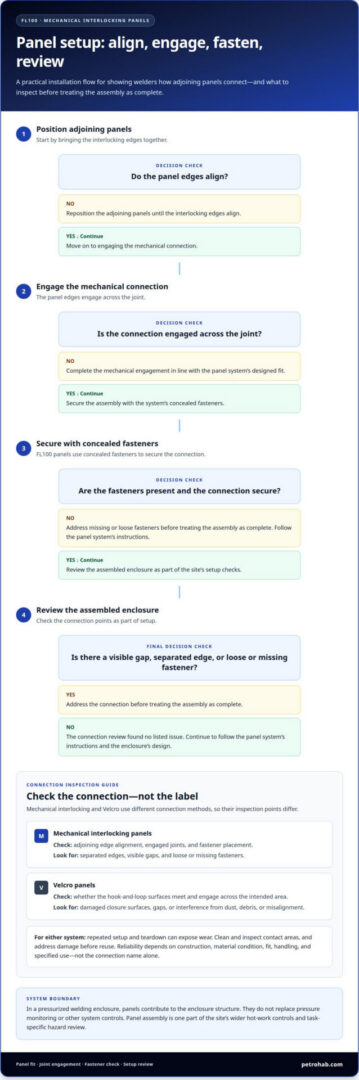
A practical installation sequence follows the panel system’s designed fit:
- Position adjoining panels so their interlocking edges align.
- Engage the mechanical connection across the joint.
- Secure the assembly with the system’s concealed fasteners.
- Review the assembled enclosure as part of the site’s setup checks.
The sequence shows welders what to inspect: aligned panels, engaged joints, and secure connections. It also gives supervisors a consistent way to explain assembly. Every seam matters, since a missed connection can leave the assembly incomplete. Follow the panel system’s instructions and the enclosure’s design during installation.
Mechanical interlocking panels join modular enclosure sections into a defined structure for welding work. They provide a repeatable way to connect adjoining panels, while the complete enclosure and its operating controls address wider site requirements. This distinction helps teams assess the panel installation on its merits without mistaking it for the full hot-work system.
When done correctly, heat welding can create a bond as strong as the original material. For welding work, it is important to distinguish the material from the enclosure: panels define and join the work boundary, while the welding process forms the bond. A correctly assembled enclosure supports a clear work area, but bond quality depends on carrying out the welding correctly.
How do mechanical interlocking panels compare with Velcro panels for durability and reliability?
The connection method changes how crews assemble and inspect an enclosure. Mechanical interlocking panels join through shaped edges, then use concealed fasteners to secure the assembly. Velcro panels connect through hooks engaging loops across a closure surface. These mechanisms create different inspection points, but neither name alone proves a panel’s durability or suitability for a welding task.
For an interlocking joint, the installer can examine whether adjoining edges align and whether fasteners are present. A visible gap or an unengaged edge signals that the connection needs attention before the assembly is treated as complete. With Velcro, the relevant check is whether the closure surfaces meet and engage across the intended area. Dust, debris, damage, or misalignment can interfere with either system, so condition and installation matter.
A practical comparison focuses on the connection, not assumptions about service life:
- Assembly: Check edge alignment and fastener placement on an interlocking panel; check hook-and-loop engagement across a Velcro closure.
- Inspection: Look for loose or missing fasteners, separated edges, damaged closure surfaces, and visible gaps.
- Maintenance: Clean and inspect contact areas, then address damage before reuse.
Repeated setup and teardown, for example, can expose wear at joints and closures. With a mechanical connection, crews inspect the panel edges and joint; with Velcro, they inspect the engaging surfaces. Performance depends on panel construction, material condition, fit, handling, and the enclosure’s specified use. A damaged connection is not reliable simply because it uses a mechanical interlock.
That distinction helps build frontline welder trust: explain what each connection does, demonstrate its inspection points, and avoid claims that exceed the system’s design. For a practical reference on mechanically interlocking panel design, focus discussion on joint fit, fastening, and condition during setup.
Planning can also distinguish connection choices from project logistics. Weld-up building materials in the Texoma region can be on site in 1 to 3 days, compared with 6 to 14 weeks for a fully engineered bolt-up package. That timing may shape procurement and scheduling, but it does not by itself establish whether an interlocking panel or a Velcro closure will remain dependable. Crews still need to judge each connection by fit, engagement, and condition during inspection.
How can employers demonstrate the safety benefits of mechanical interlocking panels to frontline welders?
Building frontline welder trust in mechanical interlocking panels over Velcro begins with a hands-on demonstration before an enclosure enters service. Show how adjoining panel edges align, how the interlocking joint engages, and where concealed fasteners secure the assembly. Let welders observe each step, from initial positioning through the final inspection. This gives the crew a shared reference for setup and a clear view of the connection method.
Explain what the connection does and does not establish. An engaged joint shows that panels connect as designed; it does not prove that the complete enclosure suits every hazard. Explain how panel assembly fits into the site’s wider hot-work controls, including operating procedures and the task-specific hazard review. Keep the demonstration focused on the panel’s role in the system, not as a replacement for other controls.
A practical demonstration can include these checks:
- Align two sample panels and show how their edges engage.
- Point out concealed fasteners and explain their role in securing the assembly.
- Show an incomplete connection, such as a panel edge that has not engaged.
- Repeat the inspection sequence using the site’s setup procedure.
Use the same sequence in crew training and enclosure setup. Consistent instruction helps welders recognize the intended connection and spot visible assembly issues. Invite workers to describe what they see at each joint. Their feedback may identify unclear instructions, restricted access, or steps that need more explanation. This repeatable, practical approach helps build frontline welder trust in mechanical interlocking panels over Velcro.
Record the demonstration in the work procedure with clear inspection points, such as aligned edges, engaged joints, and fasteners in place. Supervisors can reinforce those criteria during shift handovers. If the enclosure design changes, demonstrate the updated connection before use. Clear explanations and practical crew involvement give welders a sound basis for understanding the system without claiming that panels eliminate welding hazards.
What do welders report about the usability of mechanical interlocking panels compared with Velcro
Usability feedback is clearest when welders describe specific tasks, not broad preferences. During setup, they can note how easily panel edges align, whether the joint engages as expected, and how accessible fasteners are. With Velcro, useful observations include positioning the closure surfaces and confirming that they engage across the intended area. These details reveal how each connection fits the crew’s actual workflow.
A fair comparison uses the same enclosure layout and work sequence. Have the crew assemble a representative section, inspect the connection, then disassemble it according to the system’s instructions. Record where alignment is straightforward, where access is awkward, and which steps need clarification. One welder may value a clear engagement point; another may focus on how easily panels can be repositioned during setup.
Capture feedback against practical criteria:
- Handling: How easily can a worker position adjoining panels?
- Connection: Can the worker tell whether the joint or closure is fully engaged?
- Inspection: Can the crew identify an incomplete connection before work begins?
- Changeover: Which steps require extra handling when the enclosure is dismantled or reassembled?
These observations are more useful than claiming that all welders prefer one system. Usability depends on panel design, enclosure layout, access, handling, and familiarity with the procedure. A tight corner, for example, can make panel positioning more demanding, while an open wall section may offer an unobstructed view of the connection. Note the location and task so feedback can lead to a specific improvement, such as clearer instructions or a revised assembly sequence.
Use the findings in a short crew review before the next setup. Ask workers to identify one step that worked well and one that slowed assembly, then update the procedure accordingly. To discuss panel usability in a welding enclosure, review interlocking panel options.
PetroHab: Quadra-Lock Panels
PetroHab LLC’s Quadra-Lock Panels use patented Quadra-Lock technology in modular hot-work enclosure systems. They suit projects that call for mechanically interlocking panels rather than a Velcro closure. Consider how the panel connection fits the enclosure layout, installation procedure, and site requirements.
Quadra-Lock Panels are used in PetroHab Hot Work Safety Enclosures (HWSE), including pressurized welding enclosures. Panel connections are one part of the overall system, so select an enclosure with the work environment and operating controls in mind.
Contact PetroHab LLC to discuss Quadra-Lock Panels for your welding enclosure requirements.
Set the next enclosure standard with confidence
Building frontline welder trust in mechanical interlocking panels over Velcro takes more than choosing a connection method. Define project requirements, document assessment criteria, and involve frontline welders before adopting a standard. Their input gives crews a meaningful role in decisions that shape their work environment.
For projects requiring a complete hot-work enclosure system, PetroHab offers Hot Work Safety Enclosures (HWSE), Quadra-Lock Panels, and the Safe-Stop Safety Shutdown System. Each addresses a different part of the equipment decision. Contact PetroHab to discuss the enclosure and supporting systems for your planned work.
Move forward with a clear view of your enclosure requirements and the questions your team needs answered. Contact PetroHab LLC about interlocking panels to discuss the application. A disciplined evaluation gives your team a stronger basis for its next decision.