Blog Posts
Hot Work Safety Audit Checklist: A 2026 Technical Guide for Hazardous Zones
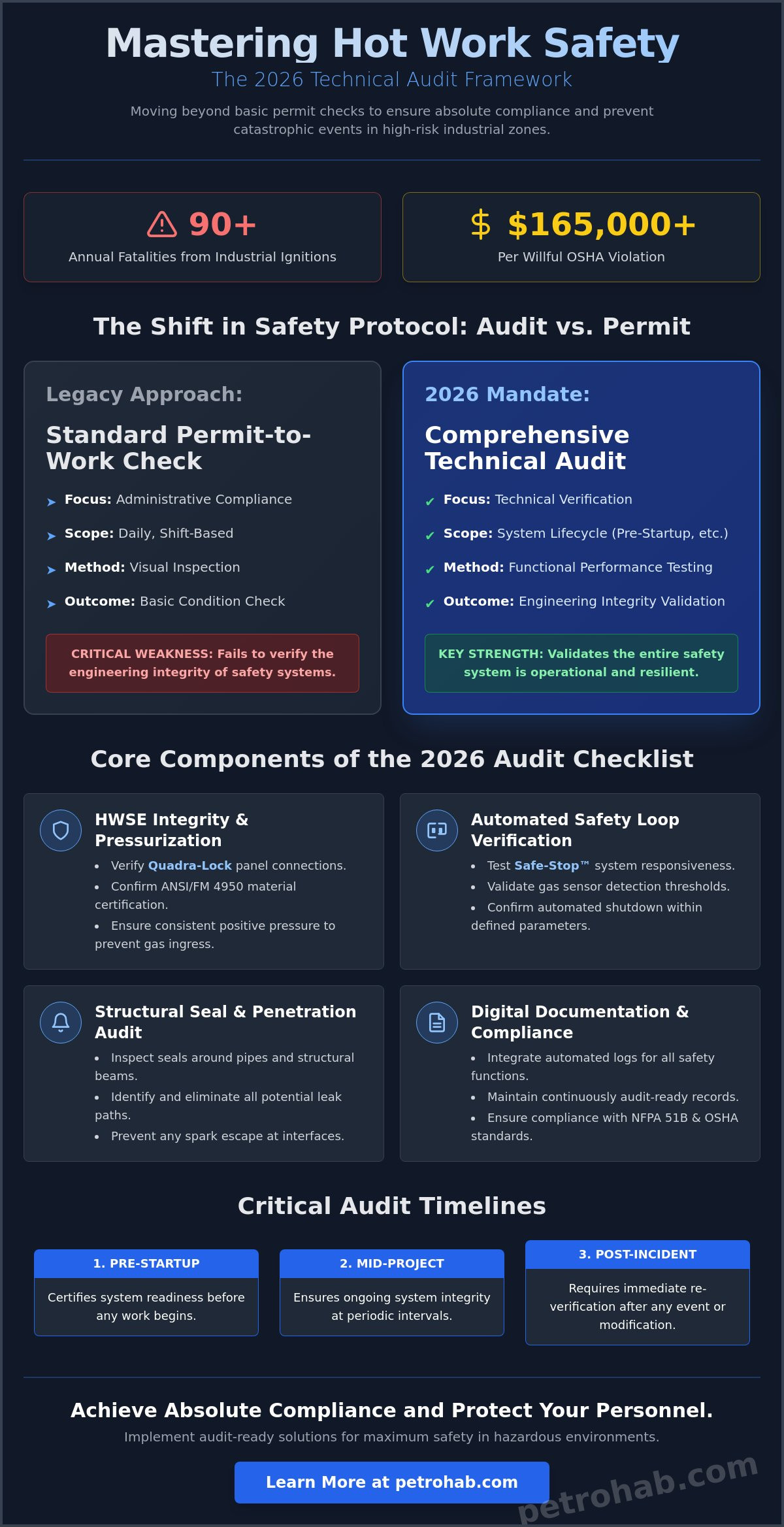
Industrial ignition events cause more than 90 fatalities annually, a statistic that underscores the lethal stakes of inadequate site oversight. In 2026, maintaining a standard permit is no longer sufficient to mitigate risk in high-consequence environments. You need a rigorous hot work safety audit checklist that accounts for the technical integrity of pressurized containment and the precision of automated safety loops. Relying on outdated protocols in Zone 1 or Zone 2 areas invites catastrophic habitat failure and exposes your organization to OSHA penalties that now exceed $165,000 per willful violation.
We understand that the ambiguity of evolving NFPA 51B standards and inefficient permit-to-work processes can jeopardize operational safety. This guide provides the technical framework required to master hot work audits in hazardous zones to ensure absolute compliance. You’ll learn to verify the performance of specialized equipment like Quadra-Lock panels and Safe-Stop systems. We will analyze the critical checkpoints for fire watch duration, gas detection thresholds, and pressurized enclosure stability to ensure your site remains fully compliant and your personnel stay protected.
Key Takeaways
- Identify the critical distinctions between routine permit-to-work documentation and a comprehensive technical safety audit for high-risk zones.
- Execute a rigorous structural inspection using a specialized hot work safety audit checklist to verify the integrity of Quadra-Lock panel connections.
- Establish a systematic procedure for testing automated safety loops, ensuring Safe-Stop systems and gas sensors respond to atmospheric hazards within defined parameters.
- Leverage modular HWSE technology to simplify the verification of pressurized containment and prevent spark escape in volatile environments.
- Integrate digital documentation and automated logs to ensure your operations remain audit-ready and compliant with 2026 international safety standards.
Defining the 2026 Hot Work Safety Audit
A hot work safety audit represents a systematic, technical verification of ignition prevention controls within a hazardous environment. Unlike a standard administrative review, this process scrutinizes the physical and functional barriers that separate high-temperature activities from volatile hydrocarbons. In environments such as offshore drilling platforms and downstream refineries, the margin for error is non-existent. Engineers must move beyond the basic Hot work safety principles found in general industry guidelines. They must adopt a 2026 hot work safety audit checklist that specifically addresses the technical integrity of pressurized containment systems.
It’s vital to distinguish between a daily hot work permit check and a comprehensive technical safety audit. A permit check confirms that immediate conditions are acceptable for a specific shift. In contrast, the technical audit validates the engineering integrity of the entire safety system, including the modular assembly of pressurized habitats. For 2026, the regulatory baseline is defined by the 2024 edition of NFPA 51B and OSHA 29 CFR 1910.252. These standards emphasize documented verification over simple visual inspections, requiring a deeper dive into the operational state of safety hardware.
To better understand the core concepts of industrial hot work protection, watch this technical overview:
The Core Objectives of a Technical Audit
The primary objective is the absolute isolation of ignition sources from flammable atmospheres. Auditors must verify that the PetroHab Hot Work Safety Enclosure (HWSE) maintains positive pressure to prevent the ingress of combustible gases. This involves examining the thermal integrity of the enclosure and ensuring that sparks cannot escape through the seams of the Quadra-Lock panels. Furthermore, the audit validates the responsiveness of automated gas detection and shutdown loops. A failure in these safety loops renders the entire containment strategy void, making functional testing a non-negotiable component of the hot work safety audit checklist.
Audit Frequency and Personnel Requirements
Technical audits should occur during three critical phases: pre-startup, mid-project intervals, and immediately following any safety incident or habitat modification. The pre-startup audit is a definitive gate that prevents the commencement of work until all pressurized systems are certified. A qualified auditor must possess a deep understanding of pressurized habitat mechanics and automated shutdown logic. While internal safety supervisors handle daily oversight, third-party auditors provide an unbiased evaluation of system performance. This objective layer of scrutiny is essential for maintaining compliance with international safety certifications and protecting high-value assets in high-stakes industrial zones.
Auditing Enclosure Integrity and Quadra-Lock Technology
The physical boundary of a pressurized habitat serves as the primary line of defense against industrial ignition. A technical hot work safety audit checklist must move beyond surface-level observations to evaluate the structural integrity of the Hot Work Safety Enclosure (HWSE). This involves a granular inspection of the modular assembly to ensure it functions as a comprehensive containment system. Every panel must be verified against ANSI/FM 4950 certifications. This standard ensures the material provides the necessary fire resistance to withstand molten metal and high-velocity sparks without compromising the habitat’s interior.
Structural seals around pipe penetrations and structural beams represent common failure points in hazardous zone containment. Auditors must inspect these interfaces for potential leak paths that could allow flammable gases to enter the workspace. If the enclosure cannot maintain consistent positive pressure, the risk of an ignition event becomes critical. Precise engineering at these junctions separates a certified enclosure from a generic barrier. For those overseeing high-stakes operations, reviewing the technical specifications of the PetroHab HWSE provides a benchmark for these structural requirements.
Verifying Quadra-Lock Panel Security
The Quadra-Lock system is the fundamental component of habitat stability and ignition prevention. During the audit, inspectors must verify that each locking mechanism is fully engaged across the entire modular structure. There shouldn’t be any visible gaps or misalignments between panels. Even a minor breach in the interlocking seam can allow sparks to escape or cause positive pressure to drop. Auditors should also examine the physical condition of the panels, looking for signs of mechanical tears, thermal burns, or chemical degradation that could compromise the system’s resilience during hot work operations.
Enclosure Ventilation and Airflow Audit
Ventilation audits focus on the source and volume of air supplied to the habitat. The air intake ducting must draw from a verified clean source, situated well away from potential hydrocarbon releases. Auditors must calculate the air exchange rates to ensure welding fumes are effectively removed. This prevents an accumulation of toxic or flammable gases within the workspace. Inspecting the integrity of the air ducting connections to the HWSE is equally vital. Leaking ducts reduce the effectiveness of the pressurized environment and undermine the safety of the entire operation, making this a high-priority item on the technical audit list.
Auditing Automated Safety Loops and Shutdown Systems
A technical hot work safety audit checklist isn’t complete without a rigorous evaluation of the active safety systems that govern the habitat environment. While the structural integrity of Quadra-Lock panels provides passive protection, the Safe-Stop Automatic Shutdown System serves as the active guardian. The audit must verify the functional state of this system by simulating alarm conditions. This ensures that the power-kill functionality immediately de-energizes all hot work equipment, such as welding leads and grinders, the moment a hazard is detected. Relying on manual intervention in a high-stakes zone is a risk that modern safety protocols don’t permit.
Testing gas detection sensors requires a methodical, step-by-step procedure during the audit. Inspectors should introduce test gases to both the internal and external sensors to confirm they trigger at the correct setpoints. According to current industry standards, a 10% Lower Explosive Limit (LEL) detection should trigger a visual and audible alarm, while a 25% LEL detection must initiate an immediate shutdown. The audit also requires a thorough review of calibration records for all LEL and H2S sensors to ensure they remain within the manufacturer’s specified tolerances. Sensors that haven’t been calibrated within their required window must be flagged as critical non-compliance items.
Pressure Monitoring and Manometer Verification
Positive pressure is the mechanism that keeps flammable gases out of the enclosure. The audit must confirm that the manometer readings consistently show a minimum positive pressure of 0.05 inches of water. This is the technical threshold required to ensure the habitat’s safety. Auditors must also verify the ‘low pressure’ alarm trigger points. If the pressure drops below the setpoint, the Safe-Stop system must react instantly. Checking the physical condition of pressure sensing lines is equally critical; even small kinks or leaks can result in inaccurate readings that compromise the entire safety loop.
Gas Detection Placement and Coverage
Strategic sensor placement determines the effectiveness of the monitoring system. The audit evaluates the location of sensors relative to potential leak sources, such as valves or flanges, and the air intake of the HWSE. In classified zones, the audit must confirm that all gas detection hardware carries the appropriate ATEX or IECEx certifications. Beyond detection, the system’s output must be unmistakable. Inspectors should walk the site to verify that alarm audibility and visibility are sufficient to alert personnel across the entire work area, even amidst the high ambient noise of a live refinery or offshore rig.
The Comprehensive Hot Work Safety Audit Checklist (2026 Edition)
The 2026 hot work safety audit checklist serves as the definitive technical record for hazardous zone operations. It demands more than a cursory glance at equipment; it requires documented verification of the engineering controls that prevent industrial ignition. This audit is the final barrier between a safe operation and a catastrophic event. Safety managers must utilize this framework to validate that every component of the pressurized habitat system functions according to its design specifications. A rigorous audit ensures compliance with international hazardous environment standards and protects high-value assets from molten metal and sparks.
- Pre-Audit Documentation: Verify that the Permit-to-Work (PTW) is fully documented and aligns with site-specific risk assessments.
- Structural Integrity: Confirm all HWSE panels are secured using the patented Quadra-Lock technology to eliminate gaps in the containment.
- Atmospheric Controls: Validate that positive pressure is maintained at a minimum of 0.05 inches of water and verify that gas detectors have current calibration certificates.
- Operational Safety: Ensure fire-resistant flooring is installed and that all potential leak paths for sparks are sealed.
- Automated Protection: Confirm the Safe-Stop system is armed, powered, and communicating with all gas detection sensors.
Pre-Startup Verification Points
Before any hot work commences, the auditor must verify the location of the air intake ducting. It’s critical that the intake draws from a verified non-hazardous source that is free from potential hydrocarbon contamination. The auditor must also perform a full review of the pressurized welding habitat setup against the manufacturer’s technical manual. This ensures the modular configuration is appropriate for the specific site geometry. Personnel qualifications are equally vital to the audit process. You must verify that every technician on-site has completed the necessary hot work habitat training to operate the equipment safely.
During-Work Audit Intervals
Safety isn’t a static condition; it’s a state of constant vigilance. Auditors must perform periodic checks of the positive pressure levels directly on the Safe-Stop display throughout the shift. Visual inspections at the enclosure seams are mandatory to ensure that the Quadra-Lock panels remain tightly engaged and that no sparks escape the habitat. The auditor must also monitor for changes in the external environment. Shifts in wind direction or the commencement of adjacent industrial processes can introduce new risks that require immediate habitat adjustments or work suspension. To ensure your facility meets these rigorous requirements, standardize your site safety with PetroHab HWSE systems.
Implementing PetroHab Solutions for Audit-Ready Operations
Achieving a successful technical audit requires more than just following a list; it requires hardware designed for verification. PetroHab’s suite of technologies transforms the hot work safety audit checklist from a procedural burden into a streamlined validation process. By utilizing standardized components, safety managers ensure that every installation meets the same rigorous benchmark for ignition prevention. This uniformity eliminates the variances often found in ad-hoc containment setups and provides a clear, documented path to regulatory compliance. When your equipment is engineered for scrutiny, the audit becomes a confirmation of excellence rather than a search for deficiencies.
PetroHab HWSE: Engineered for Compliance
The modular design of hot work safety enclosures fundamentally reduces the risk of human error during the assembly phase. Each component is engineered to fit precisely, ensuring that the structural integrity of the habitat isn’t left to chance. The use of Quadra-Lock panels facilitates a rapid, gap-free assembly that consistently passes the most stringent inspections. These panels are not only fire-resistant but are also designed to maintain the positive pressure required in Zone 1 and Zone 2 environments. PetroHab provides comprehensive technical documentation and support for your internal safety audits. This ensures that every structural checkpoint is backed by verifiable engineering data and international fire standards.
Safe-Stop: The Future of Hot Work Safety Systems
Digital accountability is a cornerstone of 2026 safety standards. Integrating advanced hot work safety systems like Safe-Stop allows for the automation of risk mitigation. This system doesn’t just monitor gas levels and pressure; it records them. This real-time data logging is invaluable for post-work audit reviews and incident investigations. It provides an unalterable record of the habitat’s internal atmosphere and the functional state of the safety loops throughout the project’s duration. These digital logs simplify the hot work safety audit checklist by providing objective evidence of a controlled environment, which is far more reliable than manual readings taken at intervals.
To further guarantee audit compliance, we offer professional on-site supervision. Our technicians understand the granular requirements of a technical audit and can ensure your habitat is optimized for the specific hazards of your site. This expert oversight acts as an additional layer of protection for your personnel and high-value assets. It ensures that your safety protocols are not only planned but executed with surgical precision. Contact PetroHab today for a technical consultation to secure your next hazardous zone project with industry-leading containment and shutdown technology.
Securing Operational Excellence in Hazardous Environments
Industrial safety in 2026 demands a shift from administrative compliance to technical verification. This guide has established that a robust hot work safety audit checklist must prioritize the structural integrity of pressurized containment and the functional responsiveness of automated shutdown systems. By validating the engagement of patented Quadra-Lock technology and testing the active safety loops of the Safe-Stop system, you eliminate the ambiguity that leads to habitat failure in Zone 1 and Zone 2 areas. These checkpoints are the definitive barriers against industrial ignition.
Maintaining absolute protection of personnel and high-value assets requires a commitment to rigorous inspection protocols. Our ATEX and IECEx compliant systems provide the reliability needed for the high-stakes environments of the energy and safety sectors. With global support and certified training, your team can maintain audit-ready operations that exceed international regulatory standards. Precision in your safety audit today prevents catastrophe tomorrow.
Don’t leave your site’s safety to chance. Request a technical consultation for your HWSE project to ensure your next operation is backed by the industry benchmark in ignition prevention. We are ready to act as your critical safety partner in the field.
Frequently Asked Questions
What is the difference between a hot work permit and a hot work safety audit?
A hot work permit is a documented authorization that confirms immediate conditions are safe for a specific task or shift. A technical hot work safety audit checklist involves a deeper verification of the engineering controls, such as habitat integrity and safety loop functionality. While the permit is administrative, the audit is a rigorous structural and functional validation of the entire containment system.
How often should a pressurized welding habitat be audited during a shift?
You should perform a technical audit before startup and at defined intervals throughout the shift. While the Safe-Stop system provides continuous digital monitoring, physical inspections should occur at least once mid-shift or immediately if environmental factors change. This ensures that the modular configuration remains secure and that positive pressure is consistently maintained to prevent gas ingress.
What are the minimum positive pressure requirements for a hot work enclosure?
The minimum technical requirement for positive pressure within a pressurized habitat is 0.05 inches of water. Maintaining this threshold is critical to prevent the ingress of flammable gases from the external environment into the workspace. Auditors must verify this reading on the manometer and ensure that the Safe-Stop system is programmed to trigger an alarm if pressure falls below this level.
Does an automatic shutdown system replace the need for a fire watch?
An automatic shutdown system like Safe-Stop does not replace the requirement for a physical fire watch. Current standards, including the 2024 edition of NFPA 51B, mandate a fire watch for at least 60 minutes after work is completed. The automated system acts as a secondary engineering control that provides immediate protection if gas is detected or pressure is lost during active operations.
What certifications should I look for in hot work safety enclosure panels?
Look for panels that carry the ANSI/FM 4950 certification for fire resistance. This standard ensures the material can withstand sparks and molten metal in high-risk industrial zones. Additionally, verify that the locking mechanisms, such as Quadra-Lock technology, are tested to maintain a secure seal. These certifications are linguistic anchors for quality and compliance in hazardous environments.
Can hot work be performed in a Zone 1 area without an HWSE?
Performing hot work in a Zone 1 area without a PetroHab Hot Work Safety Enclosure (HWSE) is generally prohibited unless the entire plant is shut down and purged of hydrocarbons. The HWSE creates a controlled environment that allows for safe welding or cutting in live hazardous areas. It functions by isolating the ignition source from the surrounding volatile atmosphere through constant positive pressure.
How do I audit the gas detection system used with a welding habitat?
Auditing the gas detection system requires verifying current calibration certificates and performing functional bump tests with test gases. You must confirm that internal and external sensors accurately detect Lower Explosive Limit (LEL) levels. The audit should validate that the system triggers an alarm at 10% LEL and initiates an automatic shutdown at 25% LEL to ensure absolute site safety.
What should be included in the emergency section of a hot work audit?
The emergency section must include a functional test of the power-kill system to ensure all hot work equipment de-energizes instantly upon alarm. It should also verify the audibility of alarms across the work site and confirm that evacuation routes are unobstructed. Documenting these points on your hot work safety audit checklist ensures that personnel can react effectively to any containment breach.