Blog Posts
Hot Work Safety: Engineering & Operational Guide 2026
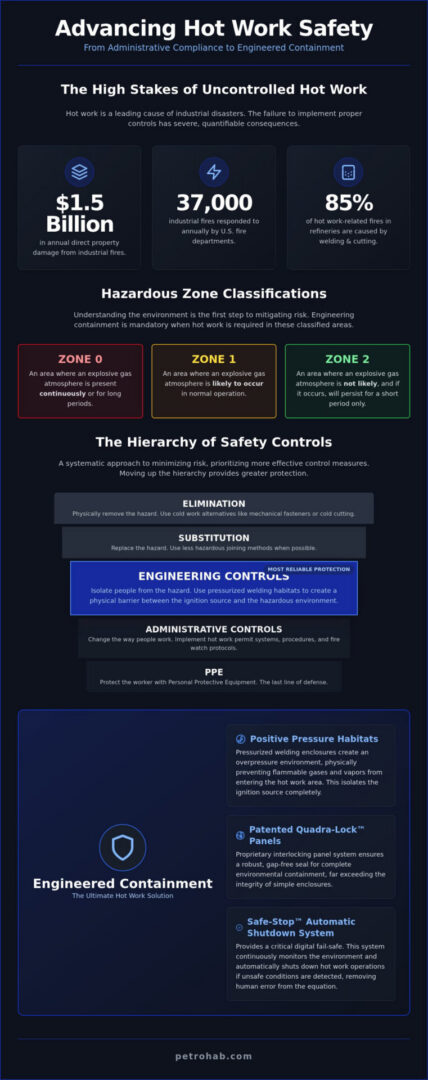
Industrial fires at manufacturing facilities result in nearly $1.5 billion in direct property damage annually. This data underscores the inherent volatility of performing high-heat tasks in hazardous environments. For safety managers and engineers, the administration of a hot work permit to work system is more than a regulatory hurdle; it’s a critical defense mechanism against catastrophic asset loss. You recognize that traditional administrative controls often fall short when faced with the complexities of live facility maintenance and the stringent requirements of OSHA 29 CFR 1910.252 or the 2024 edition of NFPA 51B.
This guide details the technical requirements and engineering controls necessary to mitigate ignition risks effectively. You’ll learn how to implement a zero-incident strategy that satisfies international safety standards while minimizing costly production downtime. We’ll analyze the deployment of pressurized welding enclosures, the integration of Safe-Stop automatic shutdown systems, and the application of patented Quadra-Lock panels to ensure environmental containment. By shifting from basic compliance to advanced engineering isolation, you protect your personnel and high-value assets with uncompromising precision and operational excellence.
Key Takeaways
- Understand how a robust hot work permit to work system integrates with advanced engineering controls to move beyond administrative compliance toward total risk isolation.
- Master the technical principles of positive pressure containment to prevent the ingress of flammable gases during welding and grinding operations in live facilities.
- Align your facility operations with the latest 2026 safety standards, including the 35-foot rule and extended fire watch protocols mandated by OSHA and NFPA 51B.
- Discover how proprietary technologies like Quadra-Lock panels and Safe-Stop automatic shutdown systems provide a critical digital fail-safe for continuous environmental monitoring.
- Implement a structured safety architecture to eliminate ignition risks while effectively reducing production downtime during high-stakes maintenance turnarounds.
Defining Hot Work and Its Risks in Industrial Environments
Hot work encompasses any industrial activity involving open flames or generating sufficient heat and sparks to ignite flammable materials. Primary examples include welding, grinding, thermal spraying, and brazing. In high-risk environments like refineries and petrochemical plants, these activities introduce a deliberate ignition source into areas where flammable vapors or dusts may be present. The administration of a hot work permit to work system is more than a regulatory hurdle; it’s a critical defense mechanism against catastrophic asset loss.
The Fire Triangle takes on a lethal dimension in hazardous industrial atmospheres. Oxygen is omnipresent. Fuel is often the byproduct or raw material of the facility. Hot work provides the final, controlled element: heat. A failure in the Permit-to-work (PTW) process allows these three elements to converge unexpectedly. Data from the Chemical Safety Board (CSB) and OSHA confirms that hot work remains a leading cause of industrial disasters. In the US, fire departments respond to approximately 37,000 industrial fires annually. Between 2017 and 2021, these incidents resulted in an average of $1.5 billion in direct property damage each year. Refineries are particularly vulnerable. Welding and cutting activities accounted for 85% of all hot work-related fires in recent reporting periods.
The Consequences of Hot Work Failures
The failure of a hot work permit to work system often leads to catastrophic asset loss and personnel fatalities. In the energy sector, a single spark can trigger a vapor cloud explosion (VCE), destroying multi-million dollar infrastructure instantly. Beyond the immediate tragedy of loss of life, petrochemical plants face a massive ripple effect from unplanned downtime. Production halts can cost millions per day. Safety non-compliance carries severe legal and regulatory liabilities. These include heavy fines and the potential for criminal negligence charges against site leadership.
Hazardous Zone Classifications (Zone 0, 1, and 2)
Technical precision in risk assessment requires adherence to ATEX and IECEx zone definitions. These standards categorize explosive atmospheres based on the frequency and duration of the occurrence of an explosive gas atmosphere:
- Zone 0: An area where explosive atmospheres are present continuously or for long periods.
- Zone 1: An area where explosive atmospheres are likely to occur in normal operation.
- Zone 2: An area where explosive atmospheres are not likely to occur, but if they do, will persist for a short period only.
Traditional hot work is strictly restricted in these zones. The risk of ignition is mathematically unacceptable. Engineering containment becomes mandatory when maintenance requires heat-generating tasks within or adjacent to these classified areas. This ensures a physical barrier exists between the ignition source and the potential fuel source, maintaining site integrity even during critical repairs.
The Hierarchy of Hot Work Safety Controls
The NIOSH Hierarchy of Controls provides a rigorous framework for managing industrial hazards. At the apex, elimination requires safety managers to seek cold work alternatives. Mechanical fasteners, cold cutting, or hydraulic bolting remove the ignition source entirely. When elimination isn’t feasible, substitution involves using less hazardous joining methods. However, in heavy industry, welding and grinding are often unavoidable. This necessitates a shift toward engineering controls. These systems create a physical barrier between the work and the environment. They represent the most reliable method for mitigating risks when heat-generating tasks must proceed in live facilities.
Administrative Controls and Permitting
The hot work permit to work system acts as the primary administrative layer. It documents the risk assessment and ensures authorized personnel oversee the task. Compliance with EPA hot work requirements is non-negotiable for facilities handling hazardous substances. Despite its importance, administrative control is often the weakest link. It relies on human vigilance. Fire watch personnel, while required by OSHA for at least 30 minutes post-work, cannot detect gas leaks as reliably as automated sensors. Human error or procedural lapses remain common failure points in even the most disciplined facilities.
Engineering Controls: The Technological Shield
Engineering controls actively isolate the hazard. Rather than relying on a worker to notice a change in the atmosphere, pressurized welding enclosures maintain a higher internal pressure to keep flammable gases out. These systems represent a definitive technological remedy for high-stakes maintenance. Integrating a pressurized habitat into your safety protocol ensures that protection is structural rather than just procedural. This approach moves beyond simple monitoring to active prevention, ensuring site integrity through engineered containment.
Personal Protective Equipment (PPE) for Hot Work
PPE is the final, least effective tier of the hierarchy. It includes the following essential gear:
- Flame-resistant (FR) clothing to mitigate flash fire injuries.
- Welding helmets with appropriate shade levels for ocular protection.
- Respiratory protection for metal fume extraction.
- Heavy-duty gloves and leather aprons for spark protection.
A dangerous misconception exists that PPE provides a primary defense against explosions. It doesn’t. PPE only protects the individual after a control failure has occurred. It must be integrated with broader site safety systems, acting as a secondary fail-safe rather than a standalone solution. Meticulous adherence to the higher levels of the hierarchy ensures that PPE is rarely tested by an actual ignition event.
Engineering Containment: The Role of Pressurized Welding Habitats
Administrative layers like the hot work permit to work system provide the necessary framework for safety, but they don’t physically isolate the ignition source from the surrounding environment. Traditional mitigation strategies, such as the use of fire blankets, often prove insufficient in high-hazard zones because they fail to address the risk of gas ingress. A hot work safety enclosure (HWSE) serves as the definitive engineering control by creating a pressurized, spark-containment environment. This methodology ensures that even if flammable vapors are present in the facility, they cannot reach the welding or grinding activity. By establishing a physical barrier, the HWSE mitigates the risk of a catastrophic ignition event far more effectively than administrative oversight alone.
Adherence to the EPA Hot Work Permit Regulation (40 CFR § 68.85) requires facilities to manage hazardous procedures with extreme technical precision. While the regulation mandates the permit process, the integration of engineering containment fulfills the safety intent by removing the possibility of human error during monitoring. Unlike fire blankets, which only provide a passive shield against sparks, an HWSE actively manages the atmosphere within the work area. This shift from passive to active protection represents the current industry benchmark for high-risk maintenance operations.
How Positive Pressure Habitats Function
Positive pressure habitats operate by maintaining an internal air pressure slightly higher than the external ambient environment. This pressure differential is monitored continuously by precise manometers. If the pressure drops below a calibrated threshold, the system alerts the operator or triggers an automatic shutdown of the hot work equipment. Air must be drawn from a verified non-hazardous area using high-capacity blowers to ensure a constant flow of fresh, breathable air. To maintain this vital differential, the enclosure must achieve a gas-tight seal. Utilizing modular Quadra-Lock panels ensures that the integrity of the enclosure remains uncompromised, even when the habitat is constructed around complex piping or structural steel.
Material Standards for Safety Enclosures
The panels of an HWSE must adhere to rigorous international fire-resistance certifications. These materials are engineered to withstand intense thermal energy and prevent flame spread. Durability is a primary consideration; offshore environments demand saltwater-resistant components and reinforced construction to handle extreme weather conditions. Modularity is a technical necessity for complex industrial sites. It allows the enclosure to be configured precisely around existing infrastructure. Every panel must integrate seamlessly to prevent spark escape or gas ingress. This meticulous engineering ensures the protection of personnel and high-value assets during critical repair cycles.
Operational Best Practices for Hot Work Safety in 2026
Operational excellence in hazardous environments requires a methodical approach that transcends basic regulatory compliance. A robust hot work permit to work system serves as the administrative backbone, but its effectiveness depends on the rigorous execution of field-level protocols. You must move from high-level safety concepts to practical, real-world applications to ensure site integrity. These best practices transform a standard hot work permit to work system into a comprehensive safety architecture that protects both personnel and high-value assets.
- Step 1: Conduct a comprehensive Job Safety Analysis (JSA) and pre-work gas testing. This process identifies site-specific hazards and establishes baseline atmospheric conditions before any equipment is deployed.
- Step 2: Clear the area of combustibles following the 35-foot rule mandated by OSHA 29 CFR 1910.252. While this distance is a regulatory minimum, it’s often insufficient in live facilities without secondary containment.
- Step 3: Establish physical isolation. Install a pressurized welding habitat utilizing Quadra-Lock panels to create a definitive barrier against flammable vapors and sparks.
- Step 4: Integrate automatic shutdown systems with real-time gas detection. This removes the reliance on human reaction times during a gas excursion or pressure loss.
- Step 5: Execute post-work monitoring. Per NFPA 51B 2024 standards, maintain a fire watch for at least 60 minutes to detect smoldering materials or hidden ignition sources.
Gas Detection and Monitoring Protocols
Strategic placement of Lower Explosive Limit (LEL) sensors is critical for environmental containment. Sensors must be positioned at potential leak sources and at the air intake of the habitat. Real-time data provides the only acceptable level of protection in volatile zones; it’s clear that periodic monitoring leaves dangerous gaps in safety coverage. Calibration of gas detection hardware must follow a strict schedule to prevent sensor drift. This ensures the system’s reliability as an active guardian of the site.
Emergency Response and Shutdown Procedures
Clearly defined triggers for immediate work cessation are mandatory. Any detection of gas at 10% LEL or a loss of habitat pressure requires an instant, automated shutdown of all ignition sources. Personnel must be trained on habitat emergency egress routes to ensure rapid evacuation without compromising environmental containment. On-site supervision acts as a critical fail-safe, managing the transition from operational status to emergency response with disciplined precision. Implementing advanced safety enclosures ensures your facility remains protected even during the most complex maintenance turnarounds.
Advanced Safety Solutions: The PetroHab HWSE Advantage
PetroHab provides the engineering benchmark for maintenance in hazardous zones. While a hot work permit to work system establishes the procedural rules, PetroHab HWSE technology enforces the physical safety boundary. This system transforms potential ignition points into controlled environments, ensuring that live facility operations continue without compromise. By integrating advanced hardware with established safety protocols, operators move beyond administrative oversight to definitive risk isolation. This technical synergy is essential for protecting personnel and high-value assets in volatile industrial landscapes.
Quadra-Lock Panels: Redefining Enclosure Integrity
The patented Quadra-Lock technology represents a significant advancement over traditional enclosure fastening methods. These panels utilize a specialized interlocking mechanism that ensures a gas-tight seal capable of maintaining high-pressure differentials. Unlike standard fastening systems that may fail under stress or environmental degradation, Quadra-Lock panels provide a rigid, durable barrier. This is particularly vital in extreme offshore conditions where wind loads and corrosive atmospheres challenge the structural integrity of safety equipment. The result is a more reliable seal that prevents the ingress of flammable vapors throughout the duration of the hot work task.
The Safe-Stop Automatic Shutdown System
The Safe-Stop Automatic Shutdown System functions as a digital guardian for every habitat deployment. It simultaneously monitors Lower Explosive Limit (LEL) levels and internal habitat pressure. If the system detects a gas excursion or a loss of positive pressure, it immediately executes a fail-safe power isolation of the welding equipment. This automated response removes the risk of human error or delayed reaction times. The system is also highly adaptable, allowing for customization to match specific industrial gas profiles encountered in different refinery or platform environments. It acts as an uncompromising fail-safe that maintains site integrity 24/7.
Global Support, Training, and Supervision
Site safety depends as much on correct deployment as it does on hardware quality. PetroHab ensures global availability for these hot work safety systems through both leasing and direct equipment sales. To maintain the highest standards of protection, certified PetroHab technicians are available for on-site setup and supervision. We also offer comprehensive training programs designed to empower your local workforce. This ensures that every pressurized welding habitat is managed with the meticulousness required for zero-incident operations. Integrating these solutions into your hot work permit to work system provides a layered defense that protects your facility with calculated precision.
Advancing Industrial Safety Through Engineering Isolation
Achieving zero-incident hot work operations in 2026 requires a disciplined transition from administrative oversight to integrated engineering isolation. While a robust hot work permit to work system provides the necessary procedural framework, it’s the deployment of pressurized containment that physically eliminates ignition risks. By utilizing modular enclosures, you ensure that hazardous vapors and high-heat activities remain strictly separated. This maintains site integrity during the most complex maintenance turnarounds. It’s a matter of operational excellence.
PetroHab offers the technical precision required for high-stakes environments. Our patented Quadra-Lock technology ensures maximum isolation integrity. Meanwhile, the Safe-Stop Automatic Shutdown System provides a continuous digital fail-safe. With global deployment capabilities across the US, UK, and Brazil, we act as a critical safety partner for the energy and petrochemical sectors. You can protect your personnel and high-value assets with calculated reliability and uncompromising expertise. Our systems are built to endure the most rigorous industrial demands.
Request a Technical Consultation for Your Hot Work Project to align your facility with the industry’s highest safety standards. We look forward to securing your next operational challenge and ensuring your site remains a benchmark for safety.
Frequently Asked Questions
What is the definition of hot work in 2026 safety standards?
Hot work is defined as any activity involving open flames or producing heat and sparks, such as welding, grinding, and brazing. Current 2026 standards, including OSHA 29 CFR 1910.252 and NFPA 51B, require these tasks to be managed under a strict hot work permit to work system. This definition covers any thermal energy source capable of igniting flammable vapors or combustible materials. It’s the primary trigger for implementing advanced engineering controls.
How does a pressurized welding habitat prevent explosions?
A pressurized welding habitat prevents explosions by maintaining an internal air pressure higher than the surrounding ambient atmosphere. This positive pressure creates a physical barrier that prevents the ingress of flammable gases into the workspace. By drawing air from a verified non-hazardous area, the habitat ensures that ignition sources remain isolated from potential fuel. This engineering control provides a definitive remedy for maintaining site integrity during live facility maintenance.
What is the difference between administrative and engineering controls for hot work?
Administrative controls rely on procedural management, such as the hot work permit to work system and fire watch personnel, to mitigate risk. Engineering controls, like PetroHab HWSE, use physical hardware to isolate the hazard. While administrative layers are essential for compliance and authorization, engineering solutions provide a more reliable fail-safe. They remove the possibility of human error by establishing structural containment and automated monitoring in volatile zones.
Why is the 35-foot rule important for welding safety?
The 35-foot rule is a regulatory requirement from OSHA that mandates clearing all combustible materials within a 35-foot radius of the hot work site. This distance reduces the probability of stray sparks or slag igniting secondary fires. In high-hazard environments, this rule is a baseline requirement. It’s often supplemented with engineering containment to ensure total isolation from flammable vapors that can travel well beyond this distance.
What happens if gas is detected near a hot work habitat?
If gas is detected near a hot work habitat, the system triggers an immediate cessation of all heat-generating activities. Advanced systems like the Safe-Stop Automatic Shutdown System monitor gas levels continuously. Upon detecting a pre-set threshold, such as 10% LEL, the system automatically isolates power to the welding equipment. This rapid, automated response ensures that the ignition source is eliminated. It’s a critical mechanism for protecting personnel and high-value assets.
Are hot work safety enclosures required for all offshore welding?
While regulatory requirements vary by jurisdiction, hot work safety enclosures are standard industry best practice for welding in classified zones on offshore platforms. These environments often contain Zone 1 or Zone 2 hazards where flammable vapors are likely to be present. Utilizing a pressurized habitat allows maintenance to proceed without shutting down production. It provides the necessary environmental containment to satisfy both international safety standards and insurance requirements.
How does the Safe-Stop system integrate with existing site safety?
The Safe-Stop system integrates with existing site safety by acting as a dedicated digital guardian for the hot work area. It interfaces directly with the power supply of welding machines and other ignition sources. By monitoring both internal habitat pressure and external gas concentrations, it provides a localized fail-safe that complements broader facility emergency shutdown systems. This integration ensures that hot work is managed with technical precision and immediate response capabilities.
What certifications should I look for in a hot work safety enclosure?
You should look for hot work safety enclosures that meet international fire-resistance and material standards. Essential certifications include those related to ATEX and IECEx for equipment used in explosive atmospheres. Additionally, panels should be constructed from fire-resistant materials that comply with recognized testing protocols for thermal protection. PetroHab utilizes patented Quadra-Lock technology to ensure the structural integrity of the enclosure meets these rigorous global safety benchmarks.