Blog Posts
Lighting Requirements for Hot Work Enclosures: Technical Standards and Safety Compliance in 2026
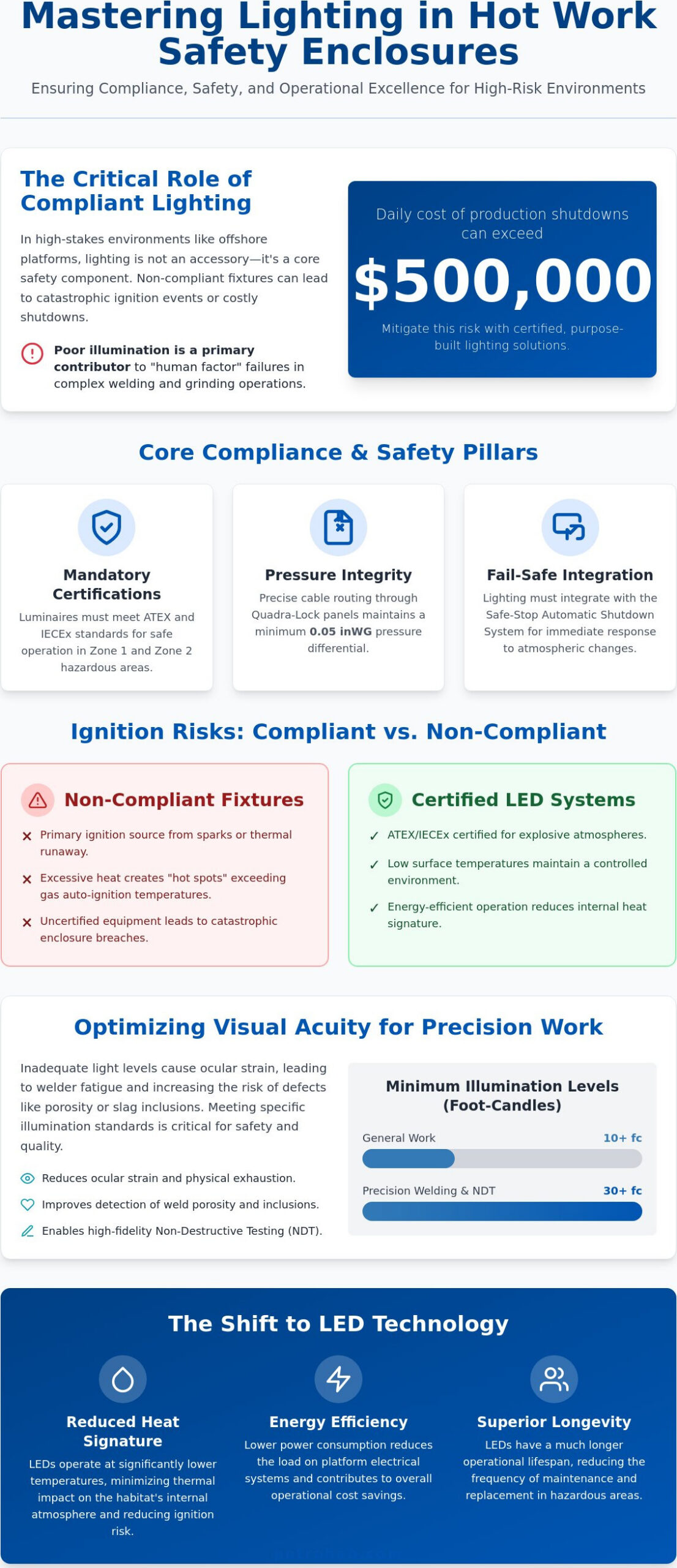
Lighting within a pressurized habitat is not a secondary accessory; it’s a critical safety component that must meet the same atmospheric and thermal integrity standards as the enclosure itself. You recognize that in high-stakes environments like offshore platforms or refineries, even a minor oversight in electrical specifications can lead to catastrophic ignition or production shutdowns costing upwards of $500,000 daily. Mastering the specific lighting requirements for hot work enclosures is essential to mitigate these risks while maintaining peak operational visibility for welding and grinding tasks.
This guide provides the technical expertise needed to ensure 100% compliance with international safety standards, including ATEX, IECEx, and the 2026 National Electrical Code. You’ll learn how to optimize worker visibility without compromising the structural integrity of your PetroHab Hot Work Safety Enclosure (HWSE). We’ll analyze the integration of explosion-proof fixtures, the thermal impact of high-lumen LED systems, and the precise methods for managing cable penetrations through Quadra-Lock panels. By the end of this article, you’ll have a clear roadmap for maintaining a minimum 0.05 inWG pressure differential while providing the illumination levels required for safe, high-precision industrial operations.
Key Takeaways
- Identify mandatory ATEX and IECEx certifications for luminaires to ensure full compliance within Zone 1 and Zone 2 hazardous areas.
- Master the technical lighting requirements for hot work enclosures to maximize visual acuity for high-pressure welding while minimizing thermal output.
- Evaluate the shift toward LED technology to optimize energy efficiency and reduce the internal heat signature of the pressurized habitat.
- Execute precise cable routing through Quadra-Lock panels to maintain a minimum 0.05 inWG pressure differential during hot work operations.
- Integrate habitat lighting with the Safe-Stop Automatic Shutdown System to ensure a fail-safe response to hazardous atmospheric changes.
The Critical Role of Lighting in Hot Work Safety Enclosures
In the high-stakes environment of offshore oil and gas, human error accounts for a significant portion of industrial accidents. Poor illumination directly correlates with these “human factor” failures, particularly when executing complex welding procedures. Standard rig lighting cannot penetrate the opaque, fire-retardant Quadra-Lock panels of a pressurized habitat. This creates an isolated work environment where shadows and high-contrast glare can obscure defects or trip hazards. Adhering to specific lighting requirements for hot work enclosures is not just a regulatory hurdle but a fundamental safety protocol that ensures every weld bead and structural joint is visible under consistent, high-fidelity light.
To better understand this concept, watch this helpful video:
General illumination on a platform is designed for broad movement, not the granular precision required for high-pressure piping. Inside a habitat, shadow zones created by complex structural geometry can hide flammable gas pockets or equipment malfunctions. Reliability in these spaces depends on a dedicated, internal lighting system that provides uniform coverage across the entire floor and workspace. Without a tailored approach to lighting requirements for hot work enclosures, the risk of accidental ignition and sub-standard workmanship increases exponentially.
Visual Acuity and Precision Welding
Precision welding demands exceptional visual acuity to ensure the integrity of the fusion zone. When light levels are inadequate, welders experience increased ocular strain, which leads to physical exhaustion and a higher probability of weld porosity or slag inclusions. Maintaining a minimum of 10 foot-candles for general work and up to 30 foot-candles for precision tasks significantly reduces ocular strain and the subsequent onset of welder fatigue in confined habitats. Secondary task lighting is also mandatory for Non-Destructive Testing (NDT). Inspectors require localized, high-intensity light sources to identify microscopic fissures that general habitat lighting might miss.
Ignition Risks of Non-Compliant Electrical Equipment
Standard industrial lighting fixtures aren’t engineered for the volatile atmospheres found on offshore rigs. In hydrocarbon-rich environments, a single non-compliant housing can serve as a primary ignition source. Traditional lamps generate excessive heat, creating “hot spots” that exceed the auto-ignition temperature of surrounding gases. Within a hot work safety enclosure, every luminaire must adhere to the ATEX directives to prevent sparks or thermal runaway. Historical analysis of electrical failures in confined spaces reveals that using uncertified equipment frequently results in catastrophic enclosure breaches. Reliable safety managers prioritize certified LED systems that maintain low surface temperatures, ensuring the habitat remains a controlled environment even if external gas concentrations fluctuate.
Technical Standards and ATEX/IECEx Requirements for Habitat Lighting
Compliance with international regulations is non-negotiable when operating within pressurized habitats. Lighting equipment used in these environments must carry specific certifications to ensure it doesn’t become an ignition source. For Zone 1 and Zone 2 hazardous areas, luminaires must adhere to ATEX or IECEx standards. These certifications verify that the equipment has undergone rigorous testing to operate safely in explosive atmospheres. Adhering to the specific lighting requirements for hot work enclosures ensures that every electrical component within the habitat meets these stringent global benchmarks for safety and reliability.
The ‘Ex’ marking system provides critical data regarding the protection method, gas group, and temperature class of a luminaire. When selecting lighting for a pressurized enclosure, engineers must decipher these codes to match the equipment to the specific site hazards. Additionally, Ingress Protection (IP) ratings are vital. A minimum rating of IP66 is typically required to prevent the entry of dust and high-pressure water, which is common in offshore environments. Furthermore, all wiring must comply with NFPA 70 (National Electrical Code) and the OSHA hazardous location standards to maintain a unified safety profile across the entire electrical installation.
Understanding Temperature Classes (T-Ratings)
Temperature classes, or T-ratings, define the maximum surface temperature a piece of equipment can reach during operation. For habitats situated near flammable gases, T4 (135°C) or T6 (85°C) classifications are essential. Luminaires designated for hydrocarbon environments must maintain a T-rating of T4 or higher to ensure the surface temperature remains below the auto-ignition threshold of the specific gas group present. It’s critical to remember that the ambient temperature inside the habitat can elevate the luminaire’s surface temperature. Meticulous thermal management is required to prevent the lighting housing from exceeding its rated temperature class during extended hot work shifts.
Intrinsic Safety vs. Explosion-Proof Housing
Two primary protection methods dominate the sector: Intrinsic Safety (Ex i) and Flameproof (Ex d). Intrinsic safety limits the electrical and thermal energy to levels that cannot cause ignition, even under fault conditions. Conversely, explosion-proof housings are designed to contain an internal explosion and prevent it from igniting the surrounding atmosphere. For modular HWSE applications, ‘Ex d’ lighting is frequently preferred due to its durability and higher luminous intensity. These systems should be integrated with an automated disconnection protocol. If the habitat loses pressure, the power to the lighting must be severed immediately to eliminate any potential ignition risk. Many safety professionals choose pressurized welding enclosures that come pre-configured with these compliant, high-performance lighting solutions.
Evaluating Light Sources: Thermal Management and Luminous Intensity
Selecting the appropriate light source is a calculation of both safety and performance. For precision welding and grinding within a pressurized habitat, general illumination is insufficient. To meet the rigorous lighting requirements for hot work enclosures, engineers must specify systems capable of maintaining 500 to 1000 lux at the work surface. This intensity ensures that welders can clearly identify the root pass and weld pool dynamics. High luminous intensity must be balanced with a high Color Rendering Index (CRI) of 80 or above. A superior CRI allows technicians to detect subtle material discolorations or defects that signify structural weaknesses during the fabrication process.
Compliance with the OSHA Lighting Standard 1915.82 is mandatory when working in environments with flammable vapors. This standard dictates the use of explosion-proof, self-contained lights in specific hazardous conditions. Safety managers must ensure that the chosen luminaires provide adequate visibility without introducing new risks. In complex structural habitats, the placement of these lights is as important as their output. Proper positioning eliminates shadows and ensures that every square meter of the floor and work area is visible to personnel and safety monitors alike.
The LED Advantage in HWSE Environments
The industry has shifted decisively from halogen and fluorescent lamps to advanced LED technology. This transition is driven by the need to minimize the internal thermal load of the enclosure. LEDs consume 50% to 75% less energy than traditional metal halide lamps. This efficiency significantly reduces the electrical demand on the Safe-Stop Automatic Shutdown System. Beyond energy savings, LEDs offer a lifespan of approximately 50,000 hours and superior vibration resistance. This durability is vital in offshore and refinery settings where mechanical tremors can cause traditional filaments to fail prematurely. Lower heat emission profiles also mean that the luminaire housing remains cooler to the touch, reducing the risk of accidental burns or localized ignition points.
Thermal Dissipation Strategies
Thermal management is a critical safety variable. Every watt of energy consumed by lighting is converted into heat. This adds to the thermal load within the confined space. Safety managers must calculate this load to ensure the habitat’s internal temperature doesn’t exceed the designated T-rating thresholds. Passive cooling through heavy-duty heat sinks is standard in explosion-proof LED fixtures. Air circulation within the habitat also helps. The continuous flow of pressurized air mitigates luminaire heat build-up by moving warm air away from the source. Monitoring internal habitat temperature is a constant requirement to ensure that the lighting requirements for hot work enclosures are met without compromising safety. It prevents the environment from reaching temperatures that could ignite flammable gases present outside the enclosure. It keeps the workspace safe for personnel.
Operational Best Practices: Installation, Cable Management, and Pressure Integrity
The operational success of a pressurized habitat depends on the seamless integration of electrical systems without compromising the environmental seal. Installing luminaires requires more than simply providing light; it involves a calculated approach to cable management that preserves the internal atmosphere. When addressing lighting requirements for hot work enclosures, safety managers must prioritize the method of entry for power leads. Every cable penetration through the Quadra-Lock panels represents a potential leak path. Specialized pass-through components are required to maintain the mandatory 0.05 inWG pressure differential.
Integrating habitat lighting into the Permit-to-Work (PTW) electrical isolation checklist is a mandatory step for site safety. This ensures that all lighting circuits are verified for integrity and correct T-rating before hot work commences. Emergency lighting protocols must also be established. In the event of a primary power failure, the system must maintain 10% of standard illumination levels. This provides sufficient visibility for personnel to safely stop welding activities and evacuate the enclosure according to established emergency procedures.
Maintaining the Positive Pressure Seal
Preserving the habitat’s integrity requires the use of certified cable glands or modular pass-through systems specifically designed for HWSE applications. These components ensure that the seal remains airtight even as cables are adjusted or replaced. Daily inspection protocols are essential. Technicians must verify the condition of cable insulation and the tightness of all seals at the beginning of every shift. Secondary gas monitoring is also required at electrical entry points. This provides an additional layer of protection, detecting any trace of flammable gas that might migrate along the cable path into the pressurized workspace.
Mounting and Positioning for Maximum Safety
Luminaires must be mechanically secured to the HWSE frame to prevent falling hazards or displacement during high-pressure welding operations. Mounting heights should be optimized to minimize glare for the welder while maximizing floor-level visibility. Strategic placement is critical to eliminate blind spots behind large pipes, vessels, or structural members. If the primary lighting cannot reach a specific area, portable ATEX hand-lamps are utilized for localized inspection tasks. These units must meet the same ‘Ex’ certification standards as the fixed luminaires to ensure site-wide compliance. For those seeking standardized, high-performance habitat components, you can explore our range of Quadra-Lock panels and safety systems to ensure total site protection.
Optimizing Your PetroHab Habitat with Compliant Lighting Solutions
PetroHab provides a cohesive safety ecosystem where every component is engineered to function as a unified barrier against industrial hazards. The modularity of our systems allows safety engineers to address the specific lighting requirements for hot work enclosures regardless of the structural complexity of the site. By utilizing interchangeable components, operators can position illumination exactly where it is needed to ensure precision during critical welding tasks. This adaptability eliminates the reliance on inadequate external rig lights and ensures that the internal workspace remains fully visible and compliant with 2026 technical standards.
A primary advantage of the PetroHab system is the seamless integration of lighting with the Safe-Stop Automatic Shutdown System. Lighting should never be an independent variable in a hazardous environment. If the system detects a loss of positive pressure or the presence of flammable gases, the Safe-Stop immediately severs power to all non-intrinsically safe electrical equipment, including luminaires. This automated response removes potential ignition sources within milliseconds. It provides an uncompromising layer of protection for personnel and high-value assets alike.
Synergy Between Quadra-Lock and Electrical Infrastructure
The structural integrity of Quadra-Lock panels provides a robust foundation for internal electrical infrastructure. Unlike flimsy alternatives, these panels possess the tensile strength to support heavy, explosion-proof LED fixtures without compromising the habitat’s shape or pressure seal. This strength facilitates the rapid deployment of lighting systems during the habitat assembly phase, which is essential for meeting tight turnaround schedules in refineries and offshore platforms. Operators can customize lighting layouts to accommodate complex geometries, such as those found around large spherical vessels or intricate manifold systems. This ensures that the technical lighting requirements for hot work enclosures are met in every corner of the habitat.
The PetroHab Commitment to Total Safety
PetroHab maintains a rigorous commitment to total safety by providing ATEX-certified accessories and on-site technical supervision. Our experts ensure that every luminaire and cable pass-through aligns with international standards like IEC 60079. This meticulous oversight guarantees that the lighting installation does not create thermal “hot spots” or pressure leaks. By closing the loop between illumination, positive pressure maintenance, and gas detection, we create a definitive secure workspace for hot work. This engineered approach minimizes the “human factor” risks discussed earlier and establishes a benchmark for zero-incident operations in the most demanding energy sectors. Reliability is built into every connection, ensuring your site remains protected under all operational conditions.
Securing the Future of Industrial Hot Work
Adhering to the specific lighting requirements for hot work enclosures is a fundamental necessity for maintaining the safety and integrity of offshore and refinery operations. We’ve established that the synergy between high-fidelity LED illumination and rigorous atmospheric control is essential for preventing catastrophic ignition and ensuring weld precision. By utilizing patented Quadra-Lock technology, you achieve a level of structural reliability that standard enclosures cannot match. This technical precision ensures that your habitat remains a secure environment even in the most volatile conditions.
Total site protection is reached through global compliance with ATEX and IECEx standards, combined with the Safe-Stop system for automated ignition source control. These engineered safeguards transform a hazardous workspace into a controlled environment where precision and protection coexist. Don’t compromise on the safety of your personnel or the value of your high-priority assets. Reliability is built into every component of our pressurized habitats.
Ensure your next project is compliant; request a quote for a PetroHab HWSE system today.
Invest in the technical excellence and uncompromising safety standards that your operations demand.
Frequently Asked Questions
What is the minimum lux level required for welding inside a hot work safety enclosure?
Precision welding tasks require a minimum illumination level of 500 to 1000 lux at the work surface to ensure visual acuity. While general construction areas may operate at lower levels, the confined nature of a habitat necessitates higher intensity to eliminate shadows and identify material defects. Adhering to these lighting requirements for hot work enclosures ensures that technicians maintain peak performance without experiencing ocular fatigue during extended shifts.
Can I use standard industrial LED lights if the habitat is pressurized?
Standard industrial LEDs are strictly prohibited unless they carry specific ATEX or IECEx certifications for the designated hazardous zone. Even within a pressurized enclosure, the risk of external gas ingress during a pressure loss event remains a critical safety concern. All luminaires must be explosion-proof or intrinsically safe to prevent them from becoming an ignition source if the primary containment system fails.
How do lighting cables affect the positive pressure seal of the habitat?
Lighting cables represent potential leak paths that can compromise the mandatory 0.05 inWG pressure differential required for hot work. To mitigate this risk, cables must pass through Quadra-Lock panels using certified, airtight glands or modular pass-through systems. Regular inspections of these entry points are essential to ensure the environmental seal remains intact and that no flammable gas migrates along the cable path.
Are there specific ATEX categories for lighting used in pressurized welding habitats?
Lighting equipment must typically meet Category 2 or Category 3 requirements, which correspond to Zone 1 or Zone 2 hazardous areas respectively. The ‘Ex d’ (flameproof) or ‘Ex i’ (intrinsically safe) protection methods are the industry standards for these applications. These categories ensure the equipment is specifically engineered to operate safely in environments where flammable gases or vapors are likely to occur.
How does the heat generated by lighting affect the interior temperature of an HWSE?
Every luminaire contributes to the total thermal load within the confined space of an HWSE. High-wattage lighting can significantly elevate the internal temperature, potentially exceeding the equipment’s T-rating or creating an unsafe environment for personnel. Utilizing LED systems reduces this thermal impact, but safety managers must still calculate total heat dissipation to maintain a stable and compliant internal atmosphere during hot work.
What are the emergency lighting requirements for an offshore welding habitat?
Emergency systems must provide a minimum of 1 foot-candle at floor level or 10% of standard illumination during a primary power failure. These systems are required to operate for at least 90 minutes to facilitate safe equipment shutdown and personnel evacuation. This backup lighting is a critical safety redundancy that ensures workers aren’t left in total darkness during a catastrophic rig power loss.
Is a T4 temperature rating sufficient for lighting in a refinery environment?
A T4 rating, which limits the maximum surface temperature to 135°C, is generally sufficient for most hydrocarbon-rich refinery environments. However, safety engineers must verify this against the auto-ignition temperature of the specific gases present on-site. If gases with lower ignition points are present, a more restrictive T6 rating is required to eliminate the risk of thermal ignition from the luminaire housing.
How does the PetroHab Safe-Stop system interact with the interior lighting?
The Safe-Stop Automatic Shutdown System acts as the primary electrical gatekeeper by immediately severing power to all non-intrinsically safe lighting upon detecting a safety breach. If the system identifies a loss of pressure or the presence of flammable gas, it eliminates the lighting as a potential ignition source within milliseconds. This integration ensures that lighting requirements for hot work enclosures are supported by a definitive, fail-safe mechanism.