Blog Posts
LNG Turnaround Habitat Planning: A Practical Step-by-Step Guide
What if a habitat plan is already out of step before worksite preparation begins? During an LNG turnaround, scope changes, access constraints, and operational interfaces can quickly affect enclosure requirements. Effective LNG turnaround habitat planning brings these factors together early, before assumptions become schedule or readiness issues.
That coordination takes more than identifying where hot work will occur. Safety, engineering, maintenance, operations, and contractor teams may each hold different parts of the planning basis. Bringing those details together helps reveal interface questions and information gaps while there is still time to address them.
This guide shows how to build a documented, project-specific habitat plan that reflects the work scope and site conditions. It covers gathering scope and layout information, identifying operational and safety interfaces, defining enclosure requirements, and carrying agreed actions into schedule coordination and readiness reviews. The result is a practical basis for planning habitat deployment alongside the wider turnaround sequence.
Key Takeaways
- Start LNG turnaround habitat planning with the work scope and location so enclosure requirements reflect actual tasks and site conditions.
- Document what is confirmed, what is assumed, what remains open, and which items require review by the responsible project parties.
- Map habitat interfaces to work-package sequencing, site procedures, and concurrent activities. Record an owner and required evidence for each action.
- Carry agreed habitat actions into the turnaround schedule and readiness reviews, with clear ownership and completion evidence.
- Use project-specific requirements to guide review of PetroHab habitat and monitoring-system configurations.
Why LNG turnaround habitat planning must start with the work scope
A habitat requirement begins with the work to be done, not with a standard enclosure arrangement. Habitat planning is the documented process of matching enclosure needs to project-specific work conditions, site constraints, operating interfaces, and readiness requirements. In LNG turnaround habitat planning, first establish the task and work location, then record conditions that could affect enclosure selection, access, installation, and coordination.
Location matters because work packages at the same facility can involve different work positions, access routes, nearby equipment, and operational interfaces. Start with a defined scope tied to drawings, work-package information, and current site knowledge. Mark unresolved details for review rather than treating them as settled. For context on LNG production, storage, and transportation, see the Liquefied Natural Gas (LNG) Overview.
Planning an enclosure is not authorization to perform hot work. It documents proposed work conditions and enclosure requirements to support project coordination. The responsible project parties still determine whether a task is authorized under applicable site procedures and requirements.
Which turnaround work details should trigger habitat planning?
Start habitat planning when a work package identifies hot work in a defined location, especially if access, nearby equipment, or concurrent activities could affect enclosure arrangements. Capture the information in a record that links the task to its physical worksite and anticipated sequence.
- Task and position: Describe the hot-work activity and intended work position.
- Movement: Record access routes, egress, and the expected work sequence.
- Surroundings: Note nearby equipment, physical constraints, and concurrent activities relevant to the task.
- Input ownership: Identify the maintenance, engineering, operations, or safety representative responsible for each input and open question.
Assigning input owners keeps assumptions visible. For example, a work position may be shown in a package while another project function holds information about access restrictions or activity conflicts. Record each input’s source and review status instead of treating incomplete information as confirmed.
Why a generic habitat plan may not fit an LNG worksite
A generic plan can miss the differences that determine whether an enclosure arrangement fits a particular work package. Scope, work position, access, nearby equipment, and operating interfaces can vary by location. A hot work safety enclosure guide can provide broader context, but project requirements must reflect the actual task and worksite.
Hypothetical example: One turnaround package might require hot work at an elevated position beside equipment, while another places the task at ground level near a shared access route. These are illustrative assumptions, not claims about a specific LNG facility. Document each work position, access and egress, sequence, nearby equipment, and concurrent activities separately. Assign unresolved site questions to the responsible project parties before carrying the enclosure plan into preparation and readiness reviews.
Build an LNG turnaround habitat planning basis from project data
A useful planning basis turns work-package information into requirements that technical and safety reviewers can assess. It shows what is known, what remains an assumption, and what needs review by the responsible project parties. This keeps missing or changing inputs visible instead of allowing them to become hidden planning decisions.
Capture work-package and worksite information
Start with approved project information for the task, then compare it with the worksite. Record the work type, task boundaries, location, planned sequence, and expected duration. Use project-approved drawings and site information to map the proposed work position, enclosure footprint, access and egress routes, adjacent equipment, and physical constraints. Note the source and revision of each key input so reviewers can trace the planning basis.
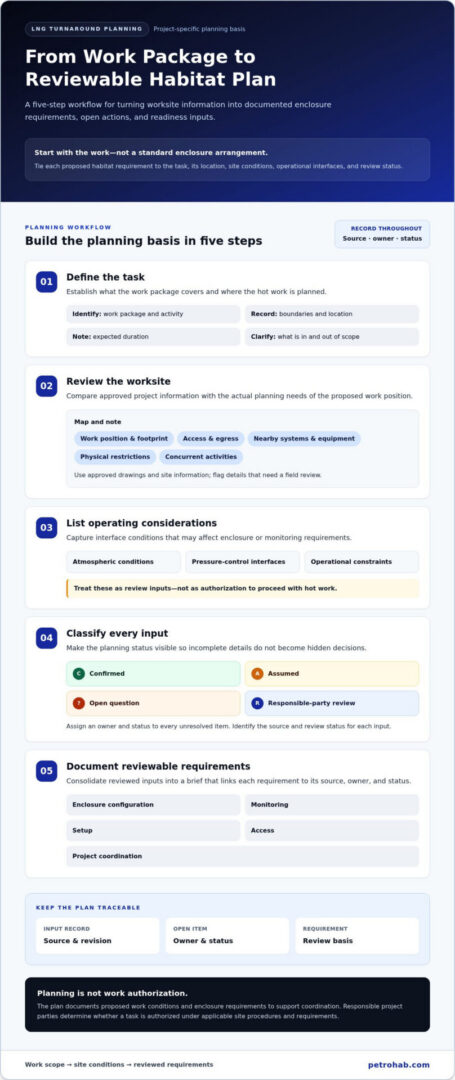
- Define the task. Identify the work package, hot-work activity, boundaries, location, and expected duration. Record what is included and what falls outside the package.
- Review the worksite. Capture the work position and footprint, access and egress, nearby systems, physical restrictions, and relevant concurrent activities. Use approved project information and flag details that need a field review.
- List operating considerations. Identify atmospheric conditions, pressure-control interfaces, and operational constraints that may affect enclosure or monitoring requirements. Record these as review inputs, not as authorization to proceed.
- Classify the information. Mark each entry as confirmed, assumed, an open question, or requiring responsible-party review. Assign an owner and status to every unresolved item.
- Document the requirements. Consolidate reviewed inputs into a brief that links each requirement to its source, owner, and status.
Turn collected information into reviewable requirements
Organize the brief so reviewers can find decisions quickly. Group requirements under enclosure configuration, monitoring, setup, access, and project coordination. A background reference on pressurized welding habitat technology can help explain habitat-system concepts; the project brief defines the conditions to assess for the specific work package.
- Confirmed: Information supported by current project-approved documents or an agreed site review.
- Assumption: A provisional planning basis, clearly marked for validation.
- Open question: Missing information with a named owner and a required resolution point.
- Responsible-party review: An item requiring input or acceptance from the relevant project function.
The written brief gives maintenance, engineering, operations, and safety reviewers one shared reference. It also gives schedule coordinators a traceable set of requirements and unresolved actions to carry forward. For LNG turnaround habitat planning, clearly separating confirmed data from pending review helps keep the planning basis aligned as project information develops. Review PetroHab habitat systems against that documented project basis at PetroHab’s habitat systems.
Coordinate habitat interfaces with LNG turnaround operations
A habitat is one part of a turnaround work package. Its planned position and setup can affect access, work sequencing, nearby activities, and coordination with operations. Equipment planning alone does not resolve those interfaces. The project team also needs to identify dependencies, assign owners, and record the procedures and decisions that govern the worksite.
Build the interface review around the work package. Identify how habitat setup relates to operations, maintenance, engineering, safety, and contractor scopes. For each interface, record the planning question, responsible role, and evidence or record that captures the agreed outcome. This makes it easier to expose conflicts before they affect preparation or execution.
Map operational and contractor interfaces
Review dependencies that could affect access, sequence, setup, or worksite readiness. A nearby activity, for example, may share an access route or rely on the same work area. Record the dependency and route it to the project function responsible for resolving it. Leave site-specific approvals, operating decisions, applicable procedures, and work authorization with the responsible project authorities.
Operations interface
Planning question: Which operating activities or site procedures intersect with the proposed work and setup?
Responsible role: Operations representative.
Required record: Applicable procedure reference and documented operational decisions.
Maintenance and contractor interface
Planning question: Do work-package sequence, access, or adjacent tasks create dependencies or conflicts?
Responsible role: Maintenance planner and relevant contractor leads.
Required record: Work-package sequence and recorded coordination actions.
Engineering interface
Planning question: Do equipment layout or physical constraints affect the planned habitat position or setup?
Responsible role: Engineering representative.
Required record: Project-approved layout information and reviewed constraints.
Safety interface
Planning question: Which project safety requirements and review inputs apply to the planned arrangement?
Responsible role: Safety representative.
Required record: Review comments and applicable site requirement references.
Plan monitoring and shutdown-system interfaces
Record project requirements for differential-pressure and gas-level monitoring, including the responsible reviewer and how those requirements connect to site procedures. PetroHab’s Safe-Stop Safety Shutdown System (SSS) monitors differential pressure and gas levels and provides immediate shutdown in unsafe conditions. The automatic shutdown systems are ATEX- and IECEx-certified (IEC 60079-13). Optional oxygen and/or carbon-dioxide detectors are available. These product features inform technical review; they do not establish site acceptance criteria or authorize work.
Close each interface with a named owner, status, and required record. If a decision remains open, keep it visible in the coordination log and identify the project authority responsible for resolution. This makes LNG turnaround habitat planning part of operational coordination, not just equipment selection, while preserving the project’s authority over procedures and work authorization.
Convert the habitat plan into turnaround schedule and readiness actions
A documented habitat requirement becomes operationally useful when it enters the same schedule and work controls as the task it supports. Link every action to a work package, an accountable role, and completion evidence. This handoff helps planners coordinate equipment planning with access preparation, assembly planning, relevant site reviews, and pre-work readiness without assuming lead times or setup durations.
Place habitat actions into the turnaround sequence
Use the sequence below to move requirements into the schedule. The accountable role should match the project’s established responsibilities. If an input is unresolved, retain it as an open action with an owner and status. Do not turn an assumption into an approved requirement simply to close a schedule line.
- Review requirements: Link the reviewed habitat basis to the work package. The work-package owner records the review status and outstanding inputs.
- Coordinate equipment planning: Connect enclosure and monitoring-system planning to the relevant package and assign an accountable coordinator. Record the configuration review or decision as completion evidence.
- Prepare access: Add access-route and worksite-preparation actions to the sequence. Assign the responsible site or work-package role and retain the applicable review record.
- Plan assembly: Identify assembly planning as a work-package dependency. Assign the responsible role and record the agreed assembly plan without inserting an unsupported duration.
- Complete pre-work review: Schedule the required readiness review against the package. Record review completion and any actions that remain open.
Use readiness reviews to confirm the planning handoff
Before execution, compare the work scope with current site conditions, interfaces, responsibilities, and the planned sequence. Confirm that required reviews are documented and unresolved items remain assigned rather than disappearing from the coordination log. Information about advanced hot work safety systems can also help explain how system planning connects to the wider work package.
Readiness is a review of the planning basis, not a substitute for site authorization. Responsible project parties determine applicable procedures and work authorization. If scope, work position, access, nearby conditions, or concurrent activities change, route the change to the responsible project reviewers and revisit affected requirements before relying on the previous basis.
- Work-package owner: Confirms the task scope and sequence remain current.
- Site and operations representatives: Review relevant access, operating interfaces, and applicable procedures.
- Technical and safety reviewers: Review changes that affect enclosure, monitoring, or safety requirements.
Keep evidence practical: a reviewed work package, recorded access preparation, documented assembly planning, and completed review actions. This gives LNG turnaround habitat planning a traceable path from requirements to readiness. For an overview of PetroHab habitat systems, review the available habitat systems.
Apply project-specific LNG turnaround plans to PetroHab habitat systems
A documented planning basis gives the project team a practical starting point for reviewing an enclosure and monitoring-system configuration. It connects the task, work position, access conditions, operating interfaces, and readiness requirements to the capabilities being assessed. This keeps equipment review anchored to the actual work package rather than a generic assumption about the site.
PetroHab’s main product is the Petro-Habitat™ Hot Work Safety Enclosure (HWSE), also called a pressurized welding enclosure or habitat. The product range also includes the Petro-Shield™ and Petro-Lite™ Hot Work Safety Enclosures. PetroHab habitats are modular, portable, fire-retardant, and designed for pressurized operation. These characteristics inform technical review, but do not determine the right configuration by themselves. Review the documented footprint, access, work position, and project requirements together, then record how the proposed enclosure arrangement relates to them.
Relate documented requirements to confirmed habitat capabilities
All PetroHab habitats use patented Quadra-Lock® panel interlocking technology, U.S. Patent Nos. 9,545,775 and 9,517,609. Panels are made from U.S.-made premium silver/gray silicone-coated fiberglass cloth, ANSI/FM 4950 certified, and can withstand continuous temperatures of 1,000 °F (over 500 °C). These are product attributes for technical consideration, not a substitute for assessing project conditions or site requirements.
Use the planning brief to structure the review. Match the documented work position and footprint to the proposed enclosure arrangement, then consider access and setup needs alongside monitoring requirements. For example, the Petro-Habitat™ has full-featured, interchangeable panels, pneumatic air supply, window panels, and intrusion/protrusion panels. The Petro-Shield™ is mobile and modular, expanding in 4-foot increments; an optional air conditioner or heater can be attached. The Petro-Lite™ has a simple modular design, can be set up by no more than two people in 5 minutes, and attaches to standard scaffolding. Optional stand-alone scaffolding is available for the Petro-Lite™ when standard scaffolding is not present.
Record the configuration reviewed, the project inputs used, and any remaining questions for the responsible project reviewers. This creates a traceable connection between the work package and habitat assessment without treating product specifications as approval to perform the task.
Carry safety and support requirements into the project discussion
PetroHab’s Safe-Stop Safety Shutdown System (SSS) monitors differential pressure and gas levels and provides immediate shutdown in unsafe conditions. The automatic shutdown systems are ATEX- and IECEx-certified (IEC 60079-13). Include the project’s monitoring requirements and associated review questions in the planning discussion. Optional oxygen and/or carbon-dioxide detectors are available for the automatic shutdown system; include them only when they align with documented project requirements.
Keep equipment assessment distinct from site authorization. The responsible project parties determine applicable operating procedures, site requirements, and work authorization. A habitat configuration review does not replace those decisions or the project’s established review process.
PetroHab offers habitat systems for lease or sale, along with training and certification programs for habitat and shutdown-system assembly, disassembly, and maintenance. Include relevant support and training needs in the project discussion so they can be considered alongside the planned work sequence and readiness activities.
Use LNG turnaround habitat planning to bring scope, site conditions, interfaces, and system requirements into one project-specific review. To discuss habitat planning for a turnaround work package, talk with PetroHab about your project requirements.
Carry the planning basis forward into execution
A habitat plan should remain a working project reference as turnaround details develop. If scope, access, or worksite conditions change, route the update through the responsible project review process before relying on the previous planning basis. This keeps technical decisions connected to current work conditions and helps teams carry clear actions into preparation.
Use LNG turnaround habitat planning to establish that connection early, then keep ownership and review status visible as the work package advances. PetroHab reports well over a million incident-free man-hours, reflecting its safety record in industrial habitat systems. Project-specific procedures and work authorization remain with the responsible project parties.
For a habitat planning discussion grounded in your project requirements, discuss LNG turnaround habitat planning with PetroHab. A clear planning basis gives your team a stronger foundation for coordinated turnaround preparation.
Frequently Asked Questions
What information should an LNG turnaround habitat plan include?
Include enough task and site information for reviewers to understand the proposed arrangement and its dependencies. Alongside the work package and location, record the planned work position, enclosure footprint, access and egress, adjacent systems, relevant operating considerations, and concurrent activities. Add document references or drawing revisions, identify information owners, and mark unresolved points for review. This creates a traceable basis for later decisions.
When should habitat planning begin for an LNG turnaround?
Begin during work-package development, as soon as the task and proposed location are defined well enough to identify potential enclosure needs. Early review gives the planning team time to surface access conflicts, missing site information, and coordination dependencies before mobilization arrangements are fixed. Continue updating the plan as approved work details develop. If the task location or sequence is provisional, label it as such rather than treating it as settled.
Who should contribute to LNG turnaround habitat planning?
Include the project roles that hold relevant work-scope, site, technical, operational, and safety information. Maintenance can clarify task boundaries and sequencing; engineering can provide layout information; operations can identify operating interfaces; and safety can direct applicable review inputs. Contractor representatives can contribute details about their work scope and planned access. Assign an owner to each input so questions reach the right project authority.
How does habitat planning account for simultaneous operations?
Compare the habitat work package with other activities planned in or near the affected area. Look for dependencies such as shared access, overlapping work locations, sequence conflicts, or setup needs that may affect another package. Record the activity, potential interface, responsible coordinator, and resolution status in the project coordination process. The relevant project authorities determine how concurrent work is managed under site procedures.
What is the role of pressure and gas monitoring in a habitat plan?
The plan should capture project requirements for differential-pressure and gas-level monitoring so reviewers can assess the relevant system configuration and operating interfaces. Identify who reviews those requirements and where applicable site criteria are documented. The Safe-Stop Safety Shutdown System monitors differential pressure and gas levels and provides immediate shutdown in unsafe conditions. Monitoring equipment supports the project’s safety controls, but does not define acceptable site conditions or grant permission to work. Responsible project parties establish applicable procedures and authorization.
Can a habitat plan be reused for every LNG turnaround work package?
Use a common template if it helps standardize records, but do not assume one package’s site assessment applies to another. Work position, access, nearby systems, operating interfaces, and concurrent activities can differ even within the same facility. For each package, verify that its inputs and requirements reflect the current scope and location. Treat copied information as a starting point for project-specific review.
How should habitat requirements be handled when the work scope changes?
Reopen the planning basis when a scope change could affect the work position, enclosure arrangement, access, sequence, monitoring needs, or operating interfaces. Record what changed, identify the affected requirements, and route them to the appropriate project reviewers. Update linked work-package and readiness records so teams do not rely on superseded information. LNG turnaround habitat planning should track the current approved task, not an earlier planning assumption.