Blog Posts
Preventing Welding Fires on Oil Rigs: Advanced Containment and Detection Strategies
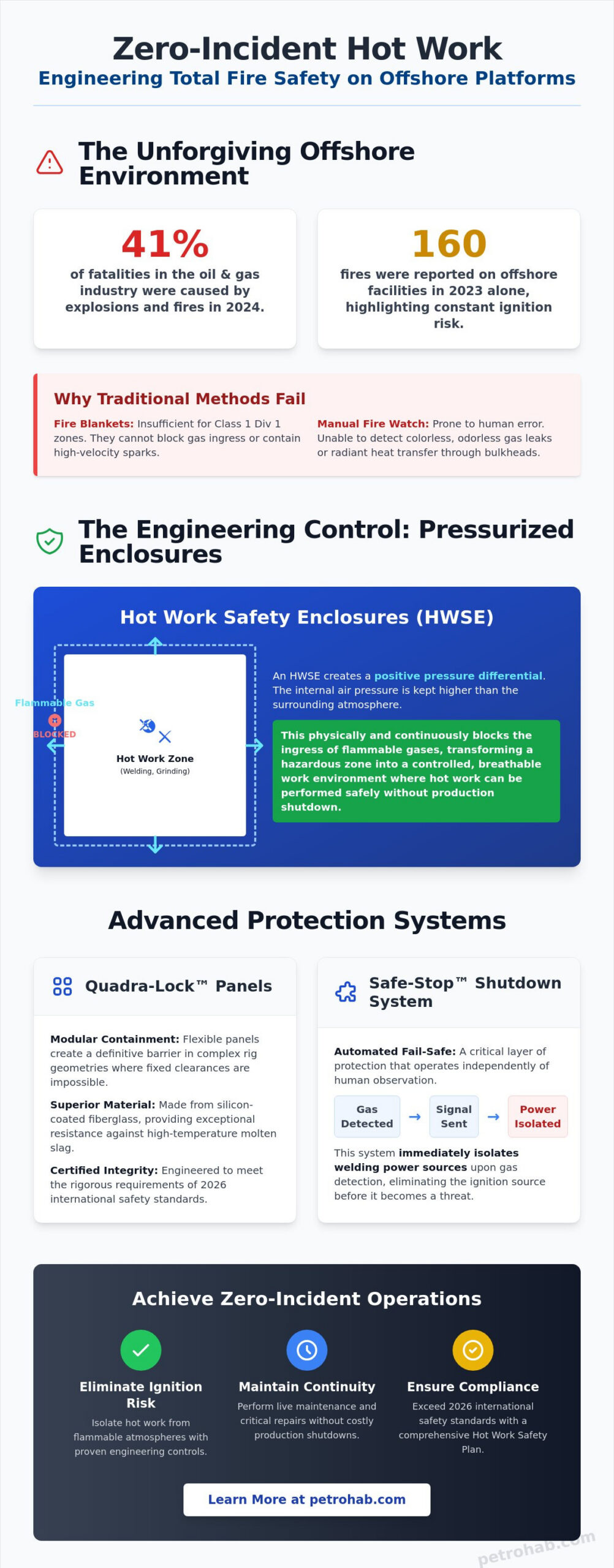
Explosions and fires accounted for 41% of fatalities in the oil and gas industry in 2024. With the Bureau of Safety and Environmental Enforcement reporting 160 fires on offshore facilities in 2023, the necessity of preventing welding fires on oil rigs has never been more urgent. You understand that production downtime is a significant financial burden, yet the risk of gas ignition in Class 1 Div 1 environments is a reality that demands absolute precision. It’s a difficult balance when complex rig geometries complicate standard safety measures.
We’re here to provide the technical protocols and hardware solutions required to eliminate ignition risks and ensure total fire safety during offshore hot work. This article examines the active protection provided by pressurized Hot Work Safety Enclosures and the Safe-Stop automatic shutdown system. We’ll also explain how the engineering behind Quadra-Lock panels meets the rigorous requirements of the latest 2026 international safety standards. You’ll discover how to maintain operational continuity and achieve zero-incident results through advanced containment and detection strategies.
Key Takeaways
- Analyze why the unique volatility of offshore environments requires specific engineering controls for preventing welding fires on oil rigs.
- Identify how pressurized Hot Work Safety Enclosures (HWSE) maintain a positive pressure differential to physically block the ingress of flammable gases.
- Evaluate the technical advantages of modular Quadra-Lock Panels and silicon-coated fiberglass in providing superior resistance against high-temperature molten slag.
- Discover how the Safe-Stop Automatic Shutdown System provides an automated fail-safe by immediately isolating welding power sources upon gas detection.
- Understand the procedural requirements for a site-specific Hot Work Safety Plan to ensure compliance with 2026 international safety standards.
The High-Stakes Risks of Hot Work in Hazardous Offshore Zones
Offshore platforms function as dense, high-pressure chemical processors where the margin for error is non-existent. Unlike onshore facilities, the proximity of process equipment to maintenance zones creates a compressed Fire Triangle. Fuel sources are abundant, and oxygen is constant. Successfully preventing welding fires on oil rigs requires a departure from basic safety protocols toward rigorous engineering controls. Every ignition source must be isolated with technical precision to protect the lives of personnel and the integrity of the asset.
Sparks and molten slag are the most visible threats, but radiant heat and invisible vapors are often more dangerous. Molten slag can travel through deck gratings, carrying enough thermal mass to ignite hydrocarbons several levels below the work area. Even more critical is the risk of a Vapor Cloud Explosion (VCE). A single ignition of a gas pocket can lead to a chain reaction that compromises the entire platform structure. Effective strategies for preventing welding fires on oil rigs must account for these multi-dimensional risks.
To better understand the intensity of these environments and the mechanics of offshore hot work, watch this helpful video:
Identifying Ignition Sources and Combustible Vapor Risks
Standard fire blankets are insufficient for Class 1 Division 1 environments. They lack the structural integrity to block gas ingress and often fail to contain high-velocity sparks. Fugitive emissions from valves and flanges create a landscape of unpredictable fire hazards that blankets cannot mitigate. While Hot work safety standards suggest a 35-foot clearance, the complex architecture of a rig makes this rule difficult to enforce. Modular containment using Quadra-Lock panels is required to create a definitive barrier in these tight spaces.
Why Traditional Fire Protection Fails in High-Pressure Environments
Manual fire watches are prone to human error and cannot detect colorless, odorless gas leaks without constant instrument assistance. In high-pressure environments, radiant heat can transfer through steel bulkheads, creating ignition points in adjacent compartments where no one is watching. Environmental factors like high offshore winds also shift spark trajectories and gas accumulation patterns. These variables demand a solution that doesn’t rely on human observation alone but uses automated detection and physical pressure barriers to maintain control.
Engineering a Controlled Environment: The Role of Pressurized Welding Habitats
A Hot Work Safety Enclosure (HWSE) serves as the primary engineering control for preventing welding fires on oil rigs. It’s more than a physical barrier; it’s a dynamic pressure system designed to isolate ignition sources from hazardous atmospheres. By utilizing pressurized welding habitats, operators can perform live maintenance without shutting down production. This technology is a cornerstone of a modern Permit-to-Work (PTW) system, ensuring that every hot work task is met with a definitive technological remedy. It transforms a high-risk zone into a controlled environment where safety is measurable and constant.
The system operates on the principle of a positive pressure differential. By maintaining internal pressure higher than the surrounding atmosphere, the enclosure creates a physical barrier that prevents the ingress of flammable gases. This is a critical distinction from passive protection like fire blankets, which offer no defense against gas migration. Adherence to OSHA hot work regulations requires such rigorous isolation when working in proximity to combustible materials. To ensure this level of protection, you can explore our range of pressurized welding enclosures designed for extreme offshore conditions.
Continuous airflow is non-negotiable for both containment and personnel health. High-capacity blowers draw air from a certified gas-free intake, providing the pressure required for containment and the ventilation needed for welder safety. This constant exchange dissipates heat and removes hazardous welding fumes, preventing the accumulation of toxic particulates within the workspace. It’s a calculated approach to risk mitigation that protects both the asset and the individual.
How Positive Pressure Prevents Ingress of Flammable Gases
Precision monitoring is essential for maintaining a controlled environment. Digital manometers provide real-time data on the pressure differential between the habitat and the external rig environment. Safety protocols typically require a minimum pressure of 0.05 inches of water column (12.5 Pa) to ensure a reliable barrier. Calculating the required air exchange rates depends on the habitat volume, but a standard target is at least 20 air changes per hour. This constant throughput ensures that even if a seal is momentarily compromised, the outward flow of air physically rejects any external gas ingress.
Maintaining HWSE Integrity During Prolonged Maintenance
Maintaining the integrity of the habitat is a continuous operational duty. Rig environments are characterized by high vibration and corrosive salt spray, which can stress modular components. Personnel must use specialized airlock entry systems to enter and exit the habitat without losing internal pressure. If the system detects a drop in pressure, visual and audible alarm protocols immediately alert the welding team and safety supervisors. These fail-safes ensure that hot work only continues when the environment is fully isolated and secure.
Material Integrity and Modular Containment: The Quadra-Lock Advantage
Habitat technology has evolved from rudimentary heavy tarps to sophisticated, modular systems designed for the rigors of offshore life. Early containment methods relied on cumbersome materials that were difficult to seal around the dense infrastructure of a platform. Modern strategies for preventing welding fires on oil rigs now utilize the Quadra-Lock system, which provides a high-integrity interlocking panel design. This modularity allows safety engineers to construct a hot work safety enclosure around existing pipes, beams, and valves with surgical precision. It’s an engineering solution that prioritizes both flexibility and absolute containment.
The science of the materials used is just as critical as the architecture of the enclosure. Silicon-coated fiberglass represents the current industry benchmark for habitat fabric, offering superior resistance to high-velocity sparks and concentrated molten slag. In the corrosive maritime climates of offshore platforms, durability is a primary concern. These specialized fabrics resist salt-air degradation and UV exposure, ensuring the enclosure remains a reliable barrier throughout prolonged maintenance cycles. By using materials that won’t degrade under environmental stress, operators maintain a consistent level of protection against ignition risks.
Specialized Fabrics and Fire-Resistant Panel Engineering
Offshore testing standards for fire-retardant materials are rigorous, requiring fabrics to maintain their properties under extreme thermal stress. Quadra-Lock panels utilize a proprietary interlocking mechanism that eliminates the gaps and leak paths inherent in traditional Velcro or zipper closures. PetroHab’s Quadra-Lock panels are engineered to maintain their physical integrity and fire-resistant properties at continuous temperatures up to 1,000°F (538°C). This high thermal threshold ensures that even high-amperage welding tasks don’t compromise the pressurized environment or the safety of the surrounding facility.
Modular Deployment: Adapting to Complex Rig Geometry
Rig geometries are rarely uniform, often requiring enclosures to fit into “impossible” locations where space is at a premium. The lightweight nature of modular panels improves safety during setup, reducing the physical strain on technicians and the time spent in hazardous zones. Achieving a gas-tight seal at the intersection of panels and rig structures is critical for maintaining the positive pressure discussed in previous sections. The Quadra-Lock system’s versatility allows for a customized fit around irregular obstructions, ensuring that the internal atmosphere remains completely isolated from external combustible vapors.
Automating Fire Prevention: Integrating Gas Detection and Shutdown Systems
Manual gas monitoring is a legacy safety protocol that introduces unacceptable levels of human risk. For preventing welding fires on oil rigs, the industry has shifted toward integrated hot work safety systems that remove the burden of detection from personnel. These systems provide a continuous, electronic vigil over the work area, identifying hazardous gas concentrations long before they reach an explosive threshold. By automating the response to a threat, operators ensure that protection is instantaneous and absolute. It’s a shift from passive observation to active, technological guardianship.
The Safe-Stop Automatic Shutdown System serves as the central intelligence of the habitat. It doesn’t just alert the crew; it takes definitive action by cutting power to the welding equipment. This immediate isolation of the ignition source is the most effective method for preventing welding fires on oil rigs when a gas leak occurs. The system uses fail-safe logic, meaning any loss of signal or hardware malfunction also triggers a shutdown. This ensures the site remains protected even if the monitoring hardware itself is compromised, maintaining a stoic defense against unpredictable hazards.
The Safe-Stop Mechanism: Real-Time Monitoring and Response
When sensors detect a gas concentration exceeding a pre-set limit, typically 10% of the Lower Explosive Limit (LEL), the Safe-Stop system engages. It terminates power to the welding machines within milliseconds, effectively removing the heat element of the fire triangle. Simultaneously, it can interface with the rig-wide emergency shutdown (ESD) systems to provide a coordinated response across the entire platform. This multi-gas detection capability monitors for LEL, Hydrogen Sulfide (H2S), and Oxygen levels, providing a comprehensive safety profile of the internal and external atmospheres without the delays inherent in manual reporting.
Compliance with ATEX and IECEx Standards for Offshore Safety
Adherence to hazardous environment standards is mandatory for any equipment operating in Zone 1 or Zone 2 atmospheres. These international certifications, such as ATEX and IECEx, verify that the gas detection hardware is explosion-proof and won’t itself become an ignition source. Third-party certification provides the necessary assurance that the system will perform under the extreme pressures and corrosive conditions of an offshore environment. It’s a critical anchor for quality and compliance in heavy industry. You can secure your operations and ensure total reliability by integrating the Safe-Stop Automatic Shutdown System into your next maintenance cycle.
Strategic Implementation: Transitioning to Zero-Incident Hot Work Operations
Zero-incident hot work operations are only achievable when advanced hardware is integrated into a rigorous organizational strategy. Developing a site-specific Hot Work Safety Plan is the final step in preventing welding fires on oil rigs. This plan must move beyond generic safety checklists to address the specific spatial constraints and gas migration risks of the offshore asset. By establishing clear protocols for the use of PetroHab Hot Work Safety Enclosures, operators can safely perform live-welding on active platforms, effectively eliminating the high cost of production downtime during essential maintenance. Precision in planning is just as critical as the integrity of the enclosure itself.
Optimizing rig turnarounds requires a shift toward proactive risk management. When safety managers deploy pressurized habitats as a standard engineering control, they create a predictable environment for complex repairs. This systematic approach ensures that every ignition source is isolated and every hazardous vapor is monitored by the Safe-Stop Automatic Shutdown System. The goal is to create a culture of safety excellence where preventing welding fires on oil rigs is a measurable outcome of superior engineering and disciplined execution. This disciplined framework allows for the protection of high-value assets and the personnel who maintain them.
Training and Supervision: The Human Element of Habitat Safety
The effectiveness of an HWSE is dependent on the competence of the personnel managing it. Certified technicians must possess a granular understanding of pressure differentials, gas detection calibration, and modular assembly. Pre-work briefings are mandatory to align the welding team with safety supervisors, ensuring everyone understands the emergency shutdown triggers. Regular drills are required to maintain readiness for habitat-related emergencies, such as sudden pressure loss or the detection of fugitive emissions. These competencies ensure that the human element of the safety equation remains as resilient as the hardware.
Procurement and Deployment: Rental vs. Purchase for Rig Turnarounds
Safety managers must evaluate the logistics of their maintenance schedules to determine the most cost-effective procurement strategy. Leasing PetroHab habitats is often the preferred choice for short-term maintenance projects or specific rig turnarounds where modularity and rapid deployment are prioritized. Conversely, direct purchase of Quadra-Lock Panels and Safe-Stop systems makes sense for long-term facility integrity management, providing on-site availability for emergency repairs. Global support networks are essential for ensuring equipment availability in remote offshore basins, allowing for the consistent application of safety standards regardless of geographic location. Whether through rental or ownership, the commitment to safety remains uncompromising.
Advancing Offshore Safety Through Technical Precision
The transition from passive fire protection to active, pressurized containment is the only reliable method for preventing welding fires on oil rigs. By integrating the PetroHab Hot Work Safety Enclosure with the Safe-Stop Automatic Shutdown System, you replace human fallibility with a definitive technological remedy. These systems ensure that molten slag is contained and flammable gas ingress is physically blocked through constant positive pressure. You’ve seen how modularity and automated detection work together to protect high-value assets without sacrificing operational continuity or risking catastrophic ignition.
Our commitment to safety is backed by patented Quadra-Lock technology and ATEX and IECEx certified components. We provide global deployment capability with on-site supervision to ensure your maintenance projects meet the most rigorous international standards. It’s time to secure your facility with engineering that’s as resilient as your operations. Request a technical consultation for your next offshore project to discuss how we can partner in achieving zero-incident hot work. Your team’s safety and your platform’s integrity remain our highest priority. We look forward to helping you maintain a secure work environment.
Frequently Asked Questions
How does a pressurized welding habitat prevent fires on an oil rig?
A pressurized welding habitat prevents fires by maintaining a positive pressure differential between the interior of the enclosure and the external hazardous atmosphere. This pressure barrier physically blocks the ingress of flammable gases into the work area. By ensuring that any air movement is directed outward, the enclosure isolates ignition sources from combustible vapors, which is a fundamental requirement for preventing welding fires on oil rigs.
What is the difference between a fire blanket and a PetroHab HWSE?
A fire blanket is a passive barrier that only provides limited protection against sparks and molten slag. In contrast, the PetroHab Hot Work Safety Enclosure (HWSE) is an active engineering control that provides a gas-tight, pressurized environment. While blankets cannot stop gas migration, the HWSE utilizes Quadra-Lock Panels to eliminate gaps and maintains internal pressure to ensure absolute isolation from hydrocarbon risks in Class 1 Div 1 zones.
Can welding be performed on a live offshore platform safely?
Welding can be performed safely on a live offshore platform provided that a certified pressurized habitat is utilized. These systems isolate the hot work area from the surrounding operational environment, allowing maintenance to proceed without the need for a total facility shutdown. By implementing rigorous monitoring and automated shutdown protocols, operators maintain total fire safety while preserving production continuity and minimizing downtime costs.
What happens if gas is detected near the hot work area?
If gas is detected, the Safe-Stop Automatic Shutdown System immediately terminates power to all welding equipment. This response occurs within milliseconds of the sensors identifying gas concentrations at a pre-set threshold, typically 10% of the Lower Explosive Limit (LEL). By instantly removing the ignition source, the system prevents the possibility of a fire or explosion, ensuring the safety of the crew and the asset.
Are PetroHab enclosures compliant with ATEX and IECEx standards?
Yes, PetroHab enclosures and their integrated electronic components are fully compliant with ATEX and IECEx standards. These international certifications verify that the equipment is engineered for safe operation in explosive atmospheres, specifically Zone 1 and Zone 2 environments. Adhering to these rigorous standards provides safety managers with the necessary assurance that the hardware itself won’t become an ignition source in high-pressure offshore settings.
How long does it take to set up a modular hot work safety enclosure?
The setup time for a modular hot work safety enclosure varies based on the complexity of the rig geometry, but the Quadra-Lock system significantly reduces installation duration compared to traditional methods. Because the panels are lightweight and utilize a proprietary interlocking design, technicians can construct a secure habitat around complex obstructions quickly. This efficiency is critical for meeting tight maintenance windows during offshore turnarounds without compromising seal integrity.
What is the Safe-Stop system and how does it prevent explosions?
The Safe-Stop system is an automated gas detection and shutdown unit designed to interface with welding power sources. It prevents explosions by continuously monitoring for LEL, H2S, and oxygen levels and automatically isolating the ignition source if hazardous conditions arise. By removing the risk of human error in emergency response, it provides a fail-safe mechanism that is essential for preventing welding fires on oil rigs during high-stakes maintenance tasks.
Do I need a dedicated fire watch if I use a pressurized habitat?
While a pressurized habitat provides the primary engineering control, international safety standards and regulatory bodies typically still require a dedicated fire watch. However, the presence of an HWSE fundamentally changes the role of the fire watch from manual gas detection to general oversight. The habitat’s automated sensors and physical pressure barrier provide a level of reliability that manual observation alone cannot achieve, significantly reducing the overall risk profile.