
Blog Posts
Welding Habitat vs. Scaffolding and Sheeting: A Technical Comparison for Hazardous Zones
Relying on passive barriers in a Zone 1 environment is a calculated risk that frequently ignores the fundamental physics of ignition prevention. You’re tasked with maintaining live production while managing the constant threat of gas ingress and uncontrolled spark escape. The technical choice between a welding habitat vs scaffolding and sheeting isn’t merely about convenience; it’s about the critical gap between basic shielding and true atmospheric isolation. Traditional sheeting acts as a physical guard, but it lacks the engineering required to prevent explosive gases from entering the workspace.
This article analyzes the engineering requirements necessary to achieve zero-incident hot work in hazardous zones. We’ll compare the structural integrity of basic containment against the pressurized PetroHab Hot Work Safety Enclosure (HWSE). You’ll discover how patented Quadra-Lock panels maintain the mandatory 50 Pascal pressure differential required for safety. We’ll also detail how the Safe-Stop automatic shutdown system ensures compliance with BSEE 30 CFR 250 and NFPA 51B standards. This comparison provides the technical data you need to protect high-value assets and ensure continuous operational uptime.
Key Takeaways
- Identify the critical engineering failures of a welding habitat vs scaffolding and sheeting when managing gas ingress in Class 1 Division 1 environments.
- Learn how the interlocking Quadra-Lock panel technology achieves the 50 Pascal pressure differential required for total atmospheric isolation.
- Understand the role of the Safe-Stop automatic shutdown system in providing an active safety layer that traditional containment methods cannot offer.
- Review the regulatory requirements for BSEE, OSHA, and NFPA 51B to ensure your hot work operations remain fully compliant during inspections.
- Discover operational best practices for habitat deployment, from conducting pre-work site surveys to securing reliable air intake sources.
The Critical Failure of Passive Scaffolding and Sheeting in Hazardous Zones
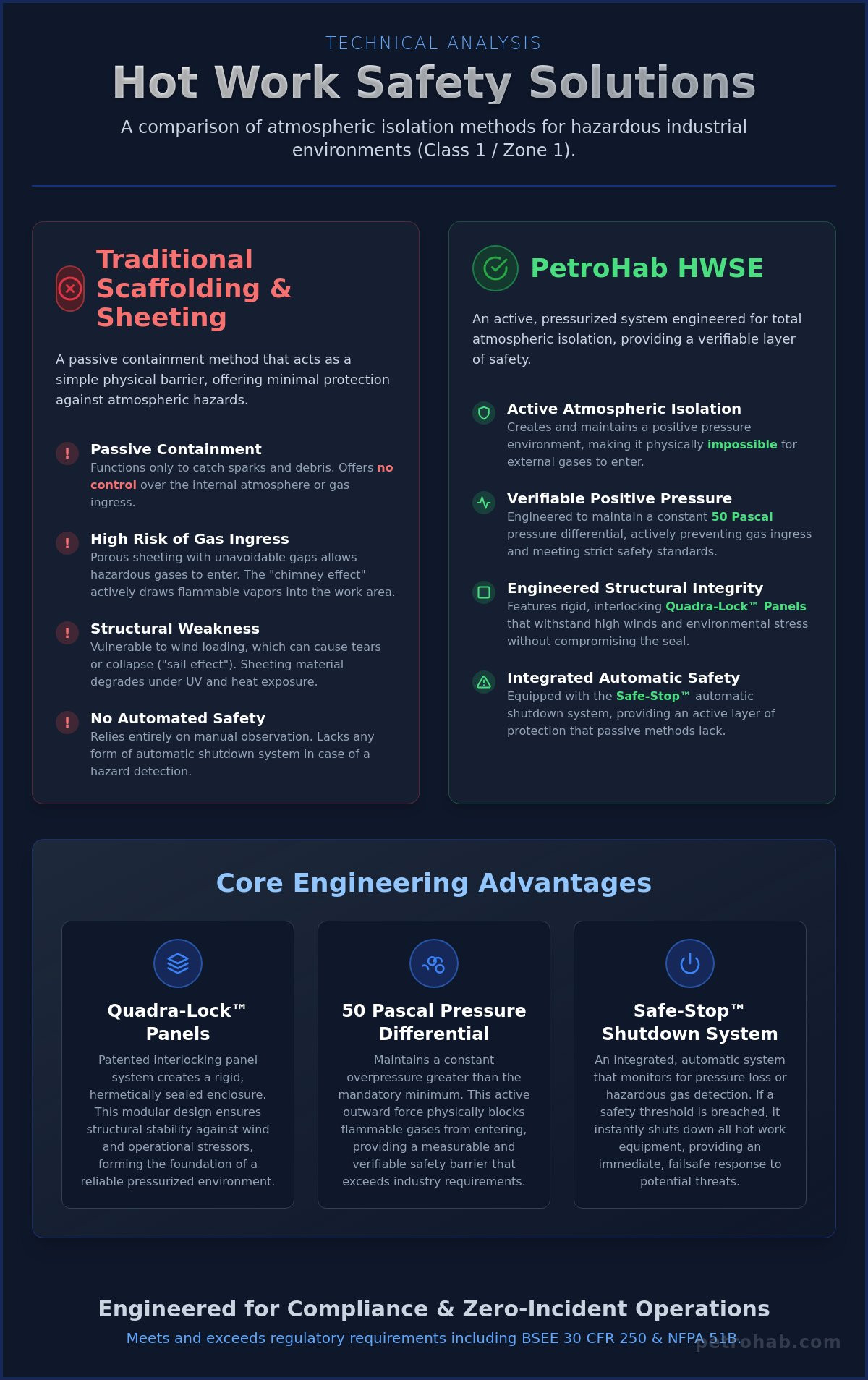
Traditional scaffolding and fire-retardant sheeting are categorized as passive containment systems. They function solely as physical barriers designed to catch sparks or debris. These systems rely on the material’s density to block ignition sources, but they lack any mechanism to control or monitor the internal atmosphere. When evaluating a welding habitat vs scaffolding and sheeting, the primary distinction lies in the ability to manage explosive risks actively. A Positive pressure enclosure, conversely, uses mechanical ventilation to create a barrier that gas cannot penetrate. A Hot Work Safety Enclosure (HWSE) is an active, pressurized environment for ignition prevention.
In Class 1 Division 1 areas, gas ingress is a constant threat that passive systems cannot mitigate. Overlapping sheets used in scaffolding containment are inherently porous and cannot be sealed hermetically. Even small gaps allow heavier-than-air hydrocarbons to accumulate at the floor level where welding sparks are most prevalent. Sparks can also find egress through these same gaps, potentially contacting flammable vapors in the external environment. Relying on such permeable barriers in live production zones creates an unacceptable level of risk for personnel and high-value assets.
To better understand this concept, watch this helpful video:
The Limitations of Fire-Retardant Sheeting
Fire-retardant materials are often misused as a complete safety solution. These fabrics degrade under prolonged UV exposure and extreme welding heat, losing their structural integrity over time. A critical risk is the chimney effect, where the heat from welding operations causes internal air to rise. This creates a low-pressure zone at the base of the scaffolding, which draws in hazardous gases from the surrounding environment. This fundamental flaw makes it impossible for passive systems to meet the rigorous hazardous environment standards required for modern offshore and refinery operations.
Structural Integrity and Wind Loading
Wind loading presents another significant failure point for traditional setups. In offshore environments, loose sheeting acts as a sail during high-wind events. This creates lateral force on the scaffolding structure that can lead to structural collapse or the tearing of the containment barrier. Maintaining environmental containment requires a rigid, modular frame that can withstand environmental stressors without compromising the seal. When comparing a welding habitat vs scaffolding and sheeting, the modularity of a pressurized system provides the stability necessary for high-stakes industrial zones where wind speeds are unpredictable.
Engineering the Modern Welding Habitat: Modularity and Pressure Integrity
The engineering transition from flexible sheeting to rigid Quadra-Lock Panels represents a fundamental shift in how industrial sites manage ignition risks. While traditional methods rely on overlapping layers of fire-retardant plastic, modern habitats utilize a modular architecture designed for structural rigidity and pressure retention. This distinction is central to the debate of welding habitat vs scaffolding and sheeting. An active system maintains a constant positive pressure differential of 0.1 inch water gauge, which is approximately 25 Pascals. This active force ensures that external hydrocarbons cannot enter the work area, even if a minor breach occurs in the enclosure wall.
Silicone-coated fiberglass panels provide a level of thermal resistance that standard plastics cannot match. These materials are engineered to withstand continuous exposure to welding temperatures without the melting or off-gassing associated with inferior sheeting. Adhering to OSHA hot work regulations requires more than just a physical barrier; it necessitates a controlled environment where the risk of fire is systematically eliminated through engineering controls. These modular systems provide a resilient shield that protects both the welder and the facility’s high-value infrastructure.
Achieving a Pressurized Seal with Quadra-Lock Technology
The patented Quadra-Lock interlocking mechanism eliminates the need for adhesive tapes or external fasteners that frequently fail under heat. This system creates a near-airtight seal at every panel junction by using a mechanical overlap. It allows for rapid assembly around complex geometries like irregular piping or structural steel penetrations. Specialized penetration seals further secure these points, ensuring that the enclosure maintains its pressure integrity regardless of the facility’s layout. If you need to secure a complex work site, you can request a technical consultation to determine the best configuration for your specific assets.
Thermal and Acoustic Protection
Beyond gas isolation, the modular habitat provides a superior working environment for high-precision tasks. The rigid panels significantly reduce noise pollution for surrounding personnel, which is a common complaint in busy refinery settings. Integrated air ducting manages internal temperatures by providing a constant flow of fresh air. This ventilation prevents heat stress for the welder and ensures that oxygen levels remain within the required parameters of 19.5% to 23.5%. This controlled atmosphere allows for higher quality welds and increased productivity compared to the cramped, unventilated conditions found in traditional scaffolding containment.
Comparative Analysis: HWSE vs. Scaffolding and Sheeting for Industrial Hot Work
Analyzing the technical merits of a welding habitat vs scaffolding and sheeting reveals a significant disparity in risk mitigation. Passive barriers like fire-retardant sheeting are essentially spark shields. They offer no protection against the ingress of combustible gases, making them insufficient for high-risk offshore platforms or refineries. An active system, such as a PetroHab HWSE, provides a pressurized seal that physically displaces hazardous atmospheres. This capability isn’t just a safety preference; it’s a regulatory necessity in environments where live production cannot be halted.
Compliance with Global Safety Standards
Regulatory bodies like the Bureau of Safety and Environmental Enforcement (BSEE) maintain strict protocols for offshore hot work. Under 30 CFR 250, hot work is generally prohibited within 10 feet of pressurized equipment. However, utilizing a certified hot work safety enclosure allows operators to obtain waivers for these restrictions. This enables critical repairs to proceed without shutting in production wells. This active containment strategy ensures that the ignition source remains isolated from the surrounding hydrocarbon environment at all times.
Compliance also extends to OSHA General Welding Requirements, which mandate that guards confine heat, sparks, and slag. While scaffolding sheeting attempts this, it lacks the pressure integrity to prevent gas-related incidents. Modular habitats are engineered to meet ATEX and IECEx zone classifications, ensuring that the enclosure acts as a definitive boundary between the ignition source and the hazardous zone. This rigorous adherence to international standards provides a level of legal and operational security that traditional scaffolding cannot replicate.
Downtime vs. Safety Investment
The financial implications of choosing between these methods are stark. A single day of unplanned production downtime on a Tier 1 offshore platform can cost over $1.5 million in lost revenue. While the initial setup of a pressurized system requires a technical investment, the ROI is realized by avoiding facility shutdowns. A 48-hour repair using a habitat can prevent a full 120-hour facility shut-in, saving an estimated $2.5 million in production revenue. These figures demonstrate that the cost of a habitat is negligible compared to the massive losses incurred during a total asset shutdown.
Deployment speed also favors modularity. A standard 2m x 2m x 2m habitat can be assembled by a two-person crew in 2 to 4 hours. Compare this to the days required for complex scaffolding builds and the subsequent inspection time for non-pressurized containment. The ability to begin hot work almost immediately after a site survey significantly reduces the total cost of ownership and project timelines. By integrating these systems into a Permit-to-Work (PTW) system, safety managers can authorize hot work with the confidence that they’ve implemented the highest tier of engineering controls available.
Operational Best Practices for Modular Habitat Deployment
The technical superiority of a welding habitat vs scaffolding and sheeting is only realized through rigorous operational discipline. Deployment begins with a comprehensive site survey to identify the safe air intake source. This location must be upwind and free from potential hydrocarbon releases to ensure the habitat remains pressurized with clean, breathable air. Unlike passive scaffolding, which requires little more than structural stability, a pressurized enclosure demands precise environmental control and constant monitoring of the internal atmosphere. Safety managers must verify that all equipment is calibrated to detect combustible gases at the Lower Explosive Limit (LEL) before any work commences.
Verifying the integrity of the enclosure is a mandatory procedural step. Before authorizing ignition, technicians must follow this 5-step protocol to ensure the Quadra-Lock seal is functional:
- Inspect Junctions: Visually confirm that every Quadra-Lock panel overlap is mechanically engaged without gaps.
- Secure Penetrations: Check that all specialized seals around piping and structural steel are tight and show no signs of leakage.
- Activate Ventilation: Start the blower system and monitor the pressure manometer until it reaches the required 50 Pascal (0.2 inches of water column) differential.
- Conduct Leak Test: Perform a tactile or smoke-aided inspection at floor levels to identify localized pressure drops.
- Document Findings: Record the stable pressure reading in the hot work permit log to establish a safety baseline.
Maintaining Positive Pressure Integrity
Maintaining a pressurized environment requires active troubleshooting. If pressure loss occurs, the floor-to-deck interface is often the primary failure point. Certified on-site supervision is mandatory to manage these variables and ensure the enclosure functions as intended throughout the work shift. Personnel must also be trained on emergency egress and airlock procedures. These protocols ensure that workers can exit the habitat quickly without causing a catastrophic loss of internal pressure that could allow external gases to enter the workspace.
Integrated Gas Detection Protocols
Modern hot work safety systems rely on strategically placed gas sensors. One sensor monitors the air intake ducting to detect external gas clouds, while internal sensors track oxygen levels and welding fume concentrations. Maintaining oxygen between 19.5% and 23.5% is critical for worker safety and fire prevention. If gas levels reach 10% LEL, the system must trigger an audible alarm. At 20% LEL, an automatic shutdown of all power sources is required to eliminate the risk of ignition. If you’re planning a high-risk project, contact our engineering team to design a deployment strategy that fits your facility’s layout.
Beyond Containment: Integrating Automated Safety with Safe-Stop
Physical containment represents only the first layer of a robust safety protocol. In high-risk Zone 1 environments, an enclosure alone is insufficient because it cannot respond to dynamic atmospheric changes. The technical superiority of a welding habitat vs scaffolding and sheeting is fully realized through the integration of the Safe-Stop automatic shutdown system. While scaffolding remains a dormant structure, a pressurized habitat acts as an active safety guardian. This system creates a mandatory synergy between the mechanical seal of Quadra-Lock panels and automated atmospheric monitoring.
Safe-Stop provides a level of redundancy that eliminates reliance on human reaction times during a gas release. It functions by continuously polling the environment for hazardous conditions. When sensors detect combustible gases or a loss of internal pressure, the system instantly isolates all ignition sources; this includes welding machines, grinders, and lighting. This instantaneous response ensures that even if the physical barrier is compromised, the potential for ignition is neutralized before a fire or explosion can occur. This active isolation is a critical differentiator that passive sheeting cannot provide.
The Safe-Stop Mechanism
The system operates on precise trigger parameters designed to meet international safety standards. If flammable gas levels reach 10% of the Lower Explosive Limit (LEL), an audible and visual warning alarm is triggered. If levels escalate to 20% LEL, the system executes an immediate power shutdown to all hot work equipment. This same protocol applies to pressure loss. If the internal differential drops below the required 50 Pascal threshold, the system halts operations. This logic ensures compliance with ATEX-certified gas detection requirements and significantly reduces the risk of human error in the safety chain.
Procurement Strategy: Leasing vs. Purchase
Choosing between leasing and purchasing depends on the facility’s long-term maintenance schedule. For short-term refinery turnarounds or specific offshore repairs, the leasing model provides a cost-effective solution that includes technical support and certified supervision. Facility owners with recurring maintenance requirements often find higher ROI in long-term equipment ownership. This allows for immediate deployment of pressurized systems whenever hot work is required. Accessing professional hot work safety enclosure suppliers ensures that your assets are protected by the latest engineering innovations and global support networks in Houston, the UK, and Brazil. This strategic procurement ensures that safety is never compromised for the sake of project speed.
Advancing Industrial Safety Through Active Pressure Integrity
The technical analysis between a welding habitat vs scaffolding and sheeting confirms that passive containment is no longer sufficient for Tier 1 asset protection. While traditional sheeting provides a basic spark shield, it doesn’t manage the atmospheric risks inherent in live production zones. Integrating patented Quadra-Lock technology ensures a superior seal that maintains the necessary pressure differential to block hydrocarbon ingress. Coupled with Safe-Stop automatic shutdown systems, operators achieve 100% ignition control by removing the possibility of human error. These engineering controls allow for continuous production, ensuring that regulatory compliance and operational uptime are maintained simultaneously.
With a global operational footprint and certified technicians available in Houston, the UK, and Brazil, our team is ready to support your most complex safety requirements. You can request a technical quote for your next turnaround project to secure your facility’s future. Implementing these advanced systems is the definitive step toward achieving zero-incident hot work on every site. It’s the most reliable way to protect your personnel and high-value infrastructure while maintaining full production capacity.
Frequently Asked Questions
What is the main advantage of a welding habitat over scaffolding and sheeting?
The primary advantage is active atmospheric isolation through positive pressure. While comparing a welding habitat vs scaffolding and sheeting, it’s clear that traditional sheeting only provides a passive spark barrier. A pressurized habitat actively prevents the ingress of flammable gases by maintaining a higher internal pressure than the surrounding environment. This engineering control allows hot work to proceed safely in high-risk areas where passive systems would fail to provide adequate protection.
Can a pressurized habitat be used on a live offshore platform?
Yes, pressurized habitats are specifically engineered for use on live offshore assets. Regulatory bodies like the Bureau of Safety and Environmental Enforcement (BSEE) allow for waivers to perform hot work near pressurized equipment when a certified Hot Work Safety Enclosure is utilized. This technology enables critical repairs without the massive revenue loss associated with shutting in production wells. It provides a definitive safety boundary that facilitates continuous operations in hazardous offshore environments.
How does the Quadra-Lock system prevent pressure loss?
The Quadra-Lock system utilizes a patented interlocking panel mechanism that creates a mechanical seal at every junction. Unlike inferior systems that rely on adhesive tapes or hook-and-loop fasteners, these panels overlap to ensure structural rigidity and superior air retention. This design allows the enclosure to maintain the mandatory 50 Pascal pressure differential even when assembled around complex piping geometries. The result is a resilient, airtight barrier that remains stable under the thermal stresses of industrial welding.
Is a pressurized welding habitat compliant with ATEX Zone 1 standards?
PetroHab habitats are designed to meet and exceed international standards for explosive atmospheres, including ATEX and IECEx certifications. These systems comply with IEC 60079-13 requirements for the design and construction of pressurized rooms. By maintaining a controlled internal atmosphere and utilizing certified gas detection, the enclosure effectively reclassifies the internal workspace. This compliance is essential for safety managers who must adhere to rigorous global safety protocols during refinery or offshore turnaround projects.
How quickly can a PetroHab modular enclosure be assembled?
A standard 2m x 2m x 2m PetroHab Hot Work Safety Enclosure can be fully assembled in approximately 2 to 4 hours. This rapid deployment is made possible by the modularity of the Quadra-Lock panels, which don’t require specialized tools for installation. A two-person crew can efficiently construct the unit around existing infrastructure. This speed provides a significant operational advantage over the days required to build complex scaffolding and install fire-retardant sheeting for traditional containment.
What happens if the pressure drops inside the habitat during welding?
If the internal pressure falls below the safety threshold, the Safe-Stop system initiates an immediate response. The system first triggers an audible and visual alarm to alert the technicians and the fire watch. If the pressure isn’t restored, the system automatically shuts down power to all welding machines and grinders. This fail-safe mechanism ensures that no ignition source can remain active if the atmospheric integrity of the habitat is compromised, preventing potential accidents before they occur.
Does the Safe-Stop system work with any welding machine?
The Safe-Stop system is designed for universal integration with various types of industrial hot work equipment. It functions as a power isolation hub that can accommodate welding machines, grinders, and lighting systems. By serving as the primary power source for all tools within the enclosure, it ensures that every potential ignition source is under the control of the automated safety logic. This integration is a critical component of the total atmospheric monitoring required in high-risk industrial zones.
Are the panels used in PetroHab habitats fire-resistant?
All panels used in our Hot Work Safety Enclosures are manufactured from high-grade silicone-coated fiberglass. This material is specifically chosen for its exceptional fire resistance and thermal durability in extreme industrial environments. These panels meet international fire-resistant standards and don’t suffer from the melting or degradation common with standard plastic sheeting. This material superiority ensures that the enclosure remains a reliable barrier against sparks, slag, and intense heat during high-precision welding tasks.