
Blog Posts
Safe Hot Work Near Live Electrical Equipment: Safety Precautions
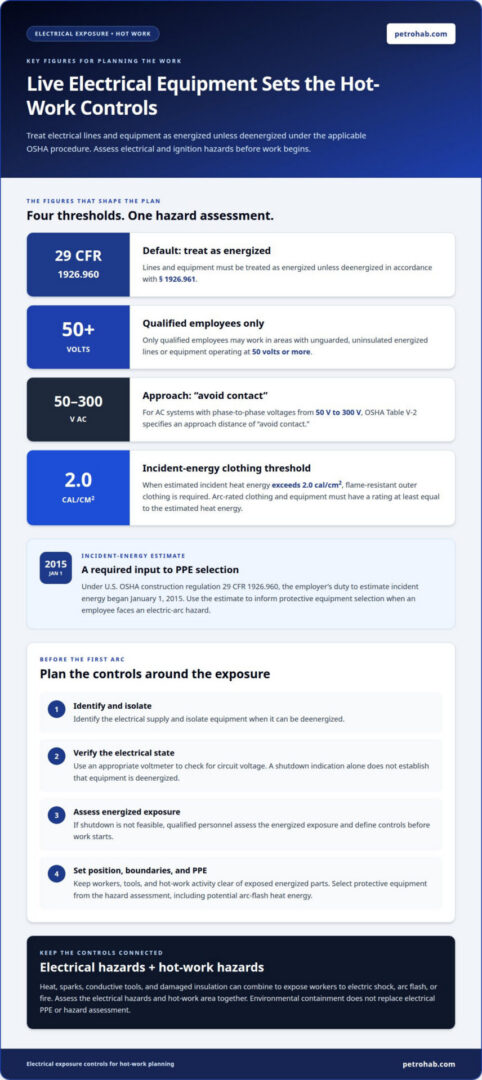
Live electrical equipment changes the hot-work plan before the first arc is struck. For safe hot work near live electrical equipment, control the electrical exposure first: under U.S. OSHA construction regulation 29 CFR 1926.960, lines and equipment must be treated as energized unless deenergized in accordance with § 1926.961. If equipment remains energized, the work requires controls suited to the specific electrical and ignition hazards.
Heat, sparks, conductive tools and damaged insulation can combine to expose workers to electric shock, arc flash or fire. A sound plan identifies the hazards, determines whether work can proceed and establishes protective measures before the job starts.
This article covers practical precautions for work near electricity, including de-energization and verification, approach boundaries, suitable PPE, and applicable U.S. codes and regulations. It also explains how containment and shutdown systems can support hot-work controls in hazardous industrial environments.
Key Takeaways
- Treat electrical lines and equipment as energized unless they’re deenergized under the applicable OSHA procedure.
- Base protective clothing and equipment on the hazards identified for the task, including potential arc-flash heat energy.
- Set approach limits according to voltage and applicable rules, and keep workers, tools, and hot-work activity clear of exposed energized parts.
- For industrial hot work requiring environmental containment, consider how a PetroHab Hot Work Safety Enclosure (HWSE) and associated shutdown systems fit into the site’s controls.
What are some general safety tips for working with or near electricity?
Control electrical exposure before hot work begins. Identify energized parts, determine whether equipment can be de-energized, and establish work positions and safeguards before starting.
De-Energizing Equipment Before Service
De-energizing means isolating equipment from electrical power before service or repair. Under U.S. OSHA construction regulation 29 CFR 1926.960, electrical lines and equipment must be treated as energized unless deenergized in accordance with § 1926.961, according to Occupational Safety and Health Administration (OSHA). Before work, identify the supply and isolate the equipment. Then use an appropriate voltmeter to check for circuit voltage. A shutdown indication alone doesn’t establish that equipment is de-energized.
Qualified Employees Around Energized Equipment
A qualified employee has the training needed to work safely around the specific electrical hazard. Under U.S. OSHA construction regulation 29 CFR 1926.960, only qualified employees may work in areas with unguarded, uninsulated energized lines or equipment operating at 50 volts or more, according to Occupational Safety and Health Administration (OSHA). Energized testing may be needed to diagnose a fault or assess equipment operation. Keep that testing within the qualified person’s scope, and control access to exposed parts. A process need or diagnostic task doesn’t remove the need for hazard controls.
Safe Positions Near Energized Parts
Choose a working position that keeps workers and tools clear of exposed energized parts. Plan the approach before bringing welding leads, tools or materials into the area. Avoid reaching across live components or positioning the body where a slip could cause contact. Use insulated hand tools for electrical tasks, and keep equipment and cords in good condition. If the position cannot maintain separation, stop and reassess the setup before proceeding.
Hot Work Near Live Equipment
Hot work near live electrical equipment involves heat, flame or sparks generated close to energized parts. Welding and cutting are examples because they create ignition sources while workers handle conductive equipment. The key question is whether electrical contact, heat or sparks from the task could create exposure. Assess the electrical hazards and hot-work area together. If shutdown is not feasible, qualified personnel must assess energized exposure and define controls before work starts.
Electrical safety regulations and protective equipment
Apply the electrical hazard assessment to both the hot-work task and its surroundings. Select protective clothing, switching controls and enclosure safeguards based on the identified exposure.
Electrical Safety Regulations
Electrical safety regulations set requirements for assessing hazards and selecting controls. Under U.S. OSHA construction regulation 29 CFR 1926.960, the employer’s duty to estimate incident energy began January 1, 2015, according to Occupational Safety and Health Administration (OSHA). This estimate informs protective equipment selection when an employee faces an electric-arc hazard. Record the assessment and use it to guide task planning, rather than relying on general workwear or assumptions about the electrical source.
Plan switching operations carefully because they can change equipment’s electrical state. Identify the switching task, the qualified personnel responsible and the affected equipment before work proceeds. After a fault, shed loads by turning off load switches before restarting, so equipment does not close into numerous motor loads. Include enclosure access in the same assessment, since exposed components and worker position affect the required controls.
Protective Equipment and Fire Protection
Protective equipment is clothing and gear selected to address the task’s electrical and thermal hazards. What PPE and fire protection are required for hot work near live electrical equipment? Choose PPE from the hazard assessment, including incident-energy estimates and potential flame or arc exposure. Under U.S. OSHA construction regulation 29 CFR 1926.960, flame-resistant outer clothing is required when estimated incident heat energy exceeds 2.0 cal/cm2, according to Occupational Safety and Health Administration (OSHA).
When an estimate exceeds 2.0 cal/cm2, arc-rated protective clothing and equipment must have an arc rating at least equal to the estimated heat energy. The required rating must cover the employee’s entire body, subject to listed exceptions. Avoid clothing that could melt onto skin or ignite and continue burning where flame or electric-arc hazards exist. Keep protective layers compatible with the work and emergency response plan. For contained industrial hot work, pressurized welding enclosures can form part of the environmental-control plan; they don’t replace electrical PPE or hazard assessment.
Electrical shock, arc flash, fire, and equipment hazards
Assess electrical, ignition and equipment hazards together before hot work begins. Changes in equipment status or work position can alter the exposure.
Electrical Shock and Arc-Flash Hazards
Electrical shock occurs when current passes through the body, while an arc flash releases intense energy from an electrical fault. A short circuit can trigger an arc and damage equipment. For AC systems with phase-to-phase voltages from 50 V to 300 V, OSHA Table V-2 specifies an approach distance of “avoid contact,” according to Occupational Safety and Health Administration (OSHA). Treat exposed conductive parts as a contact hazard.
Arc-flash exposure can extend beyond the point of contact. Include the electrical source and worker position in the hazard assessment.
Fire and Equipment Hazards
Fire hazards arise when hot-work ignition sources reach flammable materials or equipment. Sparks can travel beyond the immediate weld area, and heat can affect nearby cables, insulation or components. Identify nearby combustibles and remove or protect them before work. Inspect electrical equipment for damage that could expose conductors or compromise insulation.
After an electrical fault, do not restart equipment until qualified personnel have assessed its condition. Damaged cables or enclosures can create additional hazards.
Identifying Electrical Hazards
Electrical hazard identification means locating exposed energized parts, conductive objects and possible contact paths. Stop and survey the work area before moving welding leads, tools or materials into position. Note access routes, equipment openings, damaged insulation and nearby flammable materials. For example, a metal tool placed across an exposed electrical part can create a contact path.
Where possible, change the work position or remove the conductive path. Reassess if equipment status or task conditions change.
Assessing Risks Before Hot Work
A hot-work risk assessment records the task’s hazards, controls and response arrangements. Identify the electrical source, exposed parts, contact paths, ignition sources, flammable materials, work position and responsible qualified personnel. Set out the controls and emergency response before work starts.
Use a checklist to confirm that each control is in place, including the condition of the area and equipment, and communication arrangements. Stop work if a hazard changes or a control cannot be maintained.
Electrical safety codes and jurisdictional rules
Electrical safety rules depend on the work and the governing jurisdiction. Identify the applicable standards and approval process before authorizing hot work.
Electrical Safety Codes
An electrical safety code sets requirements for electrical systems and workplace controls. In the United States, 29 CFR 1910 covers electrical safety requirements for employee workplaces, while 1910 Subpart S covers electrical standards. OSHA 1910.269 concerns electric power generation, transmission, and distribution. For construction work, 29 CFR 1926.960 addresses live electrical work and approach distances.
The National Electrical Code, NFPA 70, has been adopted as law by most states and many other government entities. NFPA 70E, Part II, is also cited in connection with OSHA electrical safety regulations. Apply the standard relevant to the work and jurisdiction; don’t treat one code reference as a substitute for the others.
Where a worker operates remotely from a disconnect, 29 CFR 1910.333(b) (2) et al. addresses lockouts, lockoff tags, and equipment. Include the disconnect location and isolation method in the electrical safety plan to prevent unintended energization.
Jurisdictional Rules and Approvals
Jurisdictional rules are requirements set by the authority governing the work location. What permits and approvals are required for hot work near energized equipment? The cited electrical standards don’t establish one universal hot-work permit or approval route. Determine the applicable jurisdictional requirements and facility authorization process before the task is released.
For each job, document the work classification, electrical system, responsible authority, and required approvals. Then align the hot-work authorization with the electrical controls, including isolation and approach limits. In construction, employers must establish live-work minimum approach distances no less than those calculated using Table V-2 for AC systems or Table V-7 for DC systems. This makes voltage and system type central to planning.
For industrial work requiring containment, review hot-work enclosure options as part of the site’s control planning.
PetroHab: PetroHab Hot Work Safety Enclosure (HWSE)
PetroHab Hot Work Safety Enclosures (HWSE) provide a contained work environment for hot work in hazardous industrial areas. They suit projects where the site plan calls for separation between hot-work activity and surrounding conditions, alongside electrical controls for nearby energized equipment.
The enclosure is part of a broader control setup, not a substitute for electrical isolation decisions, approach limits, or task-specific PPE. The Safe-Stop Automatic Shutdown System monitors gas levels and pressure, while Quadra-Lock Panels use the company’s patented panel technology. Select the configuration according to the work scope and site hazards.
When the project plan calls for enclosure-based hot-work controls, PetroHab offers HWSE by lease or sale. Contact PetroHab to discuss your project requirements.
Set the Next Hot-Work Project Up for Control
Planning safe hot work near live electrical equipment starts with a job-specific decision: can the task proceed with electrical sources isolated, or must the plan account for energized components? Resolve that question before finalizing work sequencing, access, containment and personnel responsibilities. A defined sequence helps operations and safety teams coordinate around the same plan.
Use the planning discussion to establish the job scope, location, surrounding hazards and interface with operating equipment. This gives the project team a practical basis for aligning hot-work controls with site conditions. In hazardous industrial areas, include enclosure requirements and shutdown considerations in the plan.
Bring the project details into a focused discussion. Plan your hot-work project with PetroHab and take the next step toward a clearly defined work plan. Careful preparation gives your team a stronger starting point for controlled execution.
Frequently Asked Questions
Why is it so important to work safely with or near electricity?
Electrical hazards can cause fatal shock, arc flash, fire, and equipment damage, so safe work protects personnel and plant. A 120 V circuit can be lethal, not only higher-voltage systems. For example, a damaged cord near a metal workpiece can create a contact path. Treating ordinary voltage as harmless can expose workers during setup, operation, or fault response.
When must electrical equipment be de-energized before welding, cutting, or brazing?
De-energize equipment before servicing or repairing it. Under U.S. OSHA construction regulation 29 CFR 1926.960, treat electrical lines and equipment as energized unless deenergized in accordance with § 1926.961. Before work starts, verify the condition with an appropriate voltmeter. If testing or diagnosis requires energized equipment, restrict that work to qualified personnel using controls suited to the specific exposure.
What safe distance should hot work maintain from live electrical equipment?
There isn’t one clearance that applies to every system; approach limits depend on voltage and system conditions. For example, OSHA Table V-5 lists an alternative minimum approach distance of 0.63 m for phase-to-ground and phase-to-phase exposures at nominal voltages from 0.751 to 5.0 kV. That value is not a universal spark-clearance distance. Determine the applicable electrical boundary for the actual system before positioning hot-work activity.
How should workers control sparks, slag, and heat around electrical equipment?
For safe hot work near live electrical equipment, control where sparks and hot material can travel. Clear combustible and flammable materials from the work area, keep the space orderly and protect nearby equipment using the controls established for the job. Consider overhead and concealed paths as well as the immediate weld location. Stop if sparks, slag or heat reach equipment or materials beyond the planned control area.
What lockout/tagout and electrical safety procedures apply during nearby hot work?
Use the site’s energy-isolation procedure whenever equipment can be de-energized. OSHA Regulation 29 CFR 1910.333(b) (2) et al. addresses lockouts and lockoff tags when work occurs remotely from a disconnect device. Identify the correct disconnect, prevent unintended operation, and verify the equipment’s state before work. If a fault occurs, qualified personnel should assess the circuit before restarting it.
What hazards can welding or hot work create for live electrical equipment and workers?
Welding can expose workers to shock or arc flash and create ignition sources near equipment. Conductive tools or materials can bridge exposed electrical parts, while heat and sparks can damage insulation or ignite nearby combustibles. A short circuit can also damage equipment and disrupt operations. Before authorizing the task, assess worker contact paths and the equipment’s exposure to heat, slag and sparks.