Blog Posts
Welding Ignition Source Control: Engineering Safety in Hazardous Zones
Ignition control in welding isn’t a matter of human behavior; it’s a matter of absolute environmental isolation through pressurized engineering. In high-hazard industrial zones, the margin for error is non-existent. You understand that a single spark in a Zone 1 or Zone 2 environment can result in a catastrophic explosion, yet shutting down production for every maintenance task is often financially unsustainable. Effective welding ignition source control requires moving beyond simple fire watches to implement rigorous engineering controls that physically separate the heat source from the volatile atmosphere.
This guide provides the technical strategies you need to neutralize ignition risks without compromising operational uptime. We’ll explore how pressurized Hot Work Safety Enclosures (HWSE) from PetroHab LLC utilize proprietary Quadra-Lock panels to create a resilient barrier against flammable gases. You’ll also learn how to integrate automatic shutdown systems that respond to gas leaks at 10% of the Lower Explosive Limit. From meeting OSHA 29 CFR 1910.252 requirements to navigating the new EN IEC 62395-2:2026 standards, this article delivers the expertise required to achieve zero-incident welding operations in the world’s most demanding environments.
Key Takeaways
- Implement rigorous welding ignition source control by utilizing engineering barriers that physically isolate high-temperature work from volatile hydrocarbons.
- Analyze the critical relationship between localized welding arc temperatures and the auto-ignition temperatures (AIT) of common industrial gases.
- Deploy modular Hot Work Safety Enclosures (HWSE) featuring Quadra-Lock panels to maintain a pressurized environment that prevents the ingress of flammable atmospheres.
- Transition from passive containment to active protection by integrating Safe-Stop automatic shutdown systems that de-energize equipment upon gas detection.
- Align your hot work protocols with the latest international safety standards, including the 2026 updates to NFPA 51B and EN IEC 62395-2.
What is Welding Ignition Source Control in Industrial Safety?
Welding ignition source control is the systematic application of engineering and administrative controls designed to prevent heat, sparks, or slag from igniting flammable atmospheres. In the high-stakes environment of heavy industry, this discipline serves as the primary defense against catastrophic loss of life and the destruction of high-value assets. While traditional safety protocols often focus on human behavior, true ignition control relies on physical isolation and rigorous technological intervention. It’s the difference between managing a hazard and neutralizing it entirely.
For decades, industrial sites relied heavily on administrative controls like hot work permits and manual fire watches. These methods are necessary but fallible because they depend on human observation. Modern safety standards now prioritize engineering controls, such as pressurized habitats provided by PetroHab LLC, which provide a definitive physical barrier. This shift ensures that hot work operations don’t require total facility shutdowns, allowing for maintained production during essential maintenance.
The Fire Triangle in Oil and Gas Environments
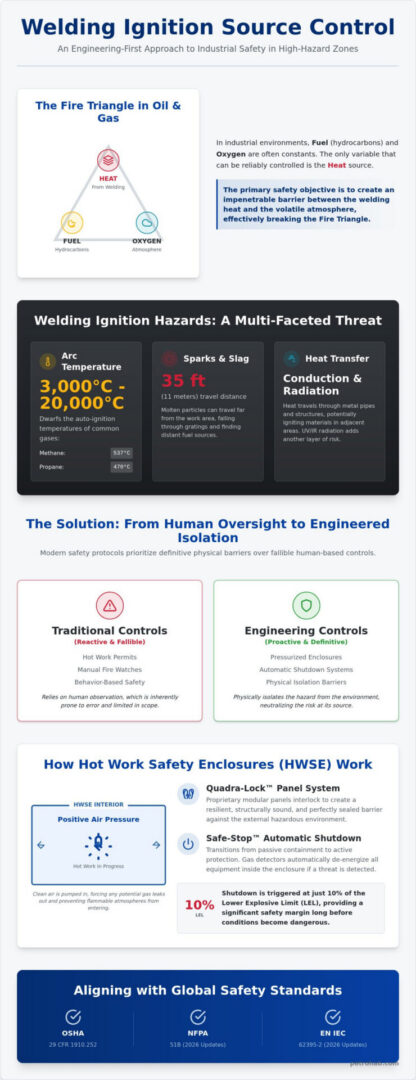
In oil and gas facilities, two legs of the Fire Triangle, oxygen and fuel, are often ubiquitous. Hydrocarbons represent a constant presence, making the isolation of the “Heat” leg the only viable path to operational safety. Various Welding processes generate temperatures that far exceed the auto-ignition points of almost all industrial gases. Without definitive welding ignition source control, a routine repair can quickly escalate into an uncontrolled disaster. Engineering solutions like pressurized enclosures ensure the heat source remains isolated from the surrounding volatile environment, effectively breaking the Fire Triangle.
Identifying Welding Hazards: Sparks, Slag, and Radiation
Effective welding ignition source control must account for multiple thermal threats that extend beyond the immediate arc. Welding sparks are not localized; they can travel up to 35 feet (11 meters) from the point of origin if they aren’t contained. This trajectory poses a severe risk in multi-level offshore platforms where molten slag can fall through gratings to lower decks, potentially finding fuel sources far from the welder’s sight.
Beyond physical particles, ultraviolet and infrared radiation act as secondary ignition triggers. These factors necessitate the use of robust engineering controls like the PetroHab LLC Hot Work Safety Enclosure (HWSE). By utilizing a modular system of Quadra-Lock panels, operators create a sealed environment that contains sparks and radiation while preventing the ingress of flammable gases. This methodical approach to containment is essential for protecting personnel and maintaining the integrity of the site’s safety infrastructure.
The Physics of Ignition Control: Managing Heat and Environment
The physics of welding ignition source control necessitates a granular understanding of thermal dynamics and atmospheric interaction. While a standard welding arc operates at temperatures ranging from 3,000°C to 20,000°C, the auto-ignition temperatures (AIT) of common industrial hydrocarbons are significantly lower. Methane, for instance, has an AIT of approximately 537°C, while propane ignites at 470°C. In the specific context of Zone 1 hydrocarbons, ignition temperature is defined as the lowest temperature of a heated surface at which the ignition of a flammable substance in the form of a gas or vapor mixture with air will occur. Because the thermal output of the arc is several orders of magnitude higher than these thresholds, environmental isolation is the only reliable safety mechanism.
Thermal conductivity poses a secondary but equally severe threat to site integrity. Heat transfers through metallic substrates via conduction, potentially raising surface temperatures on the opposite side of structural bulkheads or piping walls. This thermal migration can trigger ignition in adjacent compartments that safety managers might otherwise consider secure. Adherence to OSHA hot work regulations requires a complete assessment of these heat paths. Identifying potential thermal bridges is essential to prevent accidental combustion in connected piping systems or structural voids where flammable vapors may accumulate.
Thermal Isolation Strategies
Engineers must deploy fire-resistant materials to create a definitive thermal barrier between the arc and the external environment. Specialized welding blankets and heat-shielding components are required to manage radiant energy and contain molten slag. However, the risk persists even after the arc is extinguished. Managing hot surfaces post-welding is critical; surfaces must cool to levels safely below the AIT of any potential gas ingress before containment is breached. Utilizing modular pressurized habitats from PetroHab LLC, which incorporate proprietary Quadra-Lock panels, provides the structural integrity needed to maintain these thermal barriers throughout the entire work cycle.
Environmental Displacement via Positive Pressure
The most effective engineering remedy for atmospheric ignition risks is environmental displacement through positive pressure. By maintaining an internal air pressure higher than the external atmosphere, the system creates a physical safeguard against gas ingress. This pressure differential ensures that air always flows outward through any minor gaps, sealing the workspace from the outside. Continuous air ducting systems provide the necessary fresh air supply, which is vital for worker safety and atmospheric stability. This methodical displacement of potentially hazardous air remains the cornerstone of modern welding ignition source control in high-risk energy sectors.
Engineering Controls: The Role of Hot Work Safety Enclosures (HWSE)
The Hot Work Safety Enclosure (HWSE) serves as a comprehensive engineering solution for high-risk maintenance. While administrative permits provide a procedural framework, the HWSE from PetroHab LLC offers a physical guarantee of safety in live industrial environments. These modular systems adapt to the intricate piping and structural configurations common in refineries and offshore installations. This flexibility ensures that welding ignition source control is maintained even in confined or complex spaces. The technical superiority of pressurized welding habitats lies in their ability to maintain operational continuity without compromising the safety of the wider facility.
Implementing an HWSE allows for localized hot work in areas that would otherwise require a complete facility shutdown. This engineering control works by establishing a controlled environment where the internal atmosphere is isolated from external volatile gases. By utilizing these pressurized enclosures, safety managers can authorize welding operations in Zone 1 or Zone 2 areas with absolute confidence. The system acts as an active guardian, providing a resilient barrier against the thermal energy and molten particles generated during the welding process.
Quadra-Lock Technology: Ensuring Habitat Integrity
Habitat integrity depends on the precision of the paneling system. PetroHab LLC utilizes patented Quadra-Lock technology, featuring an interlocking mechanism that eliminates gaps prone to gas ingress. These panels are constructed from high-durability, fire-resistant materials designed to withstand the corrosive effects of salt spray and industrial chemicals. The modular nature of these panels allows for rapid assembly around structural obstacles like valve stems or support beams. This design ensures a secure seal that adheres to OSHA General Requirements for Welding. It’s a definitive hardware solution for environmental containment.
Habitat Ventilation and Air Quality
Effective ventilation is a dual-purpose requirement. It provides essential cooling for personnel while sustaining the positive pressure differential necessary for welding ignition source control. Real-time monitoring is facilitated through the use of manometers. These instruments provide engineers with precise pressure readings to confirm the habitat’s protective status at all times. All ventilation ducting is equipped with high-efficiency spark arrestors to prevent thermal particles from escaping the enclosure. This methodical approach to air management ensures a stable and secure internal atmosphere during the entire hot work procedure. It’s a calculated system of protection designed for the high-stakes environment of heavy industry.
Advanced Ignition Control: Automatic Shutdown Systems
Passive containment provides a critical physical barrier, but high-hazard environments demand the integration of active hot work safety systems. While the HWSE and Quadra-Lock panels prevent gas ingress under normal operating conditions, an automatic shutdown system acts as the final failsafe for welding ignition source control. In high-velocity gas release scenarios, manual intervention is fundamentally insufficient. The speed of a gas plume’s migration often outpaces human reaction time, making automated electronic isolation the only reliable method for preventing combustion. ATEX-certified gas detectors monitor the atmosphere continuously and send an electronic signal to the logic controller to de-energize all connected hot work equipment the moment gas concentrations exceed safety limits.
The Safe-Stop Automatic Shutdown Sequence
The Safe-Stop system from PetroHab LLC operates through a structured sequence designed to provide maximum warning before total isolation. It prioritizes the safety of personnel while ensuring that no ignition source remains active during a gas event. This methodical approach eliminates the risks associated with human error or delayed response times during an emergency.
- Step 1: Detection – Highly sensitive gas detectors identify the presence of hydrocarbons when they reach 10% of the Lower Explosive Limit (LEL).
- Step 2: Notification – The system immediately activates high-intensity visual and audible alarms to notify habitat occupants and site safety managers.
- Step 3: Isolation – The Safe-Stop system severs all power to welding machines and heat sources, typically triggered at 25% LEL or upon loss of habitat pressure.
- Step 4: Containment – Ventilation systems are managed to prevent further ingress, ensuring the internal atmosphere remains isolated from the external threat.
Gas Detection Placement and Monitoring
Strategic sensor placement is vital for the effectiveness of the shutdown system. Detectors must be positioned at the habitat air intakes to identify incoming threats and inside the HWSE to monitor for localized leaks from the work piece itself. The Safe-Stop logic controller manages multiple sensor inputs simultaneously, providing a centralized point of truth for atmospheric safety. In corrosive offshore environments, these detectors require regular calibration to maintain their precision and reliability. This rigorous monitoring ensures that the Safe-Stop Automatic Shutdown System remains an uncompromising guardian of your operations. To integrate this level of active protection into your next maintenance project, evaluate the specific technological remedies offered by PetroHab LLC for your facility.
Implementing Ignition Control with PetroHab LLC HWSE Solutions
PetroHab LLC provides the engineering framework necessary to implement welding ignition source control in the world’s most volatile environments. While previous sections detailed the physics and hardware, the practical application of these systems is what drives operational continuity. The modular design of the HWSE allows for rapid deployment, often reducing maintenance timelines by several hours compared to non-modular habitats. This efficiency is critical for multi-national operators who must balance safety with the high costs of production downtime. By utilizing standardized components, PetroHab LLC ensures that a solution deployed in the North Sea maintains the same level of reliability when used in a Middle Eastern refinery.
The synergy between the physical containment of Quadra-Lock panels and the active monitoring of the Safe-Stop system ensures compliance with international hazardous environment standards. By meeting ATEX and IECEx requirements, PetroHab LLC provides a globally recognized benchmark for safety. These systems are not merely protective barriers; they are essential components of a broader mission to eliminate industrial accidents through technological excellence. This integrated approach allows safety managers to maintain a zero-incident record while meeting aggressive production targets.
Global Reach and Certified Supervision
A successful habitat installation requires more than just high-quality hardware; it demands expert oversight. PetroHab LLC maintains a global network of certified supervisors who oversee habitat setup and conduct rigorous pressure testing before any hot work commences. This onsite presence ensures that the system performs to its engineered specifications in every unique site condition, whether offshore or onshore. Furthermore, the company offers specialized training programs for client personnel, building long-term competence and ensuring that site teams understand the granular details of maintaining a pressurized environment. This knowledge transfer is a critical step in creating a sustainable safety culture.
The Future of Ignition Control: 2026 and Beyond
As industrial regulations tighten through 2026, the demand for sophisticated engineering controls is reaching an all-time high. Innovations in fire-resistant materials and increased sensor precision are further refining the capabilities of welding ignition source control. Regulatory bodies are increasingly moving away from purely administrative permits toward mandatory physical isolation for all hot work in Zone 1 and Zone 2 areas. This trend is mirrored in the updated NFPA 51B requirements for 2026, which emphasize the necessity of engineering-based fire prevention. To secure your facility against thermal hazards and ensure full regulatory compliance, contact PetroHab LLC for a technical consultation on advanced ignition source control.
Achieving Operational Excellence Through Engineered Ignition Control
Mastering welding ignition source control requires a fundamental shift from passive observation to active engineering. By implementing pressurized Hot Work Safety Enclosures, you create a definitive barrier that neutralizes the threat of hydrocarbon ignition. This technical approach ensures that your facility remains compliant with the most stringent ATEX and IECEx standards while maintaining production during critical maintenance intervals. The integration of automated monitoring removes the variable of human error, providing a calculated response to atmospheric changes in real time.
PetroHab LLC’s systems utilize patented Quadra-Lock Technology to ensure structural integrity in the harshest offshore and onshore environments. When paired with the Safe-Stop Automatic Shutdown System, these enclosures deliver proven reliability that protects both personnel and high-value assets. You don’t have to choose between safety and uptime; the right engineering controls provide both simultaneously. Secure Your Hot Work Operations with PetroHab LLC HWSE to eliminate the risk of catastrophic incidents and ensure full regulatory compliance. With these advanced systems in place, you can conduct hot work with absolute confidence in your site’s safety and operational resilience.
Frequently Asked Questions
What is the most common welding ignition source in industrial settings?
Welding sparks and molten slag are the most frequent ignition sources in industrial environments. These particles can travel up to 35 feet from the work area, often falling through platform gratings to lower levels. While the arc itself is a primary heat source, these mobile, high-temperature particles pose a greater risk of finding undetected fuel sources. Effective containment requires a combination of physical barriers and continuous air monitoring to manage these risks.
How does a pressurized habitat control welding ignition sources?
A pressurized habitat controls ignition by maintaining an internal air pressure higher than the surrounding atmosphere. This pressure differential ensures that flammable gases cannot enter the enclosure where welding occurs. Air flows outward through any minor openings, creating a continuous seal. This engineering control physically separates the “Heat” leg of the Fire Triangle from the “Fuel” present in hazardous zones, ensuring hot work is performed in a controlled environment.
Is an automatic shutdown system required for all offshore welding?
While specific requirements vary by jurisdiction, an automatic shutdown system is typically mandated for hot work in Zone 1 and Zone 2 hazardous areas. Modern industry standards increasingly favor active engineering controls over passive containment alone. PetroHab’s Safe-Stop system’s the necessary failsafe for de-energizing equipment if gas is detected or pressure is lost. This automation is critical in environments where manual reaction times aren’t sufficient for high-velocity gas releases.
What is the difference between administrative and engineering ignition controls?
Administrative controls rely on procedures and human behavior, such as hot work permits and fire watches. Engineering controls utilize physical barriers and technology to neutralize hazards, such as Hot Work Safety Enclosures (HWSE). While administrative measures are necessary for site management, they’re fallible due to human error. Engineering solutions provide a definitive, measurable defense by physically isolating the ignition source from the volatile atmosphere, regardless of personnel actions.
Can welding ignition be controlled in Zone 0 environments?
Hot work and welding are strictly prohibited in Zone 0 environments because flammable gases are present continuously. Ignition control strategies focus on Zone 1 and Zone 2, where the presence of gas is likely or possible but not constant. In these areas, it’s engineering controls like pressurized habitats that allow for safe operations. If work must be done near a Zone 0 area, the atmosphere must be purged and certified safe before hot work begins.
What role does Quadra-Lock technology play in habitat safety?
Quadra-Lock technology provides the structural integrity necessary to maintain a reliable pressure seal in modular habitats. The interlocking panel design eliminates the gaps found in traditional fire blankets, preventing the ingress of flammable hydrocarbons. These panels are manufactured from fire-resistant materials capable of withstanding extreme thermal loads. By ensuring a tight, durable seal, Quadra-Lock technology serves as a fundamental component of effective welding ignition source control in high-risk industrial zones.
How often should gas detection systems be calibrated for hot work?
Gas detection systems must undergo calibration or bump testing before every work shift to ensure operational accuracy. In corrosive offshore environments, sensors are prone to drift or degradation, making regular verification essential. Manufacturers and international standards like ATEX/IECEx provide specific intervals for full laboratory calibration. Maintaining precise sensor data is vital for the Safe-Stop system to trigger power isolation at the correct Lower Explosive Limit (LEL) thresholds.
What are the NFPA 51B requirements for welding ignition source control?
NFPA 51B establishes the framework for fire prevention during hot work, including the mandatory 35-foot rule for clearing or shielding combustible materials. It’s a requirement for a designated fire watch to remain for at least 30 minutes after welding is completed. The standard emphasizes the hierarchy of controls, favoring the relocation of work to non-hazardous areas. When work must remain in situ, engineering controls like pressurized enclosures are utilized to meet these requirements for welding ignition source control.