Blog Posts
15 Critical Questions to Ask Welding Habitat Suppliers Before Procurement
Procuring a welding habitat is never just a hardware purchase; it’s a critical risk-mitigation strategy where a single technical oversight can lead to catastrophic ignition in hazardous environments. You recognize that in high-stakes oil and gas or petrochemical facilities, the margin for error is zero. Relying on a supplier who lacks rigorous certification puts your personnel and high-value assets at unacceptable risk. Identifying the right partner requires more than a surface-level review of brochures. It demands a deep dive into the specific questions to ask welding habitat suppliers to ensure they can maintain environmental containment under pressure.
We’ll equip your procurement and safety teams with a definitive checklist to vet HWSE providers with precision. You’ll learn how to verify essential certifications like IEC 60079-13:2017 and ATEX compliance while assessing the engineering behind critical components like Quadra-Lock panels. This article previews the 15 technical inquiries necessary to minimize operational downtime and guarantee that your hot work safety enclosure functions as a reliable guardian of your industrial site.
Key Takeaways
- Learn to distinguish between general vendors and specialized HWSE suppliers to mitigate catastrophic risks in Zone 1 and Zone 2 hazardous environments.
- Discover the critical technical questions to ask welding habitat suppliers to verify ATEX/IECEx certifications and NFPA 51B fire-resistance standards.
- Evaluate the reliability of automatic shutdown systems and gas detection protocols to ensure continuous monitoring and ignition prevention.
- Understand how modular Quadra-Lock panels and certified on-site supervision optimize safety and flexibility during complex hot work operations.
- Establish a rigorous vetting process that prioritizes active environmental containment and regulatory compliance over simple hardware procurement.
Beyond the Weld: Why Habitat Supplier Vetting is Critical for Asset Integrity
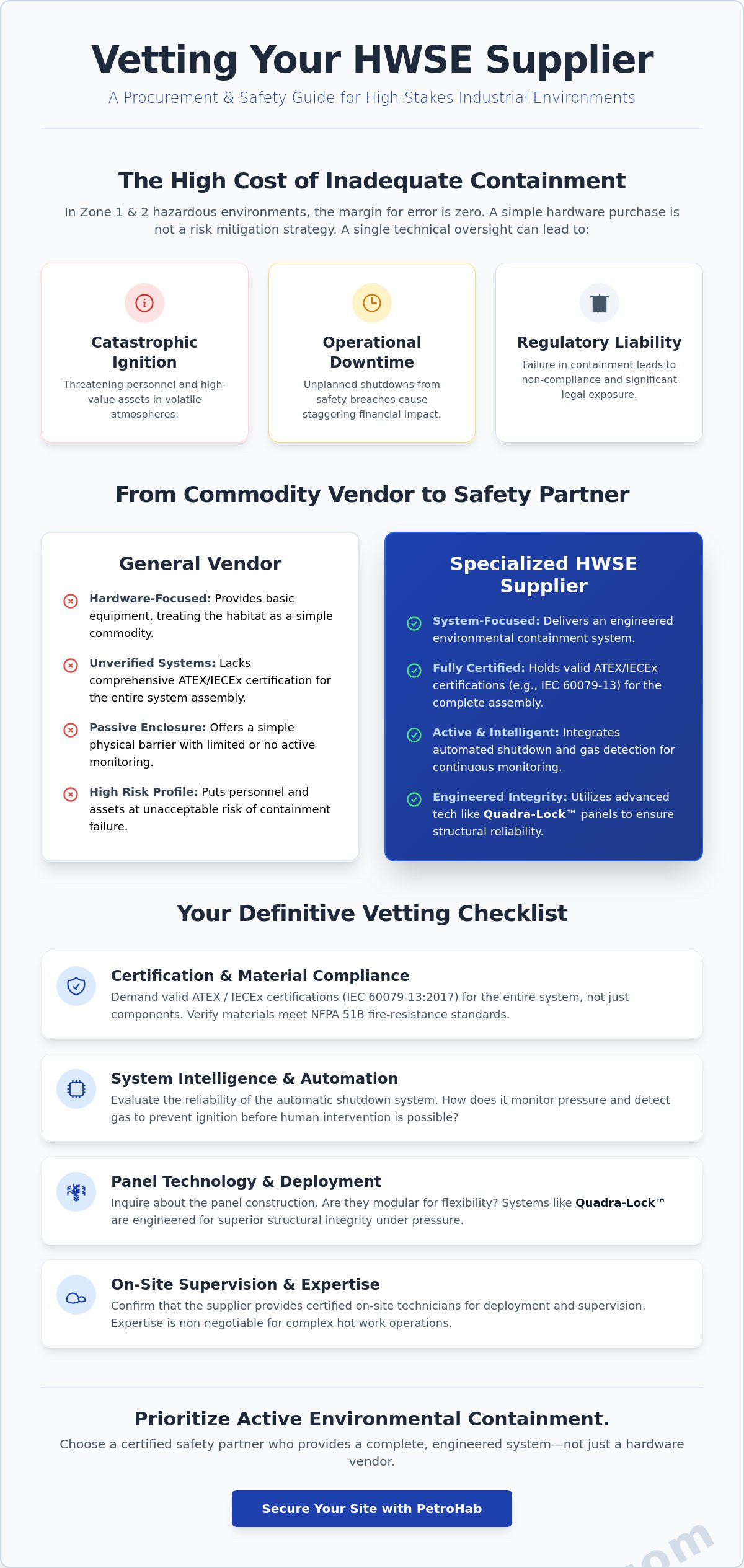
Procurement teams often classify welding habitats as simple commodities, yet this perspective compromises site safety. A general welding vendor provides basic equipment, but a specialized Hot Work Safety Enclosure (HWSE) supplier provides a rigorous environmental containment system. When formulating the questions to ask welding habitat suppliers, the focus must shift from procurement costs to technical capability. In Zone 1 or Zone 2 hazardous environments, the presence of volatile hydrocarbons makes any hot work a potential catalyst for disaster. Failure isn’t just an equipment malfunction; it’s a catastrophic ignition risk that threatens personnel and high-value assets.
System integrity serves as the primary metric for vetting. You aren’t merely leasing hardware; you’re selecting a safety partner who acts as an active guardian of your facility. This partnership requires a supplier who understands the granular details of industrial hazards and provides a calculated technological remedy to mitigate them. Reliability is built on technical precision, not marketing claims.
Review the following comparison to visualize the critical nature of the work environment and the associated risks:
The High Cost of Inadequate Hot Work Containment
Unplanned shutdowns caused by safety breaches carry a staggering financial impact. Beyond the immediate loss of production, a failure in containment leads to regulatory non-compliance and significant legal liability for safety managers. Selecting a partner who adheres to hazardous environment standards reduces these risks. A professional supplier provides the documentation and technical assurance needed to satisfy rigorous audit requirements. They ensure that every component, from the pressure sensors to the specialized panels, functions as a cohesive shield against external hazards.
Moving from Hardware to Safety Systems
It’s vital to distinguish between passive enclosures and active systems. A Positive pressure enclosure is a complex engineering solution designed to maintain a controlled internal atmosphere. “Good enough” is a dangerous mindset in offshore or refinery procurement where environmental variables are unpredictable. Understanding the technical questions to ask welding habitat suppliers helps identify systems like the PetroHab HWSE, which use Quadra-Lock panels to maintain structural integrity while integrating with automated monitoring. This section establishes the baseline for the technical inquiries that follow, ensuring your team prioritizes protection and control over mere convenience.
Essential Questions Regarding Certification and Material Compliance
Vetting a supplier based on verbal assurances is a significant liability for safety managers. You must demand technical documentation that proves the system can withstand the rigors of a hazardous site. One of the primary questions to ask welding habitat suppliers is whether their equipment carries valid ATEX or IECEx certifications for the entire assembly, including both the enclosure and the control logic. Compliance with the OSHA standard for hot work is merely the baseline; high-stakes environments require much more stringent evidence of conformity.
Decoding Certification: ATEX and IECEx Requirements
Reliability in explosive atmospheres depends on the synergy between the pressurized enclosure and the monitoring electronics. A supplier must demonstrate that the complete system is certified under standards such as IEC 60079-13:2017. You should ask how the supplier maintains these certifications across a rental fleet that undergoes heavy industrial use. Validating a Certificate of Conformity for the specific units being deployed ensures that the equipment hasn’t been modified or degraded in a way that voids its safety rating. Integrating advanced hot work safety systems into your procurement strategy ensures that your facility remains compliant with the latest 2026 global safety mandates.
Material Science and Fire Resistance
The physical barrier of the habitat must do more than just block sparks. It must resist chemical degradation from common industrial fluids and maintain structural integrity under sustained thermal stress. Fire-retardant materials are the foundation of any HWSE, but their effectiveness depends on the precision of their engineering. When evaluating the physical build of the habitat, focus on these three technical metrics:
- Temperature Ratings: What is the continuous temperature rating of the habitat fabric? It’s vital to know if the material can withstand the specific heat load of your welding or grinding operations without off-gassing or melting.
- NFPA 51B Compliance: All panels must meet the fire-resistance requirements of NFPA 51B. This standard ensures the material won’t support combustion.
- Panel Durability: Inquire about the seam strength and the longevity of the interlocking mechanisms. Systems using Quadra-Lock panels provide superior mechanical seals compared to traditional hook-and-loop fasteners.
Inquire about the chemical resistance of the panels to common industrial fluids like hydraulic oil or drilling mud. If the habitat fabric weakens when exposed to site-specific chemicals, the entire containment system is compromised. For those seeking absolute assurance in material integrity, reviewing the technical specifications of PetroHab HWSE solutions provides a benchmark for industry-leading compliance and durability.
Evaluating System Intelligence: Automatic Shutdown and Pressure Monitoring
Passive containment is a relic of the past. In modern heavy industry, the “brain” of the Hot Work Safety Enclosure (HWSE) determines the survival of your assets. When evaluating system intelligence, the most critical questions to ask welding habitat suppliers center on the integration of automated shutdown logic. A habitat that relies solely on manual observation by a fire watch is a liability. You need a system that actively monitors the environment and reacts with millisecond precision to eliminate ignition sources before a catastrophe occurs.
The Role of the Safe-Stop Automatic Shutdown System
Manual monitoring is insufficient for modern safety protocols because human reaction time cannot compete with automated sensors. The Safe-Stop Automatic Shutdown System acts as the primary fail-safe by constantly communicating with the habitat’s internal environment. If the system detects a gas ingress or a loss of positive pressure, it immediately isolates the power supply to all hot work equipment. This automation is essential for compliance with U.S. Federal Welding Regulations, which mandate strict control over ignition sources in offshore environments.
Ask your supplier about the fail-safe state of their equipment. If the control unit loses power or a sensor cable is severed, does the system default to a shutdown state? A reliable system must use “normally closed” logic to ensure that any fault in the safety loop results in an immediate cessation of hot work. This calculated approach to risk mitigation ensures that your personnel remain protected even during unforeseen technical failures.
Pressure Integrity and Gas Detection
Pressure integrity is the core of the HWSE’s protective shield. You must question the supplier on the sensitivity and calibration of their manometers. How does the system handle a sudden loss of positive pressure? If a Quadra-Lock panel is compromised or a door is left ajar, the system must recognize the pressure drop and trigger an alarm or shutdown. Gas detection adds another layer of security. It’s not enough to detect hydrocarbons; you must ask if the system is capable of detecting H2S, which is a common and deadly threat in many energy sectors.
Sensor positioning is a technical detail that many procurement teams overlook. Ask where the sensors are placed during operation. Ideally, detectors should be positioned at the habitat air intake and within the enclosure itself to monitor for internal leaks. For a deeper understanding of these requirements, refer to the pressurized welding habitats guide to establish technical benchmarks for your vetting process. Understanding the response time between a gas detection event and power isolation is vital. A delay of even a few seconds can be the difference between a controlled incident and an explosion.
Operational Logistics: Deployment, Supervision, and Panel Technology
Logistics often dictate the success of a maintenance shutdown. While certifications provide the legal framework for safety, the physical deployment of a habitat determines its operational efficiency. One of the most practical questions to ask welding habitat suppliers involves the modularity of their enclosure system. High-stakes environments like offshore platforms or refineries don’t present simple, flat surfaces. You need a system that adapts to complex piping geometries without sacrificing the integrity of the pressurized environment. If a system can’t conform to your site’s specific footprint, it’s a liability to your project timeline.
The Quadra-Lock Advantage in Modular Design
Sealing integrity depends on the mechanical connection between panels. Standard zip or velcro systems often fail under the thermal stress of welding or the physical pressure of a habitat. Quadra-Lock panels offer a superior mechanical seal that ensures a gas-tight enclosure. When vetting a supplier, ask if their panels allow for seamless penetrations of pipes, beams, or electrical conduits. A truly modular system must maintain pressure even when built around existing infrastructure. In a recent refinery turnaround, this level of modularity allowed a maintenance team to bypass extensive dismantling of adjacent pipework, saving significant hours of downtime. The ability to customize the footprint of the PetroHab HWSE ensures that protection is never compromised by site layout constraints.
Supervision and Training Requirements
The hardware is only as effective as the personnel managing it. You must verify if the supplier provides certified on-site supervisors to oversee the setup and continuous monitoring of the enclosure. These technicians must be certified for work in hazardous zones and possess a deep understanding of the Safe-Stop system’s logic. Inquire about the specific training curriculum they provide to your own personnel who will be working inside the habitat. Effective training covers emergency egress, gas detector calibration, and the operational limits of the pressurized system. Consult the 2026 procurement guide to understand the service level expectations you should demand from a top-tier partner.
Lead time for mobilization is a critical logistical factor, especially for remote or offshore locations. A supplier’s capacity to deploy equipment and personnel quickly can be the difference between a scheduled restart and a costly delay. Ask for specific timelines regarding mobilization and the availability of backup components. Ensuring that every panel is secured with a gas-tight seal requires meticulous attention to detail during the initial build. If you require a partner that prioritizes these operational details, explore the PetroHab HWSE and mobilization services to ensure your next project is protected by industry-leading technology and expertise.
Establishing a Long-Term Safety Partnership with PetroHab LLC
Selecting a vendor based on the 15 questions to ask welding habitat suppliers outlined in this guide is a rigorous starting point for any procurement team. However, the ultimate objective for a safety manager is to secure a long-term partnership that transcends a simple equipment transaction. PetroHab LLC doesn’t just provide hardware; we deliver a comprehensive risk-management ecosystem designed for the most volatile environments on earth. Our Houston-based engineering team combines decades of field experience with a relentless focus on technical precision to ensure every deployment is a calculated success.
Global availability ensures that whether your assets are in the Gulf of Mexico, the North Sea, or Southeast Asia, the PetroHab LLC Hot Work Safety Enclosure (HWSE) and Safe-Stop systems are accessible. This global reach is supported by a logistical infrastructure capable of rapid mobilization to remote offshore sites. Our commitment to safety is a functional reality embedded in our patented technologies. PetroHab LLC acts as an active guardian of industrial sites, providing the durable and resilient equipment necessary to protect personnel and high-value assets during critical hot work operations.
Why PetroHab LLC is the Industry Benchmark
PetroHab LLC sets the benchmark for safety excellence by addressing the granular details of industrial hazards that competitors often overlook. Our Quadra-Lock technology provides the definitive solution for complex hot work challenges. Unlike standard enclosures that struggle with irregular geometries, our modular panels create a high-integrity mechanical seal around existing infrastructure. This ensures that the pressurized environment remains intact even in the presence of intrusive beams or pipes, a feature that is essential for maintaining environmental containment.
The Safe-Stop Automatic Shutdown System serves as the ultimate failsafe for hazardous environments. It integrates seamlessly with our enclosures to provide active monitoring and power isolation. By adhering to international standards like IEC 60079-13:2017 and maintaining ATEX certification, PetroHab LLC provides the technical assurance required for Zone 1 and Zone 2 operations. This calculated approach to risk mitigation is why leading energy companies trust us as their critical safety partner for offshore and onshore projects.
Next Steps for Your Safety Program
Improving your site safety protocols requires a structured approach to supplier vetting. We encourage procurement teams to utilize these questions to ask welding habitat suppliers to develop a robust RFP template for future HWSE requirements. This ensures that every potential vendor is held to the same uncompromising standards of certification and system intelligence. A definitive checklist is the best defense against regulatory non-compliance and catastrophic ignition risks in live facilities.
Your asset protection and personnel safety are our primary mission. To move beyond general inquiries, contact a PetroHab LLC representative for a site-specific evaluation. Our experts can help you determine the optimal configuration for your next project, ensuring that your hot work is conducted within a controlled and pressurized environment. Request a technical consultation or a quote for a PetroHab LLC HWSE or Safe-Stop system today to secure the highest level of protection for your facility.
Securing Operational Excellence through Technical Vetting
Prioritizing technical precision over procurement convenience is the only way to safeguard your facility from ignition risks. By focusing on international certifications like ATEX and IECEx and demanding modular integrity through Quadra-Lock technology, you ensure that your safety protocols are built on a foundation of engineering excellence. These questions to ask welding habitat suppliers provide the framework necessary to move beyond passive enclosures toward active, intelligent protection systems that act as an uncompromising guardian of your high-value assets.
PetroHab LLC remains the industry benchmark by offering patented Quadra-Lock panels and the Safe-Stop Automatic Shutdown System. With global deployment capabilities spanning over 20 countries, we provide the localized expertise and specialized equipment required for high-stakes environments. Our commitment to risk mitigation ensures that your personnel and assets remain protected under the most demanding conditions, maintaining operational continuity without compromising on safety standards.
Take the next step in fortifying your hot work safety program. Request a Technical Quote for PetroHab LLC HWSE Systems to partner with a veteran safety guardian committed to your operational success. We look forward to supporting your team in achieving zero workplace accidents.
Frequently Asked Questions
What is the most important certification for a welding habitat supplier?
The most critical certification is IEC 60079-13:2017, which governs equipment used in explosive atmospheres. Suppliers must also provide evidence of ATEX compliance for equipment used in potentially explosive environments and meet NFPA 51B fire-resistance standards. These certifications serve as linguistic anchors for quality, ensuring the enclosure and monitoring electronics function as a unified safety system in hazardous zones.
Can I use a welding habitat without an automatic shutdown system?
Operating a pressurized habitat without an automatic shutdown system like Safe-Stop is a significant safety violation in high-risk environments. Manual fire watches cannot react with the millisecond precision required to isolate ignition sources during a gas ingress. An integrated shutdown system is essential to meet U.S. Federal Welding Regulations and ensure the protection of personnel and high-value assets.
How does a pressurized habitat prevent gas ingress?
A pressurized habitat uses a continuous flow of air to maintain an internal pressure higher than the external atmosphere. This overpressure creates a physical barrier that forces air out of any openings, preventing flammable gases from entering the work area. This mechanism is one of the primary technical metrics to evaluate when considering questions to ask welding habitat suppliers during the procurement process.
What are the main differences between renting and buying a welding habitat?
Renting is suitable for short-term maintenance projects where logistical support and on-site supervision are prioritized. Purchasing a PetroHab HWSE is a more cost-effective strategy for long-term asset integrity programs. It eliminates recurring rental fees and ensures equipment is immediately available for emergency repairs. Buyers must account for the ongoing responsibility of maintaining certifications and sensor calibrations after the initial purchase.
How long does it take to train a crew to use a PetroHab HWSE?
Basic operational training for a work crew typically takes a few hours. This training focuses on emergency egress, gas detector alarms, and habitat entry protocols. However, the personnel responsible for setup and continuous monitoring require more intensive certification. PetroHab provides a structured curriculum to ensure that site supervisors understand the complex logic of the Safe-Stop system and the mechanical assembly of the enclosure.
Are welding habitats suitable for both onshore and offshore applications?
Yes, pressurized habitats are engineered for diverse environments, including offshore platforms, refineries, and chemical plants. The modular nature of the system allows it to conform to complex piping geometries found in both sectors. When reviewing questions to ask welding habitat suppliers, verify that their equipment can withstand site-specific environmental conditions, such as high wind loads or corrosive salt spray.
What happens if the positive pressure is lost during welding?
If positive pressure falls below the required threshold, the Safe-Stop system immediately isolates the power supply to all welding and grinding equipment. This fail-safe mechanism prevents sparks from coming into contact with potentially flammable external atmospheres. Work cannot resume until the enclosure is resealed and the internal pressure is restored to safe operational levels, as verified by calibrated manometers.
How do Quadra-Lock panels improve habitat safety over older designs?
Quadra-Lock panels utilize a patented mechanical interlocking system that creates a superior gas-tight seal compared to traditional zip or velcro fasteners. This design prevents the gaps and leaks common in older models, especially under high thermal stress. The structural integrity of these panels ensures the habitat remains durable and resilient, acting as a reliable shield against environmental hazards in the field.