
Blog Posts
Automatic Shutdown Systems for Hot Work Habitats: An Industrial Safety Guide
A single day of unplanned production downtime can cost an industrial facility as much as $500,000, but the true price of a containment failure in an explosive atmosphere is measured in human lives and asset loss. You recognize that relying on manual gas monitoring creates an unacceptable margin for human error, especially when operating under the strict requirements of ATEX or IEC 60079-13:2017. Maintaining absolute control over ignition sources requires more than just a physical barrier; it demands sophisticated hot work safety monitoring systems that act with technical precision when seconds matter.
This guide demonstrates how integrated automatic shutdown systems provide the ultimate fail-safe for pressurized welding habitats in hazardous environments. You’ll discover how the Safe-Stop system integrates with a PetroHab Hot Work Safety Enclosure (HWSE) to automate gas detection and response. We will examine how proprietary Quadra-Lock panels ensure habitat integrity and why transitioning from manual oversight to automated protection is the only way to achieve total regulatory compliance and operational peace of mind.
Key Takeaways
- Define the critical role of an automatic shutdown system in providing immediate ignition source isolation during hazardous gas ingress.
- Examine the real-time monitoring capabilities of the Safe-Stop system to ensure combustible gases are detected before reaching explosive limits.
- Analyze the risk advantages of automated hot work safety monitoring systems over manual gas checks, focusing on 24/7 reliability and reduced human error.
- Review the essential ATEX and IECEx certifications required for safety equipment to operate securely within explosive atmospheres.
- Understand the synergy between Safe-Stop technology and Quadra-Lock panels in maintaining the pressurized integrity of a Hot Work Safety Enclosure.
What is an Industrial Automatic Shutdown System in Hot Work?
An industrial automatic shutdown system (ASD) serves as the primary safety instrumented layer for hazardous operations. In environments where flammable vapors or gases may be present, Hot work activities like welding or grinding present an immediate ignition risk. The ASD functions by continuously monitoring the environment and executing a pre-programmed response to isolate all potential ignition sources the moment a hazard is detected. Unlike standard monitoring tools, these systems are engineered to act as a definitive fail-safe. They eliminate the latency associated with human observation and manual intervention.
Modern hot work safety monitoring systems rely on hardware-based industrial safety loops rather than simple software triggers. Software can crash, freeze, or lag. A dedicated safety loop uses hard-wired logic and redundant components to ensure that a shutdown command is executed every time. In high-risk Zone 1 and Zone 2 environments, where the atmosphere can become explosive without warning, manual gas monitoring is insufficient. A technician with a hand-held monitor cannot provide the 24/7 vigilance or the millisecond response time required to prevent a catastrophe during a sudden gas release.
Primary Components of a Safety Shutdown Loop
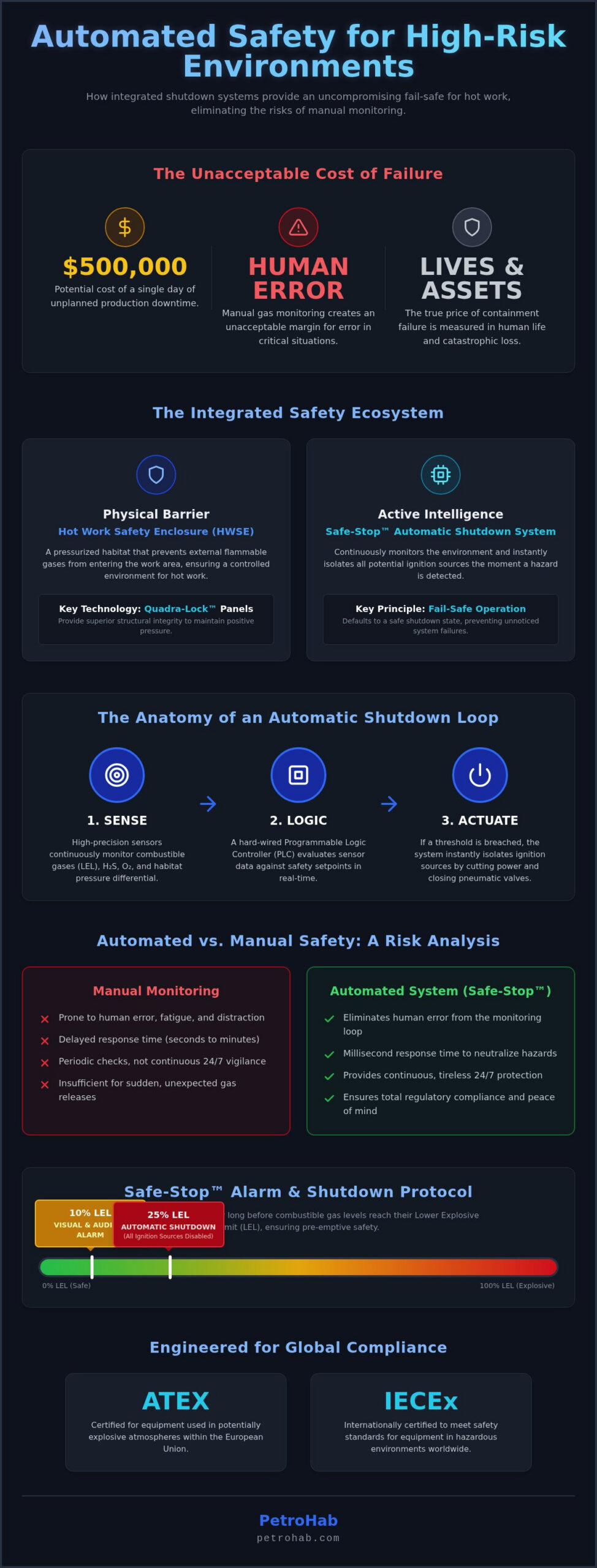
A reliable safety loop consists of three fundamental stages: sensing, logic, and actuation. Gas detection sensors are the eyes of the system. These sensors are strategically placed at air intakes and within the work area to monitor Lower Explosive Limit (LEL) percentages, Hydrogen Sulfide (H2S), and Oxygen (O2) levels. These inputs feed directly into a central control logic unit, typically a Programmable Logic Controller (PLC). The PLC evaluates the data against safety setpoints. If a threshold is breached, the system triggers shutdown actuators. These actuators perform critical functions like isolating electrical power to welding machines and closing pneumatic valves to stop the flow of combustible gases.
The Critical Link to Pressurized Habitats
The effectiveness of pressurized welding habitats depends entirely on maintaining a positive pressure differential. This pressure prevents external flammable gases from entering the workspace. The ASD monitors this differential constantly. If the pressure drops below a safe level, the system immediately cuts power to all ignition sources inside the PetroHab Hot Work Safety Enclosure (HWSE). This integration ensures that the physical barrier provided by Quadra-Lock panels is always supported by active electronic protection. By combining these technologies, operators create a redundant safety environment that meets the highest international standards for risk mitigation and personnel protection.
How the Safe-Stop System Prevents Industrial Disasters
The Safe-Stop Automatic Shutdown System acts as the active intelligence for the PetroHab Hot Work Safety Enclosure (HWSE). While the physical enclosure provides containment, the Safe-Stop system ensures that no ignition source can exist if the environment becomes compromised. By integrating high-precision sensors with automated logic, this technology adheres to OSHA hot work safety regulations by providing a continuous, reliable watch over atmospheric conditions. It’s designed to detect combustible gases long before they reach their Lower Explosive Limit (LEL), triggering a sequence of protective actions that neutralize risk.
Reliability in hot work safety monitoring systems is built on the “Fail-Safe” principle. If the system loses signal from a sensor or experiences a power interruption, it defaults to a state of maximum safety: immediate shutdown. This logic prevents the dangerous scenario where a system failure goes unnoticed while hot work continues. Before a total shutdown occurs, the system utilizes audible and visual alarm protocols. These multi-stage alerts notify personnel of rising gas levels or pressure fluctuations; this allows for an orderly evacuation and cessation of work before the safety loop is fully triggered.
Monitoring Combustible and Toxic Gases
Effective gas monitoring requires specific thresholds. Safe-Stop systems are typically configured to trigger a visual alarm at 10% LEL and an automatic shutdown of all ignition sources at 25% LEL. In offshore environments, the system also monitors for toxic Hydrogen Sulfide (H2S), ensuring personnel are protected from both ignition and inhalation hazards. Maintaining these hot work safety monitoring systems requires regular calibration. Sensors must be tested against known gas concentrations to ensure their response times and accuracy haven’t drifted over time, which is a requirement that aligns with international safety standards.
Pressure Differential and Airflow Management
A pressurized habitat works by keeping the interior pressure higher than the outside atmosphere. Safe-Stop monitors this differential to ensure no flammable vapors can enter. If a blower fails or a habitat breach occurs, the system detects the drop in airflow and executes a shutdown. To maintain the integrity of a Hot Work Safety Enclosure, the system must ensure the internal pressure remains at a minimum of 0.1 inch water gauge, which is equivalent to 25 Pascals. This constant positive pressure is the primary defense against gas ingress. For facilities prioritizing total risk mitigation, the Safe-Stop Automatic Shutdown System remains the industry benchmark for automated protection.
Automated vs. Manual Safety Monitoring: A Risk Analysis
The reliance on human intervention for gas detection in high-risk environments introduces a significant variable: reaction time. In the event of a sudden pressurized gas release, combustible vapors can migrate and reach an ignition source in seconds. Manual fire watches or technicians using hand-held monitors often operate on a periodic schedule, performing checks every thirty minutes or hour. This leaves dangerous gaps where a leak could occur undetected. Hot work safety monitoring systems eliminate these windows of vulnerability by providing continuous, 24/7 atmospheric surveillance that never suffers from fatigue or distraction.
Beyond immediate response, automated systems provide a level of accountability that manual checks cannot match. Every sensor reading, alarm trigger, and shutdown event is recorded in a digital data log. These audit trails are essential for post-operational analysis and regulatory compliance. They prove that safety protocols were active and functional throughout the duration of the work. This objective data also reduces “Permit-to-Work” friction. When safety managers can verify the presence of an automated, hardware-based barrier, the administrative burden of approving high-risk permits becomes more manageable because the risk is mitigated by technology rather than just policy.
Eliminating Human Error in Hazardous Zones
Human error remains a leading cause of industrial accidents. Personnel assigned to safety watches are susceptible to environmental stressors like extreme heat, noise, and long shifts, which naturally degrade situational awareness. Automated systems provide consistent data interpretation regardless of external conditions. While a human might hesitate or misjudge a rising gas trend, a safety loop executes a shutdown the moment a threshold is crossed. Considering that gas migration speeds can easily outpace human physical response, the automation provided by the Safe-Stop system is a technical necessity for Zone 1 operations.
Operational Efficiency and Downtime Reduction
Precision is the key to maintaining productivity during complex projects. Manual monitoring often results in over-cautious, broad-stroke shutdowns that halt work across entire sectors. In contrast, advanced hot work safety systems utilize specific alarm thresholds to provide early warnings. This allows for localized corrections before a full shutdown is required. During refinery turnarounds, this precision prevents the cascading delays that drive up costs. Investing in automated hardware reduces the long-term reliance on large manual safety teams, offering a superior cost-benefit ratio through increased uptime and the protection of high-value assets. By integrating these systems with Quadra-Lock panels, operators ensure that both the physical and electronic barriers are working in perfect technical harmony.
Key Standards for Automatic Shutdown Systems: ATEX and IECEx
In the energy and heavy industry sectors, technical certifications aren’t merely administrative hurdles; they’re the foundation of operational integrity. For hot work safety monitoring systems, two primary international frameworks dominate: ATEX and IECEx. These standards verify that electrical components, logic controllers, and sensors won’t ignite the very atmosphere they’re designed to monitor. In environments where flammable gases are a constant threat, utilizing hardware that lacks these rigorous third-party validations introduces an unacceptable level of risk to personnel and high-value assets. Global procurement teams prioritize these certifications to ensure equipment reliability across different jurisdictions.
The shutdown system itself must be engineered with explosion-proof protection, typically classified as Ex d or Ex i. An Ex d, or flameproof, enclosure is designed to contain an internal explosion and prevent it from igniting the surrounding atmosphere. Conversely, Ex i, or intrinsically safe, circuitry limits the electrical and thermal energy to levels that can’t cause ignition under normal or fault conditions. These technical distinctions are critical for Zone 1 and Zone 2 environments. Zone 1 requires equipment capable of safe operation where hazardous gases are likely to occur during normal operations. Zone 2 hardware is rated for areas where hazards are less frequent but still present a significant danger if a release occurs.
Navigating Hazardous Environment Standards
Safety managers must align their equipment procurement with a complex web of hazardous environment standards that vary by region and application. While NFPA 51B and OSHA provide the regulatory framework for hot work in the United States, global projects often require adherence to the IEC 60079-13:2017 standard for pressurized rooms. The Safe-Stop system is specifically engineered to bridge these requirements, ensuring that your hot work safety monitoring systems provide a compliant safety loop across international borders. ATEX certification is a non-negotiable legal requirement for equipment operating in offshore environments within the European Union’s jurisdiction to ensure absolute explosion protection.
Certification Maintenance and Compliance
Compliance isn’t a one-time event but a continuous commitment to safety excellence. All electronics and sensors within the safety loop require annual inspections and periodic recertification to maintain their Ex-rated status. It’s vital that every peripheral component, including cables, glands, and junction boxes, meets the same rigorous standard as the central controller. The January 2026 update to the ATEX guidelines emphasizes the digitalization of this documentation, making it easier to track the lifecycle of safety hardware. Using non-certified components creates a weak link that can invalidate the entire safety system’s integrity, leading to massive liability risks. To ensure your site remains fully compliant, consult with our engineers about the ATEX-certified Safe-Stop system today.
Implementing PetroHab Solutions: Safe-Stop and Quadra-Lock Integration
Effective risk mitigation in high-stakes environments requires a unified approach where physical containment and electronic surveillance operate in total synergy. The Safe-Stop Automatic Shutdown System serves as the active intelligence for the PetroHab Hot Work Safety Enclosure (HWSE), creating a redundant safety architecture. While the enclosure provides the necessary pressurized barrier, the Safe-Stop system acts as the definitive fail-safe, ensuring that no ignition source remains active if a breach or gas ingress is detected. This integration transforms a passive habitat into an active safety instrumented system that protects both personnel and high-value assets.
For large-scale industrial projects, such as offshore platform modifications or refinery turnarounds, scalability is essential. The modular design of PetroHab’s hot work safety monitoring systems allows for the deployment of multiple sensor arrays and shutdown logic units across complex sites. This flexibility ensures that safety managers can protect multiple welding stations simultaneously without compromising response times or system reliability. To support these deployments, PetroHab provides comprehensive global support, including on-site supervision and specialized technician training; this ensures that every installation adheres to the most rigorous international safety protocols.
The Quadra-Lock Advantage for System Integrity
The foundation of any pressurized zone is the integrity of its panels. Quadra-Lock Panels utilize a patented interlocking technology that eliminates the gaps and leaks common in inferior habitat designs. By maintaining a superior seal, these panels prevent the pressure fluctuations that often lead to false alarms in hot work safety monitoring systems. The durability of these fire-resistant materials ensures they withstand the harsh conditions of heavy industry, providing a stable environment for the Safe-Stop system to monitor. This physical reliability reduces the workload on the automated shutdown logic, allowing it to focus on genuine external threats.
Next Steps: Securing Your Hot Work Site
Securing a hazardous work site begins with a detailed evaluation of your project’s specific gas and pressure monitoring requirements. Safety engineers must account for the types of flammable vapors present, the volume of the workspace, and the proximity of ignition sources to potential release points. Once these variables are defined, a technical consultation for Safe-Stop deployment can be initiated to tailor the hardware configuration to your facility’s layout. Prioritizing personnel safety through automation isn’t just a regulatory requirement; it’s a commitment to operational excellence. By integrating PetroHab’s advanced technologies, you ensure that your facility remains a leader in industrial safety and risk management.
Advancing Operational Safety with Automated Control
Industrial safety in hazardous zones requires a multi-layered approach that leaves nothing to chance. You’ve seen how physical containment via patented Quadra-Lock technology works in tandem with electronic shutdown logic to neutralize ignition risks. Transitioning to automated hot work safety monitoring systems ensures your facility meets the highest international standards, including ATEX and IECEx requirements, while eliminating the inherent latency of manual oversight. These systems provide the technical precision needed to protect personnel and high-value assets during complex welding operations.
It’s time to eliminate the risks of human error and ensure continuous compliance on your site. Request a technical consultation for the Safe-Stop Automatic Shutdown System to see how our engineering solutions fit your specific project needs. With global 24/7 technical support and specialized training, we act as a dedicated safety partner for your most demanding environments. Secure your next turnaround with the reliability and discipline that your engineers demand and your workforce deserves.
Frequently Asked Questions
What is the primary function of an automatic shutdown system in hot work?
The primary function is to provide an immediate fail-safe by isolating all ignition sources when hazardous conditions are detected. It acts as the central logic unit for hot work safety monitoring systems, receiving data from sensors and executing shutdown commands. This process severs electrical power to welding equipment and closes pneumatic valves. By automating this response, the system eliminates the risks associated with human latency during a gas release event.
How fast does a Safe-Stop system react to gas detection?
The Safe-Stop system provides near-instantaneous reaction times through its hardware-based safety loop. Once a gas sensor reaches a programmed threshold, such as 25% LEL, the logic controller executes the shutdown sequence in milliseconds. This speed is critical because gas migration can occur faster than a human operator can react. The system’s reliability is further enhanced by its fail-safe design, which triggers a shutdown if a signal is lost.
Is an automatic shutdown system required by law for offshore welding?
Automatic shutdown systems are a legal requirement for offshore welding in regions governed by ATEX Directive 2014/34/EU. International standards like IEC 60079-13:2017 also mandate these systems for pressurized rooms in hazardous locations. These regulations ensure that hot work doesn’t proceed without a verified, automated safety barrier. Compliance with these standards is essential for safety managers to maintain legal operation and protect offshore assets from ignition events.
Can the shutdown system be used in Zone 1 hazardous areas?
Yes, the Safe-Stop system is specifically engineered for use in Zone 1 and Zone 2 hazardous areas. Its components feature Ex d flameproof or Ex i intrinsically safe certifications to ensure the equipment itself doesn’t become an ignition source. This allows the system to operate safely in environments where explosive atmospheres are likely to occur. Utilizing certified hot work safety monitoring systems is the only way to maintain safety integrity in these high-risk zones.
What happens to the welding equipment when the system triggers a shutdown?
When a shutdown is triggered, the system immediately severs electrical power to all welding machines and ignition sources located within the habitat. It also closes pneumatic solenoid valves to halt the flow of combustible gases used in the work process. This dual-action isolation ensures that the arc is extinguished and the fuel source is removed. Work cannot resume until the atmosphere is cleared and the system is manually reset by authorized personnel.
How does the system monitor positive pressure inside the habitat?
The system monitors positive pressure using high-precision differential pressure sensors that compare the habitat’s internal atmosphere to the external environment. It’s programmed to maintain a minimum pressure of 0.1 inch water gauge or 25 Pascals. If the pressure drops below this threshold due to a blower failure or a breach in the Quadra-Lock panels, the system initiates an automatic shutdown. This constant monitoring prevents the ingress of flammable vapors into the workspace.
Does the Safe-Stop system require specialized training to operate?
Yes, PetroHab provides specialized training and on-site supervision to ensure the system is operated correctly. Technicians must understand how to calibrate sensors, interpret alarm signals, and perform system resets. Proper training is a core component of the safety protocol, as it ensures that the hardware is maintained to its certified standards. This expert oversight guarantees that the safety loop remains functional and reliable throughout the duration of the project.
Can the system detect toxic gases like Hydrogen Sulfide (H2S)?
The Safe-Stop system can be configured with specialized sensors to detect toxic gases such as Hydrogen Sulfide (H2S) and Oxygen (O2) levels. While combustible gas detection is the primary focus for ignition prevention, toxic gas monitoring is essential for personnel protection in offshore and refinery environments. If H2S concentrations exceed safe limits, the system triggers the same automated shutdown and alarm protocols to protect workers from inhalation hazards.