Blog Posts
Common Hot Work Permit Violations: Identifying and Mitigating Industrial Risks in 2026
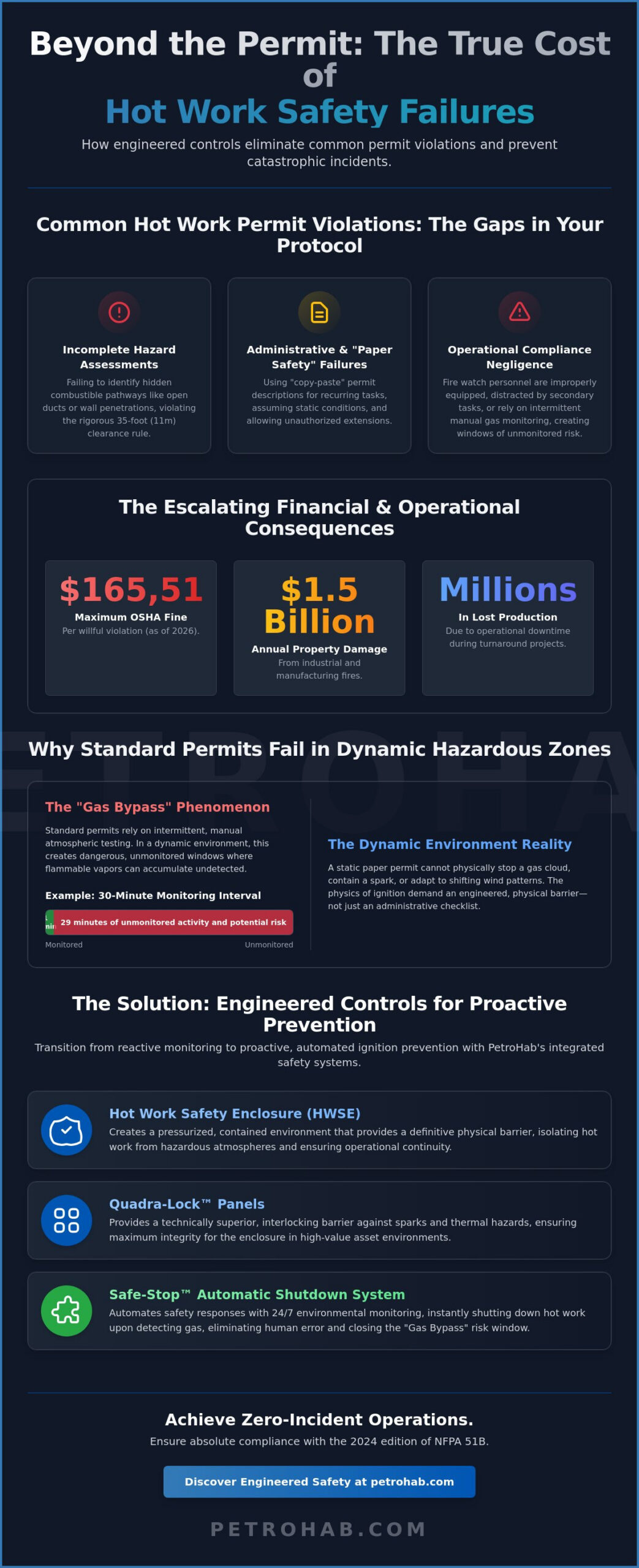
With OSHA maximum penalties for willful violations rising to $165,514 per instance in 2026, a single oversight in your safety protocol is a liability your facility can’t afford. Industrial fires cause an estimated $1.5 billion in property damage annually. Most of these incidents stem from common hot work permit violations that occur when production pressure overrides procedural discipline. You recognize that manual fire watches and gas monitoring are often susceptible to human error, especially during high-stakes turnaround projects where every hour of downtime impacts the bottom line.
This guide identifies the critical permit failures that jeopardize industrial safety and outlines how to implement engineered controls that ensure absolute compliance with the 2024 edition of NFPA 51B. We’ll analyze why traditional methods fail and how technical solutions like the PetroHab Hot Work Safety Enclosure (HWSE) provide a definitive remedy. By integrating the Safe-Stop Automatic Shutdown System and Quadra-Lock panels, you can transition from reactive monitoring to proactive ignition prevention. We provide a methodical breakdown of regulatory requirements and the technological benchmarks necessary to achieve zero-incident operations in hazardous environments.
Key Takeaways
- Identify common hot work permit violations, including incomplete hazard assessments and unauthorized extensions, to eliminate critical vulnerabilities in your safety protocol.
- Analyze the technical limitations of static permits in dynamic hazardous zones where shifting wind patterns require real-time, engineered isolation.
- Discover how modular pressurized habitats facilitate rapid maintenance without compromising the integrity of your ignition prevention strategy.
- Implement the Safe-Stop Automatic Shutdown System to automate safety responses and reduce the risk of human error during fire watch duties.
- Examine how Quadra-Lock panels provide a technically superior barrier against sparks and thermal hazards in high-value asset environments.
Identifying Common Hot Work Permit Violations in Industrial Environments
In the high-stakes environment of a refinery or offshore platform, the hot work permit serves as the primary defense against catastrophic ignition. However, common hot work permit violations frequently occur when the Permit Authorizing Individual (PAI) fails to account for the three-dimensional nature of industrial hazards. A critical failure involves incomplete hazard assessments that ignore hidden combustible pathways, such as open ducts or wall penetrations that allow sparks to travel beyond the immediate workspace. Adherence to hot work safety standards requires a rigorous 35-foot (11-meter) clearance rule. When site conditions make this radius impossible to clear, operators often proceed anyway, relying on a permit that is technically invalid and physically insufficient.
To better understand the mechanics of a compliant permitting process, watch this technical overview:
Administrative vs. Operational Compliance Failures
Paper safety is a dangerous illusion that often masks field-level negligence. Administrative failures, such as missing signatures or unauthorized permit extensions, are symptoms of a deeper breakdown in safety culture. We frequently observe “copy-paste” permit descriptions for recurring maintenance tasks. This practice assumes that site conditions remain static, ignoring dynamic variables like gas accumulation or shifting equipment layouts. Operational compliance requires active verification. When fire watch personnel are improperly equipped or distracted by secondary tasks, the permit becomes a liability rather than a safeguard. Effective mitigation demands that physical barriers, such as the PetroHab Hot Work Safety Enclosure (HWSE), reinforce the administrative intent of the permit.
The Escalating Cost of Non-Compliance in 2026
The financial consequences of safety oversight have reached unprecedented levels. As of January 15, 2026, OSHA has set the maximum penalty for a serious violation at $16,550, while willful and repeat violations can result in fines up to $165,514 per instance. Beyond regulatory penalties, the operational downtime during a turnaround project can cost facilities millions in lost production. With industrial and manufacturing fires causing an estimated $1.5 billion in annual property damage, the risk to high-value assets is absolute. Reputational damage in the global energy sector often follows preventable incidents, making full compliance with the 2024 edition of NFPA 51B an operational necessity rather than a choice. Utilizing Quadra-Lock panels and pressurized habitats ensures that your facility remains a leader in safety excellence.
Why Standard Permits Fail in Volatile Hazardous Zones
Standard hot work permits are administrative snapshots of a specific moment, yet industrial environments are inherently dynamic. In Class 1, Division 1 or 2 hazardous locations, the atmosphere can shift from non-hazardous to explosive in seconds due to equipment leaks or process upsets. This volatility is why common hot work permit violations often involve a failure to account for environmental changes that occur after the permit is signed. Relying on a static document to manage a fluid risk profile creates a false sense of security that ignores the physics of ignition.
The “Gas Bypass” phenomenon represents a critical risk where intermittent manual monitoring fails to detect transient gas plumes. If a technician tests the air every 30 minutes, there are 29 minutes of unmonitored activity where flammable vapors can accumulate. While NFPA 51B (2024 edition) provides a theoretical framework for safety, the offshore reality of high wind speeds and complex deck layouts demands engineered isolation. A permit alone cannot stop a gas cloud; only a pressurized habitat can provide the physical barrier necessary to maintain operations during a process excursion.
The Limitation of Visual and Manual Gas Monitoring
Human fire watches are incapable of detecting Lower Explosive Limit (LEL) fluctuations through sight or smell. Stagnant pockets of gas often accumulate in low-lying areas or behind structural members, remaining undetected by a single stationary monitor or a roving technician. OSHA standard 1910.252 mandates that the atmosphere must be tested before work begins and as frequently as necessary thereafter to ensure that no accumulation of flammable vapors occurs during the duration of the hot work. To eliminate the risk of human error, the Safe-Stop Automatic Shutdown System provides continuous, automated monitoring that immediately terminates the ignition source if gas is detected.
Environmental Factors Overlooked in Initial Permits
Temperature and humidity directly influence the behavior of flammable vapors, affecting their buoyancy and dispersion rates. High humidity can cause certain gases to linger near the floor, while high temperatures increase the evaporation rate of spilled hydrocarbons. Integrating hazardous environment standards into the permitting phase allows safety managers to predict these movements and implement superior ventilation. Without active containment, even a minor shift in wind direction can transport hydrocarbons directly into an active welding arc. Utilizing Quadra-Lock panels ensures that the work area remains physically isolated from these unpredictable environmental shifts.
Addressing the #1 Objection: The Efficiency vs. Safety Trade-off
Production managers often view safety protocols as friction. This perspective creates a dangerous environment where the “Quick Weld” fallacy thrives. Many operators believe that a minor, five-minute task doesn’t require the full rigor of an engineered enclosure. However, data indicates that these brief, unauthorized tasks account for a significant portion of common hot work permit violations. When a technician bypasses the permit process to maintain uptime, they introduce an unmitigated ignition source into a potentially explosive atmosphere. The perceived time saved is negligible compared to the catastrophic risk of an uncontained spark.
The setup time for a PetroHab Hot Work Safety Enclosure (HWSE) is a calculated investment, not a delay. While critics argue that engineered enclosures slow down turnaround schedules, they fail to account for the ROI of prevention. An accident investigation following a fire or explosion can halt operations for weeks or months. In contrast, a modular pressurized habitat can be deployed rapidly to provide a controlled environment. A permit is a piece of paper; it offers no physical resistance to a stray spark or a sudden gas release. Only engineered controls provide the barrier necessary to protect personnel and high-value assets from the physics of an industrial fire.
Misjudging the 35-Foot Rule in Offshore Environments
Offshore platforms present unique vertical hazards that a standard 35-foot horizontal radius doesn’t address. On multi-level structures, sparks and slag easily penetrate open steel grating, traveling far below the initial work site. This vertical migration is a leading cause of incidents because personnel on lower decks may be unaware of the hot work above. Implementing a pressurized welding habitat effectively isolates the ignition source at its origin. By using Quadra-Lock panels to seal the workspace, you eliminate the need for expansive, often impossible-to-maintain safety perimeters on complex offshore assets.
The Myth of Manual Fire Watch Sufficiency
Relying solely on a manual fire watch is a minimum regulatory requirement, not a comprehensive safety solution. Human observers are subject to fatigue, distraction, and environmental stress, making them the weakest link in the safety chain. A fire watch can only react after an ignition has occurred. True risk mitigation requires a transition from passive observation to active engineered suppression. The Safe-Stop Automatic Shutdown System automates this process, monitoring for LEL levels and pressure loss with a precision that human observers cannot match. This system ensures that the ignition source is terminated before a fire can begin, reinforcing the permit’s objectives with technical certainty.
Mitigating Risk Through Engineered Controls and Habitat Integrity
Effective risk mitigation requires shifting from administrative oversight to engineered defense. While permits document the intent to work safely, they cannot physically prevent gas ingress or spark escape. Addressing common hot work permit violations requires the implementation of the hierarchy of controls, where engineering solutions take precedence over manual observation. By establishing a pressurized environment, you create a definitive barrier that isolates the ignition source from the surrounding hazardous atmosphere. This technical approach ensures that safety is maintained through physics rather than just procedural compliance.
Habitat integrity depends on rigorous pre-work inspection and the use of high-performance materials. The PetroHab Hot Work Safety Enclosure (HWSE) utilizes modular components to adapt to complex industrial geometries. These systems don’t just contain sparks; they manage the environment. Maintaining a positive pressure differential is the primary mechanism for preventing flammable gas from entering the workspace. If the internal pressure remains higher than the external atmosphere, hazardous vapors cannot migrate toward the welding arc. This creates a controlled environment where hot work can proceed without jeopardizing the entire facility.
Implementing Pressurized Containment
Establishing a reliable pressurized habitat follows a structured technical sequence. Deviating from these steps often leads to the very common hot work permit violations safety managers aim to avoid. Consistency in setup is the hallmark of operational excellence.
- Step 1: Conduct a site-specific gas and pressure differential analysis to determine the baseline environmental risks and required airflow.
- Step 2: Deploy Quadra-Lock panels to create a 100% sealed environment around the work area, ensuring all structural penetrations are secured.
- Step 3: Establish and maintain a minimum pressure differential of 0.1 inches of water gauge (25 Pascals) to ensure continuous gas exclusion.
Automating the Shutdown Process
Removing human delay from the safety equation is essential for high-hazard operations. The hot work safety systems of 2026 integrate real-time sensors that trigger an instant shutdown if parameters are breached. When the Safe-Stop Automatic Shutdown System detects LEL levels or a loss of pressure, it terminates power to the welding equipment in milliseconds. This automation provides a level of reliability that manual fire watches cannot achieve. Digital manometers provide real-time pressure logging to create an immutable audit trail. This data proves that the habitat maintained integrity throughout the duration of the permit. For absolute reliability in volatile zones, secure your facility with the PetroHab HWSE today.
PetroHab HWSE: Eliminating Permit Violations Through Engineered Safety
PetroHab LLC engineering philosophy centers on replacing human fallibility with technical certainty. Many common hot work permit violations arise from the inability of standard equipment to adapt to the specific geometries of an industrial site. The PetroHab Hot Work Safety Enclosure (HWSE) addresses this through a modular design that allows for custom configurations around pipes, beams, and bulkheads. By utilizing premium, high-temperature fire-resistant materials, the system ensures absolute spark containment. This prevents the thermal migration and slag escape that often lead to regulatory citations and facility damage.
Global availability and on-site technical supervision further reinforce the permitting process. Having a specialist present ensures that the enclosure is installed according to the manufacturer’s precise specifications and the facility’s safety standards. This expert oversight reduces liability for safety managers, providing a documented layer of protection that satisfies both internal audits and international regulatory bodies. It transitions the permit from a mere administrative requirement into a verified safety outcome.
Patented Quadra-Lock Technology for Superior Integrity
The integrity of a pressurized habitat depends entirely on the quality of its seal. Traditional designs often rely on overlapping flaps or adhesive tapes that degrade under thermal stress, creating weak spots where sparks can escape or gas can enter. The Quadra-Lock system serves as the industry benchmark by utilizing a patented interlocking panel design. These Quadra-Lock Panels ensure a 100% sealed environment, eliminating the gaps common in inferior habitat designs. Positioned as a primary engineered control, the hot work safety enclosure provides a durable barrier that remains resilient in the harshest industrial climates.
Safe-Stop: The Ultimate Fail-Safe for Permit Compliance
While the physical enclosure provides the barrier, the Safe-Stop Automatic Shutdown System provides the intelligence. This system monitors both internal pressure and external gas concentrations without the need for constant human intervention. It ensures that hot work only occurs when the environment is fully controlled and the required pressure differential is maintained. The Safe-Stop system is engineered to terminate power to welding equipment in milliseconds upon detection of hazardous gas or pressure loss. This rapid response time eliminates the risk of human hesitation, ensuring that your facility remains compliant with the most stringent global safety standards while protecting your high-value assets from ignition risks.
Advancing Toward Zero-Incident Hot Work Operations
Achieving absolute compliance in high-hazard environments requires a transition from administrative paperwork to definitive engineered defense. You’ve seen how common hot work permit violations often stem from dynamic environmental shifts and the inherent limitations of manual observation. Relying on paper safety creates a vulnerability that only pressurized containment can eliminate. By integrating patented Quadra-Lock panel technology, you establish a 100% sealed environment that isolates ignition sources from volatile atmospheres. This technical precision is reinforced by ATEX and IECEx certified monitoring systems, providing the automated fail-safes necessary for 2026 regulatory standards.
Operational excellence is maintained through rigorous procedural discipline and the deployment of field-proven safety systems. PetroHab supports your commitment to personnel protection with a global footprint and 24/7 on-site technical support to ensure every habitat maintains peak integrity. Don’t leave your facility’s safety to chance during high-pressure turnaround projects. Request a technical consultation for your 2026 turnaround project to implement the industry’s most reliable ignition prevention protocols. Protect your high-value assets with the technical certainty they deserve.
Frequently Asked Questions
What is the most common hot work permit violation in refineries?
The failure to clear combustible materials within a 35-foot radius remains the most frequent oversight in industrial facilities. This violation occurs when personnel ignore hidden pathways like open ducts or wall penetrations that allow sparks to travel. In high-pressure environments, these common hot work permit violations often lead to immediate work stoppages. Effective mitigation requires the use of fire-resistant barriers and modular enclosures to physically isolate the work area from the surrounding plant.
Can a hot work permit be issued for a Class 1 Division 1 area?
Hot work can be performed in Class 1 Division 1 areas if the ignition source is fully isolated within a pressurized welding enclosure. These habitats create a controlled environment by maintaining positive pressure to prevent flammable gas ingress. You must use ATEX or IECEx certified monitoring systems to ensure compliance. A valid permit for these high-hazard zones requires continuous gas monitoring and an automated shutdown system to manage the extreme risk profile.
How long is a hot work permit typically valid for in 2026?
A hot work permit is typically valid for the duration of a single work shift, which usually spans 8 to 12 hours. However, the 2024 edition of NFPA 51B requires a re-evaluation of the site if conditions change significantly during that period. If work is suspended for more than 60 minutes, the Permit Authorizing Individual should inspect the area again. This ensures that no new hazards have emerged before the resumption of hot work activities.
Is a fire watch required if I am using a pressurized welding habitat?
A dedicated fire watch is mandatory even when using an engineered pressurized welding habitat. While the PetroHab HWSE provides superior physical protection, OSHA and NFPA 51B standards require human observation to detect unforeseen issues. The fire watch must remain on-site for at least 60 minutes after hot work is completed to monitor for smoldering fires. This human element complements the technical reliability of the Safe-Stop Automatic Shutdown System.
What happens if a hot work permit is violated during an OSHA inspection?
Violating a permit during an OSHA inspection leads to severe financial penalties and increased regulatory scrutiny. As of January 15, 2026, a serious violation carries a maximum fine of $16,550. If the violation is deemed willful or repeated, the penalty can escalate to $165,514 per instance. Beyond the fines, a violation often triggers a mandatory facility-wide safety audit, resulting in significant operational downtime and lost production revenue during turnaround projects.
What is the 35-foot rule in hot work safety, and are there exceptions?
The 35-foot rule requires that all flammable and combustible materials be removed or protected within an 11-meter radius of the hot work. Exceptions are permitted when the work is performed inside a pressurized habitat that contains all sparks and slag. By utilizing Quadra-Lock panels, you create a physical barrier that effectively reduces the required safety radius. This allows for hot work to proceed in congested areas without clearing the entire 35-foot zone.
How do automatic shutdown systems improve hot work permit compliance?
Automatic shutdown systems improve compliance by eliminating the risk of human error during gas detection. The Safe-Stop Automatic Shutdown System monitors LEL levels and habitat pressure with technical precision. If gas is detected or pressure is lost, it terminates power to the welding equipment in milliseconds. This proactive control ensures that common hot work permit violations related to inadequate monitoring are technically impossible, providing an immutable record for safety audits.
Who is legally responsible for a hot work permit violation on a multi-contractor site?
Responsibility for permit violations on multi-contractor sites is governed by OSHA’s Multi-Employer Citation Policy. Both the host employer and the specific contractor can be held liable for safety failures. The host employer is responsible for the overall safety of the facility, while the contractor must ensure their personnel follow all permit requirements. Shared liability underscores the need for standardized safety systems like the PetroHab HWSE to ensure universal compliance across all crews.