Blog Posts
Comprehensive Guide to Engineered Controls for Hot Work in 2026
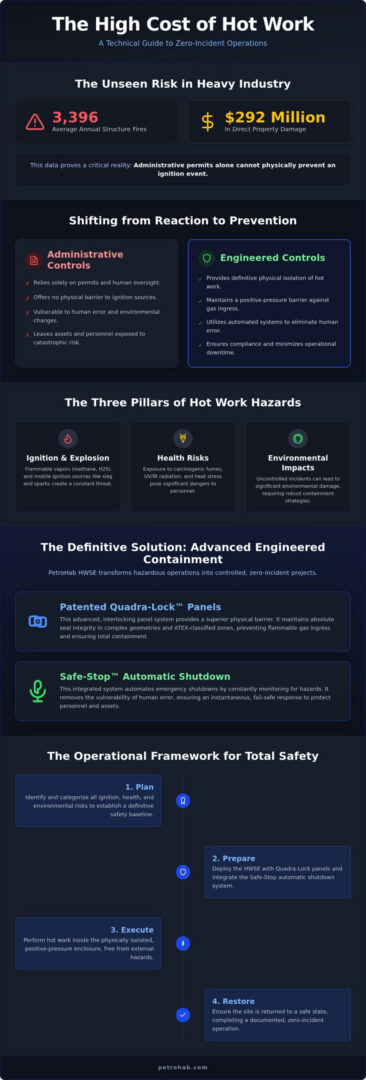
An average of 3,396 structure fires involving hot work occur annually, resulting in $292 million in direct property damage. This data underscores a fundamental reality in heavy industry: administrative permits alone cannot physically prevent an ignition event. You understand that in high-hazard environments, the margin for error is non-existent. Relying solely on fire watches and manual oversight in ATEX zones often leaves personnel and high-value assets exposed to catastrophic risk. Implementing robust engineered controls for hot work is the only way to provide definitive physical isolation from flammable gases.
This guide provides the technical framework to master the identification and mitigation of industrial ignition risks through advanced containment and automated safety protocols. We examine the implementation of PetroHab LLC Hot Work Safety Enclosures (HWSE) and the engineering behind patented Quadra-Lock panels. You’ll also learn how integrating the Safe-Stop automatic shutdown system removes human error from the safety equation to ensure global compliance and minimized maintenance downtime. This methodical approach transforms a hazardous necessity into a controlled, zero-incident operation.
Key Takeaways
- Identify and categorize industrial risks across ignition, health, and environmental pillars to establish a definitive baseline for site safety.
- Understand why engineered controls for hot work, specifically pressurized habitats, provide a superior physical barrier compared to standard administrative permits.
- Evaluate the technical advantages of patented Quadra-Lock panels for maintaining seal integrity in complex geometries and ATEX-classified zones.
- Master the deployment of Safe-Stop technology to automate emergency shutdowns and eliminate the vulnerability of human error during hazardous operations.
- Adopt a structured “Plan, Prepare, Execute, Restore” operational workflow to ensure total regulatory compliance and zero-incident performance.
Identifying Primary Hot Work Hazards in Industrial Environments
Hot work includes any industrial process producing open flames or thermal energy capable of igniting flammable substances. In hydrocarbon-rich environments, tasks like welding, brazing, and grinding represent constant threats to site integrity. To maintain operational safety, managers must follow rigorous Hot Work Safety Procedures. These hazards fall into three primary pillars: ignition and explosion risks, health-related dangers, and environmental impacts. Each pillar requires a distinct mitigation strategy to ensure the protection of personnel and high-value assets.
Traditional hazard identification often fails because it focuses on the immediate workspace while neglecting latent or distant ignition sources. Grinding sparks can travel significant distances, potentially reaching flammable vapor pockets in adjacent zones or falling through floor gratings into lower levels. This spatial risk requires the implementation of engineered controls for hot work to physically isolate the heat source from the volatile atmosphere. Relying solely on administrative oversight often leaves these peripheral risks unaddressed, increasing the likelihood of a secondary ignition event.
To better understand the practical execution of these safety roles, watch this helpful video:
Ignition Sources and Flammable Atmospheres
Industrial ignition depends on the Fire Triangle: fuel, oxygen, and heat. Hot work provides that final, critical leg. In oil and gas production, common flammable vapors like methane or hydrogen sulfide often linger in low-lying areas or within structural voids. Slag and molten metal particles act as mobile ignition points that can bypass simple barriers. Unlike administrative permits that merely record these risks, a PetroHab LLC HWSE actively neutralizes the threat by maintaining a positive-pressure barrier that prevents gas ingress into the work area.
Health Risks: Fumes, Radiation, and Heat Stress
Beyond explosion risks, hot work generates significant health hazards. Welding stainless steel produces hexavalent chromium, a carcinogen requiring specialized respiratory protection and local exhaust ventilation. UV and infrared radiation from arc welding can cause irreversible damage to the eyes and skin without proper shielding. Additionally, heat stress remains a pervasive threat in poorly ventilated or confined industrial areas. The 2026 OSHA updates now mandate specific heat index triggers, emphasizing the need for enclosures that facilitate both safety and environmental control for the workforce.
The Mechanics of Ignition: Why Standard Precautions Often Fail
Standard fire prevention measures frequently underestimate the dynamic nature of industrial hazards. While NFPA 51B establishes a 35-foot radius as a baseline for fire safety, high-velocity grinding sparks often exceed this distance, especially when propelled by offshore wind or high-capacity ventilation systems. In these high-stakes environments, basic fire blankets and portable screens don’t provide the absolute containment required for live plant operations. They are susceptible to displacement by environmental forces and cannot prevent the migration of flammable gases. These limitations demand the implementation of engineered controls for hot work that provide a continuous, physical barrier against projectile slag.
Industrial structures act as conduits for heat and ignition. The chimney effect allows sparks and thermal energy to travel vertically through floor gratings and open hatches, endangering personnel on upper decks. Vertical structures also facilitate the movement of heated air, which can reach auto-ignition temperatures in distant voids. Working on piping systems presents another layer of risk. Even after purging, pressurized residual hydrocarbons can remain trapped in valves or dead-legs. These pockets lead to explosive releases when the pipe wall is compromised by thermal stress or the heat of the weld, bypassing the protection offered by standard administrative permits.
Gas Migration and Accumulation Hazards
Effective engineered controls for hot work must account for the physical properties of escaping gases. Heavier-than-air hydrocarbons, such as propane or butane, pool in low-lying trenches and sumps, remaining undetected by workers at the site of the weld. Conversely, lighter gases accumulate in structural pockets or voids near the ceiling. Wind speed doesn’t always aid dispersion; it can push gas plumes directly toward an ignition source. Without physical isolation, a single spark can find these concentrated pockets, resulting in a flash fire. A pressurized HWSE solves this by creating a physical barrier that prevents gas ingress into the work area.
Conduction and Radiant Heat Transfer
Thermal energy travels through industrial alloys with high efficiency. During welding, heat conducts along steel pipes, potentially igniting flammable coatings or insulation in adjacent rooms. This blind ignition occurs where the worker cannot see the fuel source, making administrative oversight impossible. High thermal conductivity in common alloys ensures that the risk isn’t confined to the immediate arc. Utilizing a pressurized welding habitat equipped with Quadra-Lock panels ensures that the surrounding atmosphere remains isolated and protected, regardless of heat transfer through the substrate.
Mitigation Strategies: Engineered Containment vs. Administrative Controls
The industrial hierarchy of controls establishes a clear priority for risk mitigation: elimination, engineering, administrative, and PPE. While administrative permits are mandatory for legal compliance, they don’t physically prevent an explosion. They’re essentially a record of intent. Effective safety managers prioritize engineered controls for hot work because they address the environment itself rather than relying on human behavior. By utilizing pressurized welding habitats, operators can perform critical maintenance on live facilities without the massive financial burden of a full plant shutdown. This proactive approach treats safety as an integrated part of the engineering process.
A single day of unplanned downtime on a Tier 1 offshore platform can exceed $1.5 million in lost revenue. Implementing a PetroHab LLC HWSE allows for the safe execution of repairs during production, potentially saving between $250,000 and $1 million per day in avoided downtime costs. These systems are modular, allowing for rapid deployment around complex geometries such as manifolds and piping clusters. This capability transforms safety equipment into a tool for operational efficiency, ensuring that production targets are met without compromising site integrity. The adoption of engineered controls for hot work ensures that the ignition source remains isolated, regardless of external atmospheric changes.
The Limitations of Conventional Welding Screens
Standard welding screens or fire blankets provide a false sense of security in hazardous zones. These non-pressurized barriers fail to prevent gas ingress, as they don’t isolate the atmosphere. They’re merely visual and spark barriers. They lack the continuous electronic monitoring found in advanced systems. Because PPE is the last line of defense, it shouldn’t be the primary control method in environments where gas migration is a known variable. If a gas leak occurs, a screen won’t stop the plume from reaching the arc. Engineering the hazard out of the environment is the only reliable solution for high-stakes industrial sites.
Engineering Excellence: Positive Pressure Habitats
The core principle of a PetroHab LLC habitat is positive pressure containment. By maintaining a higher internal air pressure than the external atmosphere, the system physically blocks flammable gases from entering the workspace. This is achieved through a controlled blower system that provides continuous air exchange. This process removes toxic fumes and regulates temperature, ensuring personnel safety and compliance with the latest heat stress regulations. The integrity of the seal is maintained by patented Quadra-Lock panels, which are engineered to withstand extreme industrial conditions. For detailed technical specifications, consult The Definitive Guide to Hot Work Safety Enclosures (HWSE) in 2026.
Operational Best Practices for High-Risk Hot Work
Safe hot work execution follows a methodical lifecycle: Plan, Prepare, Execute, and Restore. During the preparation phase, the deployment of a PetroHab LLC HWSE establishes the necessary physical isolation. Execution requires strict adherence to digital Permit-to-Work (PTW) workflows, as mandated by the 2024 edition of NFPA 51B. The restore phase is equally critical, now requiring a 60-minute continuous fire watch to monitor for latent heat signatures. This structured approach ensures that engineered controls for hot work are supported by rigorous operational discipline.
Continuous gas monitoring is the cornerstone of site integrity. Periodic spot testing is insufficient in dynamic industrial environments where gas plumes can shift due to ventilation or wind. Industry data from 2025 indicates that 15% of hot work incidents resulted from improper gas detector placement or calibration. To mitigate this, monitors must be positioned at both the air intake and within the enclosure. Failure to maintain these standards can result in OSHA citations exceeding $16,131 per violation, making technical precision a non-negotiable requirement for safety managers.
Integrating Automatic Shutdown Systems
Modern safety architecture relies on the seamless integration of detection and response. When an LEL detector identifies a flammable concentration, the system must trigger an immediate cessation of all ignition-producing activities. This is achieved by interlocking power sources with habitat pressure sensors and gas detectors. If internal pressure drops or a hazard is detected, the Safe-Stop system automatically cuts power to the welding equipment. For a detailed look at this technical framework, review our guide on Advanced Hot Work Safety Systems.
Conducting a Rigorous Job Safety Analysis (JSA)
A JSA for offshore or refinery environments must address variables that standard checklists often overlook. Site conditions like wind direction and deck drainage frequently require expanding the safety perimeter beyond the standard 35-foot radius. The JSA must document how sparks will be contained if work is performed at height and how residual risks are communicated to the entire crew. Utilizing Quadra-Lock panels ensures that the enclosure remains resilient against high-pressure leaks, but the JSA must still define the specific shutdown logic for each unique task. To secure your operations with industry-leading technology, contact PetroHab LLC for a technical consultation.
Advanced Solutions: PetroHab LLC HWSE and Safe-Stop Technology
The PetroHab LLC Hot Work Safety Enclosure (HWSE) represents the definitive technological remedy for ignition risks in 2026. While standard welding tents offer limited protection, this system serves as the primary implementation of engineered controls for hot work, ensuring absolute atmospheric isolation. The modular architecture allows for precise configuration around complex industrial geometries, such as horizontal piping runs and vertical manifolds. This flexibility ensures that the physical barrier remains intact even in the most congested workspaces. By providing a customizable containment solution, PetroHab LLC enables operators to maintain rigorous safety standards without compromising the efficiency of maintenance schedules.
Engineering a resilient enclosure requires a holistic approach to risk mitigation that extends beyond simple fire resistance. Every component of the PetroHab LLC system is designed to meet or exceed the latest Hazardous Environment Standards. This commitment to technical precision ensures that the brand remains a trusted safety partner for global energy majors. By integrating advanced materials with automated logic, the HWSE transforms a high-risk task into a calculated and controlled industrial process. This integration ensures that site integrity is preserved regardless of the external atmospheric conditions or the proximity of flammable substances.
Modular Protection with Quadra-Lock Panel Technology
The structural foundation of the enclosure relies on patented Quadra-Lock panels, which provide superior seal integrity compared to standard fastening methods. Standard panels can allow for pressure loss at the seams, but the interlocking design of Quadra-Lock ensures a continuous and airtight barrier. These panels are manufactured from high-grade, silicone-coated fiberglass capable of withstanding continuous temperatures up to 1,000°F (540°C). This durability is essential for protecting against prolonged thermal exposure and projectile slag. The ease of assembly and disassembly allows crews to deploy the system rapidly in restricted offshore spaces, where deck area is limited and operational speed is critical for project success.
Ensuring Integrity with Safe-Stop Automatic Shutdown
Physical containment is maximized when paired with the Safe-Stop Automatic Shutdown System, which functions as the active guardian of the enclosure. This technology continuously analyzes data from gas detectors and pressure sensors to maintain the integrity of the work environment. If the system detects flammable gas (LEL), H2S, or a drop in internal pressure, the fail-safe mechanism immediately terminates power to all welding equipment and ignition sources. This automated response eliminates the dangerous delay inherent in manual emergency protocols. In the high-noise environments typical of heavy industry, the system utilizes both audible and visual alarms to provide instantaneous alerts. This multi-layered approach to engineered controls for hot work ensures that hazards are neutralized before they can escalate into catastrophic events.
Standardizing Operational Excellence through Advanced Containment
Industrial safety in 2026 demands a transition from reactive administrative oversight to proactive environmental isolation. You recognize that permits alone cannot physically block a gas plume or stop a high-velocity spark. Standardizing site protection requires the deployment of a pressurized habitat that creates a definitive barrier between ignition sources and flammable atmospheres. This technical shift ensures that zero-incident operations remain achievable even in the most volatile ATEX zones. It’s a fundamental requirement for maintaining site integrity during live production.
Utilizing engineered controls for hot work provides the physical integrity needed to protect high-value assets and personnel. By combining patented Quadra-Lock technology with the Safe-Stop automatic shutdown system, you eliminate the vulnerabilities associated with human error and manual monitoring. This integrated approach is why global oil and gas majors trust these systems to maintain production while executing critical repairs. Reliability is built on technical precision and an uncompromising commitment to safety excellence. Meticulous engineering is the only reliable defense against the unpredictable nature of hazardous environments.
Request a technical consultation for PetroHab LLC HWSE and Safe-Stop systems to strengthen your operational resilience. Protecting your site with the industry benchmark ensures long-term safety and operational continuity.
Frequently Asked Questions
What is the most common cause of hot work accidents in oil and gas?
The most common cause is the ignition of flammable vapors or gases that have migrated into the work area from distant leaks or structural voids. Industry data indicates that human error in administrative oversight, specifically improper gas detector placement or calibration, contributes to 15% of incidents. These accidents often occur because standard barriers fail to provide the physical isolation required in hydrocarbon-rich environments. Relying on permits alone doesn’t stop gas ingress.
How does a pressurized welding habitat mitigate hot work hazards?
A pressurized welding habitat mitigates hazards by maintaining a higher internal air pressure than the surrounding atmosphere. This positive pressure creates a physical barrier that prevents flammable gases from entering the enclosure. By utilizing engineered controls for hot work, operators ensure that the ignition source remains isolated from potential fuel sources. The system also facilitates continuous air exchange to remove toxic fumes and regulate internal temperatures for personnel safety.
Can hot work be performed in an ATEX Zone 1 area safely?
Yes, hot work can be performed in ATEX Zone 1 areas when utilizing a certified Hot Work Safety Enclosure (HWSE). These systems are designed to create a localized environment where the explosive atmosphere is physically excluded. By implementing a PetroHab LLC with Quadra-Lock panels, engineers can execute repairs on live facilities without a full plant shutdown. This approach meets the rigorous international standards required for equipment operating in potentially explosive atmospheres.
What happens if the positive pressure in an HWSE is lost?
If positive pressure is lost, the Safe-Stop Automatic Shutdown System initiates an immediate cessation of all hot work activities. Sensors detect the pressure drop and instantly cut power to welding machines and other ignition sources. This fail-safe mechanism prevents flammable gases from reaching the arc during a breach. Once the system identifies the loss of integrity, audible and visual alarms alert the crew to evacuate or restore the pressure barrier.
Is a fire watch required if a pressurized enclosure is used?
Yes, a fire watch remains a mandatory requirement under NFPA 51B and OSHA standards even when utilizing a pressurized enclosure. The fire watch provides a critical layer of human oversight to monitor for heat transfer or sparks that might bypass the enclosure’s seals. Current 2026 protocols mandate that the fire watch continues for at least 60 minutes after hot work is completed to detect any latent heat signatures or smoldering materials.
What are the OSHA requirements for hot work in confined spaces?
OSHA requirements for hot work in confined spaces, governed by 29 CFR 1910.146 and 1910.252, mandate rigorous atmospheric testing and continuous ventilation. Employers must issue a specialized permit and ensure that oxygen levels, flammable gases, and toxic fumes are within permissible limits. The use of engineered controls for hot work in these spaces helps maintain a breathable atmosphere while preventing the accumulation of hazardous vapors that could be ignited by welding or grinding.
How often should gas detectors be calibrated for hot work monitoring?
Gas detectors must be calibrated according to the manufacturer’s specifications, which typically require a full calibration every six months. However, safety protocols for high-risk industrial sites mandate a daily “bump test” before each shift to verify sensor responsiveness. Accurate calibration is vital, as industry research from 2025 shows that 15% of incidents are linked to sensor failures or improper placement. Regular maintenance ensures the Safe-Stop system functions with technical precision.
What is the difference between a welding screen and a hot work safety enclosure?
A welding screen is a passive barrier designed only to block sparks and UV radiation, whereas a hot work safety enclosure provides total environmental isolation. Unlike screens, an HWSE uses positive pressure and Quadra-Lock panels to physically exclude flammable gases from the workspace. While screens are often classified as administrative or PPE-level controls, an HWSE represents a definitive technological remedy that engineers the hazard out of the environment entirely.