
Blog Posts
Fire-Resistant Air Ducting: Ensuring Positive Pressure in Hazardous Zones
In a Zone 1 or Zone 2 hazardous environment, the difference between a controlled hot work operation and a catastrophic ignition event often depends on the integrity of a single air duct. It’s the critical artery that sustains life and safety within a pressurized enclosure. You already know that maintaining positive pressure is the only way to ensure zero gas ingress during welding or cutting operations. When high-wind offshore conditions or volatile ambient gases challenge your site’s safety protocols, your choice of fire resistant habitat material and ducting must perform without hesitation. Relying on standard ventilation isn’t just a risk; it’s a violation of the rigorous standards your operations demand.
This article details how specialized fire-resistant air ducting maintains the necessary pressure differential to protect your personnel and high-value assets. You’ll discover the engineering requirements for full compliance with the 2024 edition of NFPA 51B and ATEX standards. We’ll also examine the synergy between PetroHab’s patented Quadra-Lock technology and the Safe-Stop Automatic Shutdown System. By the end of this guide, you’ll understand how to achieve a secure, pressurized environment that safeguards your site against the most demanding industrial hazards.
Key Takeaways
- Understand why precision-engineered ducting is the only reliable method for maintaining the positive pressure required to prevent gas ingress in Zone 1 and Zone 2 environments.
- Learn to distinguish between standard industrial hoses and certified fire resistant habitat material to eliminate the risk of toxic off-gassing and material degradation during hot work.
- Evaluate critical selection factors such as diameter, friction loss, and resistance to corrosive offshore elements to ensure consistent airflow to the habitat.
- Discover how the synergy between PetroHab ducting and the Safe-Stop Automatic Shutdown System provides an automated layer of protection for personnel and assets.
Understanding Fire-Resistant Air Ducting for Industrial Hot Work
Fire-resistant air ducting serves as the primary conduit for atmospheric control in high-risk industrial zones. Unlike standard ventilation, these systems are engineered to withstand the extreme thermal loads found in refineries and offshore energy platforms. Their design prioritizes the delivery of a continuous, clean air supply to a Hot Work Safety Enclosure (HWSE), ensuring that volatile gases remain outside the work area. This equipment isn’t just a ventilation tool; it’s a critical safety component that bridges the gap between hazardous ambient conditions and a secure workspace.
Many operators mistake generic high-temperature hoses for specialized safety equipment. While a standard hose might handle heat, it often lacks the structural integrity to maintain Positive pressure during a localized fire event. True fire resistant habitat material must resist ignition while maintaining its shape under high airflow volumes. This distinction is critical for safety managers who must prevent gas ingress into active welding zones. Using the correct ducting is essential for any pressurized welding habitat to function as intended.
To better understand how these systems function within a complete safety ecosystem, watch this helpful video:
The Anatomy of Fire-Resistant Ducting
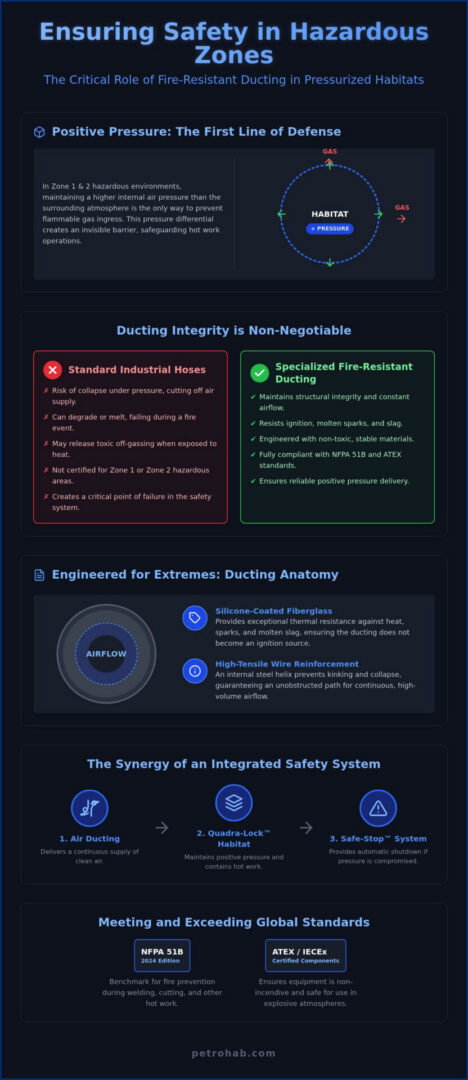
The construction of these ducts involves multi-layered engineering. Manufacturers typically use silicone-coated fiberglass for the core material because it provides exceptional thermal resistance. This material doesn’t just block heat; it resists the molten sparks and slag common in heavy welding operations. To prevent collapse under high-pressure demands, the ducting features internal high-tensile wire reinforcement. This ensures that the air supply remains unobstructed even when the ducting is routed through complex, cramped industrial structures. Without this reinforcement, the risk of a pressure drop increases, potentially compromising the entire safety enclosure.
Regulatory Standards and Compliance in 2026
Compliance is non-negotiable in hazardous zones. The 2024 edition of NFPA 51B sets the benchmark for fire prevention during hot work, requiring that all materials used in containment systems meet strict fire-resistance criteria. For operations in Zone 1 or Zone 2 areas, ducting and fan components must also carry ATEX or IECEx certifications to prevent them from becoming ignition sources themselves. PetroHab ensures that every component of its pressurized systems meets these international safety benchmarks. By integrating certified fire resistant habitat material into a broader safety strategy, engineers can guarantee that their site remains fully compliant with the latest global regulations while protecting personnel from catastrophic events.
The Critical Role of Ducting in Maintaining Positive Pressure Habitats
Positive pressure operates on a simple but absolute physical principle: keeping internal air pressure higher than the external atmosphere prevents the entry of hazardous contaminants. In industrial zones, this pressure serves as the primary barrier against flammable gases. The air ducting acts as the critical artery for the pressurized welding habitat, delivering the constant volume of air required to maintain this differential. If the ducting loses integrity, the pressure barrier collapses instantly. This failure allows ambient gases to penetrate the enclosure, transforming a controlled environment into a potential ignition site.
Reliability is the cornerstone of effective hot work safety systems. Every meter of ducting must be constructed from high-grade fire resistant habitat material to survive the radiant heat and sparks inherent in industrial maintenance. Unlike passive insulation, which only slows heat transfer, an active pressurized system requires the ducting to function perfectly under continuous stress. Any tear or structural collapse in the conduit compromises the safety of the entire operation. Maintaining this mechanical link is essential for protecting both the personnel inside and the high-value assets surrounding the work zone.
Preventing Gas Ingress Through Managed Airflow
Consistent airflow creates a physical wall against Zone 1 and Zone 2 gases. To ensure this air remains clean, operators must position intake fans in designated “fresh air” zones, far from potential hazardous sources. Compliance with OSHA hot work regulations requires rigorous monitoring of these environments to prevent the intake of toxic or flammable vapors. PetroHab systems utilize integrated manometers to provide real-time pressure data. These instruments allow technicians to verify that the internal pressure remains at least 0.05 inches of water column above the external atmosphere, effectively sealing the workspace against outside threats.
Optimizing Air Exchange Rates for Worker Safety
Maintaining pressure is only half of the technical challenge. The system must also facilitate rapid air exchange to remove toxic welding fumes and dissipate excess heat. Engineers calculate the required cubic feet per minute based on the habitat’s volume and the specific welding processes being performed. A balance is necessary; too much pressure can cause panel bulging, while too little risks worker fatigue and fume buildup. PetroHab designs its HWSE components to optimize this balance, ensuring technicians can perform long-duration maintenance shifts in a cool and breathable environment. If you’re planning a high-stakes maintenance project, consider how PetroHab’s integrated components can streamline your safety compliance.
Material Science: Why Standard Industrial Hoses Fail in Hazardous Zones
Standard industrial hoses often rely on thermoplastic or PVC construction. While these materials are suitable for general ventilation, they fail catastrophically when exposed to welding sparks or intense radiant heat. Thermoplastics melt at relatively low temperatures, causing the air conduit to collapse and the pressure barrier to fail. Even more dangerous is the risk of toxic off-gassing. When non-certified materials are exposed to high heat, they release hazardous vapors that can incapacitate personnel inside the enclosure before any fire is even detected.
Choosing the correct fire resistant habitat material is a prerequisite for any safety-critical operation. Engineered ducting must adhere to rigorous benchmarks like the NFPA 2112 standard for flame resistance. This ensures the material won’t support combustion or contribute to fire spread. This material integrity is vital when used alongside high-performance Quadra-Lock Panels, which are designed to contain sparks and heat. If the ducting fails, the entire containment system loses its functional purpose, regardless of how robust the panels are.
Environmental factors also dictate material selection for offshore energy facilities. Platforms present a corrosive combination of high UV exposure and constant salt spray. Standard hoses degrade quickly under these conditions, becoming brittle and prone to cracking. PetroHab’s ducting is specifically treated to resist these environmental stressors, ensuring a long service life in the harshest global climates without compromising the safety of the pressurized habitat.
Radiant Heat vs. Direct Flame Contact
PetroHab ducting is engineered to withstand intense radiant heat without losing its structural profile. Safety-critical ventilation must possess self-extinguishing properties, meaning it won’t continue to burn once the ignition source is removed. This prevents the ducting from acting as a “fuse” that could carry a fire from the work zone to other parts of the facility. By utilizing advanced composites, we ensure that the air supply remains protected even during localized thermal events, maintaining the integrity of the fire resistant habitat material throughout the project duration.
Mechanical Resilience and Wearstrips
Industrial sites are inherently abrasive. Ducting often drags across jagged steel gratings or sharp-edged machinery. To counter this, our ducting features external wearstrips that provide a sacrificial layer of protection against tears and punctures. Despite this ruggedness, the conduit remains highly flexible. Kink-resistance is mandatory; a single fold in the duct can restrict airflow and trigger a pressure drop. Our manufacturing process focuses on creating a resilient yet maneuverable product that survives heavy-duty site abuse while maintaining the constant airflow required for habitat safety.
Selection Criteria for Hazardous Environment Ducting
Selecting ducting for a hazardous zone requires a precise calculation of airflow volume versus friction loss. Engineers must account for the internal resistance that occurs when routing air over long distances to reach a PetroHab Hot Work Safety Enclosure. As the length of the conduit increases, static pressure drops, which can starve the habitat of the air needed to maintain its protective barrier. To avoid this, you must ensure your ducting is fully compatible with standard 12-inch or 24-inch industrial blowers capable of overcoming these losses.
Certification serves as the final filter for any selection process. Every component must possess verified fire-resistance documentation, such as UL 94 ratings. For Zone 1 and Zone 2 environments, ATEX and IECEx certifications for the fan and ducting assembly are mandatory to prevent the equipment from acting as an ignition source. Choosing a certified fire resistant habitat material ensures your safety protocols remain robust even when exposed to extreme thermal loads. This technical verification is the only way to guarantee compliance with international safety standards.
Offshore vs. Onshore Environmental Stressors
Offshore platforms present mechanical challenges that differ significantly from onshore facilities. High-wind loads can cause ducting to whip or vibrate, leading to material fatigue or detachment at connection points. Stability and reinforced attachment points are critical in these environments. Conversely, onshore refineries often expose equipment to abrasive dust and caustic chemical vapors. A one-size-fits-all approach often leads to premature material failure. You need a solution engineered to resist these specific stressors to prevent hazardous leaks during critical maintenance windows.
Deployment and Storage Best Practices
Operational efficiency depends on how easily safety equipment can be transported and deployed. High compressibility is a logistical necessity for shipping ducting to remote offshore sites or inland facilities with limited storage space. Once on-site, personnel must be trained on the correct securing techniques to prevent pressure leaks at the blower or habitat interface. Proper storage between projects is equally vital. Keeping the conduit in a dry, UV-protected environment prevents the fire resistant habitat material from losing its essential flame-retardant properties over time. If you’re ready to upgrade your containment strategy, contact PetroHab for engineered ducting solutions.
PetroHab Air Ducting: Engineered for Integrated Habitat Safety
PetroHab positions its air ducting as the definitive engineered solution for pressurized environments. While many providers offer standalone ventilation components, we deliver an integrated safety ecosystem. Our ducting is specifically designed to interface with the Quadra-Lock containment system, creating a unified barrier against external hazards. This synergy ensures that every element of the Hot Work Safety Enclosure (HWSE) operates as a single, resilient unit. By utilizing high-grade fire resistant habitat material, we eliminate the weak links often found in generic site setups. This uncompromising focus on material science guarantees that the air supply remains protected even when the enclosure is subjected to direct sparks or slag.
Reliability in hazardous zones isn’t just about individual parts; it’s about how those parts communicate under pressure. Our ducting isn’t a mere hose, but a calculated safety component that maintains its structural integrity when other materials would fail. This commitment to engineering excellence allows safety managers to authorize hot work permits with absolute confidence. When you choose PetroHab, you’re investing in a system designed by veterans who understand the granular risks of the energy sector.
Seamless Integration with Safe-Stop Technology
The true value of our ducting lies in its role within the Safe-Stop Automatic Shutdown System. It provides the managed airflow required for gas detection sensors to receive accurate environmental samples from the fresh air intake. If a pressure loss occurs or flammable gas is detected at the intake, the Safe-Stop system initiates an automatic shutdown of all hot work activities. This fail-safe ventilation loop depends entirely on the structural integrity of the ducting conduit. Because our conduit uses premium fire resistant habitat material, it maintains its profile even under significant thermal stress. This ensures that safety sensors aren’t compromised by material collapse, which could otherwise lead to a dangerous delay in the shutdown sequence.
Custom Solutions and Global Support
Complex offshore layouts often require bespoke ventilation configurations to navigate around existing infrastructure. PetroHab provides tailored ducting lengths and specialized routing strategies to overcome the logistical challenges of cramped or high-elevation work zones. We distinguish ourselves from other hot work safety enclosure suppliers by offering comprehensive on-site supervision and specialized technician training. Our global presence in Houston, Brazil, and the UK ensures that your team has expert support during every phase of habitat setup and maintenance. We don’t just supply equipment; we act as a critical safety partner to ensure operational excellence in the most demanding environments. To secure your site with an engineered solution, request a technical consultation for your HWSE ventilation needs.
Advancing Hot Work Safety Through Integrated Engineering
Maintaining the integrity of a pressurized habitat requires more than just high-quality panels. It demands a sophisticated air delivery system that functions as a reliable safety barrier. Selecting the correct fire resistant habitat material for your ducting is a critical step in preventing gas ingress and ensuring compliance with international safety standards. By choosing components engineered for the rigors of heavy industry, you eliminate the risk of material failure during high-stakes hot work operations.
PetroHab provides a solution that fully integrates patented Quadra-Lock technology with the Safe-Stop Automatic Shutdown System. Our global engineering support ensures that your specific site challenges are met with technical precision and unwavering reliability. Don’t settle for fragmented safety parts when you can implement a comprehensive, fail-safe environment for your technicians. This integrated approach is the only way to guarantee that your safety protocols remain robust under pressure.
Secure Your Hazardous Site with PetroHab Air Ducting and take the definitive step toward operational excellence and personnel protection. Your commitment to safety deserves equipment that’s as resilient as your workforce.
Frequently Asked Questions
What is the maximum temperature fire-resistant air ducting can withstand?
Fire-resistant ducting must maintain its integrity at service temperatures of at least 250°F (121°C) according to ASTM C411 standards. Specialized variants used in heavy industry often feature much higher thresholds to survive radiant heat from welding. It’s critical to verify the specific thermal rating of your fire resistant habitat material against the maximum expected heat load of your hot work operation to prevent material collapse or hazardous off-gassing.
How does ducting help maintain positive pressure in a welding habitat?
Ducting serves as the primary conduit that delivers a continuous volume of fresh air from a safe intake zone into the enclosure. This constant inflow creates an internal pressure higher than the ambient atmosphere, effectively sealing the workspace. By maintaining this pressure differential, the ducting ensures that flammable gases cannot enter the habitat. It acts as the mechanical link that sustains the active barrier required for safe hot work operations.
Is ATEX certification required for air ducting in Zone 1 areas?
Yes, equipment used in Zone 1 environments must meet ATEX or IECEx standards to ensure it doesn’t become an ignition source. While the ducting material itself is passive, the entire ventilation assembly, including the fans and conductive components, must be certified for use in explosive atmospheres. This compliance is a mandatory requirement for obtaining hot work permits in refineries and offshore facilities where volatile gases are frequently present.
Can I use standard HVAC ducting for pressurized hot work enclosures?
No, standard HVAC ducting lacks the specialized properties required for hazardous industrial zones. These materials often melt, support combustion, or release toxic off-gassing when exposed to welding sparks or radiant heat. Industrial safety protocols require engineered fire-resistant conduits that comply with NFPA 51B. Using non-certified materials compromises the integrity of the pressurized habitat and risks catastrophic failure during a localized fire event or unexpected gas leak.
What is the difference between fire-retardant and fire-resistant materials?
Fire-retardant materials are typically treated with chemicals to slow the spread of flames, whereas fire-resistant materials are inherently designed to withstand heat and resist ignition. In a pressurized welding habitat, you must use fire-resistant materials that maintain structural integrity under extreme thermal loads. This ensures the air conduit doesn’t collapse or become a fuel source, providing a more reliable safety barrier than simple retardant treatments for high-stakes industrial environments.
How often should air ducting be inspected for leaks or damage?
You should inspect air ducting before every deployment and at the start of each work shift. Technicians must check for tears, punctures, or kinks that could cause a pressure drop within the Hot Work Safety Enclosure. Environmental factors like salt spray and UV exposure on offshore platforms can accelerate material degradation. Regular maintenance ensures the fire resistant habitat material performs as engineered, protecting personnel and high-value assets from ignition risks.
How long can PetroHab air ducting be extended without losing pressure?
The maximum extension length depends on the blower’s capacity and the friction loss calculated for the specific duct diameter. PetroHab engineers help you determine the optimal configuration to ensure consistent positive pressure is maintained over long distances. We provide custom configurations that balance airflow volume with static pressure requirements. This technical precision ensures the Safe-Stop system receives accurate pressure data regardless of the distance from the air intake.
What materials are used in PetroHab fire-resistant ducting?
PetroHab utilizes high-grade materials such as silicone-coated fiberglass to provide superior thermal and spark resistance. The ducting features internal high-tensile wire reinforcement to prevent collapse and external wearstrips to protect against abrasion on jagged industrial surfaces. These components are selected for their durability in harsh offshore and refinery environments. This engineering ensures the ducting works seamlessly with Quadra-Lock panels to maintain a secure and pressurized workspace during hot work.