Blog Posts
FSRU Habitat Rental: A Buying Guide for Offshore Hot Work
What should an FSRU habitat rental include beyond the enclosure itself? For an offshore hot-work campaign, the scope needs to fit the task and worksite while accounting for monitoring, shutdown controls, and coordination with nearby operations.
Choosing a pressurized habitat is an important decision, but the project also needs clear requirements for enclosure configuration, gas and pressure monitoring, operational support, and responsibilities. Defining these details early helps the team compare the proposed scope with campaign needs and vessel constraints.
This guide explains how to define a project-specific rental scope for FSRU hot work. It covers the site and campaign details to assess, the enclosure and monitoring capabilities to consider, and how supervision and training can support execution. It also explains how PetroHab’s Safe-Stop Automatic Shutdown System fits into the control discussion, so responsibilities are clear before deployment.
Key Takeaways
- Decide whether temporary rental fits the defined maintenance or repair campaign, separately from planning the full FSRU work program.
- Match the enclosure arrangement to the work area, access constraints, and project-defined hazards. Pressurized welding enclosures are configured for the task, not assumed to suit every site.
- Define the FSRU habitat rental scope by identifying the enclosure, relevant monitoring, project configuration, and support required for the work.
- Prepare for mobilization by documenting the project location, site constraints, schedule assumptions, and responsible contacts before operational handover.
- Use PetroHab equipment, on-site supervision, and training to align the rental scope and execution support with project requirements.
When Does FSRU Habitat Rental Fit an Offshore Hot Work Campaign?
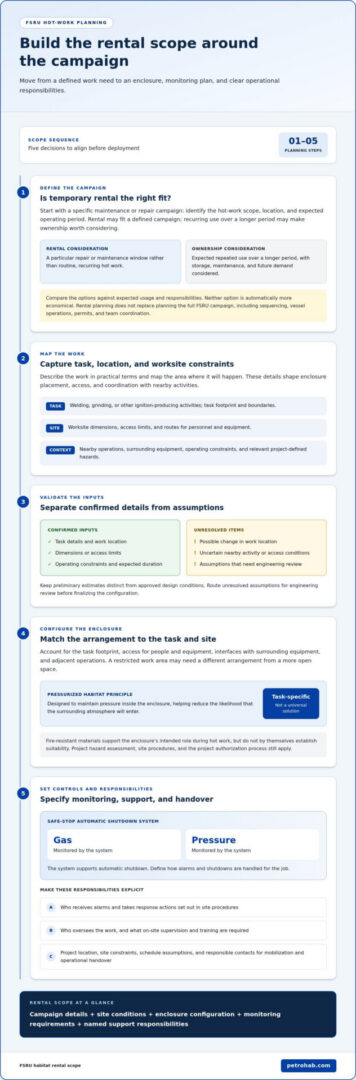
Temporary rental can suit a defined maintenance or repair campaign when the hot work has a specific scope, location, and operating period. In that case, the project can plan for an enclosure and related support for the campaign rather than keeping equipment for routine use. The rental decision concerns the habitat equipment and support. It doesn’t replace planning the full FSRU campaign, including work sequencing, vessel operations, permits, and coordination across teams.
Start by defining where the work will take place, which tasks are planned, how long the enclosure is expected to be used, and what activities will continue nearby. These inputs help the team decide whether a project-specific enclosure scope fits and what site coordination it requires. The broader hot work safety enclosure guide provides context on enclosure use and planning.
Which project conditions shape the rental requirement?
Describe the hot work in practical terms: welding, grinding, or other ignition-producing tasks; the work area and its boundaries; access for personnel and equipment; and nearby operations that could affect the job. On an FSRU, location and operating context can affect enclosure placement, access, and the controls required by project procedures. For example, a restricted route to the work area may affect how the team plans setup and movement of equipment.
A pressurized habitat is designed to maintain pressure inside the enclosure, helping reduce the likelihood that the surrounding atmosphere will enter. The Positive pressure enclosure reference explains this operating principle. Project teams still need to identify hazards and controls through applicable site procedures. An enclosure doesn’t replace those procedures or the project’s authorization process.
Separate established inputs from assumptions. Record confirmed task details, worksite dimensions or access limits, operating constraints, and expected duration. Mark unresolved items, such as a possible change in work location or uncertain nearby activity, for engineering review before finalizing the configuration. This helps prevent preliminary estimates from being treated as approved design conditions.
Rental or ownership for a defined campaign?
Rental can fit a temporary campaign when the need is tied to a particular repair or maintenance window rather than routine, recurring hot work. Ownership may merit consideration when a facility expects repeated use over a longer period. Neither option is automatically more economical. Compare the options against the expected usage pattern and the responsibilities each involves.
Include more than the time the habitat will be at the worksite. Consider the full expected period of use, how equipment will be stored between campaigns, who will manage maintenance, and whether future demand is sufficiently defined to support keeping equipment on hand. A short campaign followed by long periods without use has different requirements from recurring work across planned maintenance cycles.
For a sound decision, align the commercial analysis with the technical scope: work location, task, operating context, expected duration, and required support. PetroHab manufactures and leases modular Hot Work Safety Enclosures, so project teams can consider rental equipment and support against those specific requirements.
Match FSRU Habitats to Worksite and Safety Scope
Configure an enclosure around the hot-work task and conditions at its location, rather than assuming one arrangement fits every FSRU. A welding repair in a confined work area with restricted access may need a different arrangement from work in a more open space. Account for the task footprint, personnel and equipment access, nearby operations, and hazards identified for that worksite.
Pressurized welding enclosures are one configuration for controlling the immediate hot-work environment. They aren’t a universal solution. Suitability depends on the work area, project-defined hazards, and controls established for the job. The pressurized welding habitat technology guide provides more detail on habitat design and operating principles.
What should the enclosure scope account for?
Map the task area and the route used to access it. Include interfaces with surrounding equipment and adjacent operations, since these can affect placement, entry, and coordination. Use the project hazard assessment and site procedures to identify relevant conditions and specify controls. For U.S. offshore work, the Bureau of Safety and Environmental Enforcement (BSEE) provides agency information that can inform project planning.
Fire-resistant materials support the enclosure’s intended role during hot work, but their presence alone doesn’t establish that a configuration suits a particular task. Distinguish verified inputs, such as work location and planned activity, from assumptions about access, surrounding conditions, or operating interfaces. Route assumptions that require engineering review before treating them as rental requirements.
How do monitoring and shutdown controls support the scope?
Set monitoring requirements according to the hazards and controls identified for the specific work. PetroHab’s Safe-Stop Automatic Shutdown System monitors gas levels and pressure and supports automatic shutdown. It adds defined monitoring and response capabilities to the enclosure scope, while project teams establish how alarms and shutdowns are handled for the job.
Specify who receives alarms, takes the response actions set out in site procedures, and oversees the work. Define how the monitoring system fits with other project controls and communication arrangements. System features don’t replace site procedures, hazard assessment, or competent oversight. Clear roles matter as much as the equipment specification.
Use the worksite and control requirements to shape the configuration before mobilization. PetroHab’s modular enclosures and monitoring systems can be scoped around defined project needs. Explore PetroHab habitat and monitoring options as part of the assessment.
What Should an FSRU Habitat Rental Package Include?
A clear rental scope separates equipment for the hot-work task from services needed alongside it. For an FSRU habitat rental, define the enclosure type, whether a pressurized configuration is required, which monitoring and shutdown functions align with the project hazard assessment, and what project-specific configuration is needed. List these as individual scope items rather than assuming they are included in every rental.
This distinction helps the project team assign responsibilities before mobilization. Identify the equipment, supervision, and training required, as well as activities that remain under project site procedures and personnel. The hot work enclosure supplier procurement guide offers additional context for structuring a clear equipment and support scope.
Which equipment and controls need to be scoped?
Build the equipment scope from task and site requirements, then document the intended configuration for review. Consider:
- The Hot Work Safety Enclosure type and whether the work calls for a pressurized welding enclosure.
- Monitoring and automatic shutdown functions relevant to the hazards identified for the task.
- Project-specific configuration requirements based on work location, access, and operating conditions.
- Quadra-Lock Panels, where they form part of the selected PetroHab enclosure scope.
These are planning prompts, not a statement that every component is included in every rental. Specify equipment and services individually so the project can distinguish the selected system from site-provided resources and responsibilities. Avoid assuming a configuration or control is appropriate until the project review establishes its relevance.
When do supervision and training matter?
On-site supervision can support enclosure setup and operation with practical oversight within the agreed project scope. Training helps client personnel understand how to use PetroHab systems and how their tasks fit the project’s operating procedures. Define the participants, activities, and responsibilities as part of the support scope instead of leaving them implicit.
Before work begins, align equipment and support activities with the project’s designated procedures. Establish who directs site operations, who oversees enclosure-related activities, and how personnel receive relevant operating guidance. Supervision and training complement project controls. They don’t transfer responsibility for site procedures or replace oversight assigned by the project.
A well-defined rental package makes the boundaries between equipment, operational support, and site responsibilities visible. That clarity gives the project team a sound basis for reviewing the scope and preparing for execution.
How to Prepare FSRU Rental Mobilization and Operational Handover
Mobilization works best when equipment scope, site coordination, and operating responsibilities are connected before the habitat reaches the worksite. For an FSRU habitat rental, establish a sequence from project inputs to handover. Treat schedule information as an assumption until the project team aligns it with vessel and site plans. This helps reduce gaps between the agreed rental scope and the conditions personnel encounter during setup and operation.
What project information supports deployment planning?
Give the rental and project teams a shared planning basis. Record the vessel location, intended work area, task description, and expected campaign duration. Add constraints that may affect access or setup, such as the route to the work area, interfaces with nearby equipment, ongoing operations, and site-specific coordination requirements.
- Identify the project location and responsible site contacts.
- Describe the task and the work area where the enclosure will be used.
- Document access, operating, and interface constraints relevant to setup.
- Separate confirmed dates from schedule assumptions and note items that still need coordination.
These inputs support planning, but they don’t establish a mobilization time or guarantee that site conditions will remain unchanged. Keep updates flowing through designated project contacts if the work location, task, or schedule assumptions change.
What belongs in the operating handover?
Use handover to align the people operating the system with the agreed scope and applicable site procedures. Clarify who directs site activities, who oversees enclosure setup and operation, and how personnel should raise operating concerns or follow the project’s escalation process. Define responsibilities rather than relying on informal assumptions.
- Confirm the scope. Align the selected enclosure and relevant system elements with the approved task and worksite information.
- Coordinate the site interface. Bring responsible contacts together to review access, operating constraints, and schedule assumptions.
- Plan setup and orientation. Identify setup coordination needs and the system orientation personnel need for their assigned roles.
- Align training and procedures. Agree on training and how system use fits the applicable project procedures.
- Complete the handover. Review responsibilities, escalation routes, and handover records according to client and site requirements.
On-site supervision and training support setup, operation, and personnel familiarization as part of the project scope. Define who participates and how these activities interface with site oversight. Handover records should reflect client and site requirements, capturing relevant scope details, assigned roles, and operating arrangements without substituting for formal site documentation.
Clear inputs and a deliberate handover give the campaign team a practical basis for coordinating equipment and responsibilities. Discuss your FSRU habitat rental scope with PetroHab to align equipment and support with project requirements.
How to Move Forward with PetroHab FSRU Habitat Rental
Moving from a project need to a workable rental scope starts with a clear description of the hot work and the conditions around it. PetroHab manufactures and leases modular Hot Work Safety Enclosures for oil and gas work, and scopes equipment and operational support around project requirements. Focus the decision on three points: whether the enclosure fits the worksite, which monitoring controls align with the project hazard assessment, and what support the site team needs to use the system within its procedures.
What should the rental enquiry establish?
Provide enough project context to develop a relevant scope instead of making a general equipment request. Include:
- The FSRU location, work area, planned task, and anticipated project duration.
- Known hazards, applicable site procedures, and interfaces with ongoing operations.
- Worksite access or other constraints that could affect enclosure configuration.
- Equipment and monitoring requirements identified through project review.
- Whether the campaign requires on-site supervision or training for personnel using PetroHab systems.
Distinguish confirmed information from estimates. For example, if the work area or schedule may change, identify that as an assumption rather than treating it as a settled input. This gives the project team and PetroHab a useful basis for defining equipment and support without presuming a particular configuration or schedule.
Why work with PetroHab on the rental scope?
PetroHab focuses on manufacturing and leasing modular enclosures for hot work in oil and gas environments. Its offerings include pressurized habitats, pressurized welding enclosures, the Safe-Stop Automatic Shutdown System, and Quadra-Lock Panels. Patented Quadra-Lock technology is used in PetroHab’s enclosure offering. Project requirements determine which equipment and support are relevant to a particular campaign.
PetroHab serves clients globally, supporting project discussions across locations. A focused scope conversation connects the work description and site conditions with the enclosure arrangement, monitoring needs, and agreed supervision or training. The project team retains responsibility for defining site procedures and operational roles. The rental scope should make equipment and support boundaries clear.
Before starting the discussion, organize the worksite details, task information, known hazards, operating interfaces, and anticipated duration. Include questions about equipment, monitoring, supervision, or training that need to be addressed during scope development. This preparation keeps the conversation practical and tied to the demands of the FSRU campaign.
Share your project requirements with PetroHab to discuss an FSRU habitat rental scope aligned with the worksite and planned hot work.
Turn Project Requirements into a Clear Next Step
A well-prepared FSRU habitat rental begins with decisions the project team can act on: the work to be performed, the conditions at the worksite, the controls required, and the support needed during execution. Bring these details together in a concise project brief. Clear inputs help keep equipment planning aligned with the campaign instead of relying on assumptions that may change as the work develops.
Use the brief to identify unresolved interfaces, confirm who owns key decisions, and align the rental scope with the project’s operational constraints. This creates a practical starting point for discussing configuration and support while keeping site procedures and responsibilities visible. The result is a more deliberate path from maintenance planning to a coordinated hot-work campaign.
Take the next step with a project-specific discussion. Submit your FSRU project requirements to PetroHab to begin shaping a rental scope around the work ahead. With the relevant details in hand, your team can plan equipment and support around the campaign requirements.
Frequently Asked Questions
What does FSRU stand for?
FSRU stands for Floating Storage and Regasification Unit. It is a floating facility that receives and stores liquefied natural gas (LNG), then converts it back into gas for delivery. For maintenance planning, the term identifies the type of vessel and operating context, but it doesn’t define the hot-work task or habitat configuration. Those depend on the repair location, task requirements, and site procedures.
Is an FSRU the same as an LNG carrier?
No. An LNG carrier is designed to transport liquefied natural gas, while an FSRU also has equipment to store LNG and regasify it for delivery. The vessel types are related, and some FSRUs are converted from LNG carriers, but their operating functions differ. That distinction matters for maintenance planning because the work area and surrounding operations depend on how the vessel is configured and used.
Can a rented habitat be used during ongoing FSRU operations?
It may be possible, but continued operations don’t automatically make a hot-work location suitable for habitat use. The project team needs to assess the specific work area, nearby activities, identified hazards, and applicable operating procedures. For example, a change in vessel operations during a repair could affect the project’s hazard assessment or work authorization. The operator’s site controls determine how the work proceeds.
How long does it take to mobilize an FSRU habitat rental?
Mobilization timing depends on the project scope and site arrangements, so a general duration shouldn’t be assumed. Factors include the selected enclosure configuration, project location, access and operating constraints, schedule coordination, and support included in the scope. Share anticipated campaign dates and known site conditions early in planning. This gives the project team a basis to coordinate requirements without relying on an unsupported lead-time estimate.
What information should I provide for an FSRU habitat rental enquiry?
Provide the vessel location, planned hot-work task, work area, and expected campaign duration. Include known hazards, relevant site procedures, nearby operations, access constraints, and monitoring or shutdown functions identified for the work. If available, a work-area sketch or relevant site drawing can help clarify spatial constraints. Note which details are confirmed and which remain assumptions so they can be addressed during scope development.
Can PetroHab provide personnel training for habitat operations?
Yes. PetroHab provides training for client personnel using PetroHab systems. For a useful project plan, identify personnel who will operate or work alongside the habitat, their roles, and the procedures they must follow. Align training with the agreed equipment scope and site arrangements. This helps personnel understand system use while keeping operational authority and site responsibilities with the appropriate project team.
What does a pressurized welding habitat do?
A pressurized welding habitat creates an enclosed work area for hot work and maintains positive pressure to help prevent surrounding gases from entering the enclosure. This separation is intended to reduce the chance of flammable gases reaching ignition sources such as a welding arc. The project must still assess the worksite and establish its controls. Monitoring and operating procedures remain part of the overall hot-work plan.