Blog Posts
Hazardous Area Safety Enclosures: 2026 Buying Guide
The enclosure that contains welding hazards may not be the protection your electrical task requires. Choosing a safety enclosure for electrical work in hazardous areas starts with a more basic question: what hazard must the equipment control, and what work will take place? A hot-work habitat and equipment designed for a hazardous electrical location serve different purposes. Treating them as interchangeable can leave a critical gap in the work plan.
If you’re comparing supplier proposals, you need clear answers on site classification, task scope, equipment suitability, documentation, and operating requirements. This 2026 guide explains how to define those requirements before requesting proposals, distinguish electrical protection from hot-work containment, and compare options using relevant technical and practical criteria. It also covers when a pressurized habitat may be worth discussing, particularly when the defined scope includes welding, and what to verify with its supplier. PetroHab manufactures, leases, and sells modular Hot Work Safety Enclosures, but a habitat should be considered only if it fits the specific hot-work scope. Confirm applicable standards and documentation for the project, location, and equipment. The objective is a well-founded selection based on the hazard and task, not the enclosure label.
Key Takeaways
- Start by defining the hazard, work activity, and site conditions before choosing an enclosure or requesting proposals.
- Assess a safety enclosure for electrical work in hazardous areas by matching its intended purpose and documentation to the project’s classification and scope.
- Compare electrical protection equipment and hot-work habitats by purpose, operational interfaces, and who must review their suitability.
- Use a procurement checklist to identify the site information, technical documents, setup needs, monitoring interfaces, and support to verify with suppliers.
- Consider PetroHab’s Hot Work Safety Enclosure, pressurized welding habitats, Safe-Stop, and Quadra-Lock Panels only when the defined project scope includes hot work; confirm suitability with the supplier.
Safety Enclosures for Electrical Work in Hazardous Areas: Define the Task First
Electrical protection and hot-work containment address different hazards. A safety enclosure for electrical work in hazardous areas must be selected for the actual task and site conditions, not simply because the work takes place near electrical assets. An enclosure is a control measure; its suitability depends on its design, intended purpose, and relationship to the approved work method.
Electrical protection is designed around equipment and the hazardous atmosphere; hot-work containment is intended to manage hazards created by ignition-producing work. The distinction matters whether the job involves energized maintenance, de-energized repair, inspection, or welding near electrical equipment. For foundational context on specialized equipment and hazardous-location concepts, see Electrical equipment in hazardous areas.
This video introduces one type of electrical enclosure. Its example does not determine what a particular site or task requires.
What does “electrical work in a hazardous area” include?
The phrase can describe different activities, and each presents a distinct scope for review. Energized work involves equipment that remains powered. De-energized maintenance involves equipment taken out of service, while inspection may involve examining equipment without repair. Nearby welding or other ignition-producing work introduces hot-work hazards that electrical protection alone may not address.
Describe the atmosphere and task in site-specific terms. Don’t assume a particular zone, class, or division from a general project description. The responsible site team should provide the applicable hazard information, approved work scope, and required controls.
When is an enclosure relevant to the work?
Select equipment only after the hazard assessment and approved work method establish what risks need control. An enclosure’s label alone doesn’t establish that it suits the location, interfaces, or activity, and it doesn’t prove compliance or authorize work. Confirm the relevant technical documentation and suitability with the responsible site reviewers.
A pressurized welding habitat may be relevant when welding forms part of the defined task. It isn’t a substitute for electrical protection equipment or a general enclosure for electrical maintenance. If hot work is in scope, consult the definitive guide to hot work safety enclosures and confirm with the supplier whether a habitat fits the precise work scope.
How to Evaluate a Hazardous-Area Enclosure Before You Specify It
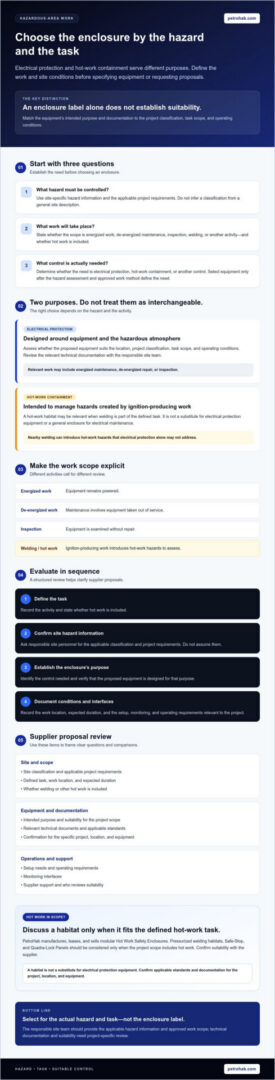
Enclosure selection starts with the documented hazard and task, not a product label. A safety enclosure for electrical work in hazardous areas must match the work scope, location, and operating conditions. Use a structured review with the responsible site team before requesting proposals or specifying equipment.
Work through the evaluation in sequence
- 1. Define the task. Record whether the work involves energized equipment, de-energized maintenance, inspection, welding, or another activity. State whether hot work is included.
- 2. Confirm site hazard information. Ask responsible site personnel to identify the location’s hazard classification and applicable project requirements. Don’t infer a classification from the industry or general description of the site.
- 3. Establish the enclosure’s purpose. Determine whether the need is electrical protection, hot-work containment, or another control. Verify that the proposed equipment is designed for that purpose.
- 4. Document conditions and interfaces. Record the work location, expected duration, access needs, and operating conditions. Identify relevant interfaces with ventilation, gas monitoring, pressure monitoring, and emergency arrangements.
- 5. Obtain and review technical documents. Request product-specific documentation and evidence for the stated application. Have qualified project personnel confirm that the documents address the actual site and work scope.
Which site and work details should buyers establish?
Include enough detail for suppliers and reviewers to assess the application: where the work will occur, how personnel and equipment will access the area, how long the work is planned, and whether ignition-producing work is part of the job. Confirm the hazard classification and governing project requirements with the responsible site team. In the United States, check whether the OSHA 1910.307 standard applies to the project. Other locations may have different requirements.
ATEX or IECEx documentation may be relevant depending on the project, equipment, and jurisdiction. Don’t treat either as automatically applicable. Confirm the required standards and documentation with qualified project personnel and the responsible site team. For broader context, see the 2026 hazardous environment standards guide.
What documentation should suppliers provide for review?
Request technical documents that identify the specific equipment and intended application, then ask who will assess them against project specifications and local requirements. Check that the proposed configuration, interfaces, and operating conditions align with the approved work method. A supplier’s statement or product label can support the review, but the responsible project personnel must determine whether the evidence fits the site.
If the scope includes welding or other hot work, discuss whether a pressurized habitat is appropriate for that defined task. You can review PetroHab’s hot-work enclosure information as a starting point, then confirm application suitability and required documentation with the supplier and site team.
Electrical Protection vs. Hot-Work Habitat: Compare the Right Solution
A safety enclosure for electrical work in hazardous areas isn’t a single equipment category. Electrical protection addresses the suitability of electrical equipment for its intended function and location. A hot-work safety habitat addresses hazards associated with activities such as welding. One category shouldn’t be represented as a substitute for the other.
Use this comparison to identify what needs review. The responsible project and site personnel should verify the specific application, documentation, and controls.
| Review point | Hazardous-area electrical equipment | Hot-work safety habitat |
|---|---|---|
| Purpose | Perform an electrical function while meeting the applicable hazardous-location requirements. | Contain or manage hazards associated with defined hot-work activities, subject to the habitat’s design and intended use. |
| Work scope | Electrical installation, maintenance, or inspection. Suitability depends on the equipment and application. | Welding or other specified ignition-producing work. It isn’t general electrical protection. |
| Documentation | Review product-specific markings and technical documents against project requirements. | Review habitat documentation, configuration, and stated application against the hot-work scope. |
| Interfaces | Confirm relevant electrical connections, equipment, and site operating conditions. | Assess applicable monitoring, pressure, ventilation, access, and emergency interfaces with the site team. |
| Responsible reviewer | Qualified electrical and project personnel, with the site team confirming location requirements. | Responsible site and project personnel, with the supplier clarifying habitat suitability and operating requirements. |
What does electrical protection equipment address?
Electrical equipment must be evaluated for its intended function and the hazardous-area requirements established for the project. Verify its markings and product-specific documentation for the precise application; don’t infer suitability from a general product description. For U.S. construction work, consult the OSHA hazardous location standards where applicable, and have qualified project personnel confirm which requirements govern the work.
What does a pressurized hot-work habitat address?
PetroHab manufactures modular Hot Work Safety Enclosures, including pressurized welding habitats. Its Safe-Stop Automatic Shutdown System monitors gas levels and pressure and supports automatic shutdown. Those features don’t make a habitat a substitute for electrical protection. If welding is part of an electrical maintenance project, coordinate the electrical equipment requirements and hot-work controls as separate, connected parts of the work plan.
Review the pressurized welding habitat technology guide, then confirm the habitat’s suitability for the defined scope with the supplier. Explore PetroHab’s hot-work enclosures as one option when the task includes hot work.
A Practical Procurement Checklist for Hazardous-Area Work Enclosures
Before issuing a request for information or proposal, separate confirmed project requirements from details that still need site-team review. This keeps supplier responses comparable and helps prevent a hot-work habitat from being specified as a substitute for electrical protection. Use the checklist to define the request for a safety enclosure for electrical work in hazardous areas:
- Work scope: Describe the task, location, planned duration, access needs, and whether welding or other hot work is included.
- Site conditions: Record the confirmed hazard classification and operating conditions. Mark any assumptions that the responsible site safety team must verify.
- Enclosure purpose: State what hazard the enclosure is intended to address and what it is not intended to control.
- Technical documents: Request product-specific documentation and evidence for the proposed application. Ask qualified project personnel to confirm relevance to project specifications and local requirements.
- Interfaces: Identify applicable gas or pressure monitoring, ventilation, shutdown functions, and emergency arrangements. Ask how proposed equipment interfaces with site systems.
- Deployment: Clarify what setup entails, who is responsible for it, and what site preparation or access is assumed.
- People and support: Identify training needs and ask what supervision or ongoing support is available for the proposed deployment.
What should a supplier proposal answer?
Require the proposal to identify included equipment, configuration, intended use, and assumed site conditions. Ask the supplier to explain monitoring and shutdown functions, setup responsibilities, and which technical documents support the proposed application. If the scope includes hot work, confirm whether the proposed habitat is suitable for that precise task. PetroHab offers on-site supervision and training; discuss whether those options fit the planned deployment and confirm the arrangements directly.
How should buyers compare purchase, leasing, and support?
Compare ownership and leasing against project duration, expected repeat demand, and your team’s capacity to manage setup and operation. Assess support scope and training requirements alongside equipment documentation, not as an afterthought. PetroHab manufactures, leases, and sells modular Hot Work Safety Enclosures, so buyers can discuss the available procurement approach for a defined hot-work scope. Review the hot work enclosure supplier procurement guide for additional evaluation points.
For a project that includes hot work, discuss your project requirements with PetroHab and confirm whether its enclosure offering fits the scope.
When PetroHab’s Hot Work Safety Enclosure May Fit the Project
PetroHab may be relevant when work in a hazardous area includes welding or other hot work within the scope of its Hot Work Safety Enclosures. It isn’t a general enclosure for electrical maintenance, nor does it replace electrical equipment selected for the hazardous location. Treat it as a hot-work option to assess alongside the project’s electrical protections and approved work method.
Which PetroHab capabilities are relevant to hot-work projects?
PetroHab manufactures, leases, and sells modular Hot Work Safety Enclosures, including pressurized welding habitats. The available equipment categories include the PetroHab Hot Work Safety Enclosure (HWSE), pressurized welding enclosures, and pressurized habitats. Confirm the specific configuration and suitability for the intended work directly with PetroHab.
The Safe-Stop Automatic Shutdown System monitors gas levels and pressure and supports automatic shutdown. Quadra-Lock Panels use PetroHab patented technology. These product details can inform supplier discussions, but they don’t by themselves establish that a habitat meets a particular project requirement or is appropriate for every site condition.
For a project combining electrical maintenance and welding, consider the habitat only for the defined hot-work scope. The project team should coordinate its use with the separate electrical equipment requirements, site controls, and work procedures.
What should be confirmed before specifying a PetroHab habitat?
Before selection, review the proposed application with PetroHab and the responsible site safety and engineering personnel. Confirm that the product documentation and configuration address the defined task and site conditions. The site team remains responsible for application approval.
- Scope: Identify the hot-work activity, its location, and how it relates to nearby electrical work.
- Site conditions: Confirm the relevant hazard information, operating conditions, and project requirements with responsible personnel.
- Technical documentation: Request documents for the specific proposed equipment and have qualified project personnel assess their applicability.
- Deployment support: Ask PetroHab about supervision and training needs for the intended deployment, as well as how monitoring and shutdown functions relate to the site’s operating arrangements.
These checks help keep the decision focused on task fit rather than assuming that one enclosure addresses every hazard. The right safety enclosure for electrical work in hazardous areas depends on the defined electrical and hot-work scopes, and those scopes may require coordinated but distinct controls.
For projects that include hot work, discuss a hot-work enclosure requirement with PetroHab and confirm the proposed habitat’s fit with your project team before specifying it.
Specify the Controls, Then Confirm the Fit
A sound enclosure decision begins with the documented task and site conditions. Electrical protection equipment and hot-work containment serve different purposes, so assess them separately even when electrical maintenance and welding occur in the same work area. For a safety enclosure for electrical work in hazardous areas, confirm the application, technical documentation, and required controls with qualified project personnel before specifying equipment.
Where the scope includes hot work, PetroHab manufactures, leases, and sells modular Hot Work Safety Enclosures. Its Safe-Stop Automatic Shutdown System monitors gas levels and pressure and supports automatic shutdown. On-site supervision and training are also available offerings. Confirm the proposed habitat’s suitability, documentation, and deployment requirements with PetroHab and the responsible site team. The site’s safety and engineering personnel retain responsibility for approving the application.
If your defined project scope includes hot work, discuss your hazardous-area hot-work enclosure requirements with PetroHab. Clear requirements and a verified fit help your team move forward with greater confidence and a safety plan grounded in the work itself.
Frequently Asked Questions
Is a safety enclosure enough to make electrical work safe in a hazardous area?
No. An enclosure alone doesn’t establish that work is safe, compliant, or authorized. The safety enclosure for electrical work in hazardous areas must suit the task, site hazard information, and approved work method. Confirm that electrical equipment and any separate containment measures match their intended purpose, then have the responsible site and project personnel review the documentation and controls before work proceeds.
Can a pressurized welding habitat be used for electrical maintenance?
A pressurized welding habitat is intended for hot-work applications, not as a general electrical protection enclosure. If maintenance includes welding, the habitat may be worth discussing for that part of the defined scope. Electrical equipment still needs separate assessment for its intended function and location. Ask the supplier to confirm habitat suitability, and have the responsible site team review how it fits the approved work method.
What is the difference between hazardous-area electrical equipment and a hot-work habitat?
Hazardous-area electrical equipment is selected for its electrical function and the requirements of its location. A hot-work habitat is a containment solution for specified ignition-producing work, such as welding. They address different hazards and aren’t interchangeable. For a job involving both electrical maintenance and welding, assess each control separately and coordinate their interfaces, documentation, and operating requirements with the responsible project and site personnel.
How do I choose an enclosure for work in a hazardous area?
Start by defining the work, including whether equipment is energized, de-energized, or being inspected, and whether hot work is involved. Confirm the site hazard classification and operating conditions with the responsible team. Then identify the enclosure’s purpose, relevant monitoring or ventilation interfaces, and setup needs. Request product-specific documentation and have qualified project personnel verify its fit against the project requirements before specifying it.
Are ATEX or IECEx requirements relevant when selecting an enclosure?
They may be relevant, depending on the project location, equipment, and applicable requirements. Don’t assume either framework applies universally or that a supplier’s general statement settles the question. Ask which standards and documents apply to the specific equipment and intended use. Confirm that assessment with qualified project personnel and the responsible site team, including whether the documentation addresses the location and defined work scope.
What should I ask a supplier before buying or leasing a hot-work enclosure?
Ask what equipment and configuration are included, what site conditions the proposal assumes, and what documentation supports the stated application. Clarify monitoring and shutdown functions, setup responsibilities, and available supervision or training. For example, PetroHab’s Safe-Stop monitors gas levels and pressure and supports automatic shutdown. Compare purchase or leasing options against project duration and internal capability, then confirm suitability with your site team.