Blog Posts
Hot Work Habitat Certification: Standards, Competency, and Compliance in 2026
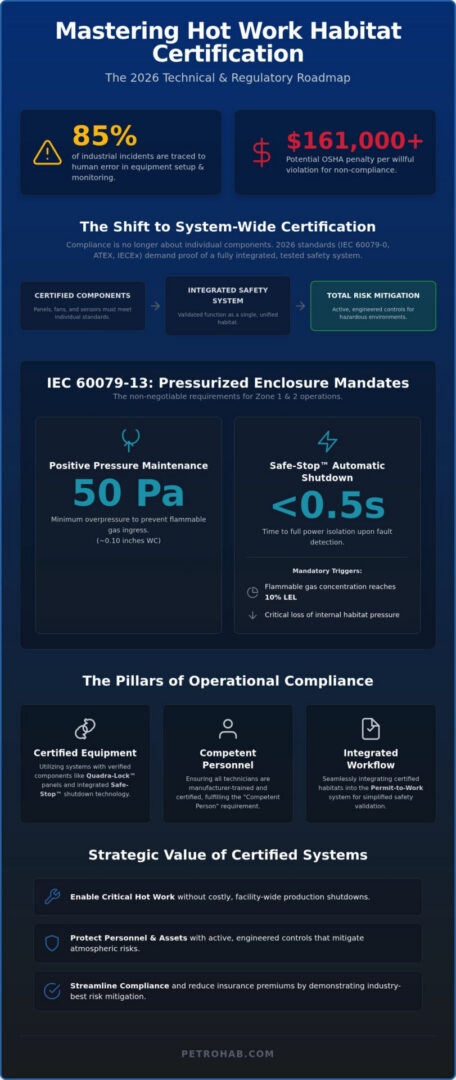
85% of industrial safety incidents are traced to human error during the setup or monitoring of safety equipment. In the high-stakes environments of offshore platforms and refineries, this statistic represents a risk that safety managers cannot ignore. You recognize that maintaining a zero-incident record requires more than just high-quality hardware; it demands a rigorous approach to hot work habitat certification that accounts for both technical integrity and personnel competency. Failure to align with evolving standards like IEC 60079-13:2026 doesn’t just invite regulatory penalties exceeding $161,000. It risks the lives of your crew and the survival of your high-value assets.
This guide provides the technical roadmap you need to master the complex regulatory landscape of 2026. We’ll detail the essential requirements for certified pressurized enclosures, including the integration of Safe-Stop automatic shutdown systems and the structural advantages of Quadra-Lock panels. By examining the latest amendments to international standards and the critical role of verified technician training, you’ll gain the expertise to ensure full compliance and seamless integration into your Permit-to-Work systems. We’ll move from high-level safety concepts to the granular technical data required for operational excellence in hazardous zones.
Key Takeaways
- Master the 2026 requirements for hot work habitat certification to ensure your enclosures meet the latest system-wide integrity and ignition prevention standards.
- Identify the critical technical specifications of IEC 60079-13 that govern pressurized enclosures in Zone 1 and Zone 2 hazardous environments.
- Understand the “Competent Person” requirement and why manufacturer-led training is a non-negotiable component of maintaining certified safety protocols.
- Learn how to achieve seamless operational compliance by integrating site-specific hazardous area reviews with certified pressurized welding habitats.
- Recognize the strategic value of certified solutions that facilitate hot work without necessitating costly, facility-wide production shutdowns.
The Regulatory Landscape of Hot Work Habitat Certification
Hot work habitat certification is the rigorous verification of enclosure integrity and ignition prevention within hazardous industrial environments. It’s not merely a label on a piece of equipment. It represents a documented assurance that the system can maintain a Positive Pressure Enclosure to exclude flammable gases. In Zone 1 and Zone 2 areas, where explosive atmospheres are either present or likely to occur, this certification acts as the definitive line between operational continuity and catastrophic failure. Hardware alone cannot provide this security. True compliance requires the seamless integration of certified components into a managed safety protocol.
Relying on hardware-only certification is a dangerous oversight. While individual panels or fans might carry certificates, the entire hot work habitat certification process validates how these components function as a unified system. This system-wide approach ensures that the hot work safety enclosure maintains overpressure and triggers automated shutdowns during a fault. In 2026, the industry has moved away from passive administrative controls toward these active, engineered solutions that prioritize total risk mitigation.
The Hierarchy of International Standards
The regulatory framework is anchored by the ATEX Directive 2014/34/EU and the global IECEx system. These standards provide the baseline for equipment used in explosive atmospheres. The publication of IEC 60079-0:2026 (Edition 8.0) on June 16, 2026, introduced stricter requirements for electrostatic bonding and thermal protection. Modern hot work habitat certification now prioritizes this system-wide validation. Regulators no longer accept piecemeal certifications; they demand evidence that the habitat functions as a single, tested unit under specified fault conditions, ensuring that the environmental containment is absolute.
Certification as a Requirement for Permit-to-Work
Safety managers and Permit Authorizing Individuals (PAIs) increasingly refuse to issue hot work permits without valid certification. The legal stakes are high. OSHA penalties for willful safety violations in 2026 can exceed $161,000 per instance. Beyond avoiding fines, operating certified enclosures reduces insurance premiums by demonstrating a commitment to industry-standard risk mitigation. A certified habitat simplifies the Permit-to-Work process by providing a pre-validated safety environment. It allows operators to focus on the task at hand while the engineered systems manage the atmospheric risks, protecting both personnel and high-value assets.
Technical Standards for Pressurized Safety Enclosures
Engineering a safe environment in Zone 1 and Zone 2 hazardous areas relies on strict adherence to technical benchmarks. A hot work habitat certification requires every component to function as a unified barrier against ignition. This process isn’t just about choosing fire-resistant materials; it involves validating the structural stability and the maintenance of a verifiable pressure differential. In these high-stakes settings, the enclosure must act as a fortress that actively monitors and reacts to atmospheric changes.
IEC60079-13: The Benchmark for Pressurized Rooms
The IEC60079-13 standard provides the primary international framework for the design, construction, and testing of pressurized rooms used in explosive atmospheres to ensure they remain safe for hot work. To meet this standard, the system must maintain a minimum overpressure of 50 Pascals (Pa), which is approximately 0.10 inches of water column. This differential prevents external flammable gases from entering the workspace. The NFPA 51B Standard complements these technical requirements by establishing rigorous fire prevention and fire watch protocols that must be followed during and after operations.
Certification is impossible without an integrated automatic shutdown system like Safe-Stop. In 2026, industry-leading systems are designed to trigger a full power isolation within 0.5 seconds of detection. These triggers occur if flammable gas concentrations reach 10% of the Lower Explosive Limit (LEL) or if the internal pressure drops below the 25-50 Pascal threshold. This automated response eliminates human error and provides a definitive remedy to hazardous leaks or structural breaches.
Quadra-Lock Technology and Structural Compliance
Generic panel designs often fail to maintain the spark-tight seal required for hot work habitat certification, particularly when dealing with complex piping and congested offshore decks. PetroHab’s patented Quadra-Lock panels address this vulnerability through a tool-less, interlocking design. This technology creates a robust, airtight seal that can be configured to fit irregular geometries without compromising the habitat’s integrity. The structural stability provided by these panels is essential for withstanding high-wind loads and mechanical vibrations common in heavy industry.
Modularity enhances safety by allowing the enclosure to be tailored to the specific geometry of the job site. The Quadra-Lock system ensures that the habitat remains a validated unit even in the most challenging environments. By prioritizing these engineered solutions over passive tarps, safety managers can ensure their sites exceed regulatory expectations. If you’re planning a complex turnaround, it’s vital to source certified pressurized habitats that utilize these advanced interlocking technologies.
Personnel Competency: The Human Element of Certification
Hardware validation is only one pillar of hot work habitat certification. The most advanced pressurized enclosure remains vulnerable if the personnel responsible for its deployment lack the technical competency to manage it. In high-risk sectors, the “Competent Person” is not a mere administrative title but a regulatory requirement that ensures the hardware performs as engineered. Relying on uncertified personnel to monitor gas levels or pressure differentials introduces a variable of human error that can lead to catastrophic ignition. Effective risk mitigation requires a workforce that is as rigorously tested as the equipment it operates.
Defining the Competent Person in 2026
Regulatory bodies establish clear mandates for personnel involved in hazardous operations. Adhering to BSEE hot work regulations requires that individuals are not only trained but also verified through practical assessments. A competent technician must demonstrate the ability to maintain a strictly controlled environment where ignition sources are isolated from flammable vapors. This role involves continuous monitoring of the pressure differential and the immediate interpretation of gas detection data to maintain the integrity of the work area. In 2026, the industry has moved toward a model where competency is validated through digital logging of setup accuracy and response times during simulated fault conditions.
Manufacturer-Led Training vs. Generic Safety Courses
Generic safety certifications often lack the granular technical depth required to operate proprietary systems. Effective hot work habitat certification protocols demand specialized training directly from the manufacturer. This ensures that technicians fully understand the operational nuances of the Safe-Stop Automatic Shutdown System and the precise assembly requirements of Quadra-Lock Panels. PetroHab training serves as the industry benchmark because it bridges the gap between theoretical safety and mechanical reality. It transforms a standard fire watch into a technical supervisor capable of managing complex safety loops.
The curriculum focuses on critical failure points, such as seal integrity in complex geometries and the integration of gas detection loops. Selecting hot work safety enclosure suppliers who provide these certified training programs is a strategic necessity for safety managers. These suppliers don’t just lease equipment; they act as safety partners by providing on-site supervision. This expert oversight guarantees that every enclosure is built to the exact specifications required for its specific hazardous zone, ensuring a zero-incident record through disciplined execution.
Achieving Operational Compliance with PetroHab Systems
Operational compliance translates high-level technical standards into field-level safety. To maintain a valid hot work habitat certification, operators must follow a disciplined, multi-step deployment process. This sequence ensures that the engineered barriers are correctly configured for the specific atmospheric risks present on-site. It’s the difference between a theoretical safety plan and a functional, zero-incident environment.
Execution begins with a site-specific hazardous area classification review to confirm the required protection levels for Zone 1 or Zone 2 environments. Once established, the next step is to select a pressurized welding habitat that is certified for the specific ATEX Zone. The installation team’s competency credentials must be verified before any hardware is assembled. Following assembly, technicians integrate the Safe-Stop system with the facility’s Emergency Shutdown (ESD) loop to ensure a synchronized response during a fault. Finally, a pre-hot work pressure test and seal verification are conducted to confirm that the habitat can maintain its protective overpressure. If you’re preparing for a complex turnaround, consult with our technical specialists for a full compliance audit.
Integrating Certified Habitats into the PTW System
A certified habitat must interface seamlessly with the site’s Permit-to-Work (PTW) system. This requires a clear communication channel between the habitat supervisor and the site safety officer. Documentation is vital. In 2026, regulatory audits demand a comprehensive certification trail, including equipment validation and personnel training records. The Safe-Stop system facilitates this by providing automatic data logs. These logs record gas levels and pressure differentials, creating a tamper-proof audit trail that demonstrates continuous compliance throughout the project’s duration.
Monitoring and Maintaining Positive Pressure Integrity
Maintaining a hot work habitat certification during active operations requires constant vigilance. Technicians must follow technical protocols for manometer monitoring to ensure the internal pressure remains at the required 50 Pascal threshold. Air ducting adjustments are often necessary as ambient conditions change or as the enclosure is modified to accommodate new equipment. Personnel transit represents a potential breach point; therefore, technicians must manage entry and exit through airlock systems without compromising the certified seal. If a pressure loss occurs, the Safe-Stop system initiates an emergency protocol, isolating all ignition sources within 0.5 seconds. This automated response ensures that the safety of the facility is never dependent on human reaction times alone.
The Strategic Value of Certified Hot Work Solutions
Investing in hot work habitat certification is a strategic decision that transcends basic regulatory compliance. In the energy sector, the cost of unplanned downtime is staggering. A single hour of lost production in offshore operations can cost as much as $416,000, while a full day of shutdown on a major platform can lead to over $1.5 million in lost revenue. Utilizing certified pressurized enclosures allows operators to perform critical maintenance while the rest of the facility remains online. This capability transforms safety equipment from a cost center into a facilitator of continuous production.
The return on investment for high-tier hot work safety systems is realized through risk elimination and operational efficiency. By isolating the ignition source within a validated environment, you remove the need for facility-wide depressurization. PetroHab provides a definitive technological remedy to the hazards of live-site welding, ensuring that personnel and high-value assets remain protected without compromising the bottom line. This calculated approach to safety instills confidence in stakeholders and regulators alike.
Minimizing Operational Downtime Through Certified Safety
Case studies from offshore environments demonstrate that certified HWSE systems significantly reduce turnaround schedules. The modularity of Quadra-Lock panels allows for rapid assembly around complex geometries, speeding up the preparation phase by as much as 40%. Beyond setup speed, professional training prevents “nuisance trips” where false gas detections or pressure fluctuations cause unnecessary work stoppages. A certified technician understands how to fine-tune the Safe-Stop system to maintain the seal integrity, ensuring that the habitat only shuts down when a genuine threat is detected. This precision protects the schedule from human error and technical miscalibration.
PetroHab as Your Global Compliance Partner
PetroHab acts as an active guardian of your industrial site by providing more than just hardware. Leasing our certified equipment includes access to on-site professional supervision and a technical support network that understands the granular details of hazardous environment standards. We maintain our technology at the leading edge of global regulations, ensuring that every deployment meets the most recent 2026 amendments to IEC 60079-13. This partnership allows safety managers to delegate the complexities of hot work habitat certification to seasoned experts. For your next safety-critical project, contact our team to integrate our certified systems into your risk management strategy.
Securing Operational Excellence in Hazardous Environments
Achieving comprehensive hot work habitat certification ensures that your site remains compliant with the latest Edition 8.0 standards while maintaining continuous production. This process requires a precise alignment of technical hardware, automated shutdown loops, and verified personnel competency. By prioritizing engineered solutions over passive administrative controls, you mitigate the risk of catastrophic ignition in Zone 1 and Zone 2 areas. It’s a commitment to safety that protects your revenue and your personnel simultaneously.
PetroHab stands ready as your active guardian in the field. Our patented Quadra-Lock technology provides a reliable, spark-tight seal for even the most complex geometries. Our Safe-Stop systems deliver ATEX and IECEx compliant protection through automated gas and pressure monitoring. We provide certified technicians for global deployment to ensure your team masters these critical safety protocols. Contact PetroHab to schedule professional on-site training and supervision today. Your facility’s safety record depends on the meticulous execution of these standards.
Frequently Asked Questions
Is specific certification required by law for hot work habitats?
Regulatory bodies such as OSHA and BSEE mandate strict fire prevention and equipment standards for hazardous environments. While the term habitat refers to a specific technology, the requirement for certified ignition prevention in Zone 1 and Zone 2 areas is legally enforceable. Operating uncertified enclosures can result in penalties exceeding $161,000 per instance. Compliance with IEC 60079-13 ensures your site meets these legal obligations.
What is the difference between ATEX and IECEx habitat certification?
ATEX is a mandatory European directive for equipment used in explosive atmospheres, while IECEx is an international certification scheme designed for global standardization. Both systems validate the safety and integrity of the enclosure components. PetroHab systems are engineered to meet both ATEX and IECEx standards. This dual compliance ensures that our pressurized habitats are accepted across diverse global jurisdictions and offshore environments.
How long does it take for a technician to become a certified Competent Person?
The timeline for becoming a certified Competent Person depends on the specific curriculum but typically involves intensive multi-day training sessions. This process requires mastering theoretical hazardous area classifications and passing practical assessments of system assembly. PetroHab provides specialized training programs to ensure technicians can manage the complexities of hot work habitat certification. This expert training is essential for maintaining a zero-incident safety record.
Can our internal safety team set up a PetroHab HWSE without manufacturer training?
No, PetroHab requires specialized on-site supervision or manufacturer-led training to ensure the system’s integrity. Proper assembly of Quadra-Lock panels and the correct integration of the Safe-Stop system are critical for maintaining a certified seal. Using untrained personnel increases the risk of human error, which is responsible for 85% of industrial safety incidents. Professional training ensures the enclosure performs as an engineered safety barrier.
What technical standards govern pressurized welding habitats in 2026?
The primary standards include IEC 60079-13 for pressurized rooms and NFPA 51B for fire prevention during hot work. The 2026 Edition 8.0 of IEC 60079-0 also introduces stricter requirements for electrostatic bonding and thermal protection that apply to these systems. These regulations ensure that pressurized welding habitats function as a validated unit. Adhering to these standards is necessary for seamless integration into Permit-to-Work systems.
Does PetroHab provide certification documentation for site audits?
Yes, PetroHab provides comprehensive documentation to support site audits and regulatory inspections. This includes equipment validation records, technician training credentials, and maintenance logs. The Safe-Stop system further assists by providing automatic digital logging of gas levels and pressure differentials. These records create a verifiable data trail that demonstrates continuous compliance with international safety protocols and helps avoid costly regulatory penalties.
What happens if a habitat loses its certified positive pressure during welding?
If the internal pressure drops below the 25-50 Pascal threshold, the Safe-Stop Automatic Shutdown System triggers immediately. It isolates all power and ignition sources within 0.5 seconds to prevent flammable gases from entering the enclosure. This automated response provides a definitive technological remedy to pressure loss. It ensures the facility remains protected even if the physical barrier of the habitat is compromised during operations.
How often must hot work habitat certification be renewed?
Hot work habitat certification for the equipment itself is verified before each deployment through pre-use inspections and pressure tests. Personnel recertification intervals are governed by specific 2026 amendments to IEC 60079-13 and internal safety management systems. Regular recertification is vital to ensure technicians remain current with the latest hardware updates. It also ensures they understand the evolving regulatory requirements for hazardous industrial environments.